For over a decade, ESA’s Gaia mission has mapped our galaxy with stunning precision—rewriting the story of the Milky Way. As its mission enters a new phase, we look back at its most groundbreaking discoveries.
Credit: ESA – European Space Agency
Chapters: 00:23 – Mapping the Milky Way and beyond 00:58 – Structure of the Milky Way 01:40 – Galactic family tree 02:27 – Mapping star-forming regions 03:00 – Ancient star streams 03:19 – Cosmic encounters 04:07 – Black holes and hidden giants
★ Subscribe: http://bit.ly/ESAsubscribe and click twice on the bell button to receive our notifications.
We are Europe’s gateway to space. Our mission is to shape the development of Europe’s space capability and ensure that investment in space continues to deliver benefits to the citizens of Europe and the world. Check out https://www.esa.int/ to get up to speed on everything space related.
On 19 March 2025, our Euclid mission released its first batch of survey data, including a preview of its deep fields. Here, hundreds of thousands of galaxies in different shapes and sizes take centre stage and show a glimpse of their large-scale organisation in the cosmic web.
📹 ESA – European Space Agency 📸 ESA /Euclid/Euclid Consortium/@NASA, image processing by J.-C. Cuillandre, E. Bertin, G. Anselmi Euclid Deep Field South, 70x zoom: ESA/Euclid/Euclid Consortium/NASA, image processing by J.-C. Cuillandre, E. Bertin, G. Anselmi
On 19 March 2025, our Euclid mission released its first batch of survey data, revealing an astonishing view of the cosmic web.
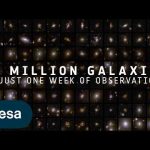
With just one scan of its deep fields, Euclid has already detected 26 million galaxies, some as far as 10.5 billion light-years away! This is just a preview of what’s to come, as Euclid will continue mapping the Universe in unprecedented detail.
What’s in this first release? – Three vast mosaics covering 63 square degrees of the sky – A catalogue of 380 000 galaxies, classified with AI + citizen scientists – 500 new gravitational lens candidates, almost all never seen before – The first hints of Euclid’s full cosmic atlas, which will eventually cover one-third of the sky
This data is a huge leap forward in understanding how galaxies are distributed across the Universe and how dark matter and dark energy shape the cosmos.
Over the next six years, Euclid will revisit these deep fields 30 to 52 times, uncovering billions of galaxies and pushing the astrophysics’ boundaries.
📹 @europeanspaceagency 📸 ESA /Euclid/Euclid Consortium/@NASA, image processing by J.-C. Cuillandre, E. Bertin, G. Anselmi Euclid Deep Field South, 70x zoom: ESA/Euclid/Euclid Consortium/NASA, image processing by J.-C. Cuillandre, E. Bertin, G. Anselmi
The European Space Agency’s Euclid space telescope mission has scouted out the three areas in the sky where it will eventually provide the deepest observations of its mission.
In just one week of observations, with one scan of each region so far, Euclid already spotted 26 million galaxies. The farthest of those are up to 10.5 billion light-years away.
In the coming years, Euclid will pass over these three regions tens of times, capturing many more faraway galaxies, making these fields truly ‘deep’ by the end of the nominal mission in 2030.
The first glimpse of 63 square degrees of the sky, the equivalent area of more than 300 times the full Moon, already gives an impressive preview of the scale of Euclid’s grand cosmic atlas when the mission is complete. This atlas will cover one-third of the entire sky – 14 000 square degrees – in this high-quality detail.
————————————————— Credits: ESA/Euclid/Euclid Consortium/NASA, image processing by J.-C. Cuillandre, E. Bertin, G. Anselmi, M. Walmsley, M. Huertas-Company; ESA/Gaia/DPAC; ESA/Planck Collaboration —————————————————
★ Subscribe: http://bit.ly/ESAsubscribe and click twice on the bell button to receive our notifications.
We are Europe’s gateway to space. Our mission is to shape the development of Europe’s space capability and ensure that investment in space continues to deliver benefits to the citizens of Europe and the world. Check out https://www.esa.int/ to get up to speed on everything space related.
Using data from the European Space Agency’s Gaia mission, scientists have found a huge exoplanet and a brown dwarf. This is the first time a planet has been uniquely discovered by Gaia’s ability to sense the gravitational tug or ‘wobble’ the planet induces on a star. Both the planet and brown dwarf are orbiting low-mass stars, a scenario thought to be extremely rare.
📹 ESA – European Space Agency 📸 ESA/Gaia/DPAC/M. Marcussen
Discover the first page of ESA Euclid’s great cosmic atlas and marvel at millions of stars and galaxies captured in pristine detail, in a huge 208-gigapixel mosaic. The mosaic covers an area of the Southern Sky more than 500 times the area of the full Moon as seen from Earth.
This video takes you through a rare sky dive. Starting from a vast cosmic panorama bedazzled by some 14 million galaxies, a series of ever-deeper zooms brings you to a crisp view of a swirling spiral galaxy, in a final image enlarged 600 times compared to the full mosaic.
Although the scenes are enticing, they are not taken for their beauty, but to help us advance our understanding of the cosmos. Many of the 14 million galaxies in the initial vista will be used to study the hidden influence of dark matter and dark energy on the Universe.
Unveiled as a teaser of the wide survey, the mosaic accounts for 1% of the area that Euclid will cover over six years, and was obtained by combining 260 observations collected in just two weeks.
This first chunk of Euclid’s survey was revealed on 15 October 2024 at the International Astronautical Congress in Milan, Italy, by ESA’s Director General Josef Aschbacher and Director of Science Carole Mundell.
————————————————— Copyright: ESA/Euclid/Euclid Consortium/NASA, CEA Paris-Saclay, image processing by J.-C. Cuillandre, E. Bertin, G. Anselmi; ESA/Gaia/DPAC; ESA/Planck Collaboration —————————————————
★ Subscribe: http://bit.ly/ESAsubscribe and click twice on the bell button to receive our notifications.
We are Europe’s gateway to space. Our mission is to shape the development of Europe’s space capability and ensure that investment in space continues to deliver benefits to the citizens of Europe and the world. Check out https://www.esa.int/ to get up to speed on everything space related.
ESA’s Euclid mission is on a quest to unveil the nature of two elusive ‘dark’ entities. As the renowned theoretical physicist Stephen Hawking remarked in 2013, “The missing link in cosmology is the nature of dark matter and dark energy”.
During the last 70 years, scientists have made enormous progress in understanding the very initial phases of the Universe and its evolution to the present day. Thanks to advances in observations and theoretical modelling, a clear picture has emerged of how stars form, and how galaxies grow and interact with each other, coming together to form groups and clusters.
Yet, fundamental mysteries remain. 95% of the Universe appears to be made up of unknown ‘dark’ matter and energy. Dark matter and energy affect the motion and distribution of visible sources but do not emit, reflect or absorb any light. And scientists do not know what these dark entities actually are.
To address this question, Euclid will create a great map of the large-scale structure of the Universe across space and time by observing with unprecedented accuracy billions of galaxies out to 10 billion light-years. This is not easy, and making sure that Euclid is up to the task has required the expertise and dedication of many people over several years of work.
This video captures the journey behind the Euclid mission, from a human and intensely visual perspective. It shows tiny screws, winding cables and shiny surfaces in a whole new light, revealing how each piece comes together to form the space telescope. Be drawn in by awe-inspiring photos of the cosmos, and stay for the seemingly choreographed ballet of teamwork necessary to assemble and test the spacecraft, before being swept away by the emotion of the launch into space.
Euclid’s adventure has begun. With its observations during the coming years, it will help us uncover the missing link in cosmology and open the gate to the ‘dark’ side of the Universe.
Credit: ESA/Studio Redgrove CC BY-SA 3.0 IGO
★ Subscribe: http://bit.ly/ESAsubscribe and click twice on the bell button to receive our notifications.
We are Europe’s gateway to space. Our mission is to shape the development of Europe’s space capability and ensure that investment in space continues to deliver benefits to the citizens of Europe and the world. Check out https://www.esa.int/ to get up to speed on everything space related.
ESA’s Euclid mission will create a 3D-map of the Universe that scientists will use to measure the properties of dark energy and dark matter and uncover the nature of these mysterious components. The map will contain a vast amount of data, it will cover more than a third of the sky and its third dimension will represent time spanning 10 billion years of cosmic history.
But dealing with the huge and detailed set of novel data that Euclid observations will produce is not an easy task. To prepare for this, scientists in the Euclid Consortium have developed one of the most accurate and comprehensive computer simulations of the large-scale structure of the Universe ever produced. They named this the Euclid Flagship simulation.
Running on large banks of advanced processors, computer simulations provide a unique laboratory to model the formation and evolution of large-scale structures in the Universe, such as galaxies, galaxy clusters, and the filamentary cosmic web they form. These state-of-the-art computational techniques allow astrophysicists to trace the motion and behavior of an extremely large number of dark-matter particles over cosmological volumes under the influence of their own gravitational pull. They replicate how and where galaxies form and grow, and are used to predict their distribution across the celestial sphere.
Explore the Euclid Flagship simulation in this video and get a sneak preview of the structure of the dark Universe, as we currently model it. New insights will be brought to you by the Euclid mission in the coming years.
Credits: ESA/Euclid Consortium/Cacao Cinema The authors kindly acknowledge the use of the Splotch package: http://www.mpa-garching.mpg.de/~kdolag/Splotch
★ Subscribe: http://bit.ly/ESAsubscribe and click twice on the bell button to receive our notifications.
We are Europe’s gateway to space. Our mission is to shape the development of Europe’s space capability and ensure that investment in space continues to deliver benefits to the citizens of Europe and the world. Check out https://www.esa.int/ to get up to speed on everything space related.
Euclid’s two instruments have captured their first test images. The mesmerising results indicate that the space telescope will achieve the scientific goals that it has been designed for – and possibly much more
Although there are months to go before Euclid delivers its true new view of the cosmos, reaching this milestone means the scientists and engineers behind the mission are confident that the telescope and instruments are working well.
📹 ESA – European Space Agency
★ Subscribe: http://bit.ly/ESAsubscribe and click twice on the bell button to receive our notifications.
We are Europe’s gateway to space. Our mission is to shape the development of Europe’s space capability and ensure that investment in space continues to deliver benefits to the citizens of Europe and the world. Check out https://www.esa.int/ to get up to speed on everything space related.
If you think its only possible be held in orbit around a central body of mass – say a planet or a star – you’d be wrong. It is in fact possible to orbit around an invisible point, an oasis of forces, infinitesimal in size. ESA’s Euclid mission was launched on 1 July 2023 to uncover the secrets of the dark universe. Its destination? Like many astronomy missions before it, Lagrange point 2.
‘L2’ is an ideal location for astronomy missions because they can keep the Sun, Earth and Moon behind them at all times, so they don’t interfere with observations, while at the same time getting a clear view of deep space and pointing an antenna back to Earth to remain in close communication. The permanent sunlight on Euclid at L2 also keeps the telescope thermally stable, allowing for the extremely high stability required for the instrument’s long exposure observations. Euclid’s orbit around Lagrange point 2 is big. In terms of distance, the ‘radius’ of Euclid’s orbit varies from about 400 000 kilometres at its closest to the centre, and up to 800 000 kilometres at its furthest. By the time Euclid has completed one full revolution around L2, the Moon will have circled the Earth six times.
The reason for this large orbit is that it is almost free, in terms of fuel, to get there. The better the accuracy of the rocket that launches a mission into such a large halo orbit around L2, the less fuel that’s needed to perform correction manoeuvres – and Euclid only required a tiny correction manoeuvre after its near-perfect launch on a Space X Falcon 9.
This animation, created using “Gaia Sky”, shows Euclid’s path from Earth to this unique and useful position in space. Located about 1.5 million kilometres from Earth in the opposite direction from the Sun, the second Lagrange point (or Libration point) is about four times further away than our Moon.
Euclid will spend about a month getting to ‘L2’ followed by a planned six years in orbit, from where it will study the mysterious nature of dark matter and dark energy, that make up 95% of our Universe, but about which very little is known.
Credits: ESA/Gaia/DPAC, CC BY-SA 3.0 IGO
★ Subscribe: http://bit.ly/ESAsubscribe and click twice on the bell button to receive our notifications.
We are Europe’s gateway to space. Our mission is to shape the development of Europe’s space capability and ensure that investment in space continues to deliver benefits to the citizens of Europe and the world. Check out https://www.esa.int/ to get up to speed on everything space related.
ESA’s latest astrophysics mission, Euclid, lifted off on a Space X Falcon 9 from Cape Canaveral in Florida, USA, at 17:12 CEST on 1 July 2023.
Euclid has now started its month-long journey to Sun-Earth Lagrange point L2, located 1.5 million kilometres from Earth, in the opposite direction from the Sun.
The telescope will survey one third of the sky with unprecedented accuracy and sensitivity. By observing billions of galaxies out to 10 billion light-years, it will create the most extensive 3D-map of the Universe, with the third dimension representing time.
ESA’s Euclid mission is designed to explore the composition and evolution of the dark Universe. Euclid will chart how the Universe has expanded and how large-scale structure is distributed across space and time, revealing more about the role of gravity and the nature of dark energy and dark matter.
Four weeks after launch, Euclid will enter its orbit around L2. Once in orbit, mission controllers will start the activities to verify all functions of the spacecraft, check out the telescope and finally turn the instruments on. Following this, scientists and engineers will be engaged in an intense two-month phase of testing and calibrating Euclid’s scientific instruments, and preparing for routine observations. The telescope begins its early phase of the survey of the Universe three months after launch.
We are Europe’s gateway to space. Our mission is to shape the development of Europe’s space capability and ensure that investment in space continues to deliver benefits to the citizens of Europe and the world. Check out https://www.esa.int/ to get up to speed on everything space related.
ESA’s latest astrophysics mission, Euclid, lifted off on a Space X Falcon 9 from Cape Canaveral in Florida, USA, at 17:12 CEST on 1 July 2023.
Euclid has now started its month-long journey to Sun-Earth Lagrange point L2, located 1.5 million kilometres from Earth, in the opposite direction from the Sun.
The telescope will survey one third of the sky with unprecedented accuracy and sensitivity. By observing billions of galaxies out to 10 billion light-years, it will create the most extensive 3D-map of the Universe, with the third dimension representing time.
ESA’s Euclid mission is designed to explore the composition and evolution of the dark Universe. Euclid will chart how the Universe has expanded and how large-scale structure is distributed across space and time, revealing more about the role of gravity and the nature of dark energy and dark matter.
Four weeks after launch, Euclid will enter its orbit around L2. Once in orbit, mission controllers will start the activities to verify all functions of the spacecraft, check out the telescope and finally turn the instruments on. Following this, scientists and engineers will be engaged in an intense two-month phase of testing and calibrating Euclid’s scientific instruments, and preparing for routine observations. The telescope begins its early phase of the survey of the Universe three months after launch.
We are Europe’s gateway to space. Our mission is to shape the development of Europe’s space capability and ensure that investment in space continues to deliver benefits to the citizens of Europe and the world. Check out https://www.esa.int/ to get up to speed on everything space related.
ESA’s Euclid space telescope is nearly ready for launch. The spacecraft arrived in Florida on 30 April for final tests and checks, and now being integrated with the SpaceX Falcon 9 rocket that will carry it into space.
For the team at ESA’s European Space Operations Centre (ESOC) in Darmstadt, Germany, this means that the most intense phase of their work is about to begin. To prepare themselves, the team has simulated the launch operations, tackling issues ranging from team members falling ill to a computer mouse being taped over.
Euclid is ESA’s space telescope designed to explore the dark Universe. The mission will create the largest, most accurate 3D map of the Universe ever produced across 10 billion years of cosmic time. Euclid will explore how the Universe has expanded and how large-scale structure is distributed across space and time, revealing more about the role of gravity and the nature of dark energy and dark matter.
Euclid is targeted to launch on a SpaceX Falcon 9 rocket from Cape Canaveral in Florida, USA, at 11:11 local time / 16:11 BST / 17:11 CEST on Saturday 1 July 2023. A back-up launch date of Sunday 2 July 2023 is foreseen.
Credit: ESA – European Space Agency
★ Subscribe: http://bit.ly/ESAsubscribe and click twice on the bell button to receive our notifications.
We are Europe’s gateway to space. Our mission is to shape the development of Europe’s space capability and ensure that investment in space continues to deliver benefits to the citizens of Europe and the world. Check out https://www.esa.int/ to get up to speed on everything space related.
ESA’s Euclid mission is designed to explore the composition and evolution of the dark Universe. The space telescope will create a great map of the large-scale structure of the Universe across space and time by observing billions of galaxies out to 10 billion light-years, across more than a third of the sky. Euclid will explore how the Universe has expanded and how structure has formed over cosmic history, revealing more about the role of gravity and the nature of dark energy and dark matter.
Euclid is a fully European mission, built and operated by ESA, with contributions from NASA. The Euclid Consortium – consisting of more than 2000 scientists from 300 institutes in 13 European countries, the US, Canada and Japan – provided the scientific instruments and scientific data analysis. ESA selected Thales Alenia Space as prime contractor for the construction of the satellite and its Service Module, with Airbus Defence and Space chosen to develop the Payload Module, including the telescope. NASA provided the near-infrared detectors of the NISP instrument.
More about Euclid: esa.int/euclid
★ Subscribe: http://bit.ly/ESAsubscribe and click twice on the bell button to receive our notifications.
We are Europe’s gateway to space. Our mission is to shape the development of Europe’s space capability and ensure that investment in space continues to deliver benefits to the citizens of Europe and the world. Check out https://www.esa.int/ to get up to speed on everything space related.
Most striking about Webb’s new image is the crisp view of the planet’s dynamic rings — some of which haven’t been seen at all, let alone with this clarity, since the Voyager 2 flyby in 1989. In addition to several bright narrow rings, the Webb images clearly show Neptune’s fainter dust bands. Webb’s extremely stable and precise image quality also permits these very faint rings to be detected so close to Neptune.
We are Europe’s gateway to space. Our mission is to shape the development of Europe’s space capability and ensure that investment in space continues to deliver benefits to the citizens of Europe and the world. Check out https://www.esa.int/ to get up to speed on everything space related.
Thousands of never-before-seen young stars are spotted in a stellar nursery called 30 Doradus, captured by the @NASA/ESA/@Canadian Space Agency James Webb Space Telescope. Nicknamed the Tarantula Nebula for the appearance of its dusty filaments in previous telescope images, the nebula has long been a favourite for astronomers studying star formation. In addition to young stars, Webb reveals distant background galaxies, as well as the detailed structure and composition of the nebula’s gas and dust.
We are Europe’s gateway to space. Our mission is to shape the development of Europe’s space capability and ensure that investment in space continues to deliver benefits to the citizens of Europe and the world. Check out https://www.esa.int/ to get up to speed on everything space related.
James Webb Space Telescope – the largest, most powerful telescope to be sent into space is getting ready for launch in autumn 2021!
Watch the replay of the media presentation and Q&A with representatives from Webb’s partners ESA, @NASA and the @Canadian Space Agency, as well as ESA’s partner @arianespace, to hear more about it and its upcoming launch. Following in the footsteps of the Hubble Space Telescope as the next great space science observatory, the International James Webb Space Telescope is designed to help answer outstanding questions about the Universe and make breakthrough discoveries in all fields of astronomy.
We are Europe’s gateway to space. Our mission is to shape the development of Europe’s space capability and ensure that investment in space continues to deliver benefits to the citizens of Europe and the world. Check out https://www.esa.int/ to get up to speed on everything space related.
A new study using data from NASA’s NuSTAR space telescope suggests that the most luminous and massive stellar system within 10,000 light-years, Eta Carinae, is accelerating particles to high energies — some of which may reach Earth as cosmic rays. https://go.nasa.gov/2tPxKpA
Cosmic rays with energies greater than 1 billion electron volts (eV) come to us from beyond our solar system. But because these particles — electrons, protons and atomic nuclei — all carry an electrical charge, they veer off course whenever they encounter magnetic fields. This scrambles their paths and masks their origins. Eta Carinae, located about 7,500 light-years away in the southern constellation of Carina, contains a pair of massive stars whose eccentric orbits bring them unusually close every 5.5 years. The stars contain 90 and 30 times the mass of our Sun.
Both stars drive powerful outflows called stellar winds, which emit low-energy X-rays where they collide. NASA’s Fermi Gamma-ray Space Telescope observes gamma rays — light packing far more energy than X-rays — from a source in the direction of Eta Carinae.
But Fermi’s vision isn’t as sharp as X-ray telescopes, so astronomers couldn’t confirm the connection. To bridge this gap, astronomers turned to NASA’s NuSTAR observatory. Launched in 2012, NuSTAR can focus X-rays of much greater energy than any previous telescope.
The team examined NuSTAR observations acquired between March 2014 and June 2016, along with lower-energy X-ray observations from the European Space Agency’s XMM-Newton satellite over the same period. NuSTAR detects a source emitting X-rays above 30,000 eV, some three times higher than can be explained by shock waves in the colliding winds. For comparison, the energy of visible light ranges from about 2 to 3 eV.
The researchers say both the X-ray emission s een by NuSTAR and the gamma-ray emission seen by Fermi is best explained by electrons accelerated in shock waves where the winds collide. The X-rays detected by NuSTAR and the gamma rays detected by Fermi arise from starlight given a huge energy boost by interactions with these electrons. Some of the superfast electrons, as well as other accelerated particles, must escape the system and perhaps some eventually wander to Earth, where they may be detected as cosmic rays. Zoom into Eta Carinae, where the outflows of two massive stars collide and shoot accelerated particles cosmic rays into space.
Credit: NASA’s Goddard Space Flight Center
Music: “Expectant Aspect” from Killer Tracks
This video is public domain and may be downloaded from NASA Goddard’s Scientific Visualization Studio at: https://svs.gsfc.nasa.gov/12989
Our Galaxy the Milky Way is made up of a hundred billion stars. To truly understand its evolution we need to know exactly where we stand in this mass of constantly moving and changing celestial objects. To do this, astrometry, the science of measuring the position, distance and movement of stars around us, is just about to take a giant leap forward with the launch of ESA’s new space telescope, Gaia. Gaia will make it possible to measure a billion stars of our Milky Way.
This animation highlights some of the many discoveries made by ESA’s Planck space telescope over its 4.5 year observing career, from new discoveries in our home Milky Way Galaxy stretching back to the first few moments after the Big Bang 13.82 billion years ago.
Acquired by ESA’s Planck space telescope, the most detailed map ever created of the cosmic microwave background — the relic radiation from the Big Bang — was released today, revealing the existence of features that challenge the foundations of our current understanding of the Universe.
This stunning movie shows the Eagle Nebula from the iconic 1995 Hubble image of the Pillars of Creation through to the latest multi-wavelength composite.