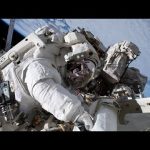
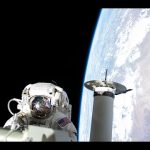
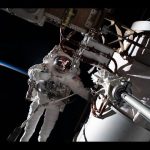
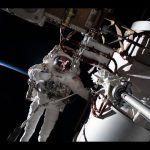
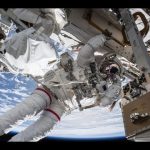
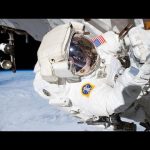
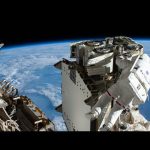
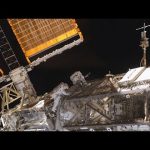
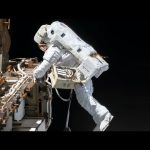
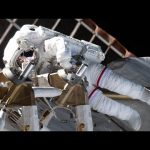
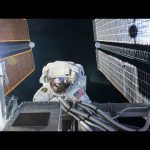
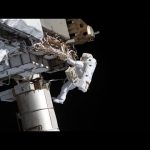
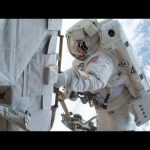
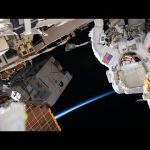
On Thursday, May 1, NASA astronauts Anne McClain and Nichole Ayers will step outside the International Space Station to complete station upgrades. The spacewalk is scheduled to begin at 8 a.m. EDT (1200 UTC) and last about six and a half hours.
McClain and Ayers will relocate communications antenna and install a mounting bracket to prepare for the installation of a new set of International Space Station Rollout Solar Arrays, also called IROSAs, on a later spacewalk. The arrays will boost the station’s power generation capability by up to 30%.
McClain will wear a suit with red stripes; Ayers will wear an unmarked suit. This will be the third spacewalk for McClain and the first for Ayers.
NASA astronauts Butch Wilmore and Suni Williams are taking a spacewalk outside the International Space Station on Thursday, Jan. 30, 2025, to maintain station hardware and collect samples of surface material for analysis from the Destiny laboratory and the Quest airlock. The spacewalk is expected to begin at approximately 8 a.m. EST (1300 UTC) and last for around six and a half hours.
Williams (wearing the suit with red stripes) and Wilmore (wearing the unmarked suit) arrived at the ISS last year and are both crew members of Expedition 72, which began on Sept. 23, 2024. This is Wilmore’s fifth spacewalk and the ninth for Williams.
NASA astronauts Nick Hague and Suni Williams are taking a spacewalk outside the International Space Station on Thursday, Jan. 16, 2025, to replace station hardware and repair the station’s NICER (Neutron star Interior Composition ExploreR) X-ray telescope. The spacewalk is expected to begin at approximately 8 a.m. EST (1300 UTC) and last for around six and a half hours.
Hague (wearing the suit with red stripes) and Williams (wearing the unmarked suit) arrived at the ISS last year and are both crew members of Expedition 72, which began on Sept. 23, 2024. This is Hague’s fourth spacewalk and the eighth for Williams.
NASA astronauts Steve Bowen and Warren “Woody” Hoburg are taking a spacewalk on Thursday, June 15, to add a new solar panel to the International Space Station.
Bowen and Hoburg are scheduled to install a second International Space Station Roll-Out Solar Array, or IROSA, on this spacewalk, after previously installing one on June 9. The new arrays will increase the power capacity of the orbiting laboratory.
The spacewalk is scheduled to begin at 8:55 a.m. EDT (1255 UTC) and last about six hours. This is Bowen’s tenth spacewalk and the second for Hoburg.
Another power-generating spacewalk outside the space station, a commercial resupply spacecraft heads to the station, and sharing the experience of a ride aboard the space station … a few of the stories to tell you about – This Week at NASA!
NASA astronauts Steve Bowen and Warren “Woody” Hoburg are taking a spacewalk on Friday, June 9, to add a new unrolling solar panel to the International Space Station.
Bowen and Hoburg are scheduled to install an International Space Station Roll-Out Solar Array, or IROSA, on today’s spacewalk, with a second one to be installed on June 15. The new arrays will increase the power capacity of the orbiting laboratory.
The spacewalk, known formally as U.S. EVA 87, is scheduled to begin at 9:15 a.m. EDT (1315 UTC) and last about six and a half hours. Bowen will wear a suit with red stripes and Hoburg will wear an unmarked suit. This is Bowen’s ninth spacewalk and the first for Hoburg.
NASA astronaut Steve Bowen and United Arab Emirates astronaut Sultan Alneyadi are conducting a spacewalk on Friday, April 28, 2023, to continue upgrading the International Space Station’s power generation system. The spacewalk is scheduled to begin at about 9:15 a.m. EDT (1315 UTC), and last about 6 hours and 30 minutes; it is part of a series to augment the station’s power channels with new International Space Station Roll-Out Solar Arrays (iROSAs). Four of the new iROSAs have been installed so far.
Astronauts Nicole Mann of NASA and Koichi Wakata of JAXA (Japan Aerospace Exploration Agency) are conducting a spacewalk on Thursday, Feb. 2, to continue preparations for the installation of new roll-out solar arrays, or iROSAs, outside the station later this summer. The new arrays will increase the orbiting laboratory’s power capacity.
The spacewalk is scheduled to begin at 8:15 a.m. EST (1315 UTC) and last about six and a half hours. This is the second spacewalk for both Mann and Wakata.
Astronauts Nicole Mann of NASA and Koichi Wakata of JAXA (Japan Aerospace Exploration Agency) will step outside the International Space Station for their first spacewalk to finish work preparing for solar array additions planned for this summer.
The spacewalk is scheduled to begin at 8:15 a.m. EST (1315 UTC) and will last up to seven hours.
NASA astronauts Josh Cassada and Frank Rubio are conducting a spacewalk on Thursday, Dec. 22, to install new rollout solar arrays to upgrade the station’s power system. This spacewalk is the second of a pair this month to install the solar arrays and is scheduled to begin at 8:30 a.m. EST (1330 UTC), when the astronauts switch on their spacesuit battery packs. The spacewalk is expected to last about seven hours. Rubio (wearing the suit with red stripes) and Cassada (wearing the unmarked suit) are part of NASA’s SpaceX Crew-5 mission, which arrived at the station on Oct. 6, 2022. This is the third spacewalk for both astronauts.
The spacewalk originally scheduled for Wednesday, Dec. 21, was postponed when the International Space Station conducted a Pre-Determined Debris Avoidance Maneuver at 8:42 a.m. EST. The decision to conduct the maneuver was based on tracking data that showed a close approach to station of a fragment of Russian Fregat-SB upper stage debris. The crew was never in any immediate danger.
NASA astronauts Josh Cassada and Frank Rubio are conducting a spacewalk on Saturday, Dec. 3, to install an International Space Station Roll-Out Solar Array (iROSA) to augment power generation on the station’s starboard truss structure. This spacewalk is the first of a pair of spacewalks this month set to prepare the future deployment of additional solar arrays for the station. The spacewalk is scheduled to begin at 7:25 a.m. EST (12:25 UTC) and last about seven hours.
Cassada (wearing the suit with red stripes) and Rubio (wearing the unmarked suit) are part of NASA’s SpaceX Crew-5 mission, which arrived at the station on Oct. 6, 2022. This is the second spacewalk for both astronauts.
NASA astronauts Josh Cassada and Frank Rubio are conducting a spacewalk outside the International Space Station on Tuesday, Nov. 15, to assemble a mounting bracket on the starboard side of the station’s truss assembly. The spacewalk, which will prepare the future deployment of additional solar arrays for the station, is scheduled to begin around 8 a.m. EST (1300 UTC) and last for about seven hours.
Cassada (wearing the suit with red stripes) and Rubio (wearing the unmarked suit) are part of NASA’s SpaceX Crew-5 mission, which arrived at the station on Oct. 6, 2022. This is the first spacewalk for both astronauts.
ESA astronaut Samantha Cristoforetti will soon complete her second mission to the International Space Station, Minerva.
She was launched from Kennedy Space Center in late April, and since then has supported many European and international science experiments, as well as taken responsibility for all operations within the US Orbital Segment. In July 2022 she performed her first spacewalk, during which she carried out work in the Russian segment to bring the European Robotic Arm into operation.
This report provides a summary of the Minerva Mission, which will end shortly with Samantha’s return to Earth.
We are Europe’s gateway to space. Our mission is to shape the development of Europe’s space capability and ensure that investment in space continues to deliver benefits to the citizens of Europe and the world. Check out https://www.esa.int/ to get up to speed on everything space related.
ESA astronaut Matthias Maurer gives a glimpse into his evening routine aboard the International Space Station during his Cosmic Kiss mission.
Matthias’s crew quarters, known as CASA (short for Crew Alternate Sleep Accommodation), is located within the European Columbus science laboratory module.
But before he floats into his sleeping bag in there for the night, Matthias takes a little detour to one of the three “bathrooms” currently on board the Space Station.
Separated from the work areas and installed in different modules of the USOS and Russian segments of the Station to allow them some privacy, the astronauts on board share these bathrooms to wash up, take a “shower” in space and brush their teeth.
We are Europe’s gateway to space. Our mission is to shape the development of Europe’s space capability and ensure that investment in space continues to deliver benefits to the citizens of Europe and the world. Check out https://www.esa.int/ to get up to speed on everything space related.
On 23 March 2022, ESA astronaut Matthias Maurer successfully performed his first extravehicular activity (EVA) alongside fellow @NASA astronaut Raja Chari. The spacewalk, dubbed “US EVA 80”, was carried out in support of assembly, refurbishment and maintenance work on the International Space Station.
In this video, Matthias Maurer answers questions and reports on his experiences, feelings and the challenges he faced during his almost seven-hour-long spacewalk.
00:00 – 01:56 What was it like to leave the ISS for the fist time? 01:57 – 04:07 Can you compare a spacewalk with underwater training? 04:08 – 05:37 What was your most difficult task? 05:38 – 08:17 There was a “problem” at the beginning. What happened? 08:18 – 10:21 Were you able to enjoy the view? 10:22 – 11:46 You flew over your homeland, Saarland, during the EVA. Were you able to see your home? 11:47 – 12:39 What surprised you the most and what did you not expect at all? 12:40 – 16:26 How did you feel afterwards and how did you sleep?
During his Cosmic Kiss mission, Matthias Maurer will live and work aboard the International Space Station for approximately six months, conducting and supporting more than 35 European and numerous other international experiments in orbit.
We are Europe’s gateway to space. Our mission is to shape the development of Europe’s space capability and ensure that investment in space continues to deliver benefits to the citizens of Europe and the world. Check out https://www.esa.int/ to get up to speed on everything space related.
NASA astronauts Kayla Barron and Raja Chari conduct a spacewalk at the International Space Station (ISS) to assemble and install brackets and struts kits for upcoming solar array upgrades. The new ISS Roll-Out Solar Arrays, or iROSAs, will increase the space station’s total available power. So far, two of six iROSAs have been deployed on the station with four additional arrays to be delivered.
Barron will serve as extravehicular crewmember 1 (EV 1) and will wear a suit with red stripes. Chari will serve as extravehicular crewmember 2 (EV 2) and will wear a suit with no stripes. The spacewalk will be the second of Barron’s career and the first for Chari.
Watch NASA astronauts Kayla Barron and Thomas Marshburn venture outside the International Space Station on Dec. 2 to replace a faulty antenna system. The antenna recently lost its ability to transmit low-rate voice communications and data to flight controllers in mission control, although it has had a limited impact on operations. The two astronauts will replace it with a spare.
The spacewalkers are expected to turn their spacesuits on to battery power at about 7:10 a.m. EST for an excursion slated to last about 6.5 hours. Marshburn will serve as extravehicular crew member 1 (EV 1), wearing a spacesuit with red stripes, and Barron will be extravehicular crew member 2 (EV 2), wearing a spacesuit with no stripes. European Space Agency astronaut Matthias Maurer will provide support from inside the orbiting laboratory, maneuvering the Canadarm2 robotic arm that will carry Marshburn. This will be the fifth spacewalk for Marshburn, and the first for Barron.
ESA astronaut Thomas Pesquet and @JAXA | 宇宙航空研究開発機構 astronaut Akihiko Hoshide performed a spacewalk on 12 September 2021 to prepare for the installation of a new solar array on the International Space Station.
The new solar arrays, called IROSA or ISS Roll-Out Solar Array, are being gradually installed over the existing arrays to boost the International Space Station’s power system.
Thomas and @NASA astronaut Shane Kimbrough prepared and installed two IROSA solar panels across three spacewalk in June. The arrays were taken from their storage area outside the Space Station and passed from spacewalker to spacewalker to the worksite. There the rolled arrays were secured, unfolded, connected and then unfurled.
Aki and Thomas prepared the P4 truss for its IROSA installation. This is the same area as where Thomas and Shane installed two IROSA’s but closer to the main body of the Space Station, in an area called the 4A channel. Only one new solar array will be installed here, on a later spacewalk. While the extravehicular activity or EVA was already the fourth spacewalk during Thomas’ Alpha mission, it was his first with Aki and the first time a spacewalking pair did not feature a US or Russian astronaut.
Aki and Thomas made good time preparing the 4A channel for the next IROSA and were able to complete a second task to replace a floating potential measurement unit that was faulty. This unit measures the difference between the Space Station’s conductive structures and the atmospheric plasma.
Thomas and Aki completed their spacewalk in six hours and 54 minutes, which hands Thomas the ESA record for longest time spent spacewalking.
Thomas posted this video on his social media channels with the caption: “Hanging out with my buddy Aki on last week’s spacewalk. The music and timelapse makes it look comical, but as you can see tools and equipment have a life of their own and never stop floating away. Keeping track and even just staying in position in front of the worksite is a constant fight! We got the support bracket done and the truss is ready for the new roll-out solar arrays. We are passing on the baton to the next crew, the arrays need to be launched still and they will be installed next year.”
Over 200 experiments are planned during Thomas’ time in space, with 40 European ones and 12 new experiments led by the French space agency @CNES.
We are Europe’s gateway to space. Our mission is to shape the development of Europe’s space capability and ensure that investment in space continues to deliver benefits to the citizens of Europe and the world. Check out https://www.esa.int/ to get up to speed on everything space related.
Does your weekend include any home improvements? Ours does! On Sun. Sept. 12 at 8:30 a.m. EDT (12:30 UTC), watch Japan Aerospace Exploration Agency astronaut Akihiko Hoshide and European Space Agency astronaut Thomas Pesquet venture outside the International Space Station to perform upgrades to the orbiting lab.
The duo will spend approximately 6.5 hours in the vacuum of space preparing the space station for the installation of its third new roll-up solar array.
NASA TV coverage starts at 7 a.m. EDT (11:00 UTC). Set a reminder to watch live!
Timelapse video made during ESA astronaut Thomas Pesquet’s second mission to the International Space Station, “Alpha”.
ESA astronaut Thomas Pesquet and @NASA astronaut Shane Kimbrough performed three spacewalks in the span of 10 days to install two new solar arrays that will generate more electricity on the International Space Station.
The third and final spacewalk for the duo happened on June 25 to finish installing the second pair of new solar arrays. This spacewalk proceeded without problems, and the two new solar arrays are already working and supplying power to the Space Station.
The design of the new solar arrays will be used to power the lunar Gateway that will be built in an orbit around the Moon – the next outpost in space for the agencies that run the International Space Station.
Thomas has now spent exactly 33 hours on spacewalks, all with Shane over the course of two spaceflights.
Thomas posted this video on his social media channels with the caption: “Aki took another great timelapse of our last spacewalk to install the new solar panels… for now. Four more are set to be installed, but they are not on the Station yet. This timelapse is great because it shows how small we are compared to the huge layout of the Space Station (it is about the same size as a football field – both types: American football or actually-using-your-feet-football fields). Note how the solar arrays we are working on don’t move, this is because they were turned off and not following the Sun so were not generating power. As an extra precaution we didn’t connect the power cables until darkness!”
Over 200 experiments are planned during Thomas’ time in space, with 40 European ones and 12 new experiments led by the French space agency @CnesFrance.
We are Europe’s gateway to space. Our mission is to shape the development of Europe’s space capability and ensure that investment in space continues to deliver benefits to the citizens of Europe and the world. Check out https://www.esa.int/ to get up to speed on everything space related.
Timelapse video made during ESA astronaut Thomas Pesquet’s second mission to the International Space Station, “Alpha”.
On Sunday 20 June 2021 Thomas and @NASA astronaut Shane Kimbrough were helped into their spacesuits again for their fourth spacewalk together. This time it was to complete installation of the first new solar array and get ahead on the second.
During this spacewalk the duo unfolded the solar arrays that are rolled into tubes for transport, aligned them, connected data cables and secured them to the mounting bracket. Connecting the power lines must be done during the orbital night-time as a precaution to avoid any chance of electric shock.
As Thomas and Shane waited for the night to arrive, Shane’s helmet lights and camera partially detached from his helmet but Thomas used some wire to successfully reattach them as a temporary fix.
From there the spacewalk went smoothly. Shane and Thomas connected the new solar array, watched it unfurl and prepared for the installation of the second new solar array. The second spacewalk lasted 6 hours and 28 minutes, with the duo arriving back at the airlock at 20:10 CEST (19:10 BST).
This video shows scenes from this spacewalk. The images for this timelapse were taken by @JAXA | 宇宙航空研究開発機構 astronaut and Space Station commander Aki Hoshide.
Thomas posted this video on his social media with the caption: “We have to do EVAs, but someone has to keep running the Space Station while we are preparing, spacewalking, reconfiguring, preparing again… Aki has been rock solid taking care of the spaceship pretty much by himself, performing all the maintenance and the science experiments, AND ON TOP OF THAT he found the time to take timelapses of our little walks outside. The man is a machine!”
Over 200 experiments are planned during Thomas’ time in space, with 40 European ones and 12 new experiments led by the French space agency @CNES.
We are Europe’s gateway to space. Our mission is to shape the development of Europe’s space capability and ensure that investment in space continues to deliver benefits to the citizens of Europe and the world. Check out https://www.esa.int/ to get up to speed on everything space related.
Timelapse video made during ESA astronaut Thomas Pesquet’s second mission to the International Space Station, “Alpha”.
On 16 June 2021 Thomas and @NASA astronaut Shane Kimbrough went on a spacewalk to install a new solar array for the International Space Station. These arrays, called IROSA for ISS Roll-Out Solar Array, had to be taken from their storage area outside the Space Station and passed from spacewalker to spacewalker to the worksite. There the rolled arrays were to be secured, unfolded, connected and then unfurled.
During the spacewalk a small technical problem in Shane’s spacesuit required him to return to the airlock and restart his Display and Control Module. This module provides astronauts with continuous information on pressure, temperature and other vital data during a spacewalk. Though the restart was successful and Shane was in no danger, it delayed the duo’s work, preventing them from completing installation of the first new solar array as planned. A second spacewalk was done on 20 June to finish installing the first solar array.
This video shows scenes from the first spacewalk with Thomas being moved on the robotic arm, at the controls was NASA astronaut Megan McArthur. The images for this timelapse were taken by @JAXA | 宇宙航空研究開発機構 astronaut and Space Station commander Aki Hoshide.
Thomas posted this video on his social media with the caption: “We have to do EVAs, but someone has to keep running the Space Station while we are preparing, spacewalking, reconfiguring, preparing again… Aki has been rock solid taking care of the spaceship pretty much by himself, performing all the maintenance and the science experiments, AND ON TOP OF THAT he found the time to take timelapses of our little walks outside. The man is a machine!”
Over 200 experiments are planned during Thomas’ time in space, with 40 European ones and 12 new experiments led by the French space agency @CNES
We are Europe’s gateway to space. Our mission is to shape the development of Europe’s space capability and ensure that investment in space continues to deliver benefits to the citizens of Europe and the world. Check out https://www.esa.int/ to get up to speed on everything space related.
SPACEWALK COMING SOON: Join us live from space on Sun. June 20 at 6:30 a.m. EDT (10:30 UTC) to cheer on NASA astronaut Shane Kimbrough and European Space Agency astronaut Thomas Pesquet as they continue work installing new, roll-up solar arrays on the International Space Station. Once their spacesuits are set to battery power around 8 a.m. EDT (12:00 UTC), the duo will spend about 6.5 hours in the vacuum of space on this demanding task.
Set a reminder to watch this special job performed live!
After more than 20 years, the International Space Station is getting new solar arrays, and you have the chance to watch it LIVE during a spacewalk! On June 16, Shane Kimbrough of NASA Astronauts and Thomas Pesquet of the European Space Agency will venture into the vacuum of space for ~6.5 hours to install and deploy two roll-out solar arrays on the space station.
Coverage starts at 6:30 a.m. EDT (10:30 UTC). Set a reminder to watch this special job performed live!
In preparation for his second mission to the International Space Station, ESA astronaut Thomas Pesquet is training for possible spacewalks at @NASA’s Johnson Space Center. His second six-month mission is called Alpha and will see Thomas launch as part Crew-2 on the @SpaceX Dragon spacecraft with NASA astronaut Megan Behnken and Shane Kimbrough and @JAXA | 宇宙航空研究開発機構 astronaut Aki Hoshide.
Watch this underwater spacewalk training session in 4K with audio from the astronauts and “mission control” recorded on 2 December 2020. Thomas is moved into position on a functional mockup of the International Space Station’s robotic arm to install hardware.
Astronauts practice spacewalks in NASA’s Neutral Buoyancy Laboratory. The training pool is the largest indoor swimming pool in the world, holding over 23 million litres of water, but it is still not large enough to hold the complete Space Station. Instead, specific parts of the Station structure are used as needed for training.
Training underwater is as close as it gets to experiencing weightlessness on Earth so spending time in a full spacesuit is used to practise techniques for spacewalks and neutral buoyancy is substituted for microgravity. Support and training divers are on hand to guide the astronauts during their tasks. In space, the astronauts are aided by mission control and colleague astronauts on the Station.
Extra Vehicular Activities (known as EVAs or spacewalks) are the most challenging tasks for an astronaut. When venturing from their spacecraft in a self-contained spacesuit to carry out repairs or install new equipment outside the International Space Station safety and efficiency are vital.
It might be relaxing and soothing to watch this underwater spacewalk at home, but spacewalks are marathons that require concentration and physical exertion for six hours at a time, with no food or bathroom breaks.
We are Europe’s gateway to space. Our mission is to shape the development of Europe’s space capability and ensure that investment in space continues to deliver benefits to the citizens of Europe and the world. Check out https://www.esa.int/ to get up to speed on everything space related.
Rise n’ grind – it’s spacewalk time. On March 13, NASA astronauts Victor Glover and Mike Hopkins will set their spacesuits to battery power at 7:30 a.m. EST (12:30 p.m. UTC) to mark the start of a 6.5 hour excursion outside the International Space Station.
This is not the duo’s first rodeo. They’ll be building on system upgrades from their Jan. 27 spacewalk, as well as servicing the station’s cooling system and communications gear.
Slip into the weekend while cheering on two astronauts working in the vacuum of space! At 7 a.m. EST on Friday, Mar. 5, Kate Rubins of NASA and Soichi Noguchi of JAXA (Japan Aerospace Exploration Agency) will exit the International Space Station to vent ammonia from the Early Ammonia System and complete several other tasks outside the orbital lab.
Once their spacesuits are switched to battery power, the spacewalk is scheduled to last approximately six-and-a-half hours.
Early riser? Watch two humans work in the vacuum of space on Sunday, Feb. 28! NASA astronauts Kate Rubins and Victor Glover will exit the orbital lab’s Quest airlock at about 6 a.m. EST to begin assembling and installing modification kits required for upcoming solar array upgrades.
Watch two spacewalkers at work outside the International Space Station! NASA astronauts Victor Glover and Michael Hopkins will exit the orbiting lab’s Quest airlock at about 7 a.m. EST, to complete tasks including battery maintenance and installing high definition cameras.
Live coverage on NASA Television begins at 5:30 a.m.. The spacewalk is will officially begin once the duo set their spacesuits to battery power, and is scheduled to last approximately six-and-a-half hours.
Watch live as astronauts Victor Glover and Michael Hopkins of NASA venture outside the International Space Station on Jan. 27. The spacewalk will begin at about 7 a.m. EST and last for approximately six and a half hours. The astronauts will focus on completing cable and antenna rigging for the “Bartolomeo” science payloads platform outside the station’s ESA (European Space Agency) Columbus module. They’ll also configure a Ka-band terminal that will enable an independent, high-bandwidth communication link to European ground stations.
Hopkins will be extravehicular crew member 1 (EV 1), wearing a spacesuit with red stripes, and Glover will be extravehicular crew member 2 (EV 2), wearing a spacesuit with no stripes. This will be the third spacewalk in Hopkins’ career, and the first for Glover.
On July 21, NASA astronauts Chris Cassidy and Robert Behnken will conduct a spacewalk to perform a number of tasks designed to upgrade station systems. Coverage will begin around 7:15 a.m. EDT, and may last up to seven hours. This will be both astronauts’ 10th spacewalk outside the orbital lab and Behnken’s final before returning to Earth on SpaceX’s Dragon Endeavor on August 2.
Another power-packed spacewalk outside the space station, highlighting a pretty cool comet, and a key piece of Space Launch System hardware is on the move … a few of the stories to tell you about – This Week at NASA!
Coffee + spacewalk = breakfast of champions. ✔️ Join us on Thursday, July 16, as NASA Astronauts Chris Cassidy and Robert Behnken venture outside the International Space Station. This will be the first spacewalk in a series of two which complete power upgrades outside the orbital lab.The duo plan to remove five of six older nickel-hydrogen batteries for the truss’ power system and install three new lithium-ion batteries, as well as accompanying hardware. Start your day with us, and set a reminder to watch! Coverage starts at 6 a.m. EDT.
A mighty powerful spacewalk outside the space station, a look at the space station’s next crew, and updates on our Artemis program … a few of the stories to tell you about – This Week at NASA!
This video is available for download from NASA’s Image and Video Library: https://images.nasa.gov/details-A%20Mighty%20Powerful%20Spacewalk%20Outside%20the%20Space%20Station%20on%20This%20Week%20@NASA%20%E2%80%93%20July%203,%202020
A power spacewalk outside the space station, honoring a former ‘Hidden Figure,’ and a “way cool” find of a hot Jupiter … a few of the stories to tell you about – This Week at NASA!
This video is available for download from NASA’s Image and Video Library: https://images.nasa.gov/details-A%20Power%20Spacewalk%20Outside%20the%20Space%20Station%20on%20This%20Week%20@NASA%20%E2%80%93%20June%2026,%202020
Our alien friend Paxi went to visit American astronaut Joe Acaba on board the International Space Station. Joe explains how the ISS recycles air and water.
★ Subscribe: http://bit.ly/ESAsubscribe and click twice on the bell button to receive our notifications.
We are Europe’s gateway to space. Our mission is to shape the development of Europe’s space capability and ensure that investment in space continues to deliver benefits to the citizens of Europe and the world. Check out http://www.esa.int/ESA to get up to speed on everything space related.
Italian ESA astronaut Luca Parmitano will return to Earth 6 February 2020, following his second long-duration mission on the International Space Station (ISS).
Luca’s mission – known as ‘Beyond’ – began 20 July 2019, exactly 50 years after the first lunar landing. On this date, Luca was launched to the Space Station in a Russian Soyuz spacecraft alongside Roscosmos cosmonaut Alexander Skvortsov and NASA astronaut Andrew Morgan.
During Beyond, Luca supported over 50 European experiments in orbit. These included remotely operating a rover in the Netherlands to collect rock samples as instructed by scientists in Germany, and completing four complex spacewalks to repair the cosmic-ray-detecting Alpha Magnetic Spectrometer AMS-02. He also supported numerous international experiments and became the third European and first ever Italian commander of the International Space Station.
Science and research completed during Luca’s mission will help pave the way for farther exploration as ESA looks beyond the International Space Station to the Moon and Mars.
We are Europe’s gateway to space. Our mission is to shape the development of Europe’s space capability and ensure that investment in space continues to deliver benefits to the citizens of Europe and the world. Check out http://www.esa.int/ESA to get up to speed on everything space related.
Live Spacewalk: Watch as astronauts complete the intricate process of repairing the Alpha Magnetic Spectrometer (AMS), a dark matter and antimatter detector outside the International Space Station.
On Sat., Jan. 25 at 6:50 a.m. EST, tune in for a live spacewalk as Luca Parmitano of the European Space Agency (ESA) and Andrew Morgan of NASA perform the fourth and final spacewalk to repair AMS, which has far outlived its planned three-year lifespan. In addition to revitalizing an important piece of scientific equipment, the process of creating the tools and procedures for these spacewalks is preparing teams for the types of spacewalks that may be required on Moon and Mars missions.
A critical test for our Commercial Crew Program, spacewalkers focus on upgrades aboard the space station, and paying tribute to one of our Great Observatories … a few of the stories to tell you about – This Week at NASA!
This video is available from NASA’s Image and Video Library: https://images.nasa.gov/details-NHQ_2020_0125_A%20Critical%20Test%20for%20Our%20Commercial%20Crew%20Program%20on%20This%20Week%20@NASA%20%E2%80%93%20January%2025,%202020