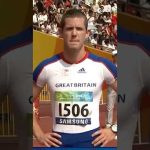
John McFall is part of our astronaut reserve. Following a motorcycle accident that resulted in the amputation of his right leg at the age of 19, John learnt to run again. He became a professional track and field athlete in 2005, going on to represent Great Britain and Northern Ireland as a @paralympics sprinter.
In November 2022, John was selected as a member of the ESA astronaut reserve and to take part in ESA’s feasibility study “Fly!” to improve our understanding of, and overcome, the barriers space flight presents for astronauts with a physical disability.
📹 European Space Agency (ESA) 📸 Novespace/N. Courtioux
This week’s edition of the Earth from Space programme features a Copernicus Sentinel-3 image showing the scale of Britain’s heatwave as it baked in extreme temperatures in August.
We are Europe’s gateway to space. Our mission is to shape the development of Europe’s space capability and ensure that investment in space continues to deliver benefits to the citizens of Europe and the world. Check out https://www.esa.int/ to get up to speed on everything space related.
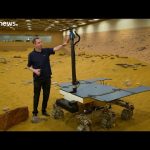
ExoMars is the first mission to head to the Red Planet to seek signs of life, now or in the past. It’s a massive scientific and technical challenge, and Euronews meets some of the team involved in this joint ESA-Roscosmos project in this month’s edition of Space.
ESA is Europe’s gateway to space. Our mission is to shape the development of Europe’s space capability and ensure that investment in space continues to deliver benefits to the citizens of Europe and the world. Check out http://www.esa.int/ESA to get up to speed on everything space related.
ECSAT (European Centre for Space Applications and Telecommunications) is the European Space Agency’s centre in the UK. With a commercially driven ethos, it supports European and Canadian industry in developing commercial satcom products and services, downstream applications and the ‘spin-out’ of space into non-space sectors.
ECSAT also the home of ESA’s Climate Office and has units dedicated to space exploration and technology development, one of which oversees the ESA–Rutherford Appleton Laboratory Advanced Manufacturing Laboratory.
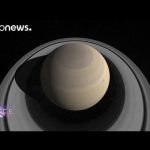
Right now the Cassini spacecraft is flying between the rings of Saturn and the planet itself, a daring trajectory chosen to conclude a unique exploration mission.
To find out what that orbit means, and to look back at some of Cassini-Huygens finest moments, we met up with key members of the science team in the UK for this edition of Space.
Die Cassini-Huygens-Mission am Saturn startete vor zwanzig Jahren, 2004 schwenkte die Doppel-Sonde in ihre Umlaufbahn um den Saturn ein. Im Dezember 2004 koppelte der Lander Huygens von der Cassini-Sonde ab und setzte im Januar 2005 auf dem Titan auf. Die Mission entdeckte unter anderem ein Eismeer auf dem Saturn-Mond Enceladus und fliegt jetzt zwischen den Ringen des Saturn und dem Planeten selbst. Im September soll Cassini mangels Treibstoffvorräten in der Saturn-Atmosphäre verglühen.
Die Saturn-Spezialisten des Mullard Space Science Laboratory (MSSL) in Südengland verfolgen die Mission und erforschen das Sonnensystem des pittoresken Planeten. Die Cassini-Sonde wird gerade auf ihre finale Umlaufbahn gebracht, um nächstmögliche Eindrücke vom Saturn zu gewinnen.
Located on the UK Space Gateway, Harwell Campus, the ESA-RAL Advanced Manufacturing Laboratory provides expertise and test services to investigate and optimise advanced materials and manufacturing processes in support of cutting-edge research and development. The facility is physically located within the Science and Technology Facilities Council’s Rutherford Appleton Laboratory (RAL).
The laboratory takes in samples of material destined for future space projects and puts them through various tests. A wide range of material properties and characteristics can be investigated in order to provide recommendations on how the materials can best be applied or improved before they can be considered for further development and used in a fully-fledged space mission. It has access to a metal-based 3D printer and is equipped with a suite of powerful microscopes, an X-ray CT machine and a range of furnaces.
Mechanical testing such as tensile and micro hardness testing is also performed.The lab is a gateway to accessing some of the extensive on-site testing facilities based on Harwell Campus, such as STFC’s ISIS Neutron Source, the Diamond Light Source synchrotron and the UK’s Central Laser Facility.
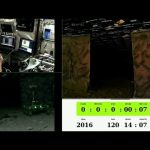
On 29 April 2016, ESA astronaut Tim Peake on the International Space Station took control of a rover, nicknamed ‘Bridget’, in the UK and over two hours drove it into a simulated cave and found and identified targets despite the dark and limited feedback information.
Before and after Tim came online from the orbiting Station, control of the rover was passed several times between engineers at the Airbus D&S ‘Mars Yard’ in Stevenage, UK, Belgium’s ISS User Support Centre in Brussels and ESA’s ESOC operations centre in Darmstadt, Germany. This complex real-time choreography was possible thanks to the ‘Internet in space’ – a network that tolerates disruptions – put in place by teams at ESOC. This network enables remote control of rovers or other devices in the difficult environment of space, with its long distances and frequent connection blackouts inevitable with orbital motion.
During the experiment, a representative mission scenario was set up in which the rover was commanded to go from a lit environment into a challenging dark location (simulating a cave or a shaded crater) and identified a number of science targets. The Mars yard (30 x 13 m) was split into two areas, one lit and one in the dark. From one end of the yard, Bridget was commanded from ESOC until it reached the edge of the shaded area. Then at the edge of the ‘cave’, control was passed to astronaut Tim Peake, on board the Station, who controlled Bridget to drive across the yard, avoiding obstacles and identifying potential science targets, which were marked with a distinctive ultraviolet fluorescent marker. Once the targets were identified and mapped, Tim drove the rover out of the shaded area and handed control back to ESOC, who drove the rover back to its starting point.
This video is a compressed extract that includes highlights of the experiment and includes scenes of the network control centre at ESOC, the Mars Yard at Stevenage and Tim Peake on the ISS. On audio, the voices of astronaut Time Peake, Lionel Ferra, the Eurocom ‘capcom’ controller at ESA’s Astronaut Centre in Cologne, Germany, and Kim Nergaard, the ground segment manager at ESOC, can be heard periodically.
Gonzalo Martín-de-Mercado specialises in optical telecommunications. He speaks about how his academic background helps him to support collaboration between ESA and companies.
Pascal Lecomte speaks about the history and the aims of the ESA Climate Office which is located in Harwell, Oxfordshire. He also explains how he began and pursued his career with ESA.