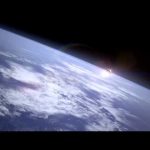
Watch live video from the International Space Station, including inside views when the crew aboard the space station is on duty. Views of Earth are also streamed from an external camera located outside of the space station. During periods of signal loss due to handover between communications satellites, a blue screen is displayed.
The space station orbits Earth about 250 miles (425 kilometers) above the surface. An international partnership of five space agencies from 15 countries operates the station, and it has been continuously occupied since November 2000. It’s a microgravity laboratory where science, research, and human innovation make way for new technologies and research breakthroughs not possible on Earth. More: https://go.nasa.gov/3CkVtC8
Did you know you can spot the station without a telescope? It looks like a fast-moving star, but you have to know when to look up. Download our mobile app for alerts to let you know when (and where) to spot the station and wave to the crew: https://www.nasa.gov/spot-the-station/
Watch live video from the International Space Station, including inside views when the crew aboard the space station is on duty. Views of Earth are also streamed from an external camera located outside of the space station. During periods of signal loss due to handover between communications satellites, a blue screen is displayed.
The space station orbits Earth about 250 miles (425 kilometers) above the surface. An international partnership of five space agencies from 15 countries operates the station, and it has been continuously occupied since November 2000. It’s a microgravity laboratory where science, research, and human innovation make way for new technologies and research breakthroughs not possible on Earth. More: https://go.nasa.gov/3CkVtC8
Did you know you can spot the station without a telescope? It looks like a fast-moving star, but you have to know when to look up. Sign up for text messages or email alerts to let you know when (and where) to spot the station and wave to the crew: https://spotthestation.nasa.gov
Ai întrebări de știință și vrei răspunsuri personale? Intră acum pe Patreon și eu își voi răspunde direct pe whatsapp ►https://patreon.com/cristianpresura
Watch live video from the International Space Station, including inside views when the crew aboard the space station is on duty. Views of Earth are also streamed from an external camera located outside of the space station. During periods of signal loss due to handover between communications satellites, a blue screen is displayed.
The space station orbits Earth about 250 miles (425 kilometers) above the surface. An international partnership of five space agencies from 15 countries operates the station, and it has been continuously occupied since November 2000. It’s a microgravity laboratory where science, research, and human innovation make way for new technologies and research breakthroughs not possible on Earth. More: https://go.nasa.gov/3CkVtC8
Did you know you can spot the station without a telescope? It looks like a fast-moving star, but you have to know when to look up. Sign up for text messages or email alerts to let you know when (and where) to spot the station and wave to the crew: https://spotthestation.nasa.gov
Watch live video from the International Space Station, including inside views when the crew aboard the space station is on duty. Views of Earth are also streamed from an external camera located outside of the space station. During periods of signal loss due to handover between communications satellites, a blue screen is displayed.
The space station orbits Earth about 250 miles (425 kilometers) above the surface. An international partnership of five space agencies from 15 countries operates the station, and it has been continuously occupied since November 2000. It’s a microgravity laboratory where science, research, and human innovation make way for new technologies and research breakthroughs not possible on Earth. More: https://go.nasa.gov/3CkVtC8
Did you know you can spot the station without a telescope? It looks like a fast-moving star, but you have to know when to look up. Sign up for text messages or email alerts to let you know when (and where) to spot the station and wave to the crew: https://spotthestation.nasa.gov
Watch live video from the International Space Station, including inside views when the crew aboard the space station is on duty. Views of Earth are also streamed from an external camera located outside of the space station. During periods of signal loss due to handover between communications satellites, a blue screen is displayed.
The space station orbits Earth about 250 miles (425 kilometers) above the surface. An international partnership of five space agencies from 15 countries operates the station, and it has been continuously occupied since November 2000. It’s a microgravity laboratory where science, research, and human innovation make way for new technologies and research breakthroughs not possible on Earth. More: https://go.nasa.gov/3CkVtC8
Did you know you can spot the station without a telescope? It looks like a fast-moving star, but you have to know when to look up. Sign up for text messages or email alerts to let you know when (and where) to spot the station and wave to the crew: https://spotthestation.nasa.gov
Steve Spangler is a bestselling author, STEM educator and Emmy award-winning television personality with more than 2,100 television appearances to his credit. Steve appeared as a regular guest on the Ellen DeGeneres Show from 2007-2022. Learn more about Steve at https://stevespangler.com/about-steve-spangler/
Watch live video from the International Space Station, including inside views when the crew aboard the space station is on duty. Views of Earth are also streamed from an external camera located outside of the space station. During periods of signal loss due to handover between communications satellites, a blue screen is displayed.
The space station orbits Earth about 250 miles (425 kilometers) above the surface. An international partnership of five space agencies from 15 countries operates the station, and it has been continuously occupied since November 2000. It’s a microgravity laboratory where science, research, and human innovation make way for new technologies and research breakthroughs not possible on Earth. More: https://go.nasa.gov/3CkVtC8
Did you know you can spot the station without a telescope? It looks like a fast-moving star, but you have to know when to look up. Sign up for text messages or email alerts to let you know when (and where) to spot the station and wave to the crew: https://spotthestation.nasa.gov
Watch live video from the International Space Station, including inside views when the crew aboard the space station is on duty. Views of Earth are also streamed from an external camera located outside of the space station. During periods of signal loss due to handover between communications satellites, a blue screen is displayed.
The space station orbits Earth about 250 miles (425 kilometers) above the surface. An international partnership of five space agencies from 15 countries operates the station, and it has been continuously occupied since November 2000. It’s a microgravity laboratory where science, research, and human innovation make way for new technologies and research breakthroughs not possible on Earth. More: https://go.nasa.gov/3CkVtC8
Did you know you can spot the station without a telescope? It looks like a fast-moving star, but you have to know when to look up. Sign up for text messages or email alerts to let you know when (and where) to spot the station and wave to the crew: https://spotthestation.nasa.gov
Ultra-high-definition video beamed from deep space, the Artemis II astronauts train for their upcoming mission, and an Artemis landing from inside the Orion spacecraft … a few of the stories to tell you about – This Week at NASA!
Watch live video from the International Space Station, including inside views when the crew aboard the space station is on duty. Views of Earth are also streamed from an external camera located outside of the space station. During periods of signal loss due to handover between communications satellites, a blue screen is displayed.
The space station orbits Earth about 250 miles (425 kilometers) above the surface. An international partnership of five space agencies from 15 countries operates the station, and it has been continuously occupied since November 2000. It’s a microgravity laboratory where science, research, and human innovation make way for new technologies and research breakthroughs not possible on Earth. More: https://go.nasa.gov/3CkVtC8
Did you know you can spot the station without a telescope? It looks like a fast-moving star, but you have to know when to look up. Sign up for text messages or email alerts to let you know when (and where) to spot the station and wave to the crew: https://spotthestation.nasa.gov
Watch live video from the International Space Station, including inside views when the crew aboard the space station is on duty. Views of Earth are also streamed from an external camera located outside of the space station. During periods of signal loss due to handover between communications satellites, a blue screen is displayed.
The space station orbits Earth about 250 miles (425 kilometers) above the surface. An international partnership of five space agencies from 15 countries operates the station, and it has been continuously occupied since November 2000. It’s a microgravity laboratory where science, research, and human innovation make way for new technologies and research breakthroughs not possible on Earth. More: https://go.nasa.gov/3CkVtC8
Did you know you can spot the station without a telescope? It looks like a fast-moving star, but you have to know when to look up. Sign up for text messages or email alerts to let you know when (and where) to spot the station and wave to the crew: https://spotthestation.nasa.gov
De la 20:00, împreuna cu Claudiu Tănăselia ( https://www.parsec.ro ) discutăm noile imagini, video și sunet transmise de pe Marte de Roverul Perseverence. Răspundem pe îndelete și la întrebările voastre.
New video from NASA’s Mars 2020 Perseverance rover chronicles major milestones during the final minutes of its entry, descent and landing (EDL) on the Red Planet on Feb. 18 as the spacecraft plummeted, parachuted, and rocketed toward the surface of Mars.
From the moment of parachute inflation, the camera system covers the entirety of the descent process, showing some of the rover’s intense ride to Mars’ Jezero Crater. The footage from high-definition cameras aboard the spacecraft starts 7 miles (11 kilometers) above the surface, showing the supersonic deployment of the most massive parachute ever sent to another world and ends with the rover’s touchdown in the crater.
Producer Credit: Sonnet Apple Music: “DMC 12″/Universal Production Music
Few conflicts have rivaled the scale and destruction of the Punic wars fought between Rome and Carthage. In this first episode I set the stage for a conflict that will reshape history!
Sources:
“The Fall of Carthage” by Adrian Goldsworthy
“In the Name of Rome” by Adrian Goldsworthy
“The Rise of Rome” by Anthony Everitt
The gameplay comes from Total War: Rome 2
“Please note this is an unofficial video and is not endorsed by SEGA or the Creative Assembly in any way. For more information on Total War, please visit www.totalwar.com.”
NASA astronauts Victor Glover, Michael Hopkins, Shannon Walker and JAXA (Japan Aerospace Exploration Agency) astronaut Soichi Noguchi take viewers on a tour of the SpaceX Crew Dragon Resilience spacecraft that will take them to their new home on orbit.
The SpaceX Falcon 9 rocket and Crew Dragon spacecraft successfully launched from Kennedy Space Center’s historic Launch Pad 39A at Nov. 15 at 7:27 p.m. EST (Nov. 16 at 12:27 a.m. UTC) with the astronauts aboard for a six-month mission to the International Space Station. Crew Dragon will perform a series of phasing maneuvers to gradually approach and autonomously dock with the International Space Station on Monday, Nov. 16, at approximately 11:00 p.m.. EST (Nov. 17 at 4:00 a.m. UTC).
In this video, NASA astronauts Robert Behnken and Douglas Hurley speak to Mission Control in Houston from SpaceX’s Dragon Endeavour Spacecraft on May 31, just hours before they arrive at the International Space Station.
The SpaceX Falcon 9 rocket and Dragon spacecraft successfully launched from Kennedy Space Center’s historic Launch Pad 39A at 3:22 p.m. EDT on May 30 and arrived at the station’s Harmony port, docking at 10:16 a.m. EDT on May 31 while the spacecraft were flying about 262 miles above the northern border of China and Mongolia.
Science gets scaled up with the first 8K ultra high definition (UHD) video from the International Space Station. Get closer to the in-space experience and see how the international partnership-powered human spaceflight is improving lives on Earth, while enabling humanity to explore the universe. More: https://go.nasa.gov/2zgPY5o Special thanks to the European Space Agency, the ISS National Lab, and astronauts Alexander Gerst, Serena Auñón-Chancellor, Ricky Arnold and Drew Feustel.
Featured investigations and facilities:
0:01, 2:36 BEST seeks to advance use of sequencing DNA and RNA in space. https://go.nasa.gov/2tNntKu
0:13 The Minus Eighty-Degree Laboratory Freezer for ISS (MELFI) is a cold storage unit that maintains experiment samples at ultra-cold temperatures throughout a mission. https://go.nasa.gov/2RkJAl5
0:21 The Advanced Plant Habitat (APH), a recent addition to the space station, is the largest growth chamber aboard the orbiting laboratory. https://go.nasa.gov/2JCi8vV
0:33 Canadarm2 is part of Canada’s contribution to the space station. This 17-metre-long robotic arm was extensively involved in the assembly of the orbiting laboratory. https://go.nasa.gov/2ReaU42
0:41 Crew Earth Observations record how the planet is changing over time, from human-caused changes like urban growth and reservoir construction, to natural dynamic events such as hurricanes, floods and volcanic eruptions. https://go.nasa.gov/2KLFAaq
0:49 The Light Microscopy Module (LMM) is a modified commercial, highly flexible, state-of-the-art light imaging microscope facility that provides researchers with powerful diagnostic hardware and software onboard the space station. https://go.nasa.gov/2RfdYwS
0:53 ACE-T-2 looks at the assembly of complex structures from micron-scale colloidal particles interacting via tunable attractive interactions. https://go.nasa.gov/2Re2ppS
0:57 Plant Habitat-1 comprehensively compares differences in genetics, metabolism, photosynthesis, and gravity sensing between plants grown in space and on Earth. https://go.nasa.gov/2MdDBfc
1:05 The Cupola provides an observation and work area for the International Space Station crew that gives visibility to support the control of the station’s robotic arms, and a beautiful view of the Earth, celestial objects and visiting vehicles. https://go.nasa.gov/2CRsxCT
1:14 Atomization observes the disintegration processes of low-speed water jets under various conditions to improve spray combustion processes inside rocket and jet engines. https://go.nasa.gov/2RkKrlN
1:30 BCAT-CS focuses on the study of forces between particles that cluster together by studying sediments of quartz and clay particles. https://go.nasa.gov/2p6WBSV
1:38 Functional Immune analyzes blood and saliva samples to determine the changes taking place in crew members’ immune systems during flight. https://go.nasa.gov/2RfUMz1
2:03 Life Support Rack (LSR) is a technology demonstrator for closed loop air revitalization. https://go.nasa.gov/2Rdfi3C
2:15 The Japanese Experiment Module Airlock is used to deliver science experiments to external platforms, and prepare small satellites for deployment from station. https://go.nasa.gov/2RdcBik
2:23 SPHERES Tether Slosh combines fluid dynamics equipment with robotic capabilities aboard the space station to investigate automated strategies for steering passive cargo that contain fluids. https://go.nasa.gov/2RfQPdQ
Watch in 360 degrees as an United Launch Alliance Delta IV Heavy rocket lifts off from Space Launch Complex-37 at Cape Canaveral Air Force Station in Florida carrying NASA’s Parker Solar Probe spacecraft. Roughly the size of a small car, the spacecraft lifted off at 3:31 a.m. EDT on Aug. 12, 2018, starting its historic mission to “touch” the Sun.
The Tonight Show Starring Jimmy Fallon features hilarious highlights from the show including: comedy sketches, music parodies, celebrity interviews, ridiculous games, and, of course, Jimmy’s Thank You Notes and hashtags! You’ll also find behind the scenes videos and other great web exclusives.
In 1958 NASA’s top management T. Keith Glennan and Hugh L. Dryden used a film presentation to introduce the new agency to former employees of NACA (National Advisory Committee for Aeronautics). Since that day visual communication has been a key element in telling the NASA story to the world.
Technology is taking over toys at New York City’s annual Toy Fair. Next to the Lincoln Logs and Tinkertoys are slot cars powered by artificial intelligence. The fair showcases the changing face of the toy industry and how kids play. Gigi Stone Woods reports from the the fair in New York City with the high-tech hype.
The video begins 10 minutes before Orion’s 11:29 a.m. EST splashdown in the Pacific Ocean, just as the spacecraft was beginning to experience Earth’s atmosphere. Peak heating from the friction caused by the atmosphere rubbing against Orion’s heat shield comes less than two minutes later, and the footage shows the plasma created by the interaction change from white to yellow to lavender to magenta as the temperature increases. The video goes on to show the deployment of Orion’s parachutes and the final splash as it touches down.
As the flight test of NASA’s Orion spacecraft nears, the agency released Oct. 8 a video detailing the spacecraft’s test and the critical systems engineers will evaluate during the Dec. 4 flight. Orion is in the final stages of preparation for the uncrewed flight test that will take it 3,600 miles above Earth on a 4.5-hour mission to test many of the systems necessary for future human missions into deep space. After two orbits, Orion will reenter Earth’s atmosphere at almost 20,000 miles per hour, and reach temperatures near 4,000 degrees Fahrenheit, before its parachute system deploys to slow the spacecraft for a splashdown in the Pacific Ocean.
On future missions, the Orion spacecraft will carry astronauts farther into the solar system than ever before, including to an asteroid and Mars.
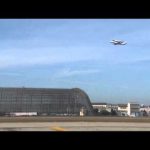
NASA’s 747 Shuttle Carrier Aircraft, carrying space shuttle Endeavour, as it flew over NASA’s Ames Research Center in Mountain Valley, Calif. on Sept. 21.
On Sept. 11, 2001, NASA astronaut, Frank Culbertson, was the lone American not on the planet. Culbertson and two Russian cosmonauts were orbiting the Earth aboard the International Space Station as members of the Expedition 3 crew. Included is video captured by Culbertson and crew as they flew over New York City just after the attacks on the World Trade Center. Included is additional footage aboard the ISS, as well as interview excerpts of Culbertson’s recollections ten years later.
An ESA-developed camera transmitted live-streaming 3D images for the first time in the history of space travel. On 6 August, NASA astronaut Ron Garan operated the Erasmus Recording Binocular (ERB-2) camera in Europe’s Columbus laboratory, showing the International Space Station as never before in high-definition quality . While talking about the work on board the Station, he enhances the sense of depth and presence by playing with an inflatable Earth globe. http://www.esa.int/esaCP/SEMWLEOT9RG_index_0.html
Use red/blue 3D glasses to experience the full 3D experience of this clip.
Learn more about Steve at https://www.stevespanglerscience.com/ Through the years, a lot has happened at Steve Spangler Science. We set a Guinness World Record, took 100 teachers on an Alaskan cruise, gave 700 people the experience of laying on a bed of nails, started a war with potato guns, and even had the police called on us… a few times! Here is a look at a few of the fun moments we’ve had!
Join Commander Steve Lindsey and his crew of Pilot Eric Boe, and Mission Specialists Alvin Drew, Steve Bowen, Mike Barratt and Nicole Stott as they journey to and from the International Space Station. Set to music, the video celebrates the final mission of space shuttle Discovery as it logs the last of its 365 days in flight.