NASA’s Parker Solar Probe is heading to the Sun.Thermal Protection System Engineer Betsy Congdon (Johns Hopkins APL) outlines why Parker can take the heat. More: https://go.nasa.gov/2O7YKsK | NASA launch schedule: https://go.nasa.gov/2JfklMB
Music credit: Cheeky Chappy [Main Track] by Jimmy Kaleth, Ross Andrew McLean Credit: NASA’s Goddard Space Flight Center Genna Duberstein (USRA): Lead Producer/Lead Editor Rob Andreoli (AIMM): Lead Videographer Betsy Congdon (Johns Hopkins University/APL): Lead Engineer Ryan Fitzgibbons (USRA): Narrator Genna Duberstein (USRA): Writer Steve Gribben (Johns Hopkins University/APL ): Animator Brian Monroe (USRA): Animator Josh Masters (USRA): Animator Michael Lentz (USRA): Animator Genna Duberstein (USRA): Animator Mary P. Hrybyk-Keith (TRAX International Corporation): Illustrator This video is public domain and along with other supporting visualizations can be downloaded from the Scientific Visualization Studio at: https://svs.gsfc.nasa.gov/12867
Euronews had a unique chance to visit the Avio rocket factory, situated in Colleferro, just south of Rome, Italy, where engineers are lovingly crafting the next generation of carbon fibre European launchers.
The site is one of the very few space rocket factories in Europe. It’s the place where the lightweight Vega launcher was born, and where the launchers of the future are being created.
Το εργοστάσιο κατασκευής πυραύλων Avio βρίσκεται στα νότια της Ρώμης. Αυτό είναι ένα από τα λίγα εργοστάσια διαστημικών πυραύλων στην Ευρώπη. Εδώ οι μηχανικοί κατασκευάζουν την επόμενη γενιά ευρωπαϊκών εκτοξευτών από ανθρακόνημα. Εδώ κατασκευάζεται ο πανάλαφρος Vega και σχεδιάζονται οι πύραυλοι του μέλλοντος.
Nella puntata di Space di questo mese abbiamo la chance unica di visitare questo posto alle mie spalle, l’azienda aerospaziale Avio a Colleferro, in provincia di Roma, dove un team di ingegneri sta lavorando alla nuova generazione europea di lanciatori in fibra di carbonio. E’ una cosa rara poter filmare dentro luoghi simili. Entriamo, quindi, incontriamo il team e scopriamo cosa c’è di nuovo.
Questa è una delle poche aziende del settore in Europa. Qui è nato il lanciatore leggero Vega. E qui saranno creati i razzi spaziali del futuro.
Tracing the source of a cosmic phenomenon, the sound of plasma waves in space, and X-ray exploration of the Eagle Nebula … a few of the stories to tell you about – This Week at NASA!
This video is available for download from NASA’s Image and Video Library: https://images.nasa.gov/details-NHQ_2018_0713_Tracing%20The%20Source%20of%20a%20Cosmic%20Phenomenon%20on%20This%20Week%20@NASA%20%E2%80%93%20July%2013,%202018.html
Humans will have to breath, drink and eat while living on the Moon. They will need energy to perform tasks using their robotic companions and materials to build structures. For a sustainable approach to space exploration these resources cannot be carried from Earth but have to be found on the Moon itself.
Angel Abbud Madrid is the Director of the Center for Space Resources at the Colorado School of Mines (CSM), where he leads a multidisciplinary research programme on the human and robotic exploration of space and the utilisation of its resources. He is also the Director of the CSM Space Resources Program, the first academic programme in the world focused on educating scientists, engineers, economists, entrepreneurs and policymakers in the developing field of space resources.
Space Bites hosts the best talks on space exploration from the most inspiring and knowledgeable speakers from the field. Held at the technical heart of the European Space Agency in the Netherlands, the lectures are now also available on YouTube. If you want to know about the present and future challenges of ESA, stay tuned for more.
We are Europe’s gateway to space. Our mission is to shape the development of Europe’s space capability and ensure that investment in space continues to deliver benefits to the citizens of Europe and the world. Check out https://www.esa.int/ to get up to speed on everything space related.
Three of the world’s largest radio telescopes team up to show a rare double asteroid. 2017 YE5 is only the fourth binary near-Earth asteroid ever observed in which the two bodies are roughly the same size, and not touching. More: https://go.nasa.gov/2zxrh7U
This video shows radar images of the pair gathered by Goldstone Solar System Radar, Arecibo Observatory and Green Bank Observatory.
Discover more about our planet with the Earth from Space video programme. In this special edition, ESA’s Aeolus mission scientist, Anne Grete Straume, joins us in the cleanroom at Airbus Defence and Space in Toulouse, France. She explains how winds are generated, how they affect our weather, and how Aeolus will measure the wind and how this information will be used to improve weather forecasts and climate models.
I had the honor and priviledge to be able to sit down with Nick Redfern and interview him in person for the second time! This was a 2 part discussion starting off with big brother, propaganda, artificial intelligence and mind control. We end with part 2 connecting the dots of the first part with the UFOs, and the Artificial Alien Threat.
PART 1
Elite Bloodlines
Illuminati
New World Order
Orchestrated Events
Big Brother the Orwellian Society
Surveillance through Social Media
Propaganda through Television and Mainstream Media
Mind Control and Dumbing Down the Masses
GMOs in Food and Pharmaceutical Drugs as a Weapon for the Elite
Black Budget Operations and Programs
Artificial Intelligence
Virtual Reality
Technology is great but can easily be abused
Post 9/11 World
DARPA and Microchip Implants
Low Frequency Weapon
Georgia Guide Stones
Depopulation Agendas
PART 2 CONNECTING THE DOTS WITH PART 1
Ronald Reagans Alien Threat Speech
Project Bluebeam and the Fake Alien Threat
Advanced Holographic Technologies
Bob Lazar, Area 51, and Alien Technologies
Black Triangle UFO’s
Fabricated Events
The Orchestration of the Second Coming of Christ
Are Governments of the World working alongside ET’s
Project Serpo and Eisenhower
Disinformation
Dulce Underground Wars
Phil Schneider
Are ET’s traveling here? Are they already here possibly underground or hollow earth?
Underground Top Secret Facilities
Underground Submersive Objects
A new resupply mission arrives at the Space Station, a closer look at dwarf planet, Ceres, and the Parker Solar Probe is ready for the heat … a few of the stories to tell you about – This Week at NASA!
This video is available for download from NASA’s Image and Video Library: https://images.nasa.gov/details-NHQ_2018_0706_New%20Supplies%20and%20Research%20for%20the%20Space%20Station%20on%20This%20Week%20@NASA%20%E2%80%93%20July%206,%202018.html
SpaceX Dragon carried an Artificial Intelligence (AI) robot named CIMON to the ISS. CIMON stands for ‘Crew Interactive Mobile Companion’ and is the first-ever AI space robot. Watch BusinessToday.In’s video to know more about CIMON, built by Airbus and how he assists astronauts in relieving their stress.
———————-
About the Channel: Watch Business Today videos to get the latest news on Business, stock market, sensex – BSE India, NSE India, personal finance, gold prices, petrol prices and more. Also, get an insight into the dealings of the top companies in India from Business Today’s award-winning journalists. Get up to date with all investment options (Mutual Funds, SIPs, Debt, Equity, Insurance, Home Loans, Pension Schemes, Retirement Plans) from our Money Today team. Also, watch interviews of top CEOs.
Regular shows to watch out:
The Good The Bad and The Ugly with BusinessToday.in Editor Rajeev Dubey to know the top stories of the day specially curated from the world of business and economy.
Watch Inside India’s Factories to find out how different products get manufactured and processed for final consumption.
At the Airbus Defence and Space facility in Toulouse, France, ESA’s Aeolus wind satellite has been prepared for its launch on top of a Vega rocket from Kourou in French Guiana. Liftoff is currently scheduled for August. The development of this latest Earth Explorer started 16 years ago and has now finished.
From orbit Aeolus will measure wind profiles on a global scale using a pioneering laser technology. These measurements will greatly benefit existing meteorological models and fill a gap in the observations of wind.
The 2018 European CanSat launch campaign took place from 28 June until 1 July 2018 on the island of Santa Maria, Azores (Portugal).
Hosted by the Regional Fund for Science and Technology (FRCT) in collaboration with local partners. Nineteen teams participated this year: the winners of the CanSat national competitions from Austria, Belgium, Czech Republic, Denmark, Germany, Greece, Ireland, Italy, Nordic (joint competition Finland-Sweden-Norway), Portugal, Poland, Romania, the Netherlands, Spain, and the UK, as well a team from Hungary selected directly by ESA.
The European CanSat competition is only one of ESA’s initiatives to help young people increase their literacy and competence in STEM disciplines and inspire them to pursue a career in the STEM (science, technology, engineering, and mathematics) fields.
A new study using data from NASA’s NuSTAR space telescope suggests that the most luminous and massive stellar system within 10,000 light-years, Eta Carinae, is accelerating particles to high energies — some of which may reach Earth as cosmic rays. https://go.nasa.gov/2tPxKpA
Cosmic rays with energies greater than 1 billion electron volts (eV) come to us from beyond our solar system. But because these particles — electrons, protons and atomic nuclei — all carry an electrical charge, they veer off course whenever they encounter magnetic fields. This scrambles their paths and masks their origins. Eta Carinae, located about 7,500 light-years away in the southern constellation of Carina, contains a pair of massive stars whose eccentric orbits bring them unusually close every 5.5 years. The stars contain 90 and 30 times the mass of our Sun.
Both stars drive powerful outflows called stellar winds, which emit low-energy X-rays where they collide. NASA’s Fermi Gamma-ray Space Telescope observes gamma rays — light packing far more energy than X-rays — from a source in the direction of Eta Carinae.
But Fermi’s vision isn’t as sharp as X-ray telescopes, so astronomers couldn’t confirm the connection. To bridge this gap, astronomers turned to NASA’s NuSTAR observatory. Launched in 2012, NuSTAR can focus X-rays of much greater energy than any previous telescope.
The team examined NuSTAR observations acquired between March 2014 and June 2016, along with lower-energy X-ray observations from the European Space Agency’s XMM-Newton satellite over the same period. NuSTAR detects a source emitting X-rays above 30,000 eV, some three times higher than can be explained by shock waves in the colliding winds. For comparison, the energy of visible light ranges from about 2 to 3 eV.
The researchers say both the X-ray emission s een by NuSTAR and the gamma-ray emission seen by Fermi is best explained by electrons accelerated in shock waves where the winds collide. The X-rays detected by NuSTAR and the gamma rays detected by Fermi arise from starlight given a huge energy boost by interactions with these electrons. Some of the superfast electrons, as well as other accelerated particles, must escape the system and perhaps some eventually wander to Earth, where they may be detected as cosmic rays. Zoom into Eta Carinae, where the outflows of two massive stars collide and shoot accelerated particles cosmic rays into space.
Credit: NASA’s Goddard Space Flight Center
Music: “Expectant Aspect” from Killer Tracks
This video is public domain and may be downloaded from NASA Goddard’s Scientific Visualization Studio at: https://svs.gsfc.nasa.gov/12989
Artificial Intelligence is everywhere now, what changed?
This artificial intelligence tutorial explains in a simple way by comparing how a child learns how to recognize various objects & why we see AI everywhere now.
00:00 So why is artificial intelligence everywhere all of a sudden? So Hi, this is Charlotte from fashion marketing and in this tutorial, I’m going to talk about why are we seeing artificial intelligence, machine learning deep learning everywhere and what has actually changed it caused this. So to understand that, let’s take a look at how a child actually learns. So when you have a child, a niece and nephew or your own kid probably, and you want your kid to tell the difference between a car and a bus. So what do you do? You show them multiple images of a car. Like, let’s say we’re driving on the freeway and you’re like, hey, that’s a car that’s a car. And then you see a bunch of buses and you tell them, hey, that’s an image of a bus or this is actually a bus looks like. So you’re teaching them and eventually you’re showing them so many images of cars and buses and telling them this is actually what a car looks like or this is actually what a bus looks like.
00:50 And eventually the kid learns to tell the difference between a car and a bus, and now when you show them an image of a car or a bus that they have not seen before, and you ask them, hey, which one is the bus? And if they’re able to get this right, that this is a bug and this is, this is not a bus, you know, that, that per, that your child is actually learning. And now in the future, if you show them an image of a bus or a car that they have not seen, they will be able to tell the difference. So this is basically how machine learning or deep learning is used to teach computers so they can recognize any object and they can tell one object from another. So in, in order for artificial intelligence to function, it basically needs three components, right?
01:34 So number one is high-performance GPU, which can calculate a fast enough. Number two is sophisticated algorithms that you can create a sophisticated model that tells what is the definition of a bus and what is, how do you define a bus? Or if I were to define a pair of shoes or things like that. And third is it lots of labeled data. So which also has like two subcategory, which means having a lot of data and then having a lot of labeled data. So in the past few years we always had, you know, we had high-performance Gpu, Nvidia, we always can create sophisticated algorithms because the programming language has not changed that much, but what would need, what we did not have was a lot of big data and lot of labeled data. So what, what is labeled data? So you think about, you know, 90 percent of the world data has been created in last two years and two point three quintillion bytes of data is created every single day.
02:32 So what is a label data? So labeling data basically means is the way you were teaching your kid, right? So you were telling him this is a car, this is a bus. So in the same way, think about having thousands and thousands and millions of images and each image actually being labeled that this is a car, this is a person you know, this is a sign, this is a signal, and the same thing was done for clothing that this is actually a mustard solid full wool coat. Know these are sneakers and they are solid, they have laces, they are pink in color or this is a sweatshirt which has yellow in color, has drowned as full and as a solid color. So a lot of this data has been available, which has turned out to be big data and big data. That data has been labeled by either by a lot of companies or lot by people.
03:21 And the biggest example is facebook. So remember back in the days when Facebook came out and it was asking you to tag your friends, it could not tell which was the person’s face. So we will just point at where a regular person and we’ll ask you to click on the person’s face and then you typed in the name of the person that this is carried. This is kate, fast forward a couple of years. Then facebook was able to tell that this is actually a face, but it still could not tell whose face it is, so it will put a little square around the face and they’ll ask you to tag the person that you will still tie it into. This is Carrie. This is kate. This is Nicole, and now facebook has had enough people on the facebook platform. Tag carries image so many different times from so many different angles and now facebook is actually able to figure out that this actually carries and this is kate and this is Nicole and this is Jessica.
NASA wishes you a safe and happy Independence Day.
Since the beginning of human space flight, NASA’s astronauts, rockets and
spacecraft have flown the American flag to Earth orbit, the Moon, Mars, and beyond.
Our alien friend Paxi, ESA Education’s mascot, went to visit American astronaut Mark Vande Hei on board the International Space Station. Vande Hei tells Paxi about how astronauts exercise in weightlessness, an important aspect of living on the ISS.
Phil builds a balloon powered car in the lab. Then he tries to make one big enough to ride. Can the Science Max build team find a big enough balloon? Or are balloons the way to go? Plus, Newton’s Cradle out of bowling balls, how Guinea Pigs got their name and Newton’s 3rd Law.
Have you ever done a science experiment and wondered “What would this be like if it were HUGE?” Welcome to Science Max, the exciting new series that turbocharges all the science experiments you’ve done at home.
In season 1, join Phil as he builds rocket cars, uses elastic energy to hurl pumpkins on a giant catapult, builds a bridge out of pasta that can hold a human, find magnets powerful enough to float Phil off the ground, and many more experiments taken to the MAX!
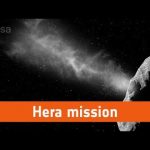
Hera is the European contribution to an ESA-NASA double-spacecraft mission intended to test whether a kinetic deflection technique can be used to shift the orbit of an asteroid. The target of the mission is a double asteroid system, called Didymos, which will come a comparatively close 11 million km to Earth in 2022. The 800-m diameter main body is orbited by a 170-m moon, informally called ‘Didymoon’.
In 2022 NASA’s DART spacecraft will first perform a kinetic impact on the smaller of the two bodies, then Hera will follow-up with a detailed post-impact survey that will turn this grand-scale experiment into a well-understood and repeatable planetary defence technique.
Hera will also gather crucial scientific data on asteroids as a whole by carefully studying the exterior and interior properties of both bodies in the system. The spacecraft will also host two 6-unit cubesats that will be deployed near Didymos to perform, for the first time ever, multi-point measurements in a “mother-daughter” configuration. A novel intersatellite link will be used to establish a flexible communications network supporting the close-proximity operations in very low-gravity conditions, a crucial step for future exploration activities around small bodies.
Hera, a further optimisation of ESA’s earlier proposed Asteroid Impact Mission, is currently in Phase B1 of mission development in preparation of the Agency’s Council of Ministers at European Level in late 2019.
Thomas Zurbuchen, associate administrator of NASA’s Science Mission Directorate, and John Mather, senior project scientist, comment on an independent review board’s findings on the agency’s James Webb Space Telescope. Webb is now targeting March 2021 as a new launch date, after the board assessed delays in integration and testing. NASA and the board unanimously agree that Webb can still achieve mission success.
NASA Administrator Jim Bridenstine discusses the findings of the Independent Review Board on one of our flagship missions, the James Webb Space Telescope. Despite Webb’s major challenges during the final testing and integration phase, the board and NASA unanimously agreed that Webb will achieve mission success with the implementation of the board’s recommendations, many of which are already underway.
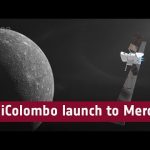
Enjoy this animation visualising BepiColombo’s launch and cruise to Mercury. Some aspects have been simplified for the purpose of this animation.
The joint ESA-JAXA mission comprises the European Mercury Planetary Orbiter and Japan’s Mercury Magnetospheric Orbiter, which will be transported to the innermost planet by the Mercury Transfer Module. The animation highlights several key milestones, including the solar array and antenna deployments once in space, through to the arrival at Mercury seven years later. When approaching Mercury, the transfer module will separate and the two science orbiters, still together, will be captured into orbit around the planet. Their altitude will be adjusted until the Magnetospheric Orbiter’s desired orbit is reached. Then the Planetary Orbiter will separate and descend to its lower orbit, and the two craft will begin their scientific exploration of Mercury and its environment.
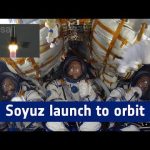
This unique video shows a full launch of the Soyuz MS-09: from liftoff to orbit.
Watch the launch from inside the crew capsule with first-ever shots from outside the spacecraft recorded by cameras fixed to the exterior of the Soyuz.
The intense launch lasts less than ten minutes whereby the Soyuz spacecraft is propelled 1640 km and gains 210 km altitude. Every second for nine minutes, the spacecraft accelerates 50 km/h on average as the rocket’s boosters burn their fuel and are discarded.
See the astronaut’s reactions and what the spacecraft looks like as the main steps are carried out to get into orbit:
-00:12 Launch command issued
-00:10 Engine turbopumps at flight speed
-00:05 Engines at maximum thrust
00:00 Launch
+1:54 Separation of emergency rescue system
+1:57 First stage separation
+2:38 Fairing separation
+4:48 Second stage separation
+4:58 Tail adapter separation
+8:45 Third stage engine cut off having arrived in orbit
+8:49 Soyuz separation, deploy solar arrays and antennae
The astronauts, from left to right, are NASA astronaut Serena Auñón-Chancellor, Roscosmos commander Sergei Prokopyev and ESA astronaut and flight engineer Alexander Gerst launched in the Soyuz MS-09 spacecraft from the Baikonur cosmodrome in Kazakhstan to the International Space Station on 6 June 2018. ESA astronaut Matthias Maurer and ESA television host Richard Hollingham provide commentary taken from the live event.
Hunched in their Sokol flight suits that offer protection in case of fire or depressurisation, the trio stay in the crew capsule of the Soyuz – the only module that is also designed to survive a return to Earth. The bags above their heads contain supplies for the International Space Station as every bit of space is used.
During a Soyuz launch astronauts typically experience forces of up to 4g – having to work while being pressed into their seats with a force that is four times more than the gravity felt on Earth. The Soyuz commander uses a stick to press buttons as they are too far away from the control panel.
The fluffy toys above the astronauts’ heads are mascots and good luck charms but also serve as a simple but effective test to see when the spacecraft is in orbit: when they start to float the spacecraft is weightless and orbiting Earth. Above Sergei is the mascot for the 2018 FIFA soccer World Cup held in Russia. Alexander took German children television icon “Die Maus” with him.
The launch went as planned as the 50-m tall Soyuz rocket propelled the astronauts to their cruising speed of around 28 800 km/h.
For this launch the astronauts took 34 orbits of Earth over two days to arrive at their destination spending their time in the cramped orbital module of the Soyuz that is no larger than a car. With limited communications and living space the astronauts had time to adapt to weightlessness and reflect on their mission ahead. They aligned their spacecraft with the International Space Station and approached the orbital outpost for docking on 8 June 2018. The files for this video were downloaded by the astronauts after arriving at the Space Station.
Alexander is a returning visitor to the International Space Station, the first of ESA’s 2009 class of astronauts to be sent into space for a second time. During the second part of his mission Alexander will take over as commander of the International Space Station, only the second time an ESA astronaut will take on this role so far.
Have you ever done a science experiment and wondered “What would this be like if it were HUGE?” Welcome to Science Max, the exciting new series that turbocharges all the science experiments you’ve done at home.
The third meeting of the National Space Council, seeking a partnership to power our Gateway, and – an educational activity that’s quite a blast … a few of the stories to tell you about – This Week at NASA!
This video is available for download from NASA’s Image and Video Library: https://images.nasa.gov/details-NHQ_2018_0622_Administrator%20Bridenstine%20Attends%20National%20Space%20Council%20Meeting%20on%20This%20Week%20@NASA%20%E2%80%93%20June%2022,%202018.html
The largest of Pluto’s five moons, Charon, was discovered on June 22, 1978, by James Christy and Robert Harrington at the U.S. Naval Observatory in Flagstaff, Arizona.
Read the story: https://www.nasa.gov/feature/charon-at-40-four-decades-of-discovery-on-pluto-s-largest-moon
Charon was discovered only about six miles from where Pluto itself was discovered at Lowell Observatory. They weren’t even looking for satellites of Pluto – Christy, examining a series of grainy telescope images, trying to refine Pluto’s orbit around the Sun.
Christy and others tell the story of this amazing scientific find, which fueled Pluto’s transformation from a telescopic dot into an actual planetary system – and a source of many discoveries to come.
Enjoy this compilation of with the last images taken by Rosetta’s high resolution OSIRIS camera during the mission’s final hours at Comet 67P/Churyumov-Gerasimenko. As it moved closer towards the surface it scanned across an ancient pit and sent back images showing what would become its final resting place.
Credits: Images: ESA/Rosetta/MPS for OSIRIS Team MPS/UPD/LAM/IAA/SSO/INTA/UPM/DASP/IDA – CC BY-SA 4.0
Image compilation: ESA–D. C. Jimeno and M. P. Ayucar
Astronauts on the International Space Station get food that’s chosen for nutritional value and specially prepared and packaged to be accessible on orbit. Could the same food feed the needs of people stuck on planet Earth? We conducted an experiment to find out how well two regular people could get by eating only astronaut food for a full week—a week that included a holiday weekend feast, just to up the difficulty factor. Could they resist the lure of their favorite foods? Take a look at how they fared…
Science Max – What makes boats float? Tinfoil doesn’t float, but a boat made of tinfoil does. It’s all about how you build it. Watch as Phil builds his human-sized tinfoil boat wrong several times before he figures it out. Plus, Phil gets into a tub full of the main ingredient in diapers. Why would he do such a thing? For Science!
Have you ever done a science experiment and wondered “What would this be like if it were HUGE?” Welcome to Science Max, the exciting new series that turbocharges all the science experiments you’ve done at home.
In season 1, join Phil as he builds rocket cars, uses elastic energy to hurl pumpkins on a giant catapult, builds a bridge out of pasta that can hold a human, find magnets powerful enough to float Phil off the ground, and many more experiments taken to the MAX!
LyreBird is an Artificial Intelligence that allows you to clone your voice.
00:03 This tiny room is the home to a startup called liar bird. It was founded by Yahshua’s former students and has built an APP that can clone your voice. Your speaking about this new algorithm to copy of voices is they can make a say anything really anything. One of its founders is this guy, Mexican expat Jose. He taught me the art of the club.
00:30 So you’ll need to record yourself for a few minutes of audio.
00:36 Thousands of letters danced across the amateur author screen. When you start to eat like this, something is the matter. You guys better quit politics and take in washing. I don’t know where that one came from.
00:52 Okay, so create my digital voice now. Creating a digital voice. It takes at least one minute. One minute. Oh my God. Yeah. So before to create some artificial voice of someone, you would need to record yourself or are at least eight hours. Test Your Voice. Alright, so now I get the types of things. Yeah, so the moment of the truth. Okay.
01:17 What’s layer birds? Ai has worked its magic. After I’m done
01:20 typing. Going to spell that out. Any words I put into the APP can be played back in my digital voice, and here’s the crazy thing,
01:30 even words I never actually said in the first place, artificial intelligence technology seems to be advancing very quickly. Should we be afraid? I mean I can definitely hear by voice in there. That’s. That is. That’s really interesting. I just picked those words at random and I definitely did not say some of them and it’s like flawless and being able to sort of pick from just about anywhere and manufacturer it.
01:56 Hello world is the best show I have ever seen.
02:02 This technology seemed sweet but lends itself to all manner of trickery. Have popped back to my hotel to test out the library and technology a little bit and you can see some really obvious ways that this could be abused. This is, this is fake. Donald Trump talking
02:25 United States is considering in addition to other options, stopping all trade with any country doing business with North Korea
02:32 and then you can picture of somebody taking over your voice and creating some mayhem in your personal life. Now to really put my computer voice to the test, I am going to call my dear, sweet mother and see if she recognizes me.
02:54 Hey Mom, where are you guys up to today when it’s shut that we didn’t have any electricity
03:00 early this morning and we’re just hanging around the house.
03:03 I’m just finishing up work and waiting for the boys to get home. Okay. I think I’m coming down with a virus.
03:11 Oh, well you feel bad. Hey,
03:15 I was messing around with you. You were talking to a computer.
03:18 I felt like I was talking to you. This mic.
03:22 Is that scary or are good?
03:24 It could be scary if it was something really important. I always knew that. I don’t know. It sounds like. Is it
03:42 after realizing that anyone with the time and inclination could mess with my life? It was only one thing left to do. I joined Hosea and a few other lyrebirds to chat more about the evils of Ai. Well, dulling my fear with food.
03:57 Obviously some people are freaked out by this technology because we’re already blurring the line about truth. In reality. Of course there is some risk in, in people using this kind of technology for better applications. Unfortunately, technologies, it’s not possible to stop it, so the ethical, but then we have this idea is to show these to people, to make them know that this kind of technology is available to make them more cautious, cautious on this kind of subject. We really believe that right now, when the technology is not perfect is the right time to let people play. They get used to it slowly so you guys think that the idea is just sort of knew and that’s why it scares people, but if you get used to it, it’s just that’s just the way it is. We want our technology to be used for, for positive things. It’s not something that we should be really afraid of. It’s something that we should be careful about, but I feel enthusiastic about.
05:02 It’s nice to be enthusiastic. It’s also nice to meditate on the consequences of your inventions instead of turning our souls over to chance and blind luck. It is kind of cool to be a cynical bastard in my new artismal computer voice.
************************************************************
Watch the Full video by Bloomberg here: (its really cool 😉
The flight will help to move the United States one step closer to normalizing unmanned aircraft operations in the airspace used by commercial and private pilots. The Ikhana aircraft is based at NASA’s Armstrong Flight Research Center in Edwards, California.
Discover more about our planet with the Earth from Space video programme. In this special edition, ESA’s Aeolus Project Manager, Anders Elfving, joins us in the cleanroom at Airbus Defence and Space in Toulouse, France, to talk about the challenges in developing the mission’s pioneering laser technology.
You’ve probably seen atoms like this emoji ⚛ everywhere from science textbooks to the logo for The Big Bang Theory. But what does an atom really look like? The truth is much stranger.
SUBSCRIBE: http://youtube.com/whatthephysics?sub
Science Max | MAGNETIC LEVITATION | Kids Science | Experiments
Magnets have poles – when you put opposite ones together, they attract. But when you but the same ones together, they repel. Could we find magnets powerful enough to repel each other and float Phil off the ground? Plus, watch magnets defy gravity all on their own.
Have you ever done a science experiment and wondered “What would this be like if it were HUGE?” Welcome to Science Max, the exciting new series that turbocharges all the science experiments you’ve done at home.
In season 1, join Phil as he builds rocket cars, uses elastic energy to hurl pumpkins on a giant catapult, builds a bridge out of pasta that can hold a human, find magnets powerful enough to float Phil off the ground, and many more experiments taken to the MAX!
A new crew aboard the space station, Curiosity rover’s new science findings on Mars, and – Celebrating 60 years of NASA … a few of the stories to tell you about – This Week at NASA!
This video is available for download from NASA’s Image and Video Library: https://images.nasa.gov/details-NHQ_2018_0608_Curiosity%E2%80%99s%20New%20Mars%20Science%20Results%20on%20This%20Week%20@NASA%20%E2%80%93%20June%208,%202018.html
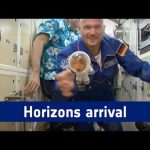
After orbiting Earth 34 times to catch up to the International Space Station, the car-sized spacecraft carrying ESA astronaut Alexander Gerst, NASA astronaut Serena Auñón-Chancellor and Roscosmos commander Sergei Prokopyev, arrived at the Station two days after launch.
The German astronaut is a returning visitor to the International Space Station, the first of ESA’s 2009 class of astronauts to be sent into space for a second time. During the second part of his mission Alexander will take over as commander of the International Space Station, only the second time an ESA astronaut will take on this role so far.
The mission is called Horizons as a symbol for the unknown and what lies beyond – reflecting on ESA’s strategy to extend human and robotic exploration beyond Earth orbit. While in space, Alexander will work on over 50 European experiments, including testing ways of operating and working with robots to develop techniques required for further human and robotic exploration of our Solar System.
The National Symphony Orchestra Pops and the John F. Kennedy Center for the Preforming Arts hosted a celebration for NASA’s 60th Anniversary June 1, 2018.
This video is available for download from NASA’s Image and Video Library: https://images.nasa.gov/details-NHQ_2018_0606_The%20National%20Symphony%20Orchestra%20Pops%20Celebrates%20NASA%E2%80%99s%2060th%20Anniversary.html
Prof. Shoucheng Zhang discusses three pillars of information technology: quantum computing, AI and blockchain. He presents the fundamentals of crypto-economic science, and answers questions such as: What is the intrinsic value of a medium of exchange? What is the value of consensus and how does it emerge? How can math be used to create distributed self-organizing consensus networks to create a data-marketplace for AI and machine learning?
Prof. Zhang is the JG Jackson and CJ Wood professor of physics at Stanford University. He is a member of the US National Academy of Science, the American Academy of Arts and Sciences and a foreign member of the Chinese Academy of Sciences. He discovered a new state of matter called topological insulator in which electrons can conduct along the edge without dissipation, enabling a new generation of electronic devices with much lower power consumption. For this ground breaking work he received numerous international awards, including the Buckley Prize, the Dirac Medal and Prize, the Europhysics Prize, the Physics Frontiers Prize and the Benjamin Franklin Medal.
He is also the founding chairman of DHVC venture capital fund, which invests in AI, blockchain, mobile internet, big data, AR/VR, genomics and precision medicine, sharing economy and robotics.










![Artificial Intelligence Can Clone Any Voice, Yours Too [ LyreBird ]](https://video.kidibot.ro/wp-content/uploads/2020/01/1544/artificial-intelligence-can-clone-any-voice-yours-too-lyrebird-150x150.jpg)