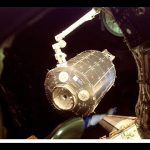
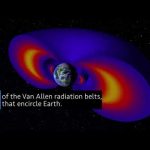
A safe return from the International Space Station, a new weather satellite launched into orbit, and our next mission to Mars moves closer to launch … a few of the stories to tell you about – This Week at NASA!
This video is available for download from NASA’s Image and Video Library: https://images.nasa.gov/details-NHQ_2018_0305_Space%20Station%20Crew%20Returns%20Safely%20on%20This%20Week%20@NASA%20%E2%80%93%20March%205,%202018.html
Have you ever done a science experiment and wondered “What would this be like if it were HUGE?” Welcome to Science Max, the exciting new series that turbocharges all the science experiments you’ve done at home.
Mohamad Jebara loves mathematics — but he’s concerned that too many students grow up thinking that this beautiful, rewarding subject is difficult and boring. His company is experimenting with a bold idea: paying students for completing weekly math homework. He explores the ethics of this model and how it’s helping students — and why learning math is crucial in the era of fake news.
The TED Talks channel features the best talks and performances from the TED Conference, where the world’s leading thinkers and doers give the talk of their lives in 18 minutes (or less). Look for talks on Technology, Entertainment and Design — plus science, business, global issues, the arts and more.
This evidence seems to suggest that the dark matter is particles that are less than four times the mass of a proton and are moving at non-relativistic speeds. This is consistent with dark matter particles being so-called WIMPs: https://en.wikipedia.org/wiki/Weakly_interacting_massive_particles.
Located in Frascati, Italy, ESRIN – known as the ESA Centre for Earth Observation – is one of the five ESA specialised centres situated in Europe. The mission and payload operations of ESA’s Earth observation satellites are managed here and ESRIN is the primary source for the acquisition, distribution and exploitation of data from these and other non-ESA satellites.Within ESRIN, a key role in Europe’s space effort has been undertaken with the development of the new small launcher, Vega, which took its maiden voyage in February 2012. ESRIN designs and develops all ESA-wide software for corporate applications and is responsible for developing security measures for classified space programmes. The European Centre for Space Records (ECSR) is also based at ESRIN. The ECSR appraises and preserves the valuable technical records of completed ESA projects together with their management archives to safeguard this valuable knowledge for generations to come.Finally, ESRIN is home to ESA’s Near-Earth Object Coordination Centre. The centre serves as the central access point to a network of European near-Earth object data sources and information providers being established under ESA’s Space Situational Awareness (SSA) Programme.For more information, visit the ESRIN site.
Located in Frascati, Italy, ESRIN – known as the ESA Centre for Earth Observation – is one of the five ESA specialised centres situated in Europe. The mission and payload operations of ESA’s Earth observation satellites are managed here and ESRIN is the primary source for the acquisition, distribution and exploitation of data from these and other non-ESA satellites.Within ESRIN, a key role in Europe’s space effort has been undertaken with the development of the new small launcher, Vega, which took its maiden voyage in February 2012. ESRIN designs and develops all ESA-wide software for corporate applications and is responsible for developing security measures for classified space programmes. The European Centre for Space Records (ECSR) is also based at ESRIN. The ECSR appraises and preserves the valuable technical records of completed ESA projects together with their management archives to safeguard this valuable knowledge for generations to come.Finally, ESRIN is home to ESA’s Near-Earth Object Coordination Centre. The centre serves as the central access point to a network of European near-Earth object data sources and information providers being established under ESA’s Space Situational Awareness (SSA) Programme.For more information, visit the ESRIN site.
Is String Theory the final solution for all of physic’s questions or an overhyped dead end?
This video was realised with the help of Dr. Alessandro Sfondrini and it was funded by SNSF under Agora Grant n. 171622 and through the NCCR SwissMAP: The Mathematics of Physics.
🐦🐧🐤 PATREON BIRD ARMY 🐤🐧🐦
▀▀▀▀▀▀▀▀▀▀▀▀▀▀▀▀▀▀▀▀▀▀▀▀▀▀
Many Thanks to our wonderful Patreons from http://kgs.link/patreon who support us every month and made this video possible:
Flavio Storino, Alice Balcon, Hari Krishnan, Warren Wiscombe, Sara Zeglin, Asiryan Alexander, maarten sprengers, William Northern, Kerem Mimaroglu, Yana Kultysheva, Josh, Keaton Anderson, Croconaw, Peter Steinberger, Jonathan Diamond, Troy McConaghy, Paddy, Darko Sperac, Peter Burkhalter, Chris Amaris, Tyler Lovell, John Ruble, Chase Henson, Arpita Singh, Edward C.P., Andreas Edlund, Ryan Bubinski, Paul Greyson, Jerry Ding, Austin Sundquist, Daniel Link, Tim Johnson, kayleigh dreste, Johan Sjöblom, Max Stuart, Mush Rain, Andor Baranyi, Eduardas Afanasjevas, Bill Clem, Jake Smith, Stephen Woerner, Jeff Sorensen, Christopher Damsgaard, Eduardo AV, Michael Gawenka, Florian Hoedt, Lucas Nyman, Nathanael Baker, Martin Wierzyk, Mauricio Streb, Karl, Rameet Chawla, Joachim Andersen, Avinash, Erik Golden, Glenn Stoltz, Elliott Nelson, Andrew Averett, Ben Wei
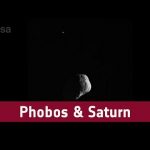
These observations of Phobos and Saturn were taken by the Super Resolution Channel of the High Resolution Stereo Camera on Mars Express. The video comprises 30 separate images acquired during Mars Express orbit 16 346 on 26 November 2016. The slight up and down movement of Saturn and Phobos in these images is caused by the oscillation of the spacecraft’s orientation after completing the turn towards the moon. Phobos can be seen in the foreground, partially illuminated, with Saturn visible as a small ringed dot in the distance. For more information go tohttp://www.esa.int/Our_Activities/Space_Science/Mars_Express/Mars_Express_views_moons_set_against_Saturn_s_rings
Have you ever done a science experiment and wondered “What would this be like if it were HUGE?” Welcome to Science Max, the exciting new series that turbocharges all the science experiments you’ve done at home.
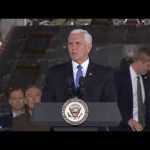
Vice President Mike Pence led the second meeting of the National Space Council, Next Space Station Crew Trains for Launch, and Webb Telescope to Reveal Secrets of Mars … a few of the stories to tell you about – This Week at NASA!
This video is available for download from NASA’s Image and Video Library: https://images.nasa.gov/details-NHQ_2018_0223_The%20Second%20Meeting%20of%20the%20National%20Space%20Council%20on%20This%20Week%20@NASA%20%E2%80%93%20February%2023,%202018.html
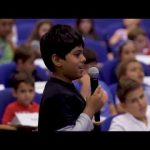
On September 11, 2017, the Deming Center at Columbia Business School partnered with the School for Engineering and Applied Science to host an event on Artificial Intelligence just for the children of faculty, staff and friends of the Center. More than 50 kids ages 6 to 16 gathered to hear Professor of Mechanical Engineering and Director of the Creative Machines Lab Hod Lipson speak to the past, present and future of AI.
Impressing on them that their lives would be profoundly impacted by advances in AI and Machine Learning, Professor Lipson took the children on a journey through the history of the field, bringing them up to speed on the incredible advances of the last 50 years. He then explored all of the ways in which AI is being used today from simply playing a game of Tic Tac Toe and painting portraits to diagnosing diseases and synthesizing the vast amounts of data being generated by computers, algorithms and images that affect our daily lives. They then turned their attention to all of the ways in which AI would permeate their lives in the near future from driverless cars to robotic traffic police.
The children asked creative, probing questions throughout compelling the adults in the room to think outside-of-the-box and consider the deep nuances their questions asked. From 6-year old Aziz who was curious as to whether Artificial Intelligence can exist in water to 12-year old Christina’s question about how AI will affect terrorism and war in the future, children and parents alike were left with a sense of wonder and excitement about the future.
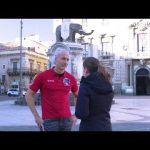
From ESA astronaut Luca Parmitano’s hometown in Catania, Italy, Luca talks about the science he ran on the International Space Station.
The European laboratory Columbus was launched in 2008 and offers scientists a permanent place in space to conduct research that is out of this world.
Luca’s first spaceflight was in 2013 with Russian cosmonaut Fyodor Yurchikhin and NASA astronaut Karen Nyberg. He conducted over 20 experiments during the Volare mission as flight engineer for Expeditions 36 and 37 and he was the first of ESA’s new generation of astronauts to fly into space.
Luca talks about space research, being a human guinea pig, dieting to avoid bone disease osteoporosis, human physiology, using ultrasound remotely to diagnose back problems, measuring eye pressure and how his body and mind reacted to living in weightlessness.
Luca is set for a second mission to the International Space Station in 2019.
A Euronews esteve em Huelva, onde conheceu o Rio Tinto, cujas margens e sedimentos se parecem em todos os aspetos aos do Planeta Vermelho. Um grupo de cientistas procura sinais de vida noutros planetas do nosso sistema solar. E fazem-no com a recolha de amostras dos lugares mais inesperados.
The Rio Tinto river snakes through the Spanish countryside for 100 kilometres, a dark, blood-red stain of acid water and rusty-looking rocks that scientists love to study. Both ESA and NASA experts regularly spend weeks in the Rio Tinto, examining the life underground, and using it as a test bed to look for life on Mars.
NASA’s Kennedy Space Center in Florida hosted a meeting of the National Space Council, chaired by Vice President Mike Pence on Wednesday, Feb. 21. This was the second meeting of the council, which President Trump reestablished last year. “Moon, Mars, and Worlds Beyond: Winning the Next Frontier” included testimonials from leaders in the civil, commercial, and national security sectors about the importance of the United States’ space enterprise.
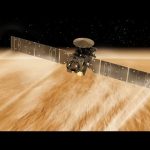
Since arriving at Mars in October 2016, the ExoMars Trace Gas Orbiter has been aerobraking its way into a close orbit of the Red Planet by using the top of the atmosphere to create drag and slow down. It is almost in the right orbit to begin observations – only a few hundred kilometres to go! With aerobraking complete, additional manoeuvres will bring the craft into a near-circular two-hour orbit, about 400 km above the planet, by the end of April. The mission’s main goal is to take a detailed inventory of the atmosphere, sniffing out gases like methane, which may be an indicator of active geological or biological activity. The camera will help to identify surface features that may be related to gas emissions. The spacecraft will also look for water-ice hidden below the surface, which could influence the choice of landing sites for future exploration. It will also relay large volumes of science data from NASA’s rovers on the surface back to Earth and from the ESA–Roscosmos ExoMars rover, which is planned for launch in 2020.
ESA’s Earth Explorer Aeolus satellite will be launched later this year to measure the world’s winds from space. The satellite carries one of the most sophisticated instruments ever to be put into orbit: Aladin, which includes two powerful lasers, a large telescope and very sensitive receivers. The laser generates ultraviolet light that is beamed down into the atmosphere to profile the world’s winds – a completely new approach to measuring the wind from space. These vertical slices through the atmosphere, along with information it gathers on aerosols and clouds, will improve our understanding of atmospheric dynamics and contribute to climate research. As well as advancing science, Aeolus will play an important role in improving weather forecasts. The mission will also complement information about the atmosphere being provided by the Copernicus Sentinel missions.
The Future is Here and It’s Ready to Play
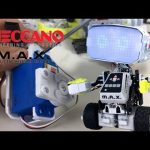
Meet M.A.X., a 12-inch tall advanced robot packed with a multitude of fun, educational features. Designed for budding engineers and tinkerers aged 10 years and older, this robot-building kit offers a challenging yet rewarding build consisting of 332 parts. Once he’s assembled, M.A.X. functions as a friendly robot companion and personal assistant. He engages kids in conversation, learns from every interaction, remembers important dates, and more. He even features a built-in gaming platform. Customizable programming allows kids to personalize M.A.X. to meet their own specifications so that every assembled M.A.X. robot is truly one of a kind. And like all Meccano kits, M.A.X. can be reassembled into a huge variety of other robotics toys.
A Meccano unboxing, demo and review by Keith’s Toy Box.
A toy review by Keith’s Toy Box, a magical bottomless toy box that reveals a new surprise toy everyday! Enjoy kid-friendly videos for babies, infants, toddlers, pre-school and primary school children. Watch unboxing, exciting demos, in slow motion, and time lapse, and play with these tried and tested toys from Hot Wheels, Thomas, Chuggington, Mega Bloks, Lego, Duplo, to Takara, Tomy, Tomica, Plarail, Disney Toys, Pixar Disney Cars, and Sesame Street! Great toy reviews for toy collectors young and old alike.
The European Space Agency (ESA) is part of an international effort to monitor and – ultimately – tackle space debris. This junk – accumulated in orbit since the dawn of the space age sixty years ago – poses an increasing risk to operational spacecraft.
ESA is developing missions to tackle the problem to help prevent a serious collision in space. The Agency is also monitoring possible dangers caused by fragments of redundant spacecraft falling to Earth, such as China’s space station Tiangong-1 – due to enter the atmosphere in the coming months.
Have you ever done a science experiment and wondered “What would this be like if it were HUGE?” Welcome to Science Max, the exciting new series that turbocharges all the science experiments you’ve done at home.
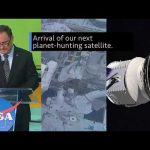
The Fiscal Year 2019 budget and the State of NASA, astronauts at work outside the International Space Station, and the arrival of our next planet-hunting satellite … a few of the stories to tell you about – This Week at NASA!
This video is available for download from NASA’s Image and Video Library: https://images.nasa.gov/details-NHQ_2018_0216_A%20Strong%20State%20of%20NASA%20on%20This%20Week%20@NASA%20%E2%80%93%20February%2016,%202018.html
On Feb. 12, NASA centers across the country hosted “State of NASA” events, following President Trump’s Fiscal Year 2019 budget proposal delivery to the U.S. Congress. The events included an address, by acting NASA Administrator Robert Lightfoot, to the agency’s workforce, from NASA’s Marshall Space Flight Center, in Huntsville, Alabama. During his speech, Lightfoot highlighted how the budget would help the agency achieve its goals for space exploration.
This Machine Learning tutorial video is ideal for beginners to learn Machine Learning from scratch. By the end of this tutorial video, you will learn why Machine Learning is so important in our lives, what is Machine Learning, the various types of Machine Learning (Supervised, Unsupervised and Reinforcement learning), how do we choose the right Machine Learning solution, what are the different Machine Learning algorithms and how do they work (with simple examples and use-cases) and finally implement a Machine Learning project/ hands-on demo on Linear Regression Algorithm using Python.
This Machine Learning tutorial will cover the following topics:
1. Life without Machine Learning ( 01:06 )
2. Life with Machine Learning ( 02:29 )
3. What is Machine Learning ( 04:35 )
4. Machine Learning Process ( 05:27 )
5. Types of Machine Learning ( 06:14 )
6. Supervised Vs Unsupervised ( 09:32 )
7. The right Machine Learning solutions ( 10:35 )
8. Machine Learning Algorithms ( 13:33 )
9. Use case – Predicting the price of a house using Linear Regression ( 23:24 )
What is Machine Learning: Machine Learning is an application of Artificial Intelligence (AI) that provides systems the ability to automatically learn and improve from experience without being explicitly programmed.
A form of artificial intelligence, Machine Learning is revolutionizing the world of computing as well as all people’s digital interactions. Machine Learning powers such innovative automated technologies as recommendation engines, facial recognition, fraud protection and even self-driving cars.
– – – – – – –
Why learn Machine Learning?
Machine Learning is taking over the world- and with that, there is a growing need among companies for professionals to know the ins and outs of Machine Learning
The Machine Learning market size is expected to grow from USD 1.03 Billion in 2016 to USD 8.81 Billion by 2022, at a Compound Annual Growth Rate (CAGR) of 44.1% during the forecast period.
– – – – – –
What skills will you learn from this Machine Learning course?
By the end of this Machine Learning course, you will be able to:
1. Master the concepts of supervised, unsupervised and reinforcement learning concepts and modeling.
2. Gain practical mastery over principles, algorithms, and applications of Machine Learning through a hands-on approach which includes working on 28 projects and one capstone project.
3. Acquire thorough knowledge of the mathematical and heuristic aspects of Machine Learning.
– – – – – – –
Who should take this Machine Learning Training Course?
We recommend this Machine Learning training course for the following professionals in particular:
1. Developers aspiring to be a data scientist or Machine Learning engineer
2. Information architects who want to gain expertise in Machine Learning algorithms
3. Analytics professionals who want to work in Machine Learning or artificial intelligence
4. Graduates looking to build a career in data science and Machine Learning
On Feb. 12, NASA centers across the country hosted “State of NASA” events, following President Trump’s Fiscal Year 2019 budget proposal delivery to the U.S. Congress. The events included an address, by acting NASA Administrator Robert Lightfoot, to the agency’s workforce, from NASA’s Marshall Space Flight Center, in Huntsville, Alabama. During his speech, Lightfoot highlighted how the budget would help the agency achieve its goals for space exploration.
This video is available for download from NASA’s Image and Video Library: https://images.nasa.gov/details-NHQ_2018_0212_Annual%20’State%20of%20NASA’%20Speech%20to%20Highlight%20Agency%20Goals%20for%20Space%20Exploration.html
With innovative technology such as artificial intelligence and mixed reality, we have more power at our fingertips than entire generations that came before us. Yet, technology is just a tool, and a tool is only as useful as the person who wields it. We’re celebrating individuals and organizations using Microsoft technology to change lives, inspiring us all to see the possibility within emerging technologies.
Have you ever done a science experiment and wondered “What would this be like if it were HUGE?” Welcome to Science Max, the exciting new series that turbocharges all the science experiments you’ve done at home.
Ginevra Favole is an ESAC research fellow working on the large-scale structures of the universe. Her main scientific field is emission-line galaxies, galaxy clustering and weak gravitational lensing. She also works with mock catalogues and N-body cosmological simulations.
Maggie Lieu is an ESAC research fellow working on Euclid, a visible and near-infrared space telescope due to launch in 2021. By measuring the shapes of distant galaxies we can determine the mass of the largest systems in the Universe, galaxy clusters. Euclid will achieve unprecedented shape measurements of galaxies covering almost half of the extragalactic sky.Maggie is developing statistical methods to deal with this upcoming big, noisy dataset, so that we can better understand the physics of galaxy clusters and theirrolein the Dark Universe.
On 7 February 2018, 10 years to the day that Europe’s Columbus space laboratory was launched to the International Space Station, 20 lucky clubbers got a taste of weightlessness – not to conduct gravity-free science but to party with superstar DJs Steve Aoki, W&W and Le Shuuk.
Taking off from Frankfurt airport and organised by BigCityBeats, the WORLD CLUB DOME project served as a teaser party for a bigger event on Earth in June. The aircraft flew up and down angled at 45º – at the top of the curve the passengers and experiments experience around 20 seconds of microgravity. Before and after the weightless period, increased gravity of up to 2 g is part of the ride.
ESA astronauts Pedro Duque and Jean-Francois Clervoy joined the weightless flight and provided background and safety tips to the DJs and party-goers.
The aircraft was on loan from its usual airport in Bordeaux, France, where it is used for scientific research and testing equipment for spaceflight. These flights are the only way to test microgravity with humans without going through lengthy astronaut-training and flights to the International Space Station. For this reason, parabolic flights are often used to validate space instruments and train astronauts before spaceflight.
ESA’s parabolic flight campaigns for science and technology investigations are generally performed twice a year, in spring and autumn.
ESA, Fraport Frankfurt and the City of Frankfurt and BigCityBeats combined a fascination of science with the joy and fun of dancing in this world’s-first flight.
This event was the official pre-party to the BigCityBeats WORLD CLUB DOME “The Hollywood Edition” taking place 1/2/3 June 2018 in Frankfurt. More info via http://www.worldclubdome.com
We did something a little different in this episode and answered questions from you, our viewers. If you have a questions about the universe, past videos, or life as a scientist, leave a comment below!
Looking at a decade of European science on the International Space Station with the Columbus laboratory.
Columbus houses as many disciplines as possible in a small volume, from astrobiology to solar science through metallurgy and psychology – more than 227 experiments have been carried out during this remarkable decade. Countless papers have been published drawing conclusions from experiments performed in Columbus.
From circadian rhythms and new temperature sensors to edible algae as astronaut food through running experiments to grow crystals and investigate processes in a pure environment without gravity interfering with the process – Columbus helping scientists push the boundaries of what is possible and increase our knowledge for life on Earth.
From building to liftoff and installation, these images show the making of European space lab Columbus and its daily use for out-of-this-world research.
Like the transatlantic voyages that Christopher Columbus made half a millennium ago, the Columbus module was meticulously planned, budgeted, scrapped and redesigned before getting the official blessing to build, ship and launch.
The laboratory ascended to orbit aboard Space Shuttle Atlantis from the Kennedy Space Center in Florida, USA on 7 February 2008. Nestling in the spaceplane’s cargo bay, Columbus was accompanied by a seven-man crew.
On 11 February, the crew on the International Space Station captured the new arrival. At that moment, Columbus became Europe’s first permanent human outpost in orbit and Europe became a full partner of the International Space Station.
Columbus houses as many disciplines as possible in a small volume, from astrobiology to solar science through metallurgy and psychology – more than 225 experiments have been carried out during this remarkable decade. Countless papers have been published drawing conclusions from experiments performed in Columbus.
ESA astronaut Andreas Mogensen narrates this re-edited video on the inspiring endeavours of human spaceflight and how it changes our daily lives.
Andreas covers the first flight in Earth-orbit and the permanent inhabitation of space on the International Space Station to future exploration of our Solar System – and how these events inspired his work as an engineer and later astronaut.
The video touches on the amazing research done in space and for space and the technological impact this has making life on Earth better.
On 7 February 2008, Space Shuttle Atlantis launched to the International Space Station. In its cargo bay, ESA’s laboratory module Columbus. Now for adecade Columbus has been a part of the ISS. It is the place where ESA astronauts have done countless experiments in microgravity and the scientific importance of the module can hardly be overstated.
Have you ever done a science experiment and wondered “What would this be like if it were HUGE?” Welcome to Science Max, the exciting new series that turbocharges all the science experiments you’ve done at home.
Super Blue Blood Moon – a rare triple treat up in the sky, celebrating America’s first explorer in space, and smoke and fire – another Space Launch System engine test … a few of the stories to tell you about – This Week at NASA!
Earth from Space is presented by Kelsea Brennan-Wessels from the ESA Web-TV virtual studios. In this edition, Sentinel-2 takes us over Tunisia’s capital Tunis and surrounding wetlands.