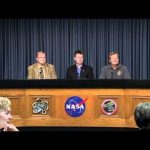
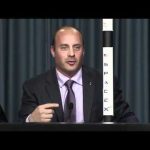
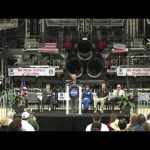
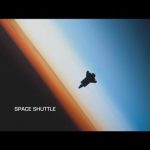
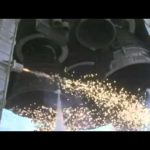
Briefing held at NASA’s Kennedy Space Center on Sunday, May 1, during which shuttle program officials outline work remaining to resolve an electronics problem that scrubbed Friday’s launch try. A new date for space shuttle Endeavour’s launch on STS-134 has not yet been set.
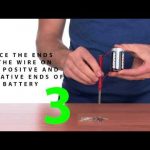
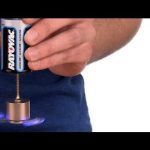
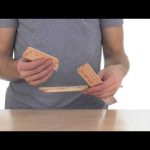
When it comes to creating something out of nothing, Steve Spangler takes the cake. The Steve Spangler Science team recently challenged Steve to create a simple homopolar motor by using objects that he could find around his home. The trick to homopolar motors is the use of electromagnets and a lack of polarity change. It’s complicated, so we were sure that Steve would have trouble. Much to the surprise of everyone, Steve not only accomplished the (what we thought to be) impossible, but he did it twice. Steve was so proud that he wanted to give both of his designs to you. It’s a Sick Science 2-for-1 with the Electromagnetic Motor.
When it comes to creating something out of nothing, Steve Spangler takes the cake. The Steve Spangler Science team recently challenged Steve to create a simple homopolar motor by using objects that he could find around his home. The trick to homopolar motors is the use of electromagnets and a lack of polarity change. It’s complicated, so we were sure that Steve would have trouble. Much to the surprise of everyone, Steve not only accomplished the (what we thought to be) impossible, but he did it twice. Steve was so proud that he wanted to give both of his designs to you. It’s a Sick Science 2-for-1 with the Electromagnetic Motor.
A briefing at the Kennedy Space Center details NASA’s recent awards of more than $269 million for the continued development of commercial transportation systems to carry astronauts to and from low-Earth orbit. Four U.S. companies received the awards in the second round of NASA’s Commercial Crew Development, or CCDev, effort. Commercial crew transport will free NASA to concentrate on developing and building new technologies for human exploration beyond low-Earth orbit.
Launched on 17 March 2009, ESA’s Gravity field and steady-state Ocean Circulation Explorer (GOCE) is bringing about a whole new level of understanding of one of Earth’s most fundamental forces of nature: the gravity field. Dubbed the ‘Formula 1’ of satellites, GOCE is mapping Earth’s gravity field in unprecedented detail.
This has given rise to a unique model of the ‘geoid’, which is the surface of an hypothetical global ocean in the absence of tides and currents, shaped only by gravity. It is a crucial reference for measuring ocean circulation and sea-level change, which are affected by climate change.
The colours in the image represent deviations in height ( -100 m to + 100 m) from an ideal geoid. The blue colours represent low values and the reds/yellows represent high values.
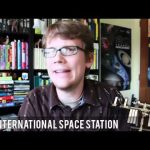
Contemplating the ritual of sending Washington a check every April 15, popular Internet vlogger Hank Green of Vlogbrothers explains why he believes NASA is worth every .45 penny of your hard-earned tax dollar.
What happens when you have a build-up of gas? Don’t answer that question! The gas in question is carbon dioxide and the explosion is nothing short of fun. Warning: It’s impossible to do this activity just once. It is addicting and habit-forming. Proceed at your own risk!
April 29 is the official launch date for space shuttle Endeavour on STS-134. That announcement came at the conclusion of the mission’s Flight Readiness Review, where shuttle managers expressed satisfaction with the preparations for the program’s next-to-last flight. Launch is scheduled for 3:47 p.m. Eastern. Also, developing new ways to low-Earth orbit; putting the freeze on Webb’s mirror; Hubble turns 21; NASA’s Earth Day; soaring student rockets; do the Logo Motion; and Yuri’s Night at Langley.
En nuestros días el GPS es una herramienta muy útil. Los europeos han querido afinar su pecisión desarrollando el sistema EGNOS, precursor de la Constelación Galileo. En esta edición de “Space” podrá descubrir cómo funciona la navegación por satélite y sus aplicaciones.
Ai giorni nostri il GPS è uno strumento familiare e molto utile. Gli europei hanno voluto perfezionare la sua precisione sviluppando il sistema EGNOS, precursore della costellazione Galileo. La navigazione satellitare e le sue applicazioni in questa edizione di Space.
Heutzutage ist das GPS ein sehr nützliches Werkzeug, das aus dem Alltag nicht mehr wegzudenken ist. Mit dem System Egnos, Vorreiter der Satelliten-Konstellation Galileo, wollen die Europäer seine Treffsicherheit erhöhen. Die Satelliten-Navigation und ihre Anwendungen in dieser Ausgabe von “Space”.
Today GPS is a common and extremely useful tool. Europeans wanted to refine its accuracy by developing EGNOS, the precursor of the Galileo constellation. We look at satellite navigation and its applications.
This experiment answers the age-old question, “Which came first, the rubber egg or the rubber chicken?” It’s easy to make a rubber egg if you understand the chemistry of removing the eggshell with vinegar. What you’re left with is a totally embarrassed naked egg and a cool piece of science.
It’s probably not a wise idea to soak a $20 bill in a flammable liquid and set it on fire, but that’s what you’ll have to do with this science demonstration. Sure, you could use just a $1 bill, but then you don’t sweat as much. There is a point to all of this burning… it’s the fact that to everyone’s amazement, paper money never actually burns (if you do it correctly). Read on to discover the secret behind this amazing demonstration.
On the anniversary of the first space shuttle flight, NASA Administrator Charles Bolden joined Kennedy Space Center Director Bob Cabana, and STS-1 shuttle pilot Robert Crippen to pay tribute to the space shuttle era at the KSC in Florida. During the event, Bolden named the four institutions that will receive a shuttle orbiter for permanent display.
An idea born in unsettled times becomes a feat of engineering excellence. The most complex machine ever built to bring humans to and from space and eventually construct the next stop on the road to space exploration.
Esta semana, há 50 anos, pela primeira vez na história da humanidade, um homem deixou a Terra e viajou para o Espaço. Quem foi Yuri Gagarin? Como é que aquele voo mudou a sua vida e a da humanidade?
Hace 50 años, por primera vez en la historia, un hombre viajó al espacio. ¿Quién era Yuri Gagarin? ¿Cómo fue el vuelo que cambió su vida y el devenir de la humanidad?
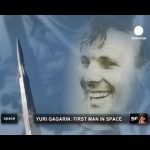
50 years ago, for the first time in history, a human travelled into space. Who was Yuri Gagarin ? How did this flight change his life and the future of humankind?
We’ve taught you the water absorbing secret behind the polymer inside diapers, but did you know that a Diaper Genie bag is a great way to demonstrate some properties of air? That’s right! That plastic smell-shield isn’t just for odor defense any longer. Now you can use the thin plastic bag to show Bernoulli’s Principle and amaze your friends.
NASA has re-targeted the liftoff of space shuttle Endeavour for Friday, April 29, at 3:47 p.m. EDT. The move comes to resolve a scheduling conflict with a Russian Progress supply vehicle scheduled to launch April 27 and arrive at the station two days later. Also, Goddard Memorial Symposium; “Wheels” rolls with big Shorty; cost-saving software summit; two honors for Ames; and, marking Odyssey’s beginning.
The Soyuz TMA-21 spacecraft and its booster and were moved to the launch pad at the Baikonur Cosmodrome in Kazakhstan on a railcar April 2 for final preparations before launch April 5, Baiknour time, to the International Space Station. The Soyuz will carry Expedition 27 Soyuz Commander Alexander Samokutyaev, NASA Flight Engineer Ron Garan and Russian Flight Engineer Andrey Borisenko to the complex. The trio will spend six months on the station, joining station Commander Dmitry Kondratyev, NASA Flight Engineer Cady Coleman and European Space Agency Flight Engineer Paolo Nespoli, who have been in orbit since December 2010. Samokutyaev, Garan and Borisenko are in final training for launch with their backups, Anatoly Ivanishin, Dan Burbank and Anton Shkaplerov. The footage includes interviews with Astronaut Nicole Stott, STS-133 Mission Specialist, and with Mike Lopez-Alegria, Deputy Director for ISS, NASA Flight Crew Operations.
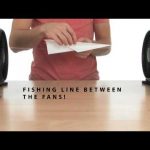
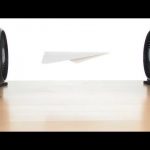
APRIL FOOL’S! A few days ago we posted a video showing a paper airplane hovering between two fans. This is not actually possible without the help of a little fishing line. We thought why not have some fun around April Fool’s Day and see how many people we could trick.
We don’t know if the Wright Brothers ever made the attempt, but Steve Spangler has defied the odds to create a hovering airplane. We don’t suggest any passengers (because they wouldn’t fit), but this Floating Paper Plane is a great hands-on science tool for teaching the science behind airplanes, lift and drag, and principles of air.
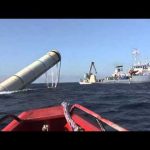
NASA has released the first ever up-close, high-definition video of Kennedy Space Center’s solid rocket booster (SRB) recovery ships retrieving SRB segments from the Atlantic Ocean following a space shuttle launch. The unprecedented video is from the launch of the most recent shuttle mission, STS-133, Discovery’s final flight, on Feb. 24.
Following each space shuttle launch, crew members of Liberty Star and Freedom Star pull the spent boosters out of the ocean and return them to Hangar AF at Cape Canaveral Air Force Station in Florida. Once they are processed, the boosters are transported to Utah, where they are refurbished and stored, if needed.
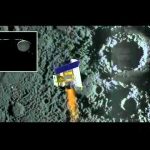
NASA’s MErcury Surface, Space ENvironment, Geochemistry, and Ranging, or MESSENGER spacecraft successfully achieved orbit around Mercury at approximately 9 p.m. EDT Thursday. This marks the first time a spacecraft has accomplished this engineering and scientific milestone at our solar system’s innermost planet. Shown is reaction in MESSENGER mission control at the Johns Hopkins University Applied Physics Laboratory in Laurel, Md., as engineers received telemetry data confirming orbit insertion, plus animated depiction of the event. Among other goals, MESSENGER is expected to detect whether ice exists at Mercury’s poles.
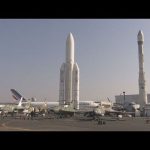
Ariane 5, la punta de lanza de la industria europea de cohetes espaciales, lidera el mercado de lanzadores comerciales. En breve, otros cohetes se le unirán para completar la oferta europea, haciendo de 2011 el año de los lanzadores espaciales europeos
Ariane 5, the European space industry’s workhorse, continues to successfully carry payloads into orbit. Two new launchers will soon complement Ariane 5, offering a full range of competitive services to Europe. 2011 will be the year of the launchers.
After more than a dozen laps through the inner solar system, NASA’s MESSENGER spacecraft will move into orbit around Mercury on March 17, 2011. The durable spacecraft — carrying seven science instruments and fortified against the blistering environs near the sun — will be the first to orbit the innermost planet. At 8:45 p.m. EDT, MESSENGER — having pointed its largest thruster very close to the direction of travel — will fire that thruster for nearly 14 minutes, with other thrusters firing for an additional minute, slowing the spacecraft by 862 meters per second (1,929 mph). The orbit insertion will place the spacecraft into a 12 hour orbit about Mercury with a 200 kilometer (124 mile) minimum altitude. At the time of orbit insertion, MESSENGER will be 46.14 million kilometers (28.67 million miles) from the sun and 155.06 million kilometers (96.35 million miles) from Earth. MESSENGER has been on a 6.6 year mission to become the first spacecraft to orbit Mercury. The spacecraft followed a path through the inner solar system, including one flyby of Earth, two flybys of Venus, and three flybys of Mercury. This impressive journey is returning the first new spacecraft data from Mercury since the Mariner 10 mission over 30 years ago.
Our science guy, isn’t taking a break to read the newspaper. He’s using a sheet of newspaper and some karate-chopping skills to demonstrate the incredible power of air pressure.
The ascent of space shuttle Discovery from NASA’s Kennedy Space Center on Feb. 24 is shown from a number of unique angles recorded by multiple engineering cameras situated at and around Launch Pad 39A.
The Tea Bag Rocket is really an adaptation of a classic science demonstration called the Ditto Paper Rocket. If you’re old enough to have experienced Ditto paper, you’ll recall the bluish-purple ink and that unforgettable smell of freshly printed copies. (Come to find out… both the Ditto machine solvent and the ink were highly toxic, but no one seemed to care back then.) Each piece of Ditto paper had a sheet of tissue paper that separated the two-part form, and it was this discarded piece of paper that teachers and kids used to make Ditto paper “rockets.” Since Ditto paper is a thing of the past, science enthusiasts have found a simple replacement – a tea bag.
Last summer, Spangler Labs took a company trip to an amusement park. We didn’t go for a company retreat, we didn’t even go on a day off. We went to do research on physics, the science of motion. One amusement park ride that really got Steve thinking was the gravitron. As we all stood in a circular room with our backs against the wall, the walls began to spin. Faster and faster the walls spun until the floor dropped out from under us. There were shrieks of terror as everyone thought they were about to fall, but to our surpise… we didn’t drop! Steve wanted to find a way to recreate this phenomenon on a small, kitchen-science scale. Steve Spangler Science gives you the Marble Gravitron!
Administrator Charles Bolden talks of the contributions to the space program made by African Americans, including Guy Bluford, the first black man in space; the first African American woman in space; and Fred Gregory, the first black to pilot and command a space shuttle mission.
Follow Expedition 24 crewmembers Aleksandr Skvortsov, Mikhail Korniyenko, Tracy Caldwell Dyson, Fyodor Yurchikhin, Shannon Walker, and Doug “Wheels” Wheelock as they live and work aboard the International Space Station. The music of Five for Fighting provides the backdrop for this compilation of images taken before, during, and after the mission.
Tredici miliardi e settecento milioni di anni fa nasceva l’Universo. Si tratta del Big Bang. Cos’è? Esisteva qualcosa prima? A quest’interrogativo si comincia a dare delle risposte grazie alla missione spaziale Planck.
The universe was born 13.7 billion years ago with the Big Bang. But what is the Big Bang and what was there before? Scientists are starting to get an answer thanks to the time-travelling Planck mission.