Rejoins Paxi dans son voyage vers la Planète rouge pour l’aider à découvrir si les Martiens existent et en savoir plus sur les missions ExoMars de l’Agence spatiale européenne.
Tag: Animation
-

Paxi – Onko marsilaisia olemassa?
Lähde Paxin mukaan punaiselle planeetalle tutkimaan, onko marsilaisia olemassa, ja tutustu Euroopan avaruusjärjestön ExoMars-ohjelmaan.
-

Paxi – Findes marsmænd i virkeligheden?
Tag med Paxi til den røde planet for at undersøge, om der findes marsmænd, og få mere at vide om Den Europæiske Rumorganisations ExoMars-missioner.
-
Paxi – Tajemství Rudé planety
Následujte Paxiho na jeho cestě na Mars, kde bude zkoumat vyschlá koryta řek, sopky a polární ledové čepice.
-
Paxi – Geheimnisse des Roten Planeten
Folge Paxi zum Mars, wo er die trockenen Flussbetten, einen beeindruckenden Vulkan und die polaren Eiskappen des Planeten erforschen wird.
-
Paxi – Punaisen planeetan salaisuudet
Lähde Paxin mukaan Marsiin, jossa hän tutkii planeetan kuivia joenuomia, tulivuoria ja napajäätiköitä.
-
Paxi – Geheimen van de Rode Planeet
Volg Paxi op zijn reis naar Mars, waar hij de droge rivierbeddingen, de vulkaan en de ijskappen op de polen gaat verkennen.
-
Paxi – I segreti del Pianeta Rosso
Seguite Paxi nel suo viaggio su Marte, all’esplorazione dei vulcani, degli alvei asciutti dei fiumi e delle calotte polari del pianeta.
-
Paxi – Secrets de la Planète Rouge
Suis Paxi dans son voyage vers Mars pour explorer avec lui des rivières asséchées, un volcan et des calottes de glace polaire.
-

Behold The Artificial Intelligent Baby X
Behold The Future…Imagine a machine that can laugh and cry, learn and dream, and can express its inner responses to how it perceives you to feel. It can express itself in a natural manner but also allows you to visualise the mental imagery emerging in its mind.
The Laboratory for Animate Technologies is creating ‘live’ computational models of the face and brain by combining Bioengineering, Computational and Theoretical Neuroscience, Artificial Intelligence and Interactive Computer Graphics Research.
We are developing multidisciplinary technologies to create interactive autonomously animated systems which will define the next generation of human computer interaction and facial animation.
“If I had my time again I’d want to spend it in this lab” – Alvy Ray Smith, Co-founder of Pixar (on his visit to the Laboratory for Animate Technologies).
We believe the best way to simulate biological behaviour is through biological models. We model the brain processes which give rise to behaviour and social learning and use these to animate lifelike models of the face that can interact with you.
BabyX is an interactive animated virtual infant prototype. BabyX is a computer generated psychobiological simulation under development in the Laboratory of Animate Technologies and is an experimental vehicle incorporating computational models of basic neural systems involved in interactive behaviour and learning.
These models are embodied through advanced 3D computer graphics models of the face and upper body of an infant. The system can analyse video and audio inputs in real time to react to the caregiver’s or peer’s behaviour using behavioural models.
BabyX embodies many of the technologies we work on in the Laboratory and is under continuous development, in its neural models, sensing systems and also the realism of its real time computer graphics.
We create interactive models of neural systems and neuroanatomy enabling visualisation of the internal processes generated by computational simulations giving rise to behaviour.
The Auckland Face Simulator is being developed to cost effectively create extremely realistic and precisely controllable models of the human face and its expressive dynamics for Psychology research.
We are developing the technology to simulate faces both inside and out. We simulate how faces move and how they look, and even their underlying anatomic structure.
We are developing a visual modelling methodology for the construction, visualisation and animation of neural systems called Brain Language [BL], a novel simulation environment for neural models.
This allows users to create animations and real-time visualisations from biologically based neural network models, allowing simulation effects to be viewed in an interactive context. Such a visual environment is not only suitable for visualising a simulation; it is also ideal for model development.
We are developing computer vision based systems to track and analyse facial expression and state of the art algorithms to solve for individual facial muscle activation.
Applications range from real-time expression recognition to microdynamic interaction analysis for psychology research.
http://www.abi.auckland.ac.nz/en/about/our-research/animate-technologies.html
————————————————————————————This Freaky Baby Could Be the Future of AI. Watch It in Action
-
What is Physics?
Learn about what physics actually is, why it’s awesome, and why you should come with me on a ride through understanding the wacky universe in which we live.
-

Black Holes Explained – From Birth to Death
Black holes. Lets talk about them.
OUR CHANNELS
▀▀▀▀▀▀▀▀▀▀▀▀▀▀▀▀▀▀▀▀▀▀▀▀▀▀
German Channel: https://kgs.link/youtubeDE
Spanish Channel: https://kgs.link/youtubeESHOW CAN YOU SUPPORT US?
▀▀▀▀▀▀▀▀▀▀▀▀▀▀▀▀▀▀▀▀▀▀▀▀▀▀
This is how we make our living and it would be a pleasure if you support us!Get Merch designed with ❤ from https://kgs.link/shop
Join the Patreon Bird Army 🐧 https://kgs.link/patreonDISCUSSIONS & SOCIAL MEDIA
▀▀▀▀▀▀▀▀▀▀▀▀▀▀▀▀▀▀▀▀▀▀▀▀▀▀
Reddit: https://kgs.link/reddit
Instagram: https://kgs.link/instagram
Twitter: https://kgs.link/twitter
Facebook: https://kgs.link/facebook
Discord: https://kgs.link/discord
Newsletter: https://kgs.link/newsletterOUR VOICE
▀▀▀▀▀▀▀▀▀▀▀▀▀▀▀▀▀▀▀▀▀▀▀▀▀▀
The Kurzgesagt voice is from
Steve Taylor: https://kgs.link/youtube-voiceOUR MUSIC ♬♪
▀▀▀▀▀▀▀▀▀▀▀▀▀▀▀▀▀▀▀▀▀▀▀▀▀▀
700+ minutes of Kurzgesagt Soundtracks by Epic Mountain:Spotify: https://kgs.link/music-spotify
Soundcloud: https://kgs.link/music-soundcloud
Bandcamp: https://kgs.link/music-bandcamp
Youtube: https://kgs.link/music-youtube
Facebook: https://kgs.link/music-facebookThe Soundtrack of this video:
https://soundcloud.com/epicmountain/black-holes
https://epicmountainmusic.bandcamp.com/track/black-holes
http://epic-mountain.comHelp us caption & translate this video!
http://www.youtube.com/timedtext_cs_panel?c=UCsXVk37bltHxD1rDPwtNM8Q&tab=2
-
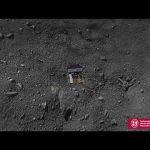
Reconstructing Philae’s flight
Data from both the Philae lander and Rosetta orbiter experiments, as well as simulation results based on Philae’s mechanical design have been used to reconstruct the lander’s attitude and motion during its descent and touchdowns on Comet 67P/Churyumov-Gerasimenko on 12 November 2014.
The new animation presented today, one year after Philae touched down on the comet, focuses on Philae’s dramatic two-hour flight from Agilkia to Abydos.
More details in the Rosetta blog: http://blogs.esa.int/rosetta/2015/11/12/reconstructing-philaes-flight-across-the-comet/
Credits: The video was prepared with inputs from the ROMAP, RPC-MAG, OSIRIS, ROLIS, CIVA CONSERT, SESAME and MUPUS instrument teams as well as from the Lander Control Centre at DLR and Science Operation and Navigation Center at CNES.
-
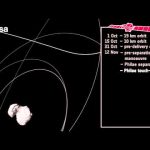
Rosetta: close orbits to lander deployment (annotated)
Animation showing Rosetta’s orbit in the lead up to, during and after lander separation.
The animation begins on 1 October 2014, when Rosetta is orbiting about 19 km from Comet 67P/Churyumov–Gerasimenko (all distances refer to the comet’s centre). The animation shows the transition to the close 10 km orbit by mid-October, and then the steps taken to move onto the pre-separation trajectory.
On the day of landing, 12 November, Rosetta makes a further manoeuvre 2–3 hours before separation to move to 22.5 km from the comet centre to deploy the lander, Philae. While Philae descends to the surface over a period of seven hours, Rosetta makes another manoeuvre to maintain visibility with the lander. A series of ‘relay phase’ manoeuvres then move Rosetta out to a distance of about 50 km, before moving first to a 30 km orbit and later to an orbit at about 20 km by early December.
The speed of the animation slows during the separation and lander phase to better highlight these events. The comet shape and rate of rotation is real – the comet rotates with a period of about 12.4 hours.
Credits: ESA
-
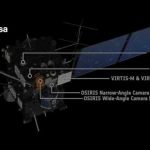
Rosetta’s imaging and spectroscopy instruments
Animation highlighting the imaging and spectroscopy instruments on ESA’s Rosetta spacecraft. The animation focuses on the wavelengths and the fields of view of the Alice, MIRO, OSIRIS and VIRTIS instruments.
Credit: ESA
-
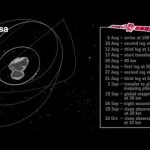
How to orbit a comet
What happens after Rosetta arrives at comet 67P/Churyumov–Gerasimenko? This animation describes the key dates for the next set of manoeuvres that will bring Rosetta even closer to the comet between August and October.
After arriving on 6 August, Rosetta will follow a set of two, three-legged triangular trajectories that require a small thruster burn at each apex. The legs are about 100 km long and it will take Rosetta between three and four days to complete each one.
The first triangle is conducted at a distance of about 100 km from the comet, the second at around 50 km. Then Rosetta will switch to a ‘global mapping phase’ at an altitude of about 30 km. During this period, it will make a ‘night excursion’, whereby the ground track of the spacecraft will be on the night-side of the comet (with the spacecraft still fully illuminated the Sun).
In October Rosetta will transfer to a close mapping phase to observe the comet from a distance of 10 km. The spacecraft will move even closer to dispatch lander Philae to the surface in November.
In this animation the comet is an artist’s impression and is not to scale with the spacecraft. The comet rotation is not representative (67P rotates once per 12.4 hours). Dates may be subject to change.
Credits: ESA
-
Philae’s mission at comet 67P
Extended version of Philae touchdown animation to include visualisations of some of the science experiments on the lander.
The animation begins with the deployment of Philae from Rosetta at comet 67P/Churyumov–Gerasimenko in November 2014. Rosetta will come to within about 10 km of the nucleus to deploy Philae, which will take several hours to reach the surface. Because of the comet’s extremely low gravity, landing gear will absorb the small forces of landing while ice screws in the probe’s feet and a harpoon system will lock the probe to the surface. At the same time a thruster on top of the lander will push it down to counteract the impulse of the harpoon imparted in the opposite direction. Once it is anchored to the comet, the lander will begin its primary science mission, based on its 64-hour initial battery lifetime. The animation then shows five of Philae’s 10 instruments in action: CIVA, ROLIS, SD2, MUPUS and APXS.
Rosetta’s Philae lander is provided by a consortium led by DLR, MPS, CNES and ASI.
Also watch:
Philae touchdown animation: http://youtu.be/BzfJlXHiagw
Philae’s panoramic camera (CIVA): http://youtu.be/k1IFU6kxcD8
Science on the comet: http://youtu.be/Pi0rwJktEF8Credits: ESA/ATG medialab
-

#RosettaAreWeThereYet – Once upon a time…
..there was a spacecraft called Rosetta. Rosetta had been travelling in space for 10 years, towards a comet called 67P/Churyumov-Gerasimenko. Before long, Rosetta was able to see the comet in the distance, and she took stunning pictures as she got closer and closer. There was only a little way to go now…
This video is also available in the following languages:
Italian: https://youtu.be/PnF9KG5XN1s
French: https://youtu.be/g5ON54S07f4
Spanish: https://youtu.be/tfv1kGI7ho4
German: https://youtu.be/FdjSBCB93sUMore videos in the series are available in this playlist:
https://www.youtube.com/playlist?list=PLbyvawxScNbui_Ncl9uQ_fXLOjS4sNSd8 -
Comet 67P/C-G in Rosetta’s navigation camera
Animation using a sequence of raw NAVCAM frames from 8 May to 22 June. The NAVCAM has a 5-degree field of view and takes 1024 x 1024 12-bit per pixel images.
Read more in the Rosetta blog:
http://blogs.esa.int/rosetta/2014/06/25/comet-67pc-g-in-rosettas-navigation-camera/Credit: ESA/Rosetta/NAVCAM
-
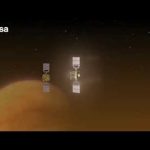
Venus Express aerobraking
Visualisation of the Venus Express aerobraking manoeuvre, which will see the spacecraft orbiting Venus at an altitude of around 130 km from 18 June to 11 July. In the month before, the altitude will gradually be reduced from around 200 km to 130 km. If the spacecraft survives and fuel permits, the elevation of the orbit will be raised back up to approximately 450 km, allowing operations to continue for a further few months. Eventually, however, the spacecraft will plunge back into the atmosphere and the mission will end.
Credit: ESA–C.Carreau
-
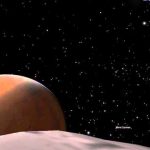
Mars Express flyby as seen from Phobos (Animation)
On 29 December 2013, ESA’s Mars Express will make the closest flyby yet of the Red Planet’s moon Phobos, skimming past only 45 km above its surface.
As the spacecraft passes close to Phobos, it will be pulled slightly off course by the moon’s gravity, by a few tens of centimetres. This small deviation will be measured using the spacecraft’s radio signals, and then translated into measurements of gravity, mass and density at different locations on the moon.
This animation shows the flyby (speeded up) as if you were standing on Phobos, with Mars in the background and Mars Express sweeping out an arc above. Toward the end of the sequence, Mars Express disappears behind Mars and out of sight of Phobos.
Credit: ESA
-
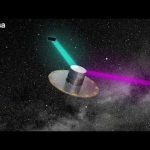
Inside Gaia’s billion-pixel camera
ESA’s Gaia mission will produce an unprecedented 3D map of our Galaxy by mapping, with exquisite precision, the position and motion of a billion stars. The key to this is the billion-pixel camera at the heart of its dual telescope. This animation illustrates how the camera works.
See http://sci.esa.int/gaia/53281-inside-gaias-billion-pixel-camera/ for a more detailed description.
Credits: ESA
-
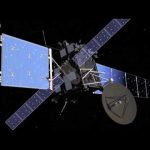
How Rosetta wakes up from deep space hibernation
Visualisation of how the Rosetta spacecraft wakes up from deep space hibernation, 673 million kilometres from the Sun, on 20 January 2014.
Prior to entering hibernation on 8 June 2011, Rosetta was oriented so that its solar arrays faced the Sun, and it began rotating once per minute for stability. The only devices left running were its computer and several heaters.
Rosetta’s computer is programmed to carry out a sequence of events to re-establish contact with the Earth on 20 January, starting with an ‘alarm clock’ at 10:00 GMT. Immediately after, the star trackers begin to warm up. Around 6 hours later the thrusters are fired and the slow rotation stops. A slight adjustment is made to Rosetta’s orientation to ensure that the solar arrays now face the Sun. Then the star trackers switch on to determine its attitude. The spacecraft rotates towards Earth, and the transmitter is switched on. Then Rosetta’s high-gain antenna points to Earth and the signal is sent. The journey takes 45 minutes before the signal is received and mission controllers can begin to check Rosetta’s health, ready for the next phase of the mission.
The first opportunity for receiving a signal on Earth is between 17:30 GMT and 18:30 GMT.
Credits: ESA/ATG medialab; music: B. Lynne.
-
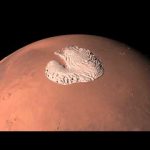
Mars 360: the north pole
Enjoy views of the martian north pole from all angles in this new animation from ESA’s Mars Express.
The ice cap has a diameter of about 1000 km and consists of many thin layers of ice mixed with dust that extend to a depth of around 2 km below the cap. The prominent gap in the ice cap is a 318 km-long, 2 km-deep chasm called Chasma Boreale.
The layers result from variations in the orbit and rotation of Mars that affect the amount of sunlight received at the poles, and thus the amount of melting and deposition of materials over time. Meanwhile, strong prevailing winds are thought to be responsible for shaping the spiral troughs.
The polar ice cap in this movie was constructed using data provided by the Mars Advanced Radar for Subsurface and Ionospheric Sounding instrument, MARSIS.
Low-frequency radio waves beamed towards the surface are reflected back to Mars Express from the planet’s surface and from interfaces between layers of different materials underground.
The strength and timing of the radar echoes are a gauge of the depths of different types of interfaces, such as between rock, water or ice. This information can then be translated into 3D views, as seen in this movie.
Credit: ESA/ASI/NASA/JPL/La Sapienza University/INAF (A. Frigeri)
-
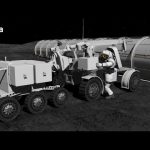
Advanced-concept robots
ESA is looking to the future of space exploration using robots ranging from small humanoid robots to larger construction robots with varying degrees of autonomy and flexibility.
This animation shows advanced concepts of robots designed to explore, prepare and help humans in the very harsh conditions found on the Moon and beyond. For many of the concepts shown, ESA has already developed real-life prototypes, including the multifunctional wheels seen on the first robot in this video.
-
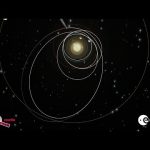
Rosetta’s twelve-year journey in space
This animation tracks Rosetta’s journey through the Solar System, using gravity slingshots from Earth and Mars to reach its final destination: Comet 67P/Churyumov–Gerasimenko. Rosetta made three flybys of Earth, on 4 March 2005, 13 November 2007 and 13 November 2009, and one of Mars, on 25 February 2007. Rosetta has also visited two asteroids, taking extensive close-up images of 2867 Steins on 5 September 2008 and 21 Lutetia on 10 July 2010. Once the spacecraft is woken up from deep space hibernation on 20 January 2014, it will head for rendezvous with the comet in May. In November the Philae probe will be deployed to the comet surface. Rosetta will follow the comet to its closest distance to the Sun on 13 August 2015 and as it moves back towards the outer Solar System. The nominal mission end is December 2015.
Credits: ESA(This replaces a previously published version)
-

How The Economic Machine Works by Ray Dalio
Economics 101 — “How the Economic Machine Works.”
Created by Ray Dalio this simple but not simplistic and easy to follow 30 minute, animated video answers the question, “How does the economy really work?” Based on Dalio’s practical template for understanding the economy, which he developed over the course of his career, the video breaks down economic concepts like credit, deficits and interest rates, allowing viewers to learn the basic driving forces behind the economy, how economic policies work and why economic cycles occur.
To learn more about Economic Principles visit: http://www.economicprinciples.org.
[Also Available In Chinese] 经济这台机器是怎样运行的: http://www.youtube.com/watch?v=-ZbeYejg9Pk
[Also Available In Russian] Как действует экономическая машина. Автор: Рэй Далио (на русском языке): http://youtu.be/8BaNOlIfMLE
For more from Ray:
Principles | #1 New York Times Bestseller: https://amzn.to/2JMewHb
Buy his new book, Principles for Success: https://amzn.to/34lgnNJ
Connect with him on Facebook: https://www.facebook.com/raydalio
Follow him on Twitter: https://www.twitter.com/raydalio
Follow him on Linkedin: https://www.linkedin.com/raydalio
Follow him on Instagram: https://www.instagram.com/raydalio/
Download his free iOs app: https://principles.app.link/PFS -
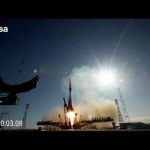
The Soyuz launch sequence explained
What are the parts of the Soyuz rocket? What are the stages into orbit? What is the launch sequence? Watch and find out. This video has been produced from an actual lesson delivered to the ESA astronaut class of 2009 (also known as the #Shenanigans09) during their ESA Basic Training in 2009-2010
This video is a joint production of the ESA Human Spaceflight & Operation Astronaut Training Division & Promotion Office
Note: Subtitles are available for English, Italian, Russian and German. Click on the caption button to choose.
Technical Experts: Stephane Ghiste, Dmitriy Churkin
Content Design: Stephane Ghiste, Dmitriy Churkin, Pascal Renten, Simon Trim, Matthew Day
Video Production & Editing: Pascal Renten, Simon Trim, Andrea Conigli
Narration Voice: Bernard Oattes
Project Co-ordination: Loredana Bessone, Matthew DaySpecial Thanks to:
Massimo Sabbatini, Guillaume Weerts ESA Human Spaceflight & Operation Promotion Office
Martin Schweiger (for use of his Orbiter software: http://orbit.medphys.ucl.ac.uk)
Nikita Vtyurin, Andrew Thielmann (Orbiter Soyuz model)
Iacopo Baroncini (Soyuz model)
Joey P. Wade (Google Earth Soyuz models)
NASA
ROSCOSMOSWatch Part 2: Soyuz rendezvous and docking explained
https://www.youtube.com/watch?v=M2_NeFbFcSwWatch Part 3: Soyuz undocking, reentry and landing explained
https://www.youtube.com/watch?v=-l7MM9yoxII -
Build a Zoetrope – Sick Science #150
Download the Zoetrope Template Here: https://docs.google.com/file/d/0B4KpAKVy76V7TlNDZ0VncXEydms/edit
Find out how this works at: http://www.stevespanglerscience.com/lab/experiments/build-a-zoetrope
Vision and the way our brains perceive what we are seeing are incredible. Just think of optical illusions, 3D images, the fact that your eyes are processing the world around you upside-down! A fun trick to play on your eyes and brain uses a zoetrope. This fantastic tool is able to change multiple still images, into a moving animation that would make Walt Disney jealous.
Want more experiments like this? Check out http://www.stevespanglerscience.com/product/naked-eggs-and-flying-potatoes
Sick Science™ is a trademark of Steve Spangler, inc.
© 2013 Steve Spangler Science all rights reserved
-
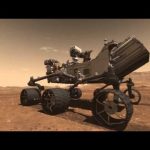
Mars Science Laboratory Curiosity Rover Animation
This 11-minute animation depicts key events of NASA’s Mars Science Laboratory mission, which will launch in late 2011 and land a rover, Curiosity, on Mars in August 2012. A shorter 4-minute version of this animation, with narration, is also available on our youtube page.