Join ESA astronaut Samantha Cristoforetti for a guided tour of the International Space Station’s crew quarters – the bedroom.
After a day’s work running experiments and maintaining the weightless research centre astronauts can retreat to their private quarters that is no larger than a changing room. In this small space they can store personal items, use a laptop for internet and float to sleep in their sleeping bag.
The green light has been given for all users to have open access to all of the data from ESA’s Sentinel-2A satellite, launched in June for the Copernicus programme.
This video celebrates Sentinel-2A’s life, from its birth to what it has become today, and what it can give us tomorrow.
LISA Pathfinder’s name, Laser Interferometer Space Antenna, clearly indicates the role of precursor that this mission plays. Its goal is to validate the technology required to detect gravitational waves from space. Gravitational waves will open a new door in our understanding of the Universe, and at the same time help to verify Einstein’s General Theory of Relativity. LISA Pathfinder will be launched early December 2015 on a Vega rocket from Kourou in French Guiana.
Tim Peake is the first British astronaut to be selected as a member of ESA’s European Astronaut Corps. With a background in flight dynamics, he served in the British Air Corps as flight commander, helicopter instructor and test pilot.
Scheduled to fly to the ISS in late 2015, he’ll be staying in orbit for five months. He also has close ties with the UK Space Agency, working on the development of its microgravity research programme.
Discover how you can participate in ESA programmes as a student, and learn about your entry options once you’ve got your Masters degree. ESA recruitment and education colleagues share some valuable info with you.
Named after Isaac Newton’s text Naturalis Principia Mathematica, ESA’s Principia mission will be the eighth long-duration mission to the International Space Station. British astronaut Tim Peake will be launched from Baikonur in Kazakhstan onboard a Russian Soyuz vehicle, spending five months in orbit. He’ll carry out an intensive schedule of European and international experiments, in addition to numerous educational activities from space.
This timelapse shows ESA astronaut Andreas Mogensen working with Roscosmos cosmonaut Sergei Volkov during the iriss mission to unpack, setup, test and then store the MARES muscle-measurement machine in Europe’s space laboratory Columbus on the International Space Station over three days.
The Muscle Atrophy Research and Exercise System, or MARES for short, is a three-in-one muscle-measurement machine on the International Space Station that monitors astronauts’ muscles as they work out.
Muscle strength decreases during spaceflight and researchers need to know why this happens in order to prepare for long-duration missions and safe space tourism. MARES is an exercise bench that offers detailed information about how muscles behave during spaceflight.
MARES was a large part of Andreas’s ten-day iriss mission to the International Space Station that started 2 September 2015.
We are Europe’s gateway to space. Our mission is to shape the development of Europe’s space capability and ensure that investment in space continues to deliver benefits to the citizens of Europe and the world. Check out https://www.esa.int/ to get up to speed on everything space related.
LISA Pathfinder will pave the way for future missions by testing in flight the very concept of gravitational wave detection: it will put two test masses in a near-perfect gravitational free-fall and control and measure their motion with unprecedented accuracy. LISA Pathfinder will use the latest technology to minimise the extra forces on the test masses, and to take measurements.
The inertial sensors, the laser metrology system, the drag-free control system and an ultra-precise micro-propulsion system make this a highly unusual mission.
LISA Pathfinder is an ESA mission, which will also carry a NASA payload.
Data from both the Philae lander and Rosetta orbiter experiments, as well as simulation results based on Philae’s mechanical design have been used to reconstruct the lander’s attitude and motion during its descent and touchdowns on Comet 67P/Churyumov-Gerasimenko on 12 November 2014.
The new animation presented today, one year after Philae touched down on the comet, focuses on Philae’s dramatic two-hour flight from Agilkia to Abydos.
Credits: The video was prepared with inputs from the ROMAP, RPC-MAG, OSIRIS, ROLIS, CIVA CONSERT, SESAME and MUPUS instrument teams as well as from the Lander Control Centre at DLR and Science Operation and Navigation Center at CNES.
It’s been an extraordinary year for the Rosetta comet mission since Philae landed on the surface of Comet 67P/Churyumov-Gerasimenko on 12 November 2014.
Continual data from the orbiter, together with information collected over several days from the lander, is providing a comprehensive picture of a remnant from our Solar System.
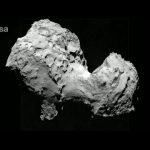
This film covers the most recent science news from the Rosetta mission, as well as selected scientific highlights from the last year. It includes the comet’s unusual surface terrace structure, its formation from two colliding objects producing the unusual rubber duck shape, how water is transported from inside the comet towards the surface, and the surprising detection of molecular oxygen – familiar on Earth but not on a comet.
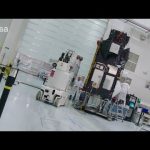
Sentinel-3A’s preparation is finished and the satellite will soon be shipped to the Russian Cosmodrome of Plesetsk, in Northern Russia for its launch on top of a Rockot planned end of this year. Carrying a suite of state-of-the-art instruments, Sentinel-3 is set to play a key role in Copernicus, the world’s largest environmental monitoring programme operated by the European Commission. It will provide highly accurate measurements on Earth’s oceans, land, ice and atmosphere.
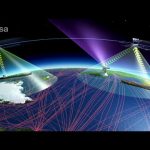
At sea, space technology is used to help save lives every day: managing traffic between ships, picking up migrants and refugees in distress or spotting oil spills. The European Space Agency is once again at the forefront developing new technologies and satellites: to keep us safe at sea and to monitor the environment. Space makes a difference here on Earth and certainly at sea where there is no infrastructure.
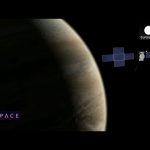
In this edition of Space we set a course for Jupiter, destination of the next European Space Agency mission.
The aim of JUICE (JUpiter ICy moon Explorer) is to provide the most comprehensive exploration of the giant planet and, in particular, of its moons; supposedly hiding habitable zones under their icy crusts.
Jupiter is more than eleven times larger than Earth but is mainly made of gas. During its three and a half year mission, which blasts off in 2022, JUICE will travel around the giant planet, studying its atmosphere and three of its planet-sized satellites: Ganymede, Europa, and Callisto.
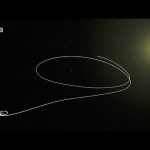
The journey and final orbit of LISA Pathfinder, ESA’s technology demonstration mission that will pave the way for future gravitational-wave observatories in space.
LISA Pathfinder is scheduled for launch on 2 December 2015 on a Vega rocket from Europe’s Spaceport in French Guiana. Vega will place the spacecraft into an elliptical orbit, with a perigee (closest approach to Earth) of 200 km, apogee (furthest point) of 1540 km, with the path angled at 6.5º to the equator.
Then, once Vega’s final stage is jettisoned, LISA Pathfinder will continue under its own power, beginning a series of six apogee-raising manoeuvres over the next two weeks.
The last burn will set LISA Pathfinder on its way towards its final orbiting location. The cruise will last about six weeks, and the propulsion module will be discarded along the way four weeks in.
Eventually, the spacecraft will circle the L1 Sun–Earth Lagrangian point. There, LISA Pathfinder will begin its six months of demonstrating key technologies for space-based observation of gravitational waves.
The iconic group Inspiral Carpets from Oldham, Greater Manchester, have dedicated their classic song Saturn V to ESA astronaut Tim Peake. Formed by musicians Graham Lambert and Stephen Holt in 1983, Inspiral Carpets were one of the bands associated with the ‘Madchester’ scene that came to prominence in the late 1980s and early 1990s. The band send this message: “From Inspiral Carpets, with respect and love, to our friend Tim Peake!”
Tim Peake is set for launch to the International Space Station on his five-month Principia mission on 15 December 2015.
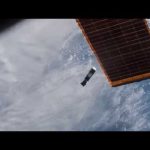
On 5 October at 15:55 CEST two ESA CubeSats, the student-built AAUSAT5 and the professional technology demonstrator GomX-3, were deployed from the International Space Station (ISS). The two satellites have just started their mission in space.
Teresa Antoja holds a PhD in Physics and works as Research Fellow on the Gaia Mission. She gets everything ready so that the data coming down from the spacecraft can be used quickly and efficiently, contributing to its scientific exploitation by scientists all over the world that will revolutionise our view of our galaxy.
The pioneering and highly influential British synthpop band Orchestral Manoeuvres in the Dark (OMD) have dedicated their classic song ‘Electricity’ to ESA astronaut Tim Peake.
The band have always been fascinated by science, technology and transport, with songs inspired in particular by aircraft and space, so they have been following Tim’s preparations for his upcoming Principia mission with great interest. OMD are Andy McCluskey and Paul Humphreys, backed by Malcolm Holmes and Martin Cooper.
Connect with Tim Peake at timpeake.esa.int, follow Tim on Twitter at @astro_timpeake.
ESA astronaut Samantha Cristoforetti photographs stunning Earth images of Lufthansa worldwide destinations during her Futura mission onboard the ISS. An ESA for Lufthansa inflight film.
ESA astronaut Andreas Mogensen, the first astronaut from Denmark, explains the deployment of the student-built AAUSAT5 CubeSat – the first ESA student CubeSat mission launched from space and the pilot project of ESA’s ‘Fly Your Satellite from the ISS!’ education programme.
AAUSAT5, a CubeSat entirely built by a university team with ESA’s support, was launched to the International Space Station aboard the Japanese HTV-5 cargo vehicle 19 August 2015. Andreas gives a brief tour of the Japanese cargo vehicle’s storage space, where AAUSAT5 was housed during its flight to the Station. AAUSAT5 was taken to the Japanese Kibo Laboratory, put in a Nanoracks deployer, and placed into the airlock to be launched into space.
AAUSAT5 will be deployed into orbit 5 October 2015. Aalborg University will host a special event in Aalborg, Denmark entitled “ESA CubeSats from the Space Station: a new path for education and technology” to celebrate the deployment.
“11,2 km/s” is the official theme music for ESA’s Estrack ground station network. It was composed by Gautier Acher, a 17-year-old student living in Paris, France, and entered in the 2015 Tracking Station Music Contest, which celebrated the 40th anniversary of the Estrack network.
Gautier’s top-ranked entry was selected from a field 117 submissions received from over a dozen countries.
Gautier wrote: This track is a triptych that shows space is vast, but is full of interesting things, such as humankind, stars, comets, planets… It describes great achievements, in the past, and in the future.
While only three entrants could win prizes in the music contest, and only 10 could be at the top, the ESA judging panel praised all 117 submissions.
Judges commented that, “We heard some marvellous stuff created by people who are passionate, motivated and imaginative in their pursuit of music that reflects the central themes of exploration into our Universe, technological excellence and the dreams of humanity’s journeys into space.”
In 1975, the ground station at Villafranca in Spain became the kernel of the ESA tracking network, which now comprises 10 stations in seven countries and in 2015 celebrates four decades of providing links to space for ESA’s science, Earth, observatory and exploration missions.
Since inception, Estrack has expanded worldwide and today employs cutting-edge technology to link mission controllers with spacecraft orbiting Earth, voyaging deep in our Solar System and anywhere in between (more information in our Estrack web site http://www.esa.int/estrack).
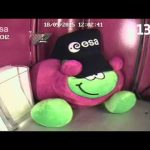
ESA Education mascot Paxi was placed in a Large Diameter Centrifuge gondola which normally houses researchers’ and students’ experiments at ESA’s ESTEC establishment. As the centrifuge starts spinning, the relative g-levels within the gondola increase and this causes Paxi’s weight to increase. At 20 g, Paxi weighs 20 times what he normally does on Earth. As the centrifuge spins down, the g levels decrease and eventually when the centrifuge stops, return to normal.
We recently surpassed 100 000 subscribers on our YouTube channel and are proud to have received a Silver Play Button to mark this achievement. Of course being the European Space Agency, we needed to make sure the Silver Play Button was fit for space…
Thanks to all our subscribers for helping us to achieve this milestone!
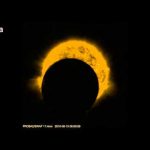
ESA’s Earth-orbiting Proba-2 satellite observed three partial solar eclipses on the morning of 13 September 2015 along with an additional passage of the Moon close to the edge of the Sun. The image was taken with Proba-2’s SWAP imager, which views the solar disc at extreme ultraviolet wavelengths to capture the turbulent surface of the Sun and its swirling corona, which can clearly be seen in between eclipses in this movie. The Sun’s rotation can also be seen.
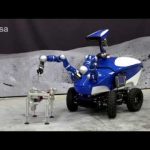
This is the Interact Centaur rover that ESA astronaut Andreas Mogensen will be operating from orbit aboard the International Space Station, to drive into position and then perform an operation requiring sub-millimetre precision.
Developed by ESA’s Telerobotics and Haptics Laboratory, the Interact Centaur is a 4×4 wheeled rover combining a camera head on a neck system, a pair of highly advanced force sensitive robotic arms designed for remote force-feedback-based operation and a number of proximity and localisation sensors.
As demonstrated here, Andreas will first attempt to guide the robot to locate an ‘operations task board’ and then to remove and plug a metal pin into it, which has a very tight mechanical fit and tolerance of only about 150 micrometres, less than a sixth of a millimetre.
As currently scheduled, Monday 7 September should see the Interact rover driven around the grounds of ESA’s ESTEC technical centre in Noordwijk, the Netherlands, from the extremely remote location of Earth orbit, 400 km up.
Signals between the crew and the robot must travel a total distance of approximately ninety thousand kilometres, via a satellite constellation located in geostationary orbit. Despite this distance, Andreas will exactly feel what the robot does on the surface – with only a very slight lag.
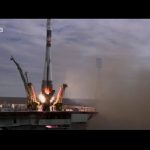
ESA astronaut Andreas Mogensen, commander Sergei Volkov and Aidyn Aimbetov were launched into space this morning 2 September at 04:37:43 GMT (06:37:43 CEST) from Baikonur cosmodrome, Kazakhstan.
The launch marks the start of ESA’s 10-day ‘iriss’ mission that will focus on testing new technologies and ways of running complex space missions.
The astronaut’s Soyuz TMA-18M spacecraft was pushed into Earth orbit as planned accelerating 50 km/h on every second for the first nine minutes of their launch.
The spacecraft separated from the Soyuz launcher at 04:46 GMT (06:46 CEST)
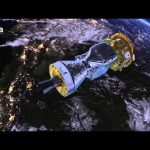
Artist’s impression of the launch of LISA Pathfinder, ESA’s technology demonstration mission that will pave the way for future gravitational-wave observatories in space.
Scheduled to lift off on a Vega rocket from Europe’s Spaceport in French Guiana in late 2015, LISA Pathfinder will operate at the Lagrange point L1, 1.5 million km from Earth towards the Sun. After launch, the spacecraft will take about eight weeks to reach its operational orbit around L1.
The Vega rocket is designed to take small payloads into low-Earth orbit. The animation shows the rocket shortly after launch, rising above our planet and releasing the fairing.
Vega will place the spacecraft onto an elliptical orbit with perigee at 200 km, apogee at 1540 km and angled at about 6.5° to the equator. Then, LISA Pathfinder will continue on its own, using its separable propulsion module to perform a series of six manoeuvres and gradually raise the apogee of the initial orbit.
Eventually, LISA Pathfinder will cruise towards its final orbiting location, discarding the propulsion system along the way, one month after the last burn. Once in orbit around L1, the spacecraft will begin its six months of operations devised to demonstrate key technologies for space-based observation of gravitational waves.
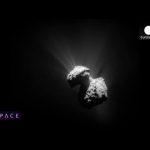
The Rosetta Mission has been writing a new chapter in what we know about the formation of life. The ESA teams involved are now preparing for the last part of this amazing journey.
Comet Churyumov-Gerasimenko has recently reached the perihelion – that’s the closest point to the Sun in its six and a half year orbit. It’s an important scientific step – as increasing solar energy warms the comet’s frozen ices, turning them to gas and dust. To stay safe, Rosetta has been forced to move further from the comet.
The Rosetta mission has been extended by nine months – until September next year. It’s hoped this will further boost the enormous amount of data that’s already been collected.
Full-orbit movies produced from Visual Monitoring Camera (VMC) images acquired as part of ESA’s #VMCSchools campaign. This clip includes images acquired by ESA’s Mars Express on 25 and 26 May 2015.
For the complete list of submitted school projects, access ESA’s Mars Express blog via http://wp.me/p2E5wN-lj
Every summer, ESA’s Education Office welcomes primary and secondary teachers from across Europe to ESA’s European Space Research and Technology Centre, The Netherlands. Over the course of three days, in the heart of ESA’s largest establishment, the teachers engage in a number of workshops about how space can be used as a context for teaching many subjects. Space experts, both from within ESA and outside, guide the teachers through mainly hands-on practical workshop sessions.
An introduction to the Sentinel-2 mission for Europe’s Copernicus programme and some of its benefits for the planet’s ever-growing population, such as deforestation monitoring, food security and the sustainable management of natural resources.
The LISA Pathfinder spacecraft is due to set off in Autumn 2015 in a bid to prove that it is possible to observe gravitational waves in space. This is the latest step in an incredible journey to spot these ripples in spacetime that were first predicted by Albert Einstein 100 years ago.
If we can manage to capture these waves, then we should be able to observe some of the most violent events in the cosmos, such as black holes colliding and galaxies merging. For the moment, however, we’re still searching.
Earth from Space is presented by Kelsea Brennan-Wessels from the ESA Web-TV virtual studios. The one hundred fifty-first edition features a satellite image of New York City in the United States.
Earth from Space is presented by Kelsea Brennan-Wessels from the ESA Web-TV virtual studios. The sandy and rocky terrain of the Sahara desert in central Algeria, captured by the Sentinel-2A satellite, is featured in the one hundred fiftieth edition.
ESA’s European Space Operations Centre links people with spacecraft travelling to the frontiers of human knowledge. Our world is about systems, communication and exploration; our passion is for humanity’s voyages into the Universe. And even the grandest journey begins with just a few steps.
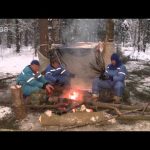
ESA astronaut Tim Peake during winter survival training in Russia.
All astronauts go through winter survival training. There is always the possibility that a Soyuz spacecraft could land in a remote, cold area. Tim has to learn to survive in harsh climates while waiting for rescue.
Tim is training for his mission to the International Space Station set to be launched on a Soyuz spacecraft from Baikonur Cosmodrome in Kazakhstan in December 2015.
ESA astronauts train with all International Space Station partners including onsite training in USA, Europe, Canada and Japan.
ESA astronaut Tim trained in Tsukuba at the Japanese Aerospace Exploration Centre on Japanes experiments and the Japanese space laboratory Kibo.
Tim is preparing for his mission to the International Space Station set to be launched on a Soyuz spacecraft from Baikonur Cosmodrome in Kazakhstan in December 2015.
ESA astronaut Tim Peake during spacewalk training in Houston, USA.
Training underwater on life-size mockups of the Space Station is one way astronauts prepare for their missions as working in water resembles working in space.
Tim is training for his mission to the International Space Station set to be launched on a Soyuz spacecraft from Baikonur Cosmodrome in Kazakhstan in December 2015.