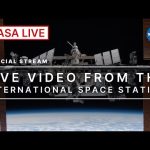
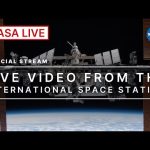
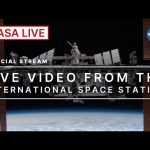
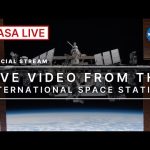
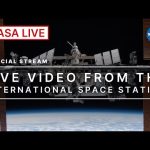
Live views from the International Space Station are streaming from an external camera mounted on the station’s Harmony module.
The camera is looking forward at an angle so that International Docking Adapter 2 is visible. If the Harmony module camera is not available due to operational considerations for a longer period of time, a continuous loop of recorded Earth views will be displayed with the caption “Previously Recorded.”
The space station orbits Earth about 250 miles (425 kilometers) above the surface. An international partnership of five space agencies from 15 countries operates the station, and it has been continuously occupied since November 2000. It’s a microgravity laboratory where science, research, and human innovation make way for new technologies and research breakthroughs not possible on Earth. More: https://go.nasa.gov/3CkVtC8
Did you know you can spot the station without a telescope? It looks like a fast-moving star, but you have to know when to look up. Download our mobile app for alerts to let you know when (and where) to spot the station and wave to the crew: https://www.nasa.gov/spot-the-station/
Watch live video from the International Space Station, including inside views when the crew aboard the space station is on duty. Views of Earth are also streamed from an external camera located outside of the space station. During periods of signal loss due to handover between communications satellites, a blue screen is displayed.
The space station orbits Earth about 250 miles (425 kilometers) above the surface. An international partnership of five space agencies from 15 countries operates the station, and it has been continuously occupied since November 2000. It’s a microgravity laboratory where science, research, and human innovation make way for new technologies and research breakthroughs not possible on Earth. More: https://go.nasa.gov/3CkVtC8
Did you know you can spot the station without a telescope? It looks like a fast-moving star, but you have to know when to look up. Download our mobile app for alerts to let you know when (and where) to spot the station and wave to the crew: https://www.nasa.gov/spot-the-station/
Steve Spangler is a bestselling author, STEM educator and Emmy award-winning television personality with more than 2,100 television appearances to his credit. Steve appeared as a regular guest on the Ellen DeGeneres Show from 2007-2022 (27 appearances).
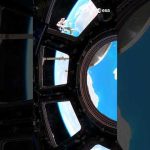
View of Earth as seen by ESA project astronaut Sławosz Uznański-Wiśniewski inside the seven-windowed cupola, the International Space Station’s “window to the world”.
The European Space Agency-built Cupola is the favourite place of many astronauts on the International Space Station. It serves not only as a unique photo spot, but also for observing robotic activities of the Canadian Space Agency’s robotic arm Canadarm2, arriving spacecraft and spacewalks.
Sławosz was launched to the International Space Station on the Dragon spacecraft as part of Axiom Mission 4 on 25 June 2025. The 20-day mission on board is known as Ignis.
During the Ignis mission, Sławosz conducted 13 experiments proposed by Polish companies and institutions and developed in collaboration with ESA, along with three additional ESA-led experiments. These covered a broad range of areas including human research, materials science, biology, biotechnology and technology demonstrations.
The Ax-4 mission marks the second commercial human spaceflight for an ESA project astronaut. Ignis was sponsored by the Polish government and supported by ESA, the Polish Ministry of Economic Development and Technology (MRiT) and the Polish Space Agency (POLSA).
📹 European Space Agency (ESA) 📸 ESA – Sławosz Uznański-Wiśniewski
John McFall is part of our astronaut reserve. Following a motorcycle accident that resulted in the amputation of his right leg at the age of 19, John learnt to run again. He became a professional track and field athlete in 2005, going on to represent Great Britain and Northern Ireland as a @paralympics sprinter.
In November 2022, John was selected as a member of the ESA astronaut reserve and to take part in ESA’s feasibility study “Fly!” to improve our understanding of, and overcome, the barriers space flight presents for astronauts with a physical disability.
📹 European Space Agency (ESA) 📸 Novespace/N. Courtioux
Watch live video from the International Space Station, including inside views when the crew aboard the space station is on duty. Views of Earth are also streamed from an external camera located outside of the space station. During periods of signal loss due to handover between communications satellites, a blue screen is displayed.
The space station orbits Earth about 250 miles (425 kilometers) above the surface. An international partnership of five space agencies from 15 countries operates the station, and it has been continuously occupied since November 2000. It’s a microgravity laboratory where science, research, and human innovation make way for new technologies and research breakthroughs not possible on Earth. More: https://go.nasa.gov/3CkVtC8
Did you know you can spot the station without a telescope? It looks like a fast-moving star, but you have to know when to look up. Sign up for text messages or email alerts to let you know when (and where) to spot the station and wave to the crew: https://spotthestation.nasa.gov
Timelapse of the International Space Station flying into a stunning aurora borealis. Shared by ESA astronaut Samantha Cristoforetti on her TikTok on 18 September 2022.
Join us live for a star-studded event this Thursday, as scientists working on ESA’s Hera mission for planetary defence release the mission’s first scientific observations beyond the Earth-Moon system, following its imminent flyby of Mars.
On 12 March 2025 ESA’s Hera mission comes to within 5000 km of the surface of the red planet and 300 km of Mars’s more distant and enigmatic moon Deimos. During this flyby Hera is performing observations of both Mars and the city-sized Deimos.
Hera then needs to swing its High Gain Antenna back to Earth to transmit its data home. The next day, on Thursday 13 March, these images will be premiered by Hera’s science team from ESA’s ESOC mission control centre in Darmstadt, Germany, explaining what they reveal, during our public webcast starting at 11:50 CET.
The team are being joined by ESA astronaut Alexander Gerst and renowned science fiction writer Andy Weir, author of The Martian and Project Hail Mary, as well as a surprise special guest!
Chapters: 00:00 Introduction 07:00 Image 1: AFC’s view of Mars and Deimos 18:20 Image 2: HyperScout’s view of colourful Mars 25:40 Audience questions 32:25 The Author and the Astronaut 50:55 Image 3: TIRI’s view of hot Mars, cold Mars 55:10 Ramses, Planetary Defence and asteroid deflection 1:00:25 The Hera AI companion – more than sci-fi! 1:05:30 What’s next for Hera?
★ Subscribe: http://bit.ly/ESAsubscribe and click twice on the bell button to receive our notifications.
We are Europe’s gateway to space. Our mission is to shape the development of Europe’s space capability and ensure that investment in space continues to deliver benefits to the citizens of Europe and the world. Check out https://www.esa.int/ to get up to speed on everything space related.
Watch live video from the International Space Station, including inside views when the crew aboard the space station is on duty. Views of Earth are also streamed from an external camera located outside of the space station. During periods of signal loss due to handover between communications satellites, a blue screen is displayed.
The space station orbits Earth about 250 miles (425 kilometers) above the surface. An international partnership of five space agencies from 15 countries operates the station, and it has been continuously occupied since November 2000. It’s a microgravity laboratory where science, research, and human innovation make way for new technologies and research breakthroughs not possible on Earth. More: https://go.nasa.gov/3CkVtC8
Did you know you can spot the station without a telescope? It looks like a fast-moving star, but you have to know when to look up. Sign up for text messages or email alerts to let you know when (and where) to spot the station and wave to the crew: https://spotthestation.nasa.gov
Live views from the International Space Station are streaming from an external camera mounted on the station’s Harmony module.
The camera is looking forward at an angle so that International Docking Adapter 2 is visible. If the Harmony module camera is not available due to operational considerations for a longer period of time, a continuous loop of recorded Earth views will be displayed with the caption “Previously Recorded.”
The space station orbits Earth about 250 miles (425 kilometers) above the surface. An international partnership of five space agencies from 15 countries operates the station, and it has been continuously occupied since November 2000. It’s a microgravity laboratory where science, research, and human innovation make way for new technologies and research breakthroughs not possible on Earth. More: https://go.nasa.gov/3CkVtC8
Did you know you can spot the station without a telescope? It looks like a fast-moving star, but you have to know when to look up. Sign up for text messages or email alerts to let you know when (and where) to spot the station and wave to the crew: https://spotthestation.nasa.gov
How did asteroid 2024 YR4 go from being the riskiest asteroid ever detected to posing no real threat? 🌍 ☄️
First spotted in December 2024, its impact risk initially soared to 2.8%, surpassing previous record-holder Apophis. But thanks to refined observations from our Near-Earth Object Coordination Centre and other institutions, its risk quickly dropped to just 0.001% within days.
This dramatic shift follows a well-known pattern—asteroid impact probabilities often rise before plummeting as more data becomes available. Now, nearly all possible impact scenarios have been ruled out, and 2024 YR4 has been safely removed from our risk list.
Live views from the International Space Station are streaming from an external camera mounted on the station’s Harmony module.
The camera is looking forward at an angle so that International Docking Adapter 2 is visible. If the Harmony module camera is not available due to operational considerations for a longer period of time, a continuous loop of recorded Earth views will be displayed with the caption “Previously Recorded.”
The space station orbits Earth about 250 miles (425 kilometers) above the surface. An international partnership of five space agencies from 15 countries operates the station, and it has been continuously occupied since November 2000. It’s a microgravity laboratory where science, research, and human innovation make way for new technologies and research breakthroughs not possible on Earth. More: https://go.nasa.gov/3CkVtC8
Did you know you can spot the station without a telescope? It looks like a fast-moving star, but you have to know when to look up. Sign up for text messages or email alerts to let you know when (and where) to spot the station and wave to the crew: https://spotthestation.nasa.gov
Live views from the International Space Station are streaming from an external camera mounted on the station’s Harmony module.
The camera is looking forward at an angle so that International Docking Adapter 2 is visible. If the Harmony module camera is not available due to operational considerations for a longer period of time, a continuous loop of recorded Earth views will be displayed with the caption “Previously Recorded.”
The space station orbits Earth about 250 miles (425 kilometers) above the surface. An international partnership of five space agencies from 15 countries operates the station, and it has been continuously occupied since November 2000. It’s a microgravity laboratory where science, research, and human innovation make way for new technologies and research breakthroughs not possible on Earth. More: https://go.nasa.gov/3CkVtC8
Did you know you can spot the station without a telescope? It looks like a fast-moving star, but you have to know when to look up. Sign up for text messages or email alerts to let you know when (and where) to spot the station and wave to the crew: https://spotthestation.nasa.gov
Watch live video from the International Space Station, including inside views when the crew aboard the space station is on duty. Views of Earth are also streamed from an external camera located outside of the space station. During periods of signal loss due to handover between communications satellites, a blue screen is displayed.
The space station orbits Earth about 250 miles (425 kilometers) above the surface. An international partnership of five space agencies from 15 countries operates the station, and it has been continuously occupied since November 2000. It’s a microgravity laboratory where science, research, and human innovation make way for new technologies and research breakthroughs not possible on Earth. More: https://go.nasa.gov/3CkVtC8
Did you know you can spot the station without a telescope? It looks like a fast-moving star, but you have to know when to look up. Sign up for text messages or email alerts to let you know when (and where) to spot the station and wave to the crew: https://spotthestation.nasa.gov
Steve Spangler is a bestselling author, STEM educator and Emmy award-winning television personality with more than 2,100 television appearances to his credit. Steve appeared as a regular guest on the Ellen DeGeneres Show from 2007-2022. Learn more about Steve at https://stevespangler.com/about-steve-spangler/
Live interviews and highlights from the ESA Open Day at ESTEC, featuring ESA astronauts Andreas Mogensen and André Kuipers, NASA astronaut Anna Fisher, The Expanse actor Steven Strait and more.
The ESA Open Day is an annual event where ESA opens the doors of the European Space Research and Technology Centre in the Netherlands to the public.
We are Europe’s gateway to space. Our mission is to shape the development of Europe’s space capability and ensure that investment in space continues to deliver benefits to the citizens of Europe and the world. Check out https://www.esa.int/ to get up to speed on everything space related.
ESA’s Jupiter Icy Moons Explorer (Juice), is on an epic eight-year journey to Jupiter. This first episode of ‘The journey of Juice’ tells the story of Juice’s first months in space, from its launch on 14 April 2023 to its lunar-Earth gravity assist (LEGA for short) in August 2024. This flyby was not only the first double gravity assist manoeuvre of its kind, it was also a perfect opportunity to test out the spacecraft’s cameras and science instruments.
In this episode, Juice’s Mission Manager Nicolas Altobelli explains how the spacecraft will become the first ever human-made machine to orbit a moon of another planet, in this case Jupiter’s largest moon Ganymede.
You’ll also hear from Claire Vallat and Marc Costa at the European Space Astronomy Centre (ESAC) near Madrid, Spain. Juice will perform incredibly complex measurements once it reaches Jupiter, and the Science Operations team at ESAC is making sure we get the most out of every instrument.
Meanwhile, the Flight Control team at the European Space Operations Centre (ESOC) in Darmstadt, Germany, makes sure Juice is and stays on the right path. This episode shows what happened ‘behind the scenes’ before and during the lunar-Earth flyby, and stars Ignacio Tanco, Angela Dietz and members of the Juice Flight Control team as they do what they do best.
Finally, we highlight the ESA tracking station network (Estrack), another crucial component for Juice. Maintenance and Operations Engineer Belén Goméz gives a tour of the facility at Cebreros.
Following the very successful lunar-Earth flyby, Juice is now on its way to planet Venus for its next flyby. On 31 August 2025, this flyby will give Juice its second gravity boost. Tune back in next year for episode two of this series!
This series follows on from ‘The making of Juice’ series, which covered the planning, testing and launch of this once-in-a-generation mission.
Credit: ESA/Lightcurve Films, original music by William Zeitler
Acknowledgments: Direction, main camera, sound, editing, post-production: Maarten Roos. Camera at Cebreros during LEGA: Mikel Larequi. LEGA timelapse: Mark McCaughrean and Simeon Schmauß. Special thanks to Marc Costa (ESA – ESAC) and Jorge Fauste (ESA – Estrack)
★ Subscribe: http://bit.ly/ESAsubscribe and click twice on the bell button to receive our notifications.
We are Europe’s gateway to space. Our mission is to shape the development of Europe’s space capability and ensure that investment in space continues to deliver benefits to the citizens of Europe and the world. Check out https://www.esa.int/ to get up to speed on everything space related.
Live views from the International Space Station are streaming from an external camera mounted on the station’s Harmony module.
The camera is looking forward at an angle so that International Docking Adapter 2 is visible. If the Harmony module camera is not available due to operational considerations for a longer period of time, a continuous loop of recorded Earth views will be displayed with the caption “Previously Recorded.”
The space station orbits Earth about 250 miles (425 kilometers) above the surface. An international partnership of five space agencies from 15 countries operates the station, and it has been continuously occupied since November 2000. It’s a microgravity laboratory where science, research, and human innovation make way for new technologies and research breakthroughs not possible on Earth. More: https://go.nasa.gov/3CkVtC8
Did you know you can spot the station without a telescope? It looks like a fast-moving star, but you have to know when to look up. Sign up for text messages or email alerts to let you know when (and where) to spot the station and wave to the crew: https://spotthestation.nasa.gov
Watch live video from the International Space Station, including inside views when the crew aboard the space station is on duty. Views of Earth are also streamed from an external camera located outside of the space station. During periods of signal loss due to handover between communications satellites, a blue screen is displayed.
The space station orbits Earth about 250 miles (425 kilometers) above the surface. An international partnership of five space agencies from 15 countries operates the station, and it has been continuously occupied since November 2000. It’s a microgravity laboratory where science, research, and human innovation make way for new technologies and research breakthroughs not possible on Earth. More: https://go.nasa.gov/3CkVtC8
Did you know you can spot the station without a telescope? It looks like a fast-moving star, but you have to know when to look up. Sign up for text messages or email alerts to let you know when (and where) to spot the station and wave to the crew: https://spotthestation.nasa.gov
Live views from the International Space Station are streaming from an external camera mounted on the station’s Harmony module.
The camera is looking forward at an angle so that International Docking Adapter 2 is visible. If the Harmony module camera is not available due to operational considerations for a longer period of time, a continuous loop of recorded Earth views will be displayed with the caption “Previously Recorded.”
The space station orbits Earth about 250 miles (425 kilometers) above the surface. An international partnership of five space agencies from 15 countries operates the station, and it has been continuously occupied since November 2000. It’s a microgravity laboratory where science, research, and human innovation make way for new technologies and research breakthroughs not possible on Earth. More: https://go.nasa.gov/3CkVtC8
Did you know you can spot the station without a telescope? It looks like a fast-moving star, but you have to know when to look up. Sign up for text messages or email alerts to let you know when (and where) to spot the station and wave to the crew: https://spotthestation.nasa.gov
Join us for Juice’s flyby of the Moon. We’ll be sharing images as soon as we can after Juice sends them down to Earth. Be among the first people in the world to see these images, and ask your questions about the mission and its lunar-Earth flyby to our panel of Juice team members.
The images will be captured using Juice’s two ‘monitoring cameras’, designed to watch the unfolding of Juice’s solar panels, antennas and booms in space in the weeks after the spacecraft launched into space in April 2023. The cameras have successfully completed their task. But we thought… what will we see if we point them at the Moon?
We don’t know how the images will look. It’s the first time the cameras will point at a big bright object in space. And we’re sharing them publicly before we’ve had a chance to process them at all.
We are Europe’s gateway to space. Our mission is to shape the development of Europe’s space capability and ensure that investment in space continues to deliver benefits to the citizens of Europe and the world. Check out https://www.esa.int/ to get up to speed on everything space related.
Watch live video from the International Space Station, including inside views when the crew aboard the space station is on duty. Views of Earth are also streamed from an external camera located outside of the space station. During periods of signal loss due to handover between communications satellites, a blue screen is displayed.
The space station orbits Earth about 250 miles (425 kilometers) above the surface. An international partnership of five space agencies from 15 countries operates the station, and it has been continuously occupied since November 2000. It’s a microgravity laboratory where science, research, and human innovation make way for new technologies and research breakthroughs not possible on Earth. More: https://go.nasa.gov/3CkVtC8
Did you know you can spot the station without a telescope? It looks like a fast-moving star, but you have to know when to look up. Sign up for text messages or email alerts to let you know when (and where) to spot the station and wave to the crew: https://spotthestation.nasa.gov
Watch live video from the International Space Station, including inside views when the crew aboard the space station is on duty. Views of Earth are also streamed from an external camera located outside of the space station. During periods of signal loss due to handover between communications satellites, a blue screen is displayed.
The space station orbits Earth about 250 miles (425 kilometers) above the surface. An international partnership of five space agencies from 15 countries operates the station, and it has been continuously occupied since November 2000. It’s a microgravity laboratory where science, research, and human innovation make way for new technologies and research breakthroughs not possible on Earth. More: https://go.nasa.gov/3CkVtC8
Did you know you can spot the station without a telescope? It looks like a fast-moving star, but you have to know when to look up. Sign up for text messages or email alerts to let you know when (and where) to spot the station and wave to the crew: https://spotthestation.nasa.gov
🚩 Today we have the Battle of Tolbiac, which took place in Gaul during/after the collapse of the last fragments of the Western Roman Empire. Despite being fought in AD 496 (or 506, depending on who you ask) it marked the beginning of what would one day become modern France.
📚 Sources and citations: Visiting Battlefields: The Battle of Tolbiac – Denny Koch (2015) Bernard S Bachrach – Merovingian Military Organization, 481-751 (1972) John F. Drinkwater – The Alamanni and Rome 213-496: Caracalla to Clovis (2007) Peter Heather – The Restoration of Rome: Barbarian Popes and Imperial Pretenders (2013) Simon MacDowell, Angus McBride – Germanic Warrior, 236-568 (1996) Ian Wood – The Merovingian Kingdoms 450-751 (1994)
ESA’s newly graduated astronauts reach the end of one year of rigorous basic astronaut training. Watch the key moments during the journey of Sophie Adenot, Rosemary Coogan, Pablo Álvarez Fernández, Raphaël Liégeois, Marco Sieber, and Australian Space Agency astronaut candidate Katherine Bennell-Pegg. Selected in November 2022, the group began their training in April 2023.
Basic astronaut training provides the candidates with an overall familiarisation and training in various areas, such as spacecraft systems, spacewalks, flight engineering, robotics and life support systems as well as survival and medical training. They received astronaut certification at ESA’s European Astronaut Centre on 22 April 2024.
Following certification, the new astronauts will move on to the next phases of pre-assignment and mission-specific training – paving the way for future missions to the International Space Station and beyond.
Credits: ESA – European Space Agency ESA/NASA NASA ESA/Royal Netherlands Air Force
★ Subscribe: http://bit.ly/ESAsubscribe and click twice on the bell button to receive our notifications.
We are Europe’s gateway to space. Our mission is to shape the development of Europe’s space capability and ensure that investment in space continues to deliver benefits to the citizens of Europe and the world. Check out https://www.esa.int/ to get up to speed on everything space related.
Climate change exacerbates droughts by making them more frequent, longer, and more severe. This can have a wide range of impacts on the environment, agriculture, ecosystems and communities including water scarcity, crop failure and food shortages.
The upcoming Copernicus Land Surface Temperature Monitoring, LSTM, mission will improve sustainable agricultural productivity in a world of increasing water scarcity and variability.
The mission will carry a high spatial-temporal resolution thermal infrared sensor to provide observations of land-surface temperature.
These data are key to understand and respond to climate variability, manage water resources for agricultural production, predict droughts and also to address land degradation.
LSTM is one of six Copernicus Sentinel Expansion missions that ESA is developing on behalf of the EU. The missions will expand the current capabilities of the Copernicus Space Component – the world’s biggest supplier of Earth observation data.
This video features interviews with Ana Bolea Alamanac, LSTM Mission Project Manager, Ilias Manolis, LSTM Mission Payload Manager and Itziar Barat, LSTM Mission System and Operations Manager.
Credits: ESA – European Space Agency
★ Subscribe: http://bit.ly/ESAsubscribe and click twice on the bell button to receive our notifications.
We are Europe’s gateway to space. Our mission is to shape the development of Europe’s space capability and ensure that investment in space continues to deliver benefits to the citizens of Europe and the world. Check out https://www.esa.int/ to get up to speed on everything space related.
Steve Spangler is a bestselling author, STEM educator and Emmy award-winning television personality with more than 2,100 television appearances to his credit. Steve appeared as a regular guest on the Ellen DeGeneres Show from 2007-2022. Learn more about Steve at https://stevespangler.com/about-steve-spangler/
Join ESA project astronaut Marcus Wandt inside the seven-windowed cupola, the International Space Station’s “window to the world”.
The ESA – European Space Agency-built Cupola is the favourite place of many astronauts on the International Space Station. It serves not only as a unique photo spot, but also for observing robotic activities of the Canadian Space Agency’s robotic arm Canadarm2, arriving spacecraft and spacewalks.
Marcus was launched to the International Space Station on the Dragon spacecraft as part of Axiom Mission 3 on 18 January 2024. His two-week mission on board is known as Muninn.
From the International Space Station to Earth, ESA astronaut Andreas Mogensen talks about what kind of person his fellow Scandinavian and ESA project astronaut Marcus Wandt is. The Axiom-3 mission with Marcus onboard is planned to launch in mid-January 2024 to the International Space Station for a 14-day mission, where Marcus will join Andreas, marking the first time two Scandinavians are in space together.
Credits: ESA – European Space Agency
★ Subscribe: http://bit.ly/ESAsubscribe and click twice on the bell button to receive our notifications.
We are Europe’s gateway to space. Our mission is to shape the development of Europe’s space capability and ensure that investment in space continues to deliver benefits to the citizens of Europe and the world. Check out https://www.esa.int/ to get up to speed on everything space related.
Ultra-high-definition video beamed from deep space, the Artemis II astronauts train for their upcoming mission, and an Artemis landing from inside the Orion spacecraft … a few of the stories to tell you about – This Week at NASA!
Watch live video from the International Space Station, including inside views when the crew aboard the space station is on duty. Views of Earth are also streamed from an external camera located outside of the space station. During periods of signal loss due to handover between communications satellites, a blue screen is displayed.
The space station orbits Earth about 250 miles (425 kilometers) above the surface. An international partnership of five space agencies from 15 countries operates the station, and it has been continuously occupied since November 2000. It’s a microgravity laboratory where science, research, and human innovation make way for new technologies and research breakthroughs not possible on Earth. More: https://go.nasa.gov/3CkVtC8
Did you know you can spot the station without a telescope? It looks like a fast-moving star, but you have to know when to look up. Sign up for text messages or email alerts to let you know when (and where) to spot the station and wave to the crew: https://spotthestation.nasa.gov
Live views from the International Space Station are streaming from an external camera mounted on the station’s Harmony module.
The camera is looking forward at an angle so that International Docking Adapter 2 is visible. If the Harmony module camera is not available due to operational considerations for a longer period of time, a continuous loop of recorded Earth views will be displayed with the caption “Previously Recorded.”
The space station orbits Earth about 250 miles (425 kilometers) above the surface. An international partnership of five space agencies from 15 countries operates the station, and it has been continuously occupied since November 2000. It’s a microgravity laboratory where science, research, and human innovation make way for new technologies and research breakthroughs not possible on Earth. More: https://go.nasa.gov/3CkVtC8
Did you know you can spot the station without a telescope? It looks like a fast-moving star, but you have to know when to look up. Sign up for text messages or email alerts to let you know when (and where) to spot the station and wave to the crew: https://spotthestation.nasa.gov
Methane is the second most important greenhouse gas contributor to climate change after carbon dioxide. Curbing methane emissions could deliver immediate and long-lasting benefits for the climate, seeing as the gas only lingers in the atmosphere for a relatively short time. Satellites have a really important role to play in reducing greenhouse gas emissions. The Tropomi instrument onboard the Copernicus Sentinel-5P satellite is the only instrument that maps global methane concentrations every single day. This lets scientists detect hotspots for large methane sources around the world – allowing us to address the consequences of methane emissions on our climate and environment.
Credits: ESA – European Space Agency
★ Subscribe: http://bit.ly/ESAsubscribe and click twice on the bell button to receive our notifications.
We are Europe’s gateway to space. Our mission is to shape the development of Europe’s space capability and ensure that investment in space continues to deliver benefits to the citizens of Europe and the world. Check out https://www.esa.int/ to get up to speed on everything space related.
Discover the first results from Europe’s first Lightning Imager onboard the Meteosat Third Generation. The Lightning Imager can continuously detect rapid flashes of lighting in Earth’s atmosphere whether day or night from a distance of 36 000 km.
This is the first time a geostationary weather satellite has the capability to detect lightning across Europe, Africa and the surrounding waters. Each camera can capture up to 1000 images per second and will continuously observe lightning activity from space. The data will give weather forecasters greater confidence in their predictions of severe storms.
We are Europe’s gateway to space. Our mission is to shape the development of Europe’s space capability and ensure that investment in space continues to deliver benefits to the citizens of Europe and the world. Check out https://www.esa.int/ to get up to speed on everything space related.
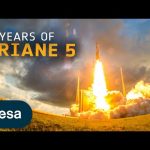
For a quarter century, Ariane 5 has been Europe’s heavy-lift workhorse. Flying from Europe’s Spaceport in French Guiana, Ariane 5 has carried to space a long series of commercial and scientific missions. Notable payloads include ESA’s comet-chasing Rosetta, a dozen of Europe’s Galileo navigation satellites – orbited with just three launches – the NASA/ESA/CSA James Webb Space Telescope and, in April 2023, ESA’s Juice mission to Jupiter.
Ariane 5 more than doubled the mass-to-orbit capacity of its predecessor, Ariane 4, which flew from 1988 until 2003 as a favourite of the telecommunications industry with its need to put large payloads into very high geosynchronous orbits. Ariane 5’s capacity enabled it to orbit two large telecommunications satellites on a single launch, or to push very large payloads into deep space.
After 117 flights, Ariane 5 is being replaced by an all-new launch vehicle, Ariane 6.
★ Subscribe: http://bit.ly/ESAsubscribe and click twice on the bell button to receive our notifications.
We are Europe’s gateway to space. Our mission is to shape the development of Europe’s space capability and ensure that investment in space continues to deliver benefits to the citizens of Europe and the world. Check out https://www.esa.int/ to get up to speed on everything space related.
Live views from the International Space Station (ISS) are streaming from an external camera mounted on the ISS module called Node 2. Node 2 is located on the forward part of the ISS.
The camera is looking forward at an angle so that the International Docking Adapter 2, or IDA2, is visible. If the Node 2 camera is not available due to operational considerations for a longer period of time, a continuous loop of recorded HD Earth Views imagery will be displayed. The loop will have “Previously Recorded” on the image to distinguish it from the livestream from the Node 2 camera.
The space station orbits Earth about 250 miles (425 kilometers) above the surface. An international partnership of five space agencies from 15 countries operates the station, and it has been continuously occupied since November 2000. It’s a microgravity laboratory where science, research, and human innovation make way for new technologies and research breakthroughs not possible on Earth. More: https://go.nasa.gov/3CkVtC8
Did you know you can spot the station without a telescope? It looks like a fast-moving star, but you have to know when to look up. Sign up for text messages or email alerts to let you know when (and where) to spot the station and wave to the crew: https://spotthestation.nasa.gov
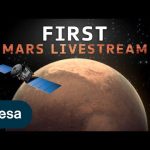
On Friday, to celebrate the 20th birthday of ESA’s Mars Express, you’ll have the chance to get as close as it’s currently possible get to a live view from Mars. Tune in to be amongst the first to see new pictures roughly every 50 seconds as they’re beamed down directly from the Visual Monitoring Camera on board ESA’s long-lived and still highly productive martian orbiter.
“This is an old camera, originally planned for engineering purposes, at a distance of almost three hundred million kilometres from Earth – this hasn’t been tried before and to be honest, we’re not 100% certain it’ll work,” explains James Godfrey, Spacecraft Operations Manager at ESA’s mission control centre in Darmstadt, Germany.
“But I’m pretty optimistic. Normally, we see images from Mars and know that they were taken days before. I’m excited to see Mars as it is now – as close to a martian ‘now’ as we can possibly get!’
We are Europe’s gateway to space. Our mission is to shape the development of Europe’s space capability and ensure that investment in space continues to deliver benefits to the citizens of Europe and the world. Check out https://www.esa.int/ to get up to speed on everything space related.
We are Europe’s gateway to space. Our mission is to shape the development of Europe’s space capability and ensure that investment in space continues to deliver benefits to the citizens of Europe and the world. Check out https://www.esa.int/ to get up to speed on everything space related.