
Tag: heliophysics

  • Heliophysics Big Year (Official NASA Trailer)

    Heliophysics Big Year (Official NASA Trailer)

    In October 2023, NASA is launching the Heliophysics Big Year – a global celebration of solar science and the Sun’s influence on Earth, our solar system, and beyond.

    Modeled after the “Big Year” concept from citizen scientists in the bird-watching community, the Heliophysics Big Year challenges everyone to get involved with fun Sun-related activities.

    Visit https://go.nasa.gov/HelioBigYear to learn more!

    Credits:
    Music: “Rise Now Our Hero” by Dan Thiessen [BMI] via Universal Production Music
    Video credit: NASA’s Goddard Space Flight Center
    Beth Anthony (KBRwyle): Producer

    This video can be freely shared and downloaded at https://svs.gsfc.nasa.gov/14428. While the video in its entirety can be shared without permission, the music and some individual imagery may have been obtained through permission and may not be excised or remixed in other products. Specific details on such imagery may be found here:
    https://svs.gsfc.nasa.gov/14428.

    For more information on NASA’s media guidelines, visit
    https://nasa.gov/multimedia/guidelines.
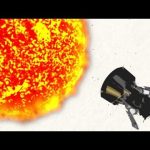
  • NASA | Parker Solar Probe: It’s Surprisingly Hard to Go to the Sun

    NASA | Parker Solar Probe: It’s Surprisingly Hard to Go to the Sun

    The Parker Solar Probe will be the first-ever mission to “touch” the Sun, traveling directly into the Sun’s atmosphere about 4 million miles from the surface. Read the story: https://go.nasa.gov/2KEExYZ NASA launch schedule: https://go.nasa.gov/2JfklMB

    The Sun contains 99.8 of the mass in our solar system. Its gravitational pull is what keeps everything here, from tiny Mercury to the gas giants to the Oort Cloud, 186 billion miles away.

    But even though the Sun has such a powerful pull, it’s surprisingly hard to actually go to the Sun: It takes 55 times more energy to go to the Sun than it does to go to Mars. Why is it so difficult? The answer lies in the same fact that keeps Earth from plunging into the Sun: Our planet is traveling very fast – about 67,000 miles per hour – almost entirely sideways relative to the Sun. The only way to get to the Sun is to cancel that sideways motion.

    Since Parker Solar Probe will skim through the Sun’s atmosphere, it only needs to drop 53,000 miles per hour of sideways motion to reach its destination, but that’s no easy feat. In addition to using a powerful rocket, the Delta IV Heavy, Parker Solar Probe will perform seven Venus gravity assists over its seven-year mission to shed sideways speed into Venus’ well of orbital energy. These gravity assists will draw Parker Solar Probe’s orbit closer to the Sun for a record approach of just 3.83 million miles from the Sun’s visible surface on the final orbits.

    Though it’s shedding sideways speed to get closer to the Sun, Parker Solar Probe will pick up overall speed, bolstered by Sun’s extreme gravity – so it will also break the record for the fastest-ever human-made objects, clocking in at 430,000 miles per hour on its final orbits.

    Music: Percs and Pizz from Killer Tracks.
    Credit: NASA’s Godddard Space flight Center

  • NASA | Sun Sonification (raw audio)

    NASA | Sun Sonification (raw audio)

    These are solar sounds generated from 40 days of the Solar and Heliospheric Observatory’s (SOHO) Michelson Doppler Imager (MDI) data and processed by A. Kosovichev. Read more & download audio: https://go.nasa.gov/2JR0wLL

    The procedure he used for generating these sounds was the following. He started with doppler velocity data, averaged over the solar disk, so that only modes of low angular degree (l = 0, 1, 2) remained. Subsequent processing removed the spacecraft motion effects, instrument tuning, and some spurious points. Then Kosovichev filtered the data at about 3 mHz to select clean sound waves (and not supergranulation and instrumental noise). Finally, he interpolated over the missing data and scaled the data (speeded it up a factor 42,000 to bring it into the audible human-hearing range (kHz)).

    For more audio files, visit the Stanford Experimental Physics Lab Solar Sounds page.​ http://soi.stanford.edu/results/sounds.html

    Credits: A. Kosovichev, Stanford Experimental Physics Lab

    Supporting materials can be downloaded from NASA’s Scientific Visualization Studio at: https://svs.gsfc.nasa.gov/13011

  • NASA | Sounds of the Sun (Low Frequency)

    NASA | Sounds of the Sun (Low Frequency)

    NASA heliophysicist Alex Young explains how sound connects us with the Sun and all other stars. This piece features low frequency sounds of the Sun. Raw audio (no commentary): https://youtu.be/-I-zdmg_Dno Read more: https://go.nasa.gov/2JR0wLL

    Credit: NASA’s Goddard Space Flight Center
    Micheala Sosby (NASA/GSFC): Lead Producer
    Katie Atkinson (GSFC Interns): Lead Producer
    C. Alex Young (NASA/GSFC): Narrator
    Aaron E. Lepsch (ADNET Systems Inc.): Technical Support
    Music: “Flow” by Lee Rosevere

    This video is public domain and along with other supporting materials can be downloaded from the Scientific Visualization Studio at: https://svs.gsfc.nasa.gov/13011