During ESA astronaut Alexander Gerst’s second mission to the International Space Station he supported over 60 European experiments and became Europe’s second ever Space Station Commander. This clip shares a few highlights from Alexander’s Horizons mission and gives a glimpse into life on the Station.
Alexander was launched to the International Space Station from the Baikonur Cosmodrome in Kazakhstan on 6 June 2018. He travelled to the Station with NASA astronaut Serena Auñón-Chancellor and Russian cosmonaut Sergei Prokopyev in a Russian Soyuz MS-09 spacecraft, spent just over six months in orbit and returned to Earth on 20 December 2018.
Watch this journey from launch to landing for a snapshot of memorable moments.
★ Subscribe: http://bit.ly/ESAsubscribe and click twice on the bell button to receive our notifications.
We are Europe’s gateway to space. Our mission is to shape the development of Europe’s space capability and ensure that investment in space continues to deliver benefits to the citizens of Europe and the world. Check out http://www.esa.int/ESA to get up to speed on everything space related.
Nur wenige Stunden nach dem ESA-Astronaut Alexander Gerst von seiner Horizons-Mission auf der Internationalen Raumstation ISS zurückgekehrt ist, gibt er ein kurzes Interview in der Forschungseinrichtung :envihab auf dem Campus des Deutschen Zentrums für Luft- und Raumfahrt in Köln.
Alexander Gerst kehrte am 20. Dezember 2018 zusammen mit den Besatzungsmitgliedern Serena Auñón- Chancellor und Sergei Prokopyev in der Sojus MS-09 auf die Erde zurück – demselben Raumschiff, dass sie am 6. Juni 2018 zur Station brachte.
Die Landung des Trios in der kasachischen Steppe markierte nach über sechs Monaten im Weltraum den erfolgreichen Abschluss der so genannten ISS Expedition 56/57. In dieser Zeit führte Alexander Gerst über 60 europäische Experimente durch, wurde der zweite europäische Kommandant der Internationalen Raumstation, nahm sechs Raumtransporter in Empfang, installierte die erste kommerzielle Forschungsanlage im Columbus-Labor der ESA, sendete eine wichtige Botschaft zum Klimawandel für Delegierte der COP24-Klimakonferenz, machte Echtzeitaufnahmen von einem Sojus-Startabbruch und vieles mehr.
Horizons war Alexander Gersts zweite Mission auf der Internationalen Raumstation – die erste im Jahr 2014 trug den Namen Blue Dot. Er hat nun 363 volle, allerdings nicht aufeinanderfolgende Tage im Weltraum verbracht (an seinem 364. Tag kehrte er nach Hause zurück).
In Köln angekommen, wird Alexander Gerst eine Vielzahl an Bord der ISS durchgeführter wissenschaftlich-technischer Experimente auf der Erde mit dem Ziel der vergleichenden Betrachtung und Bewertung der Daten wiederholen. Hinzu kommen medizinische Untersuchungen sowie viel Sport und körperliches Training zum Zwecke der Regenerierung und Rehabilitation.
★ Subscribe: http://bit.ly/ESAsubscribe and click twice on the bell button to receive our notifications.
ESA is Europe’s gateway to space. Our mission is to shape the development of Europe’s space capability and ensure that investment in space continues to deliver benefits to the citizens of Europe and the world. Check out http://www.esa.int/ESA to get up to speed on everything space related.
Just hours after returning from his Horizons mission on the International Space Station, ESA astronaut Alexander Gerst gives a short interview at the German Aerospace Centre’s ‘:envihab’ facility in Cologne, Germany.
Alexander returned to Earth alongside crew mates Serena Auñón-Chancellor and Sergei Prokopyev on 20 December 2018 in the same Soyuz MS-09 spacecraft that flew them to the Station on 6 June 2018.
The trio’s landing in the Kazakh steppe marked the successful conclusion of over six months in space during which Alexander conducted over 60 European experiments, became the second ever European commander of the International Space Station, welcomed six resupply vehicles, installed the first commercial facility for research in the Columbus laboratory, delivered an important message on climate change for leaders at the COP24 climate change conference, captured real-time footage of a Soyuz launch abort and much, much more.
#Horizons was Alexander’s second mission to the International Space Station – the first was Blue Dot in 2014.
Now back in Cologne, Alexander will take his time to readapt to Earth’s gravity supported by ESA’s team of space medicine experts. He will also continue to provide ground-based data for researchers to support experiments performed in space.
ESA is Europe’s gateway to space. Our mission is to shape the development of Europe’s space capability and ensure that investment in space continues to deliver benefits to the citizens of Europe and the world. Check out http://www.esa.int/ESA to get up to speed on everything space related.
ESA astronaut Alexander Gerst recorded a message in German to his future grandchildren from the International Space Station’s Cupola observatory during his Horizons mission in 2018. Although this message is addressed to his descendants, it applies to all of us. Everyone should contribute to the protection and improvement of this planet we call home.
Alexander’s message is as follows:
Dear grandchildren,
You have not been born yet, and I do not know if I will ever meet you, so I’ve decided to record this message for you.
I’m on the International Space Station in the Cupola Observation Module gazing down at your beautiful planet. And although I’ve now almost spent a year of my life in space and looked at Earth every single day, I just can’t get enough of this view.
I know it probably sounds strange to you, but at the time the Space Station was built and was up here in orbit, not everyone was able to travel into space and see the Earth from a distance. Before me, only around 500 people had the chance. At this very moment, there are 7 billion people living down there on Earth and only three of them live in space. And when I look down at the planet, I think I need to apologise to you.
Right now, it looks like we – my generation – are not going to leave this planet in its best condition for you. Of course, in retrospect many people will say they weren’t aware of what we were doing. But in reality, we humans know that right now we’re polluting the planet with carbon dioxide, we’re making the climate reach tipping point, we’re clearing forests, we’re polluting the oceans with garbage, we’re consuming the limited resources far too quickly, and we’re waging mostly pointless wars.
And every one of us has to take a good look at themselves and think about where this is leading. I very much hope for our own sake that we can still get our act together and improve a few things. And I hope that we won’t be remembered by you as the generation who selfishly and ruthlessly destroyed your livelihood.
I’m sure you understand these things much better than my generation. And who knows, maybe we’ll learn something new, such as: taking a step always helps; this fragile spaceship called Earth is much smaller than most people can imagine; how fragile the Earth’s biosphere is and how limited its resources are; that it’s worth getting along with your neighbours; that dreams are more valuable than money and you have to give them a chance; that boys and girls can do things equally well, but that every one of you has one thing that he or she can do much better than all the others; that the simple explanations are often wrong and that one’s own point of view is always incomplete; that the future is more important than the past; that one should never fully grow up; and that opportunities only come along once. You have to take a risk for things that are worth it, and any day during which you discovered something new – one where you gazed beyond your horizon – is a good day.
I wish I could look into the future through your eyes, into your world and how you see it. Unfortunately, that is not possible and therefore the only thing that remains for me is to try to make your future the best one I can possibly imagine.
International Space Station – Commander of Expedition 57 – Alexander Gerst – 25 November 2018 – 400 km above the Earth’s surface
——————————
Follow Alexander and review his #Horizons mission on social media via http://bit.ly/AlexanderGerstESA and on http://bit.ly/HorizonsBlogESA
——————————
★ Subscribe: http://bit.ly/ESAsubscribe and click twice on the bell button to receive our notifications.
ESA is Europe’s gateway to space. Our mission is to shape the development of Europe’s space capability and ensure that investment in space continues to deliver benefits to the citizens of Europe and the world. Check out http://www.esa.int/ESA to get up to speed on everything space related.
Experience magical moments from ESA astronaut Alexander Gerst’s Horizons mission in this time-lapse of highlights from space.
Combining thousands of images taken by Alexander over more than six months, this Ultra High Definition video provides a glimpse into spacecraft operations and the beauty of Earth as seen from the International Space Station.
Marvel at orbital sunrises, dancing auroras, city lights, oceans, clouds, the Milky Way, the release of cargo vehicles, a Soyuz launch and more against the thin band of atmosphere that surrounds our planet.
ESA is Europe’s gateway to space. Our mission is to shape the development of Europe’s space capability and ensure that investment in space continues to deliver benefits to the citizens of Europe and the world. Check out http://www.esa.int/ESA to get up to speed on everything space related.
This is what three astronauts being launched into space looks like – seen from space. ESA astronaut Alexander Gerst took this time-lapse sequence from the International Space Station’s Cupola observatory on 3 December 2018.
Inside the Soyuz MS-11 spacecraft were NASA astronaut Anne McClain, Canadian Space Agency astronaut David Saint-Jacques and Roscosmos astronaut and Soyuz commander Oleg Konenenko. The trio blasted into orbit at 11:31 GMT from the Baikonur cosmodrome in Kazakhstan and docked with the International Space Station just six hours later.
Spacecraft are launched after the Space Station flies overhead. This allowed Alexander to set up a camera to take regular pictures at intervals that are played back to create this video.
The rocket leaves behind a trail of exhaust as it gains altitude and passes through the layers of Earth’s atmosphere.
ESA is Europe’s gateway to space. Our mission is to shape the development of Europe’s space capability and ensure that investment in space continues to deliver benefits to the citizens of Europe and the world. Check out http://www.esa.int/ESA to get up to speed on everything space related.
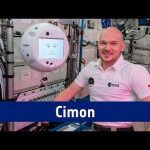
ESA astronaut Alexander Gerst welcomed a new face to the Columbus laboratory, thanks to the successful commissioning of technology demonstration Cimon. Short for Crew Interactive Mobile CompanioN, Cimon is a 3D-printed plastic sphere designed to test human-machine interaction in space.
Developed and built by Airbus in Friedrichshafen and Bremen, Germany, on behalf of German Space Agency DLR, Cimon uses artificial intelligence software by IBM Watson. Its scientific aspects are overseen by researchers at Ludwig Maximilians University Clinic in Munich.
This video shows Alexander’s first interactions with Cimon on board the International Space Station. After introducing himself, where he comes from and what he can do, Cimon tests his free-flying abilities, helps Alexander with a procedure and even plays Alexander’s favourite song ‘Man Machine’ by Kraftwerk. In fact, Cimon likes the music so much, he does not want to stop.
Happy with his initial outing, both Cimon’s developers and Alexander hope to see Cimon back in action again soon. While no further sessions are planned during the Horizons mission at this stage, it could mark the beginning of exciting collaboration between astronauts, robotic assistants and possible future artificial intelligence in space.
ESA is Europe’s gateway to space. Our mission is to shape the development of Europe’s space capability and ensure that investment in space continues to deliver benefits to the citizens of Europe and the world. Check out http://www.esa.int/ESA to get up to speed on everything space related.
Timelapse of the Russian Progress MS-10 cargo spacecraft launched on 16 November 2018 at 18:14 GMT from Baikonur cosmodrome, Kazakhstan, taken by ESA astronaut Alexander Gerst from the International Space Station.
The spacecraft was launched atop a Soyuz rocket with 2564 kg of cargo and supplies. Flying at 28 800 km/h, 400 km high, the International Space Station requires regular supplies from Earth such as this Progress launch. Spacecraft are launched after the Space Station flies overhead so they catch up with the orbital outpost to dock, in this case two days later on 18 November 2018.
The images were taken from the European-built Cupola module with a camera set to take pictures at regular intervals. The pictures are then played quickly after each other at 8 to 16 times normal speed. The video shows around 15 minutes of the launch at normal speed.
The Progress spacecraft delivered food, fuel and supplies, including about 750 kg of propellant, 75 kg of oxygen and air and 440 l of water.
Some notable moments in this video are:
00:07 Soyuz-FG rocket booster separation.
00:19 Core stage separation.
00:34:05 Core stage starts burning in the atmosphere as it returns to Earth after having spent all its fuel.
00:34:19 Progress spacecraft separates from rocket and enters orbit to catch up with the International Space Station.
ESA is Europe’s gateway to space. Our mission is to shape the development of Europe’s space capability and ensure that investment in space continues to deliver benefits to the citizens of Europe and the world. Check out http://www.esa.int/ESA to get up to speed on everything space related.
Since the very first module Zarya launched from Baikonur Cosmodrome on 20 November 1998, the International Space Station has delivered a whole new perspective on this planet we call home. Join us as we celebrate 20 years of international collaboration and research for the benefit of Earth with ESA astronaut Alexander Gerst’s longest timelapse yet.
In just under 15 minutes, this clip takes you from Tunisia across Beijing and through Australia in two trips around the world. You can follow the Station’s location using the map at the top right-hand-side of the screen alongside annotations on the photos themselves.
This timelapse comprises approximately 21 375 images of Earth all captured by Alexander from the International Space Station and shown 12.5 times faster than actual speed.
Music is Orbital Horizons, an original composition by Los Angeles-based musician Matt Piper.
Participate in further Space Station celebrations via social media using hashtag #SpaceStation20th.
ESA is Europe’s gateway to space. Our mission is to shape the development of Europe’s space capability and ensure that investment in space continues to deliver benefits to the citizens of Europe and the world. Check out http://www.esa.int/ESA to get up to speed on everything space related.
ESA astronaut Alexander Gerst launches the 2018/19 European Astro Pi Challenge; an ESA Education project run in collaboration with the Raspberry Pi Foundation. He invites students and young people to conduct their own scientific investigations in space, by writing computer programs that run on Raspberry Pi computers on board the International Space Station.
ESA is Europe’s gateway to space. Our mission is to shape the development of Europe’s space capability and ensure that investment in space continues to deliver benefits to the citizens of Europe and the world. Check out http://www.esa.int/ESA to get up to speed on everything space related.
New Horizons spots its next flyby target, Administrator Bridenstine visits our west coast facilities, and using data from space to fight a life-threatening disease … a few of the stories to tell you about – This Week at NASA!
This video is available for download from NASA’s Image and Video Library: https://images.nasa.gov/details-NHQ_2018_0831_New%20Horizons%20Detects%20Next%20Flyby%20Target%20on%20This%20Week%20@NASA%20%E2%80%93%20August%2031,%202018.html
This timelapse video shows still pictures taken from the International Space Station of the departing #Dragon supply spacecraft. Played in quick succession the video displays faster than real life but in 4K resolution.
The Dragon spacecraft was released from the Station’s robotic arm at 18:38 GMT on 3 August 2018. Thrusters fired to increase its distance from the Space Station and the spacecraft started its deorbit and return to Earth, splashing down in the Pacific Ocean less than seven hours after release.
The International Space Station flies at 28 800 km/h above our planet doing a complete orbit in around 90 minutes – during release operations the sun set and rose above the horizon many times.
As Dragon faded into the distance it flew over a stormy part of Earth – lightning flashes can be seen many kilometres below.
Dragon is the only spacecraft that can return to Earth with scientific cargo aside from the Soyuz spacecraft that ferries astronauts to space and back – this flight carried over 1700 kg of cargo.
ESA is Europe’s gateway to space. Our mission is to shape the development of Europe’s space capability and ensure that investment in space continues to deliver benefits to the citizens of Europe and the world. Check out http://www.esa.int/ESA to get up to speed on everything space related.
Ever wondered what it feels like to fly from Alaska to the Andes in 260 seconds? ESA astronaut Alexander Gerst captured this timelapse footage of Alaska, the USA and South America while orbiting Earth on board the International Space Station.
This timelapse is made up of 6,375 images shown 12.5 times faster than actual speed. Music is Our Oasis by Miriam Speyer, sourced from Audio Network Limited.
Māori, as native New Zealanders, refer to their islands as “Aotearoa” or “the land of the long white cloud”. This timelapse from ESA astronaut Alexander Gerst shows Australia and New Zealand shrouded in cloud from the unique viewpoint of the International Space Station.
Comprised of 5,175 photos, this timelapse is 12.5 times faster than actual speed and is set to the soundtrack “Try or Die” sourced from Audio Network Limited.
Orbiting Earth once every 90 minutes, the International Space Station soars into 16 sunrises and sunsets every single day. Many of these sunrises occur while the crew is working or sleeping, but ESA astronaut Alexander Gerst captured this stunning timelapse of a sunrise to share with us here on Earth.
These photos were taken by Alexander at an interval of two per second and the video has been edited at 25 frames per second.
Music: First Survivors 4 by Los Angeles-based British composer, Luke Richards. Sourced from Audio Network Limited.
On 20 July 2018 around 21:50 local time, ESA astronaut Alexander Gerst welcomed the legendary electronic band Kraftwerk and 7500 visitors to the Jazz Open Festival on Stuttgart’s Schlossplatz – live from the International Space Station, where he will live and work until mid-December 2018. During the call with space, Kraftwerk founding member Ralf Hütter and Alexander played a special duet version of the track Spacelab, for which Alexander had a tablet computer configured with virtual synthesizers on board. With thanks to Kraftwerk for sharing this video footage.
————————————————————————————————————–
So begrüßte ESA-Astronaut Alexander Gerst am 20. Juli 2018 um 21:50 Uhr Ortszeit die legendären Elektro-Pioniere Kraftwerk sowie 7500 Besucherinnen und Besucher des Jazz Open-Festivals auf dem Stuttgarter Schlossplatz – und zwar live von der Internationalen Raumstation ISS, auf der er noch bis Mitte Dezember 2018 lebt und arbeitet.
Kraftwerk-Gründungsmitglied Ralf Hütter und Alexander Gerst spielten eine spezielle Version des Tracks Spacelab im Duett an, für das Gerst eigens einen mit virtuellen Synthesizern konfigurierten Tablet-Computer an Bord hatte.
This unique video shows a full launch of the Soyuz MS-09: from liftoff to orbit.
Watch the launch from inside the crew capsule with first-ever shots from outside the spacecraft recorded by cameras fixed to the exterior of the Soyuz.
The intense launch lasts less than ten minutes whereby the Soyuz spacecraft is propelled 1640 km and gains 210 km altitude. Every second for nine minutes, the spacecraft accelerates 50 km/h on average as the rocket’s boosters burn their fuel and are discarded.
See the astronaut’s reactions and what the spacecraft looks like as the main steps are carried out to get into orbit:
-00:12 Launch command issued
-00:10 Engine turbopumps at flight speed
-00:05 Engines at maximum thrust
00:00 Launch
+1:54 Separation of emergency rescue system
+1:57 First stage separation
+2:38 Fairing separation
+4:48 Second stage separation
+4:58 Tail adapter separation
+8:45 Third stage engine cut off having arrived in orbit
+8:49 Soyuz separation, deploy solar arrays and antennae
The astronauts, from left to right, are NASA astronaut Serena Auñón-Chancellor, Roscosmos commander Sergei Prokopyev and ESA astronaut and flight engineer Alexander Gerst launched in the Soyuz MS-09 spacecraft from the Baikonur cosmodrome in Kazakhstan to the International Space Station on 6 June 2018. ESA astronaut Matthias Maurer and ESA television host Richard Hollingham provide commentary taken from the live event.
Hunched in their Sokol flight suits that offer protection in case of fire or depressurisation, the trio stay in the crew capsule of the Soyuz – the only module that is also designed to survive a return to Earth. The bags above their heads contain supplies for the International Space Station as every bit of space is used.
During a Soyuz launch astronauts typically experience forces of up to 4g – having to work while being pressed into their seats with a force that is four times more than the gravity felt on Earth. The Soyuz commander uses a stick to press buttons as they are too far away from the control panel.
The fluffy toys above the astronauts’ heads are mascots and good luck charms but also serve as a simple but effective test to see when the spacecraft is in orbit: when they start to float the spacecraft is weightless and orbiting Earth. Above Sergei is the mascot for the 2018 FIFA soccer World Cup held in Russia. Alexander took German children television icon “Die Maus” with him.
The launch went as planned as the 50-m tall Soyuz rocket propelled the astronauts to their cruising speed of around 28 800 km/h.
For this launch the astronauts took 34 orbits of Earth over two days to arrive at their destination spending their time in the cramped orbital module of the Soyuz that is no larger than a car. With limited communications and living space the astronauts had time to adapt to weightlessness and reflect on their mission ahead. They aligned their spacecraft with the International Space Station and approached the orbital outpost for docking on 8 June 2018. The files for this video were downloaded by the astronauts after arriving at the Space Station.
Alexander is a returning visitor to the International Space Station, the first of ESA’s 2009 class of astronauts to be sent into space for a second time. During the second part of his mission Alexander will take over as commander of the International Space Station, only the second time an ESA astronaut will take on this role so far.
After orbiting Earth 34 times to catch up to the International Space Station, the car-sized spacecraft carrying ESA astronaut Alexander Gerst, NASA astronaut Serena Auñón-Chancellor and Roscosmos commander Sergei Prokopyev, arrived at the Station two days after launch.
The German astronaut is a returning visitor to the International Space Station, the first of ESA’s 2009 class of astronauts to be sent into space for a second time. During the second part of his mission Alexander will take over as commander of the International Space Station, only the second time an ESA astronaut will take on this role so far.
The mission is called Horizons as a symbol for the unknown and what lies beyond – reflecting on ESA’s strategy to extend human and robotic exploration beyond Earth orbit. While in space, Alexander will work on over 50 European experiments, including testing ways of operating and working with robots to develop techniques required for further human and robotic exploration of our Solar System.
At 11:12 GMT (13:12 CEST), 6 June 2018, ESA astronaut Alexander Gerst was launched into space alongside NASA astronaut Serena Auñón-Chancellor and Roscosmos commander Sergei Prokopyev in the Soyuz MS-09 spacecraft from Baikonur cosmodrome in Kazakhstan.
‘Horizons’ is the name of ESA astronaut Alexander Gerst’s second mission to the International Space Station.
The mission name evokes exploring our Universe, looking far beyond our planet and broadening our knowledge. Alexander would also like to make people realise that there is always a chance to go beyond their personal horizons.
Alexander will be launched on 6 June with US astronaut Serena Auñón-Chancellor and Russian cosmonaut Sergei Prokopyev from the Baikonur cosmodrome, Kazakhstan in the Soyuz MS-09 spacecraft.
Alexander will take over command of the International Space Station for the second half of his mission. Alexander Gerst is the 11th German citizen to fly into space.
The astronaut is now in the last stages of training for his challenging spaceflight. The science programme is packed with European research: more than 50 experiments will deliver benefits to people back on Earth and prepare for future space exploration.
Credits: ESA
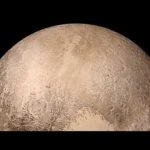
During a July 24 science update at NASA headquarters, new surprising imagery and science results were revealed from the recent flyby of Pluto, by the New Horizons spacecraft. These included an image from the Long Range Reconnaissance Imager or (LORRI) – looking back at Pluto – hours after the historic flyby that shows haze in the planet’s sunlit atmosphere, that extends as high as 80 miles above Pluto’s surface – much higher than expected. Models suggest that the hazes form when ultraviolet sunlight breaks apart methane gas.
LORRI images also show evidence that exotic ices have flowed – and may still be flowing across Pluto’s surface, similar to glacial movement on Earth. This unpredicted sign of present-day geologic activity was detected in Sputnik Planum – an area in the western part of Pluto’s heart-shaped Tombaugh Regio.
Additionally, new compositional data from New Horizons’ Ralph instrument indicate that the center of Sputnik Planum is rich in nitrogen, carbon monoxide, and methane ices.
These key excerpts from a July 24 science update at NASA headquarters, features team members of NASA’s New Horizons mission discussing surprising new images and science results from the spacecraft’s historic July 14 flyby of Pluto.
A July 24 update at NASA headquarters, featured new surprising imagery and science results from the recent flyby of Pluto, by the New Horizons spacecraft. These included an image from the Long Range Reconnaissance Imager or (LORRI) – looking back at Pluto – hours after the historic flyby that revealed a haze in the planet’s sunlit atmosphere that extends as high as 80 miles above Pluto’s surface – much higher than expected. Models suggest that the hazes form when ultraviolet sunlight breaks apart methane gas. LORRI images also show evidence that exotic ices have flowed – and may still be flowing across Pluto’s surface, similar to glacial movement on Earth. This unpredicted sign of present-day geologic activity was detected in Sputnik Planum – an area in the western part of Pluto’s heart-shaped Tombaugh Regio. Additionally, new compositional data from New Horizons’ Ralph instrument indicate that the center of Sputnik Planum is rich in nitrogen, carbon monoxide, and methane ices. Also, Kepler discovers Earth’s “bigger cousin”, New crew launches to space station, EPIC view of Earth, Newman continues NASA center visits and Small Class Vehicle launch pad complete!
After a nearly decade-long journey, NASA’s New Horizons spacecraft arrived at Pluto on July 14 – passing by at a mere 7,750 miles above the surface … resulting in an absolutely breathtaking image – the closest ever of Pluto. Initial congratulations included a Twitter post from the White House … and from iconic figures in the scientific community. The so-called “data waterfall” released by New Horizons contains so many astounding images and detailed information about Pluto that investigators anticipate it will take about 16 months to send it all back to Earth. Also, Mariner 4 Mars flyby anniversary, Newman sworn-in, New wildfire detection tool, Expedition 44/45 prepares for launch and 40th anniversary of Apollo-Soyuz!
At approximately 7:49 a.m. on July 14, NASA’s New Horizons spacecraft is scheduled to be as close as it will get to Pluto, approximately 7,800 miles (12,500 kilometers) above the surface. This historic moment is part of NASA’s coverage of New Horizons’ nine year, three billion mile journey to the Pluto system to gather data about Pluto and its moons.
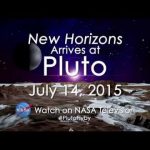
NASA’s New Horizons spacecraft arrives at Pluto on July 14th; a journey lasting nearly 10 years and traveling over 3 billion miles. Watch coverage of the historic flyby of Pluto on NASA Television as NASA counts down to the Pluto encounter of a lifetime.
Weekly pre-flyby updates aired June 23 on NASA TV provides an overview of the New Horizons mission, the spacecraft and its suite of instruments being prepared for a July 14 flyby, and a summary of Pluto science to date.
In NASA’a second televised briefings on Tuesday, April 14, plans and upcoming activities about the agency’s mission to Pluto that will make the first-ever close flyby of the dwarf planet on July 14 were briefed.
Briefers described the mission’s goals and context, scientific objectives and encounter plans – including what images can be expected and when.
New Horizons already has covered more than 3 billion miles since it launched on Jan. 19, 2006. The spacecraft will pass Pluto at a speed of 31,000 mph taking thousands of images and making a wide range of science observations. At a distance of nearly 4 billion miles from Earth at flyby, it will take approximately 4.5 hours for data to reach Earth.
Participants for the 2:20-3:30 p.m. discussion were:
– James Green, director of Planetary Science, NASA Headquarters
– Glen Fountain, New Horizons Project Manager, Johns Hopkins University Applied Physics Laboratory, Laurel, Maryland
– Hal Weaver, New Horizons Project Scientist, Johns Hopkins University Applied Physics Laboratory, Laurel, Maryland
– Alan Stern, New Horizons Principal Investigator, Southwest Research Institute, Boulder, Colorado
In NASA first of two televised briefings on Tuesday, April 14, plans and upcoming activities about the agency’s mission to Pluto that will make the first-ever close flyby of the dwarf planet on July 14 were discussed.
Briefers described the mission’s goals and context, scientific objectives and encounter plans – including what images can be expected and when.
New Horizons already has covered more than 3 billion miles since it launched on Jan. 19, 2006. The spacecraft will pass Pluto at a speed of 31,000 mph taking thousands of images and making a wide range of science observations. At a distance of nearly 4 billion miles from Earth at flyby, it will take approximately 4.5 hours for data to reach Earth.
Participants for 1-2 p.m. discussion were:
– John Grunsfeld, astronaut and Science Mission Directorate associate administrator, NASA Headquarters, Washington
– James Green, director of Planetary Science, NASA Headquarters
– Alan Stern, New Horizons Principal Investigator, Southwest Research Institute, Boulder, Colorado
– William McKinnon, New Horizons Co-Investigator, Washington University in St. Louis
– Cathy Olkin, New Horizons Deputy Project Scientist, Southwest Research Institute, Boulder, Colorado



![Nachricht an meine Enkelkinder [with Closed Captions]](https://video.kidibot.ro/wp-content/uploads/2020/03/6507/nachricht-an-meine-enkelkinder-with-closed-captions-150x150.jpg)