The Coriolis effect says that anytime you’re rotating—whether it’s on a playground toy or your home planet—objects moving in straight lines will appear to curve. This bizarre phenomenon affects many things, from the paths of missiles to the formation of hurricanes.
You may have heard that the Coriolis effect makes water in the bathtub spiral down the drain in a certain way, or that it determines the way that a toilet flushes. That’s actually wrong.
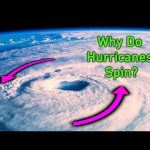
Although, as you may have noticed while tracking a hurricane on the news, storms in the Northern Hemisphere spin counterclockwise, while those in the Southern Hemisphere spin clockwise. Why do storms spin in different directions depending on their location? And why do they spin in the first place? The answer is the Coriolis effect.
You’ve probably seen atoms like this emoji ⚛ everywhere from science textbooks to the logo for The Big Bang Theory. But what does an atom really look like? The truth is much stranger.
SUBSCRIBE: http://youtube.com/whatthephysics?sub
What if the Earth were swallowed by a black hole? Would humanity’s legacy be gone forever? Or could you somehow get back that information from behind the event horizon?
There are three possible answers to this question…but they all break physics as we know it!
Have you ever wondered what it would be like to fall into a black hole? Take a 360° adventure to find out!
SUBSCRIBE: http://youtube.com/whatthephysics?sub
LINKS AND DETAILS:
More details:
#1. Speed of sound: Unlike light, sound needs a medium to travel through, and its speed depends on characteristics of that medium like density and temperature. In the extreme environment of a neutron star’s core, sound can travel extremely fast. But knowing that sound can’t surpass the speed of light, physicists can narrow down their models of neutron stars to include only those where “extremely fast” is less than light speed.
#3. Relativity rainbows: A team at MIT created a game called “A Slower Speed of Light” that lets you see the world as you would at near-light speeds. Their trailer: https://www.youtube.com/watch?v=uu7jA8EHi_0
This evidence seems to suggest that the dark matter is particles that are less than four times the mass of a proton and are moving at non-relativistic speeds. This is consistent with dark matter particles being so-called WIMPs: https://en.wikipedia.org/wiki/Weakly_interacting_massive_particles.
We did something a little different in this episode and answered questions from you, our viewers. If you have a questions about the universe, past videos, or life as a scientist, leave a comment below!
How can you train yourself to be a quantum detector? Quantum interactions happen at impossibly small scales. But the life-size effects are all around you. You can detect quantum mechanics all over — if you know how to look for it.
ADVANCED SCIENTIFIC NOTE: Quantum mechanics would be much more obvious if we had very sensitive eyes. If your eyes identified each photon individually, you would see them land as described in the video, and only build up to this wave pattern. The pattern that we see can be explained classically by waves, it is *ultimately* a quantum phenomenon. The only reason it’s hard to tell is because our light detectors (eyes) aren’t quite sensitive enough.
NOVA has teamed up with Cook’s Illustrated to cook up a recipe for stars and black holes – a culinary “course” on how the most mysterious objects in the universe are created.
SCIENTIFIC NOTES:
* The relationship between information and energy comes from Landauer’s Principle, which connects the erasure of information and energy. But, more generally changes in information (e.g. recording information) are related to changes in energy. I will talk more about this in a future episode about the physics of memory, and why you will forget everything you ever knew! https://en.wikipedia.org/wiki/Landauer%27s_principle
* The numbers calculated in this video give a lower limit on the energy to record a particular amount of information, but to create a more permanent storage of information would require more energy.
* Retina display resolution, as it’s name implies, is similar to the eye’s resolution.
What makes a brain or machine conscious? Will robots become more conscious than we are? One theory, which can actually calculate consciousness, is beginning to provide some answers.
Subscribe: http://youtube.com/whatthephysics?sub_confirmation=1
↓Want more info?↓