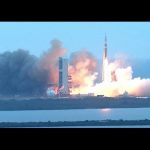
NASA’s Orion spacecraft launched successfully atop a United Launch Alliance Delta IV Heavy rocket Dec. 5 at 7:05 a.m. EST from Space Launch Complex 37 at Cape Canaveral Air Force Station in Florida. Orion’s Exploration Flight Test-1 (EFT-1), is the first flight test for NASA’s new deep space capsule and is a critical step on NASA’s journey to Mars. The 4.5 hour flight is scheduled to conclude with the splashdown of Orion in the Pacific Ocean.
Tag: launch
-
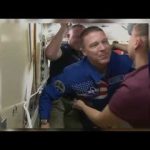
New crew launches to ISS on This Week @NASA – November 28, 2014
NASA’s Terry Virts and Expedition 42/43 crewmates, Anton Shkaplerov of the Russian Federal Space Agency and the European Space Agency’s Samantha Cristoforetti, launched Nov. 23 at 4:01 p.m. Eastern Standard Time, from Baikonur, Kazakhstan. Almost six hours later, their Soyuz spacecraft docked to the International Space Station – where they joined Expedition 42 Commander Barry Wilmore of NASA, and Flight Engineers Alexander Samokutyaev and Elena Serova of Roscosmos – returning the station crew to its full complement of six people. Also, First 3-D printed object in space, Orion flight test update, New airborne Earth Science missions and Happy Thanksgiving from space!
-
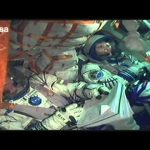
Futura launch replay
The Soyuz TMA-15M spacecraft was launched from Baikonur cosmodrome in Kazakhstan at 21:01 GMT/22:01 CET on 23 November 2014 with ESA astronaut Samantha Cristoforetti and her crewmates to the weightless research centre where they will live and work for five months.
With Samantha are Russian Soyuz commander Anton Shkaplerov and NASA astronaut Terry Virts. All three are part of the Station’s Expedition 42/43 crew.
On this mission, Samantha is flying as an ESA astronaut for Italy’s ASI space agency under a special agreement between ASI and NASA. Her mission is called the Futura mission.
-

Futura mission: Launch preparation 3
ESA astronaut Andreas Mogensen’s third video diary from Baikonur, in Kazakhstan, where he is currently joining the Expedition 42/43 crew in quarantine ahead of their launch to the International Space Station on 23 November. In this video Andreas reports on the roll-out of the Soyuz rocket to the launch pad.
Andreas is in Baikonur to experience launch preparations ahead of his own launch to the ISS in September 2015. He will spend 10 days on the Space Station for his Iriss mission.
ESA astronaut Samantha Cristoforetti is a member of the Expedition 42/43 crew and will spend 6 months on the ISS for the Futura mission.
Connect with Andreas at http://andreasmogensen.esa.int
Connect with Samantha at http://samanthacristoforetti.esa.int -
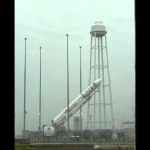
Antares Rocket Raised on Launch Pad
The Orbital Sciences Corporation Antares rocket, with the Cygnus spacecraft onboard, is seen in this time-lapse movie as it is raised at launch Pad-0A, Thursday, July 10, 2014, at NASA’s Wallops Flight Facility in Virginia. The Antares will launch with the Cygnus spacecraft filled with over 3,000 pounds of supplies for the International Space Station, including science experiments, experiment hardware, spare parts, and crew provisions. The Orbital-2 mission is Orbital Sciences’ second contracted cargo delivery flight to the space station for NASA. Photo Credit: (NASA/Bill Ingalls)
-
NASA’s Orbiting Carbon Observatory-2 (OCO-2) Launch From Vandenberg Air Force Base
NASA’s first spacecraft dedicated to studying carbon dioxide in Earth’s atmosphere was successfully launched from Vandenberg Air Force Base, California. OCO-2 will be collecting a great number of high-resolution measurements, which will provide a greater spatial distribution of CO2 over the entire globe, in short, a bigger, clearer, more complete picture of global CO2. These measurements will be combined with data from the ground-based network to provide scientists with the information that they need to better understand the processes that regulate atmospheric CO2 and its role in the carbon cycle.
-
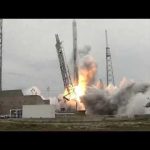
New NASA Cargo Launches to Space Station Aboard SpaceX-3 Mission
Approximately 2.4 tons of NASA science investigations and cargo were launched to the International Space Station aboard SpaceX’s Dragon spacecraft. The launch aboard the company’s Falcon 9 rocket took place from Space Launch Complex 40 at Cape Canaveral Air Force Station in Florida on Monday, April 18 at 3:25 p.m. EDT. Dragon’s cargo will support more than 150 experiments that will be conducted during space station Expeditions 39 and 40. The spacecraft will be grappled at 7:11 a.m. on Wednesday, April 16 by Expedition 39 Commander Koichi Wakata of the Japan Aerospace Exploration Agency. Dragon is scheduled to depart the space station May 18 for a splashdown in the Pacific Ocean west of Baja California, bringing with it about 3,500 pounds of science and research, hardware, crew supplies and spacewalk tools from the space station.
-

Onboard camera view: launch and separation of Sentinel-1A
Cameras mounted on the Soyuz Fregat upper stage that sent Sentinel-1A into space on 3 April 2014 captured this superb footage. It shows liftoff, the various stages in the rocket’s ascent and the Sentinel-1A satellite being released from the Fregat upper stage to start its life in orbit around Earth.
The 2.3 tonne satellite lifted off on a Soyuz rocket from Europe’s Spaceport in Kourou, French Guiana at 21:02 GMT (23:02 CEST). The first stage separated 118 sec later, followed by the fairing (209 sec), stage 2 (287 sec) and the upper assembly (526 sec). After a 617 sec burn, the Fregat upper stage delivered Sentinel into a Sun-synchronous orbit at 693 km altitude. The satellite separated from the upper stage 23 min 24 sec after liftoff.
Sentinel-1 is the first in the family of satellites for Europe’s Copernicus programme. It carries an advanced radar to scan Earth’s surface in all weather conditions and regardless of whether it is day or night. This new mission will be used to care for many aspects of our environment, from detecting and tracking oil spills and mapping sea ice to monitoring movement in land surfaces and mapping changes in the way land is used.
-
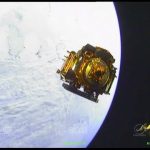
Sentinel-1A separation in space
This superb footage was acquired by cameras on the Soyuz Fregat upper stage that released Sentinel-1A into orbit on 3 April 2014. It shows the Sentinel-1A satellite separating from the Fregat to start its life in orbit around Earth.
The 2.3 tonne satellite lifted off on a Soyuz rocket from Europe’s Spaceport in Kourou, French Guiana at 21:02 GMT (23:02 CEST). The first stage separated 118 sec later, followed by the fairing (209 sec), stage 2 (287 sec) and the upper assembly (526 sec). After a 617 sec burn, the Fregat upper stage delivered Sentinel into a Sun-synchronous orbit at 693 km altitude. The satellite separated from the upper stage 23 min 24 sec after liftoff.
Sentinel-1 is the first in the family of satellites for Europe’s Copernicus programme. It carries an advanced radar to scan Earth’s surface in all weather conditions and regardless of whether it is day or night. This new mission will be used to care for many aspects of our environment, from detecting and tracking oil spills and mapping sea ice to monitoring movement in land surfaces and mapping changes in the way land is used.
Credits:
Arianespace/ESA/Roscosmos -
NASA and the Japanese Aerospace Agency Launch GPM Satellite
From the Tanegashima Space Center near the southernmost tip of Japan, NASA and the Japanese Aerospace Exploration Agency (JAXA) launched a joint mission to study global measurements of rainfall and snowfall abroad JAXA’s H-IIA rocket. The Global Precipitation Measurement (GPM) Core Observatory is a new NASA built science satellite that will link data from a constellation of current and planned satellites and produce the most precise observations of rain and snow every three hours from anywhere on the globe. The GPM Core Observatory will fly 253 miles (407 kilometers) above Earth in an orbit inclined at 65-degrees to the equator and will begin normal operations in about 60 days after launch. Data will be downlinked through NASA’s Tracking and Data Relay Satellite System to the agency’s Goddard Space Flight Center’s Precipitation Processing Center in Greenbelt, Md., where it will be processed and distributed over the Internet.
-

Ariane 5 flight VA217 liftoff replay
The first Ariane 5 launch of 2014 lifted off from Europe’s Spaceport in French Guiana on its mission to place two telecommunications satellites, ABS-2 & Athena–Fidus, into their planned transfer orbits.
Credit: ESA / CNES / Arianespace
-
Timelapse film Soyuz flight VS06, with Gaia
Soyuz flight VS06, with the Gaia space observatory, lifted off from Europe’s Spaceport, French Guiana, on 19 December 2013. This timelapse movie shows Gaia sunshield deployment test, the transfer of the Soyuz from the assembly building to the launch pad and the lift off.
ESA–S. Corvaja, M. Pedoussaut, 2013
-

Gaia launch replay highlights
ESA’s Gaia mission blasted off on 19 December 2013 on a Soyuz rocket from Europe’s Spaceport in Kourou, French Guiana, on its exciting mission to study a billion suns.
Gaia is destined to create the most accurate map yet of the Milky Way. By making accurate measurements of the positions and motions of 1% of the total population of roughly 100 billion stars, it will answer questions about the origin and evolution of our home Galaxy.
The Soyuz launcher, operated by Arianespace, lifted off at 09:12 GMT (10:12 CET). About ten minutes later, after separation of the first three stages, the Fregat upper stage ignited, delivering Gaia into a temporary parking orbit at an altitude of 175 km.
Gaia is now en route towards an orbit around a gravitationally-stable virtual point in space called L2, some 1.5 million kilometres beyond Earth as seen from the Sun.
This video includes highlights of the launch webcast including lift-off from Kourou, the Soyuz mission, separation of Gaia and the successful entry into orbit.
Credit:ESA / CNEA / Arianespace
-
Gaia launch – Full replay
Watch the full replay of the launch coverage of ESA’s billion-star surveyor Gaia. Liftoff occurred at 09:12UT/10:12CET on 19 December and the successful deployment of Gaia’s sunshield was confirmed approximately 90 minutes later. Gaia is now on its way to L2, where it will study the characteristics of 1 billion stars to create the most precise 3D map of our home galaxy, the Milky Way.
Credt: ESA / CNES / Arianespace
-
ESA’s Gaia lifts off
Watch a replay of ESA’s billion-star surveyor Gaia lift off at 09:12UT/10:12CET on 19 December
Credits: ESA / CNES / Arianespace
-
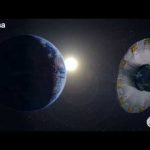
Gaia: launch to orbit
Animation showing Gaia launch and journey to its operating orbit. The animation begins by visualising the launch from Europe’s Spaceport in Kourou, French Guiana, on a Soyuz-STB/Fregat-MT vehicle. The rocket’s four boosters are jettisoned 118 seconds after launch, and the spacecraft fairing is jettisoned after 220 seconds. Following two burns, the Fregat upper stage separates from Gaia 42 minutes after launch. The separation activates an automatic sequence onboard Gaia, including switching on the spacecraft’s transmitters, pressurisation of the propulsion system, initial attitude acquisition and deployment of the sunshield. By then Gaia will be on its transfer orbit from Earth towards L2, a virtual point in space some 1.5 million kilometres ‘behind’ Earth as seen from the Sun. Gaia will take about a month to cruise and manoeuvre into a ‘Lissajous’ orbit around L2. The size of the orbit is typically 340 000 x 90 000 km and takes 180 days. There, Gaia will spin slowly in order to make systematic repeated observations of stars covering the whole sky with its two telescopes. Over its five-year mission, Gaia will monitor the positions, motions, temperatures, luminosities and compositions of a billion stars.
Credit: ESA–C. Carreau/ATG medialab
-
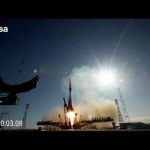
The Soyuz launch sequence explained
What are the parts of the Soyuz rocket? What are the stages into orbit? What is the launch sequence? Watch and find out. This video has been produced from an actual lesson delivered to the ESA astronaut class of 2009 (also known as the #Shenanigans09) during their ESA Basic Training in 2009-2010
This video is a joint production of the ESA Human Spaceflight & Operation Astronaut Training Division & Promotion Office
Note: Subtitles are available for English, Italian, Russian and German. Click on the caption button to choose.
Technical Experts: Stephane Ghiste, Dmitriy Churkin
Content Design: Stephane Ghiste, Dmitriy Churkin, Pascal Renten, Simon Trim, Matthew Day
Video Production & Editing: Pascal Renten, Simon Trim, Andrea Conigli
Narration Voice: Bernard Oattes
Project Co-ordination: Loredana Bessone, Matthew DaySpecial Thanks to:
Massimo Sabbatini, Guillaume Weerts ESA Human Spaceflight & Operation Promotion Office
Martin Schweiger (for use of his Orbiter software: http://orbit.medphys.ucl.ac.uk)
Nikita Vtyurin, Andrew Thielmann (Orbiter Soyuz model)
Iacopo Baroncini (Soyuz model)
Joey P. Wade (Google Earth Soyuz models)
NASA
ROSCOSMOSWatch Part 2: Soyuz rendezvous and docking explained
https://www.youtube.com/watch?v=M2_NeFbFcSwWatch Part 3: Soyuz undocking, reentry and landing explained
https://www.youtube.com/watch?v=-l7MM9yoxII -
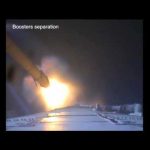
Sterex images of ATV-4 launch
ESA’s ATV-4 launch images taken by the Sterex experiment. These images provide a stunning vision of the Ariane 5 launch, including liftoff, boosters separation and ATV-4 release. The video system was developed by Kayser-Threde GmbH for ESA and DLR and integrated on Ariane by Astrium GmbH. Usage for ATV-4 was financed by DLR and ESA and supported by Arianespace and CNES.
© ESA /DLR-BMWi 2013
-
Countdown to Launch on This Week @NASA
With their launch from Kazakhstan to the International Space Station fast approaching, Expedition 34/35 Soyuz Commander Roman Romanenko, Flight Engineer Tom Marshburn of NASA and Flight Engineer Chris Hadfield of the Canadian Space Agency continue to train and finalize plans for the December 19 flight. Also, Orion taking shape; Mars field trip: GRAIL’s impact; FASTSat’s finale; “Big Wind”; rocket holiday; and more!
-
NASA Launches Radiation Belt Storm Probes Mission
NASA’s Radiation Belt Storm Probes (RBSP), the first twin-spacecraft mission designed to explore our planet’s radiation belts, launched into the predawn skies at 4:05a.m. EDT Thursday from Cape Canaveral Air Force Station, Fla.
The two satellites, each weighing just less than 1,500 pounds, comprise the first dual-spacecraft mission specifically created to investigate this hazardous regions of near-Earth space, known as the radiation belts. These two belts, named for their discoverer, James Van Allen, encircle the planet and are filled with highly charged particles. The belts are affected by solar storms and coronal mass ejections and sometimes swell dramatically. When this occurs, they can pose dangers to communications, GPS satellites and human spaceflight.
The hardy RBSP satellites will spend the next 2 years looping through every part of both Van Allen belts. By having two spacecraft in different regions of the belts at the same time, scientists finally will be able to gather data from within the belts themselves, learning how they change over space and time. Designers fortified RBSP with special protective plating and rugged electronics to operate and survive within this punishing region of space that other spacecraft avoid. In addition, a space weather broadcast will transmit selected data from those instruments around the clock, giving researchers a check on current conditions near Earth.
-
SPACEX/NASA DISCUSS LAUNCH OF FALCON 9 ROCKET AND DRAGON CAPSULE
During a press briefing at The Kennedy Space Center on May 22, SpaceX and NASA officials discussed the launch of the SpaceX Falcon 9 rocket and Dragon capsule on a demonstration flight to the International Space Station. Falcon 9 and Dragon lifted off Tuesday from Cape Canaveral Air Force Station in Florida at 3:44 a.m. EDT. On Thursday, May 24, Dragon will perform a flyby of the space station at a distance of approximately 1.5 miles to validate the operation of sensors and flight systems necessary for a safe rendezvous and approach. Following analysis of the flyby by NASA and SpaceX managers, the Dragon capsule will be cleared to rendezvous and berth with the space station on Friday, May 25, marking the first time a commercial company has attempted this feat.
-
SPACEX/NASA DISCUSS LAUNCH ABORT OF FALCON 9 ROCKET
During a press briefing at The Kennedy Space Center on May 19, SpaceX President Gwynne Shotwell and NASA Commercial Crew and Cargo Program Manager Alan Lindenmoyer discussed the launch abort of the SpaceX Falcon 9 rocket and Dragon capsule on a demonstration flight to the International Space Station. Early data shows that high chamber pressure in Engine #5 caused a cutoff of all nine engines at T- 0.5 seconds. SpaceX will continue to look at the data and inspect the engine before setting a new launch date. The next possible opportunity is May 22 from Cape Canaveral Air Force Station in Florida.
-
“Riding the Booster” Never Sounded Better
From launch to landing, a space shuttle’s solid rocket booster journey is captured, with sound mixed and enhanced by Skywalker Sound.
-
Succès pour le vol inaugural du nouveau lanceur Vega de l’ESA
Vega, le nouveau lanceur de l’ESA, est désormais prêt pour son entrée en exploitation aux côtés d’Ariane-5 et de Soyouz, après le succès de son vol de qualification, effectué ce matin depuis le port spatial de l’Europe à Kourou (Guyane française).
Avec Vega, qui vient compléter la famille des lanceurs disponibles à Kourou, l’Europe est désormais à même de répondre à toute la gamme des besoins de lancement, que ce soit pour mettre sur orbite des petits satellites scientifiques et d’observation de la Terre ou pour entreprendre des missions de vaste envergure comme l’envoi de véhicules ESA de ravitaillement à destination de la Station spatiale internationale (ISS).
Vega a décollé pour la première fois à 10h00 GMT (11h00 heure de Paris, 7h00 heure locale) de son nouveau pas de tir, et son vol de qualification s’est parfaitement déroulé.
-
ESA Euronews: A star rocket is born
The family of European rockets is growing. The next one is the youngest, called Vega, soon to be launched from Europe’s Spaceport in French Guiana.
This new rocket complements the range that Europe already has to offer in the commercial market. -
ESA Euronews: Nasce una stella tra i lanciatori spaziali europei
La famiglia dei vettori spaziali europei si allarga con il prossimo lancio di Vega dalla base europea della Guyana francese. Questo nuovo lanciatore va a completare l’offerta della gamma europea nell’ambito dei razzi commerciali. Ne parliamo nella rubrica Space.
-

PromISSe launch campaign – now in 3D!
Follow ESA astronaut André Kuipers and his crewmates, NASA astronaut Donald Pettit and Roscosmos cosmonaut Oleg Kononeko, on their journey from Baikonur cosmodrome, in Kazakhstan, up to their launch onboard a Soyuz TMA-03M spacecraft to the International Space Station (ISS).
On 21 December 2011, André embarked on ESA’s fourth long-duration mission to the ISS, “PromISSe”. During his five months onboard this human outpost in space, Andre is serving as a flight engineer for Expedition 30.
This exceptional 3D video shows some of the main events before launch, including: the city of Baikonur, the avenue of cosmonauts with the tree once planted by Yuri Gagarin, the Gagarin Museum, the roll-out of Soyuz in the early morning hours, the vertical erection of the rocket on the launch pad, the pre-launch press conference, the ready-to-fly report of the crew commander, and of course – the amazing light show of a night launch from the Gagarin launch pad in Baikonur.
Stereoscopic 3D glasses are required to properly enjoy the full 3D effect of this footage.
André and his fellow crew members will return to Earth by the end of May 2012.
-
ESA Euronews: Soyuz descola pela primeira vez do Porto Espacial da Europa
Lançou o Sputnik e Gagarin para o espaço. O mítico foguetão russo Soyuz conta já com mais de 1700 voos. O lançamento do Porto Espacial Europeu, na Guiana Francesa, abre um novo capítulo na sua longa carreira.
-
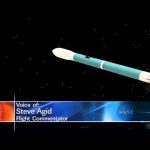
NASA’s GRAIL Spacecraft Launches on Lunar Mission
NASA’s GRAIL spacecraft launched to the moon aboard a United Launch Alliance Delta II rocket on Sept. 10, 2011, from Cape Canaveral Air Force Station, Fla.
GRAIL’s primary science objectives are to determine the structure of the lunar interior, from crust to core, and to advance understanding of the thermal evolution of the moon.
-
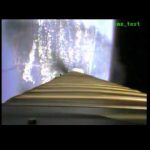
Juno Mission Launches to Jupiter
NASA’s Juno spacecraft is on its way to Jupiter after being launched aboard an Atlas V rocket from the Cape Canaveral Air Force Station, Florida on August 5 at 11:25 a.m. Eastern. The solar-powered spacecraft will arrive at Jupiter in July 2016 and orbit its poles 33 times to find out more about the gas giant’s interior, atmosphere and aurora. Scientists believe Jupiter holds the key to better understanding the origins of our solar system.
-

STS-135: Final Launch of the Space Shuttle Program
Space shuttle Commander Chris Ferguson and crewmates Pilot Doug Hurley, and Mission Specialists Sandy Magnus and Rex Walheim are on their way to the International Space Station after launching from NASA’s Kennedy Space Center at 11:29 a.m. EDT on Friday, July 8. STS-135 is the final mission of NASA’s Space Shuttle Program.
The 12-day mission will deliver the Raffaello multi-purpose logistics module filled with more than 8,000 pounds of supplies and spare parts to sustain space station operations after the shuttles are retired. STS-135 is the 135th shuttle flight, the 33rd flight for Atlantis and the 37th shuttle mission dedicated to station assembly and maintenance, -
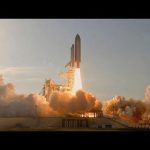
ESA Euronews: Transbordador espacial: el último viaje
Un capítulo de la aventura espacial se cierra con el lanzamiento de la nave estadounidense Atlantis, con el que se pone punto y final a las misiones del transbordador. Ha pervivido durante 30 años, una historia de momentos felices y trágicos.
-
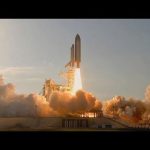
ESA Euronews: Addio, Space Shuttle
Si chiude un capitolo dell’epopea spaziale, con il lancio della navetta americana Atlantis che segna la fine delle missioni dello Space Shuttle. Una storia lunga trent’anni che ha conosciuto i suoi momenti di gloria e le sue tragedie.
-
ESA Euronews: Letzter Flug für das Space Shuttle
Mit dem letzten Start der Weltraumfähre “Atlantis” geht zugleich ein Kapitel in der Geschichte der Weltraumfahrt zuende. Denn der 135. Space-Shuttle-Flug ist der Letzte seiner Art. Zurück liegen drei Jahrzehnte mit ihren Höhepunkten sowie mit ihren Tragödien. Mehr darüber in unserer Rubrik Space.
-
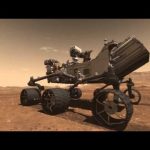
Mars Science Laboratory Curiosity Rover Animation
This 11-minute animation depicts key events of NASA’s Mars Science Laboratory mission, which will launch in late 2011 and land a rover, Curiosity, on Mars in August 2012. A shorter 4-minute version of this animation, with narration, is also available on our youtube page.
-
“Endeavour” roars up to sky with Roberto Vittori and AMS-02
Space Shuttle “Endeavour” was launched to space at 14:56 CEST (12:56 GMT) on 16 May from Kennedy Space Center in Florida.
The 16-day-long STS-134 mission will deliver AMS-02, a big cosmological instrument to the Space Station and its crew includes ESA’s Italian astronaut Roberto Vittori. This is the last flight of “Endeavour”. -

STS-134 Gets New Launch Date on This Week @NASA
The launch of space shuttle Endeavour on STS-134 has been rescheduled for May 16th. Launch is scheduled for 8:56 a.m. Eastern. Also, NASA’s Gravity Probe B mission confirms two aspects of Albert Einstein’s theory of general relativity. Plus, two Mercury explorers honored; Young innovators recognized; ISS honored; NextGen Day; rotocraft research; FIRST finals; and HQ Cyber Café.
-

New Shuttle Launch Date on This Week @NASA
NASA has re-targeted the liftoff of space shuttle Endeavour for Friday, April 29, at 3:47 p.m. EDT. The move comes to resolve a scheduling conflict with a Russian Progress supply vehicle scheduled to launch April 27 and arrive at the station two days later. Also, Goddard Memorial Symposium; “Wheels” rolls with big Shorty; cost-saving software summit; two honors for Ames; and, marking Odyssey’s beginning.
-

Expedition 27 Crew Prepares for Launch as their Soyuz Rocket Move to Launch Pad
The Soyuz TMA-21 spacecraft and its booster and were moved to the launch pad at the Baikonur Cosmodrome in Kazakhstan on a railcar April 2 for final preparations before launch April 5, Baiknour time, to the International Space Station. The Soyuz will carry Expedition 27 Soyuz Commander Alexander Samokutyaev, NASA Flight Engineer Ron Garan and Russian Flight Engineer Andrey Borisenko to the complex. The trio will spend six months on the station, joining station Commander Dmitry Kondratyev, NASA Flight Engineer Cady Coleman and European Space Agency Flight Engineer Paolo Nespoli, who have been in orbit since December 2010. Samokutyaev, Garan and Borisenko are in final training for launch with their backups, Anatoly Ivanishin, Dan Burbank and Anton Shkaplerov. The footage includes interviews with Astronaut Nicole Stott, STS-133 Mission Specialist, and with Mike Lopez-Alegria, Deputy Director for ISS, NASA Flight Crew Operations.