
Is Mars habitable? Could ancient life once have existed on the Red Planet? Is there potential for life today deep beneath the Martian crust? NASA Mars expert Ell Bogat is here to give us the details.
Tag: Mars
-

60 Years of Mars Exploration Has Led to This
Watch live on February 18, 2021, as our Perseverance Mars Rover touches down on the Red Planet.
60 years ago, NASA started sending robotic explorers to Mars, but none have been as sophisticated as Perseverance. It will gather samples from the Martian surface for possible later return to Earth, and fly a drone for the first time on any planetary body. Watch it touch down live and use the hashtag #CountdownToMars for the latest updates and news.
Producer/Editor: David Anderson
Music: Universal Production Music -

Perseverance Mars Rover Pre-Landing News Conference
After nearly 300 million miles, our Perseverance rover completes its journey to Mars on Feb. 18, 2021. To reach the surface of the Red Planet, it has to survive the harrowing final phase known as Entry, Descent, and Landing.
On Jan. 27 at 4:30 p.m. EST, find out more about the upcoming landing from the scientists and engineers on the team:
Thomas Zurbuchen, associate administrator, Science Mission Directorate, NASA Headquarters
Lori Glaze, director, Planetary Science Division, NASA Headquarters
Matt Wallace, Mars 2020 deputy project manager, JPL
Allen Chen, Mars 2020 entry, descent, and landing lead, JPL
Ken Farley, Mars 2020 project scientist, Caltech
Briony Horgan, Mars 2020 science team member, Purdue University -

3D print your own Mars rover with ExoMy
Europe’s Rosalind Franklin ExoMars rover has a younger ’sibling’, ExoMy. The blueprints and software for this mini-version of the full-size Mars explorer are available for free so that anyone can 3D print, assemble and program their own ExoMy.
Learn more at www.esa.int/exomy
★ Subscribe: http://bit.ly/ESAsubscribe and click twice on the bell button to receive our notifications.
Check out our full video catalog: http://bit.ly/SpaceInVideos
Follow us on Twitter: http://bit.ly/ESAonTwitter
On Facebook: http://bit.ly/ESAonFacebook
On Instagram: http://bit.ly/ESAonInstagram
On Flickr: http://bit.ly/ESAonFlickrWe are Europe’s gateway to space. Our mission is to shape the development of Europe’s space capability and ensure that investment in space continues to deliver benefits to the citizens of Europe and the world. Check out https://www.esa.int/ to get up to speed on everything space related.
Copyright information about our videos is available here: https://www.esa.int/ESA_Multimedia/Terms_and_Conditions
#ESA
#3DPrinting
#ExoMy -

Gravity Assist Podcast: Looking For Life in Ancient Lakes
Astrobiologists study ancient lakes on Earth in order to help us search for life in our solar system and beyond. Subscribe to our “Gravity Assist” podcast for this episode and more: www.nasa.gov/gravityassist
As the Perseverance Rover flies toward Jezero Crater on Mars, which once hosted water, astrobiologists are interested in places on Earth that are similar to the rover landing site. Kennda Lynch, scientist at the Lunar and Planetary Institute in Houston, Texas, has been doing fieldwork in an ancient lake location in Utah called the Pilot Valley Playa. In this episode of Gravity Assist, she describes her recent discoveries and why she’s excited about Perseverance. She also explains how all life forms create waste products, even bacteria, that could leave tracers or “biosignatures” for scientists to detect. By looking at how microbes survive in extreme environments on Earth, scientists can explore the bigger question of how life could sustain itself on other planetary bodies like Mars and Jupiter’s moon Europa.
Image Credits:
NASA
Vox/ YouTube Original -“Glad You Asked”
Brocken Inaglory/Wikimedia Commons
Alexander Gerst/Wikimedia Commons
Paul Hermans/Wikimedia CommonsProducer: Sonnet Apple
This video is available for download from NASA’s Image and Video Library: https://images.nasa.gov/details-NHQ_2020_0814_Gravity%20Assist_Kennda%20Lynch
-

Thomas and Matthias astro chats: space photography | Episode 4
Join ESA astronauts Thomas Pesquet and Matthias Maurer at NASA’s Johnson Space Center in Houston, Texas, USA. In part four of this video series, the astronauts discuss taking photos on the International Space Station.
Though mission details and dates are yet to be confirmed, Thomas and Matthias are the next two European astronauts in line for flights. Thomas has flown to the International Space Station before, while Matthias will fly for the first time.
Prior to a mission, astronauts train extensively to ensure they are familiar with the vast array of systems and operations on board. In this video, the pair reflect on the images Thomas took during his first mission and how he plans to approach space photography the second time around.
This video was filmed in June 2020. At that time, the platform Thomas and Matthias were standing on – in front of a full-scale mock-up of the International Space Station – was the only place at NASA’s JSC that they could interact without face masks. Despite this, the pair were required to maintain social distance at all times as a precaution.
Learn more: https://bit.ly/HumanAndRoboticExplorationESA
★ Subscribe: http://bit.ly/ESAsubscribe and click twice on the bell button to receive our notifications.
Check out our full video catalog: http://bit.ly/SpaceInVideos
Follow us on Twitter: http://bit.ly/ESAonTwitter
On Facebook: http://bit.ly/ESAonFacebook
On Instagram: http://bit.ly/ESAonInstagram
On Flickr: http://bit.ly/ESAonFlickrWe are Europe’s gateway to space. Our mission is to shape the development of Europe’s space capability and ensure that investment in space continues to deliver benefits to the citizens of Europe and the world. Check out http://www.esa.int/ESA to get up to speed on everything space related.
Copyright information about our videos is available here: http://www.esa.int/spaceinvideos/Terms_and_Conditions
#ESA
#MatthiasMaurer
#ThomasPesquet -

Our Next Mars Rover is Headed to The Red Planet on This Week @NASA – July 31, 2020
Our next Mars rover is on its way, preparing for the historic return of a Commercial Crew mission, and naming the crew for a future mission … a few of the stories to tell you about – This Week at NASA!
Download Link: https://images.nasa.gov/details-Our%20Next%20Mars%20Rover%20is%20Headed%20to%20The%20Red%20Planet%20on%20This%20Week%20@NASA%20%E2%80%93%20July%2031,%202020
-

#EZScience: Preparing to Launch the Perseverance Rover to Mars
In this “On the Go” episode of #EZScience, we’re on the scene at Kennedy Space Center with the rocket that will take the Perseverance rover and the Ingenuity helicopter to Mars.
ABOUT THE SERIES: In our #EZScience video series with the National Air and Space Museum, NASA’s associate administrator for science Dr. Thomas Zurbuchen and Museum director Dr. Ellen Stofan talk about the latest in planetary science and exploration.
Learn more about the series: https://www.nasa.gov/ezscience
-

Flight over the Mars 2020 Perseverance rover landing site
This video shows Jezero crater, the landing site of the @NASA Mars 2020 Perseverance rover on the Red Planet, based on images from ESA’s Mars Express mission. The planned landing area is marked with an orange ellipse.
Scheduled for launch from Cape Canaveral, Florida on 30 July 2020 on board an Atlas V rocket, the Perseverance rover will land on 18 February 2021 in Jezero crater.
An impact crater with a diameter of about 45 km, Jezero is located at the rim of the giant Isidis impact basin. Morphological evidence suggests that the crater once hosted a lake, some 3.5 billion years ago.
Jezero possesses an inlet- and an outlet channel. The inlet channel discharges into a fan-delta deposit, containing water-rich minerals such as smectite clays. Scientists believe that the lake was relatively long lived because the delta may have required 1 to 10 million years to reach its thickness and size. Other studies conclude that the lake did not experience periods of important water-level fluctuations and that it was formed by a continuous surface runoff. This makes Jezero crater to a prime target for the search for potential signs of microbial life, because organic molecules are very well preserved in river deltas and lake sediments.
A recent study of the ancient lakeshores, diverse minerals and violent volcanism of Jezero crater based on data from ESA’s Mars Express mission is available here: https://bit.ly/MarsExpressHelpsUncoverTheSecretsOfPerseveranceLandingSite
The animation was created using an image mosaic made from four single orbit observations obtained by the High Resolution Stereo Camera (HRSC) on Mars Express between 2004 and 2008. The mosaic combines data from the HRSC nadir and colour channels; the nadir channel is aligned perpendicular to the surface of Mars, as if looking straight down at the surface. The mosaic image was then combined with topography information from the stereo channels of HRSC to generate a three-dimensional landscape, which was then recorded from different perspectives, as with a movie camera, to render the flight shown in the video.
Copyright:
Animation: ESA/DLR/FU Berlin, CC BY-SA 3.0 IGO
Music: Björn Schreiner
Soundtrack logo: Alicia Neesemann★ Subscribe: http://bit.ly/ESAsubscribe and click twice on the bell button to receive our notifications.
Check out our full video catalog: http://bit.ly/SpaceInVideos
Follow us on Twitter: http://bit.ly/ESAonTwitter
On Facebook: http://bit.ly/ESAonFacebook
On Instagram: http://bit.ly/ESAonInstagram
On Flickr: http://bit.ly/ESAonFlickrWe are Europe’s gateway to space. Our mission is to shape the development of Europe’s space capability and ensure that investment in space continues to deliver benefits to the citizens of Europe and the world. Check out http://www.esa.int/ESA to get up to speed on everything space related.
Copyright information about our videos is available here: http://www.esa.int/spaceinvideos/Terms_and_Conditions
#ESA
#Mars
#MarsExpress -

How NASA’s Perseverance Mars Rover’s Technology Will Help Astronauts Explore Mars
NASA’s Perseverance Mars rover carries technology that helps to lay the way forward for human exploration of the Red Planet. Scientists from NASA and the Massachusetts Institute of Technology explain.
-

How the Perseverance Mars Rover Will Help NASA Return Mars Samples to Earth
When our Perseverance Mars rover launches on July 30, it’s set to be the first leg of a series of sample return missions in the search for evidence of life beyond Earth. Watch as experts from both NASA and the European Space Agency discuss how Perseverance will collect samples for future return to Earth.
-
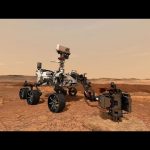
#EZScience Episode 9 Part 2: Mars Perseverance Rover Will Look for Signs of Ancient Life
Let’s talk about science! In the latest episode of #EZScience, learn about the science behind NASA’s Perseverance rover that is targeted to launch to the Red Planet on July 30.
ABOUT THE SERIES: In our #EZScience video series with the National Air and Space Museum, NASA’s associate administrator for science Dr. Thomas Zurbuchen and Museum director Dr. Ellen Stofan talk about the latest in planetary science and exploration.
Learn more about the series: https://www.nasa.gov/ezscience
-
Perseverance Mars Rover Mission Engineering & Science Briefing
Our Mars 2020 Perseverance Rover will search for signs of ancient life beyond Earth. Find out more about the mission from the scientists and engineers on the team.
Lori Glaze, Planetary Science Division Director, NASA HQ
Jennifer Trosper, NASA’s Jet Propulsion Laboratory (remote)
Farah Alibay, Second engineer about mobility, NASA’s Jet Propulsion Laboratory
Ken Farley, Project Scientist, California Institute of Technology
Tanja Bosak, Sedimentology and Astrobiology Science Team Member, Massachusetts Institute of TechnologySubmit your science and engineering questions NOW for the broadcast! Comment using #CountdownToMars.
-
Perseverance Mars Rover Pre-Launch News Conference
Learn more about the planned July 30 launch of our Mars 2020 rover from Cape Canaveral aboard an Atlas V 541 rocket, featuring:
– Jim Bridenstine, NASA Administrator
– Thomas Zurbuchen, NASA Associate Administrator
– Omar Baez, Launch Director, NASA Launch Services Program
– Matt Wallace, Mars 2020 Deputy Project Manager, NASA’s Jet Propulsion Laboratory
– Tory Bruno, President and CEO, United Launch Alliance
– Jessica Williams, 45th Space Force Weather Officer
-

Say “Bon Voyage” to our Mars Perseverance Rover!
We’re going back to Mars! Our newest rover is named Perseverance, and will be launching soon for its seven-month journey to the Red Planet to search for signs of ancient life. And it’s bringing along a friend: a little helicopter named Ingenuity! Ingenuity will test the first powered flight on Mars.
Join us in wishing Perseverance and Ingenuity “bon voyage” on their #CountdownToMars! https://mars.nasa.gov/mars2020/
-

Perseverance Rover: How We Protect Mars From Earthly Germs
As we explore Mars and other places in the solar system that might have life, scientists who work in Planetary Protection are busy making sure that we don’t contaminate them. While engineers prepare the Perseverance Rover for launch, Lisa Pratt, NASA’s Planetary Protection Officer, is making sure that it’s not carrying too many spores — cells that could re-activate and transport Earthly bacteria to Mars. It’s especially important to keep Perseverance clean because it will collect samples on Mars that will one day return to Earth. Learn what your hand sanitizer has in common with NASA’s clean rooms, and how scientists are thinking about protecting Mars in terms of future human missions.
Listen to episodes of the Gravity Assist podcast at https://www.nasa.gov/gravityassist
-
#EZScience: Launching to Mars with NASA’s Perseverance Rover
Let’s talk about science! In the latest episode of #EZScience, learn about the upcoming launch of Perseverance. Dr. E and Dr. Z talk about the technological advancements of the newest Mars rover (and helicopter!). The premiere of this episode is part of the National Air and Space Museum’s Mars Day program. Learn more: https://airandspace.si.edu/mars-day
ABOUT THE SERIES: In our #EZScience video series with the National Air and Space Museum, NASA’s associate administrator for science Dr. Thomas Zurbuchen and Museum director Dr. Ellen Stofan talk about the latest in planetary science and exploration.
Learn more about the series: https://www.nasa.gov/ezscience
#S1E9P1
-

Thomas and Matthias astro chats: training | Episode 1
Join ESA astronauts Thomas Pesquet and Matthias Maurer at NASA’s Johnson Space Center in Houston, Texas, USA. In part one of this video series, the two astronauts compare notes on their journey to date as they prepare for missions to the International Space Station.
Though mission details and dates are yet to be confirmed, Thomas and Matthias are the next two European astronauts in line for flights. Thomas has flown to the International Space Station before, while Matthias will fly for the first time.
Prior to a mission, astronauts train extensively to ensure they are familiar with the vast array of systems and operations on board. In this video, the pair discuss how training for a second mission differs from a first mission, the challenges of training during a global pandemic, and how flying to the Station on US commercial crew vehicles may differ from flying on the Russian Soyuz spacecraft.
This video was filmed in June 2020. At that time, the platform Thomas and Matthias were standing on – in front of a full-scale mock-up of the International Space Station – was the only place at NASA’s JSC that they could interact without face masks. Despite this, the pair were required to maintain social distance at all times as a precaution.
Learn more: https://bit.ly/HumanAndRoboticExplorationESA
★ Subscribe: http://bit.ly/ESAsubscribe and click twice on the bell button to receive our notifications.
Check out our full video catalog: http://bit.ly/SpaceInVideos
Follow us on Twitter: http://bit.ly/ESAonTwitter
On Facebook: http://bit.ly/ESAonFacebook
On Instagram: http://bit.ly/ESAonInstagram
On Flickr: http://bit.ly/ESAonFlickrWe are Europe’s gateway to space. Our mission is to shape the development of Europe’s space capability and ensure that investment in space continues to deliver benefits to the citizens of Europe and the world. Check out http://www.esa.int/ESA to get up to speed on everything space related.
Copyright information about our videos is available here: http://www.esa.int/spaceinvideos/Terms_and_Conditions
#ESA
#MatthiasMaurer
#ThomasPesquet -

Mars Perseverance Rover: Launching This Summer
Our Mars Perseverance rover is targeted to lift off July 30, 2020, on a seven-month journey to the Red Planet. It will search for signs of ancient life, collect rock and soil samples and help prepare for future human exploration. About the mission: https://mars.nasa.gov/mars2020/
-
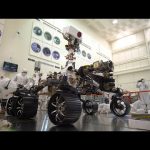
Our next Mars Rover gets closer to launch on This Week @NASA – July 10, 2020
Our next Mars Rover gets closer to launch, a comet spotted from the space station and we’re ready to build a spacecraft to explore a metal-rich asteroid … a few of the stories to tell you about – This Week at NASA!
Download Link: https://images.nasa.gov/details-Our%20next%20Mars%20Rover%20gets%20closer%20to%20launch%20on%20This%20Week%20@NASA%20%E2%80%93%20July%2010,%202020
-
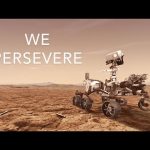
We Persevere
NASA’s next Mars rover has a name – Perseverance. Like every exploration mission before, our rover is going to face challenges, and it’s going to make amazing discoveries.
The time at hand is hard. We have already surmounted many obstacles on our way to Red Planet, but as humans we will not give up. We will always persevere.
Targeted for launch in July 2020, NASA’s Mars Perseverance rover will search for signs of habitable conditions on Mars in the ancient past and for signs of past microbial life itself.
Learn more about the mission: https://mars.nasa.gov/mars2020/
Produced by brother
Directed by Theodore Melfi
Narrated by Octavia SpencerMusic Credit: RONE – MOTION III
Composed and produced by Erwan Castex
Arranged by Romain Allender
Performed by Rone, Vanessa Wagner & Les siècles Orchestra
iF3073 – ℗ & © 2018 InFiné
Published by InFiné Éditions / Warner Chappell Music Publishing -

NASA’s Mars 2020 Perseverance Rover – Countdown to Mars
Follow the road to launch for our next mission to the Red Planet, the Mars 2020 Perseverance rover. NASA leadership and a panel of scientists and engineers will preview the upcoming mission at 2 p.m. EDT on Wednesday, June 17.
Briefing participants will be:
– NASA Administrator Jim Bridenstine
– Lori Glaze, director of NASA’s Planetary Science Division at NASA Headquarters in Washington
– Katie Stack Morgan, Perseverance deputy project scientist at NASA’s Jet Propulsion Laboratory (JPL) in Southern California
– Matt Wallace, Perseverance deputy project manager at JPL
– Luis Dominguez, Perseverance deputy electrical integration and test lead at JPL
– Omar Baez, launch director in NASA’s Launch Services Program at NASA’s Kennedy Space Center in FloridaSubmit your questions during the briefing using #AskNASA!
Perseverance is a robotic scientist that will search for signs of past microbial life on Mars and characterize the planet’s climate and geology. It will also collect rock and soil samples for future return to Earth and pave the way for human exploration of the Red Planet. The mission is scheduled to launch from Space Launch Complex 41 at NASA’s Kennedy Space Center in Florida at 9:15 a.m. EDT July 20. It will land at Mars’ Jezero Crater on Feb. 18, 2021.
For more about Perseverance visit: https://nasa.gov/perseverance and https://mars.nasa.gov/mars2020
-

Mars confinement tips
In these times of confinement, ESA astronaut support engineer Romain Charles shares nine tips on how to live in isolation – he spent 520 days locked in a mockup spacecraft and is a true expert on the subject.
Mars500 locked six ‘marsonauts’ in a simulated spaceship near Moscow, Russia for 520 days, the time it would take to fly to Mars and back plus 30 days spent exploring its surface. It was the first full-length, high-fidelity simulation of a human mission to our neighbouring planet. The crew went into lockdown on 3 June 2010, and they did not open the hatch until 17 months later on 4 November 2011.
Mars 500 was a success in that it proved that humans can survive the inevitable isolation that is needed for a mission to Mars and back. Psychologically, we can do it!
The crew had their ups and downs, but these were to be expected. In fact, scientists anticipated many more problems, but the crew did very well coping with the monotonous mission, with little variation in food and even a communication delay over 12 minutes one-way.
During their simulated mission, the crew lived in isolation without fresh food, sunlight or fresh air. The participants from Italy, Russia, China and France had no external cues such as the Sun going down at night to remind them when to sleep.
Their bodies are among the most researched in the world. Years of constant monitoring, prodding and taking blood allowed scientists examined how they reacted to the time in confinement with experiments focussing on their bodies, mental states and performance.
More on Mars 500: www.esa.int/Mars500
★ Subscribe: http://bit.ly/ESAsubscribe and click twice on the bell button to receive our notifications.
Check out our full video catalog: http://bit.ly/SpaceInVideos
Follow us on Twitter: http://bit.ly/ESAonTwitter
On Facebook: http://bit.ly/ESAonFacebook
On Instagram: http://bit.ly/ESAonInstagram
On Flickr: http://bit.ly/ESAonFlickrWe are Europe’s gateway to space. Our mission is to shape the development of Europe’s space capability and ensure that investment in space continues to deliver benefits to the citizens of Europe and the world. Check out http://www.esa.int/ESA to get up to speed on everything space related.
Copyright information about our videos is available here: http://www.esa.int/spaceinvideos/Terms_and_Conditions
#ESA
#Confinement
#Mars500 -

NASA’s Gravity Assist Podcast Season 4: Searching for Life
Is there life beyond Earth? How did life get started on Earth anyway? This season of NASA’s Gravity Assist podcast is about the origins of life on Earth and the search for life elsewhere. Subscribe at https://www.nasa.gov/gravityassist. See all NASA podcasts: www.nasa.gov/podcasts
Hosted by NASA’s Chief Scientist Jim Green, each episode features a conversation with a scientist who has researched some aspect of these questions. We’ll talk about the search for life on Mars, what kind of life might survive on Saturn’s moon Titan, and much more.
New episodes Fridays starting April 17.
-
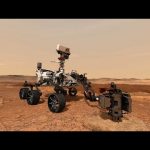
Mars Rover 2020’s Name Reveal
Drum roll, please: You voted on names for our #Mars2020 rover. Find out which was selected!
Our newest Mars rover’s name – and the student behind it – will be announced LIVE Thursday, March 5 at 1:30 p.m. EST.
-

Mars Rover 2020’s Name Will Be Revealed
NASA’s newest Mars Rover’s name – and student behind it – will be announced LIVE on Thursday, March 5 at 1:30 p.m. EST.
The Mars 2020 rover was the subject of a nationwide naming contest in 2019 that drew more than 28,000 essays by K-12 students from every U.S. state and territory. Nearly 4,700 volunteer judges – educators, professionals, and space enthusiasts from around the country – helped narrow the pool down to 155 semifinalists. A second round of judging selected the nine finalist essays that were open to an online public poll before Thomas Zurbuchen, associate administrator of NASA’s Science Mission Directorate, made the final selection.
Watch live coverage here on YouTube: https://youtu.be/Zni3MLBHDaY
-

ExoMars progress update
ExoMars 2020 has passed a number of milestones. The European carrier module was delivered in March. The European rover, which contains nine instruments, has been assembled by Airbus UK and is under environmental testing in Toulouse. It should be integrated with the spacecraft by the end of the year. The spacecraft is now in the Thales Alenia Space test facilities in Cannes to start the environmental and performance verification test campaign that will last until February 2020.
However, there remain some important challenges ahead for the parachute system of the descent module. Recent balloon high-altitude drop tests were unsuccessful. As a result, the next and final two drop tests, scheduled between January and March 2020, must be fully successful otherwise the mission cannot launch in 2020.
The joint ESA and Russian mission consists of four elements: a carrier module to propel the spacecraft to Mars, a descent module, a surface science platform and the Rosalind Franklin rover, which will use its drill up to depths of two meters to search for signs of life.
More information on ExoMars: http://www.esa.int/exomars
★ Subscribe: http://bit.ly/ESAsubscribe and click twice on the bell button to receive our notifications.
Check out our full video catalog: http://bit.ly/SpaceInVideos
Follow us on Twitter: http://bit.ly/ESAonTwitter
On Facebook: http://bit.ly/ESAonFacebook
On Instagram: http://bit.ly/ESAonInstagram
On Flickr: http://bit.ly/ESAonFlickrWe are Europe’s gateway to space. Our mission is to shape the development of Europe’s space capability and ensure that investment in space continues to deliver benefits to the citizens of Europe and the world. Check out http://www.esa.int/ESA to get up to speed on everything space related.
Copyright information about our videos is available here: http://www.esa.int/spaceinvideos/Terms_and_Conditions
#ESA
#ExoMars
#RosalindTheRover -

ExoMars – Moving on Mars
The ExoMars mission will see Rosalind Franklin the rover and its surface platform Kazachok land on the Red Planet in 2021. From fine-grained soil to large boulders and slopes, the rover has to be able to move across many types of terrain, collect samples with a 2 m-long drill and analyse them with instruments in its onboard laboratory.
This second episode about ExoMars features the challenges of leaving the surface platform, overcoming obstacles and walking on dunes.
ESA, Roscosmos, Thales, Airbus and RUAG engineers put a full-sized model through a series of tests to fine-tune how the rover will move from its landing platform onto the martian terrain.
Rovers on Mars have previously been caught in sand, and turning the wheels dug them deeper – just like a car stuck in mud or snow. To avoid this, Rosalind the rover has a unique locomotion mode called ‘wheel walking’.
More information on ExoMars: http://www.esa.int/exomars
Credits: ESA
★ Subscribe: http://bit.ly/ESAsubscribe and click twice on the bell button to receive our notifications.
Check out our full video catalog: http://bit.ly/SpaceInVideos
Follow us on Twitter: http://bit.ly/ESAonTwitter
On Facebook: http://bit.ly/ESAonFacebook
On Instagram: http://bit.ly/ESAonInstagram
On Flickr: http://bit.ly/ESAonFlickrWe are Europe’s gateway to space. Our mission is to shape the development of Europe’s space capability and ensure that investment in space continues to deliver benefits to the citizens of Europe and the world. Check out http://www.esa.int/ESA to get up to speed on everything space related.
Copyright information about our videos is available here: http://www.esa.int/spaceinvideos/Terms_and_Conditions
#ESA
#ExoMars
#RosalindTheRover -

Science & Exploration: Answering the big questions
Where do we come from? Where are we going? Why are things the way they are? Space science and exploration are entering an ambitious new era, spanning the hunt for extraterrestrial planets and detecting the fundamental nature of our Universe to roving on Mars and returning to the Moon. However, we’re not simply acquiring new knowledge – we’re helping bring the benefits of these discoveries to European industry, through commercialisation in Earth orbit, integration with new space actors and cooperation on a global scale.
★ Subscribe: http://bit.ly/ESAsubscribe and click twice on the bell button to receive our notifications.
Check out our full video catalog: http://bit.ly/SpaceInVideos
Follow us on Twitter: http://bit.ly/ESAonTwitter
On Facebook: http://bit.ly/ESAonFacebook
On Instagram: http://bit.ly/ESAonInstagram
On Flickr: http://bit.ly/ESAonFlickrWe are Europe’s gateway to space. Our mission is to shape the development of Europe’s space capability and ensure that investment in space continues to deliver benefits to the citizens of Europe and the world. Check out http://www.esa.int/ESA to get up to speed on everything space related.
Copyright information about our videos is available here: http://www.esa.int/spaceinvideos/Terms_and_Conditions
#ESA
#Space19plus
#Exoplore -

Testing Orion’s “Powerhouse” on This Week @NASA – August 9, 2019
A critical test of the “powerhouse” for our Orion spacecraft, Curiosity is still going strong after seven Earth years on Mars, and Hubble’s new portrait of Jupiter … a few of the stories to tell you about – This Week at NASA!
This video is available for download from NASA’s Image and Video Library: https://images.nasa.gov/details-NHQ_2019_0809_Testing%20Orion%E2%80%99s%20%E2%80%9CPowerhouse%E2%80%9D%20on%20This%20Week%20@NASA%20-%20August%209,%202019.html
-

We Go as the Artemis Generation
We Go: To the Moon and on to Mars. Our generation, the Artemis generation, will explore farther than we’ve ever gone before. The Artemis program will send the first woman and next man to walk on the surface of the Moon and build a sustainable base to prepare for missions to Mars and beyond.
-

We Go Together
We are building a coalition of nations that can help us get to the Moon quickly and sustainably. Together.
We have a bold vision to go back to the Moon by 2024. As we work towards this goal, we welcome a growing list of international and commercial partners.
It is the partnerships over the last 60 years that have ensured the steady progress. With Mars on the horizon, together we can explore more of our solar system and share in the advances and the knowledge that will come.We go, together.
More about NASA’s Moon to Mars plans: https://www.nasa.gov/specials/moon2mars/
This video is available for download from NASA’s Image and Video Library:
https://images.nasa.gov/details-NHQ_2019_0528_We%20Go%20Together.html -

A New Partnership to Power The Lunar Gateway on This Week @NASA – May 24, 2019
A key milestone for our lunar Gateway, “rolling out” for a critical Orion safety test, and a chance to send your name to Mars … a few of the stories to tell you about – This Week at NASA!
This video is available for download from NASA’s Image and Video Library: https://images.nasa.gov/details-NHQ_2019_0524_A%20New%20Partnership%20to%20Power%20The%20Lunar%20Gateway%20on%20This%20Week%20@NASA%20%E2%80%93%20May%2024,%202019.html
-

Watch This Space: The Latest from the Moon to Mars
On the latest Watch This Space, NASA administrator Jim Bridenstine looks back at 15 years of discoveries by our Opportunity rover on Mars, and forward to new commercial partnerships for missions to the Moon. Learn how we’ll work with American companies to design and develop human lunar landers and reusable systems so we can return to the Moon — to stay.
This video is available for download from NASA’s Image and Video Library: https://images.nasa.gov/details-NHQ_2019_0221_Watch%20This%20Space%20with%20NASA%20Administrator%20Jim%20Bridenstine%20with%20the%20latest%20from%20the%20Moon%20and%20Mars.html
-

ExoMars Rover: from concept to reality
The second part of the ExoMars programme is ongoing.
In Stevenage, UK, a rover is being built that will carry a drill and a suite of instruments dedicated to exobiology and geochemistry research. It will be the first mission to combine the capability to move across the surface and to study Mars at depth.
The primary goal of the ExoMars programme is to address the question of whether life has ever existed on the red planet.
The first part of the programme was launched in March 2016 with the Trace Gas Orbiter. The second part is planned for launch in 2020 and comprises the rover and surface science platform
ExoMars is a joint endeavour between ESA and the Russian space agency, Roscosmos.
★ Subscribe: http://bit.ly/ESAsubscribe and click twice on the bell button to receive our notifications.
Check out our full video catalog: http://bit.ly/SpaceInVideos
Follow ESA on Twitter: http://bit.ly/ESAonTwitter
On Facebook: http://bit.ly/ESAonFacebook
On Instagram: http://bit.ly/ESAonInstagram
On Flickr: http://bit.ly/ESAonFlickrESA is Europe’s gateway to space. Our mission is to shape the development of Europe’s space capability and ensure that investment in space continues to deliver benefits to the citizens of Europe and the world. Check out http://www.esa.int/ESA to get up to speed on everything space related.
Copyright information about our videos is available here: http://www.esa.int/spaceinvideos/Terms_and_Conditions
#ExoMars
#Mars
#PlanetaryScience -
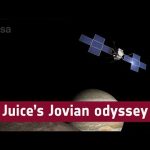
Juice’s Jovian odyssey
Juice, ESA’s Jupiter Icy Moons Explorer, is set to embark on a seven-year cruise to Jupiter starting May 2022. The mission will investigate the emergence of habitable worlds around gas giants and the Jupiter system as an archetype for the numerous giant planets now known to orbit other stars.
This animation depicts the journey to Jupiter and the highlights from its foreseen tour of the giant planet and its large ocean-bearing moons.
An Ariane 5 will lift Juice into space from Europe’s Spaceport in Kourou. A series of gravity-assist flybys at Earth (3), Venus (1) and Mars (1) will set the spacecraft on course for its October 2029 rendezvous in the Jovian system.
It is expected that a number of instruments will be activated during the gravity assists (indicated by the different coloured beams scanning across the planets) and measurements will be taken for calibration and to check the health of the instruments. The visualisations of the Earth flybys show the closest approaches over the planet according to current planning – over the South Pacific Ocean, Argentina and Peru, respectively. Throughout the animation, the instrument beam colours correspond to example observations by JANUS (green), MAJIS (red), UVS (purple), Gala (Blue) and RIME (grey), which are cameras, spectrometers, laser altimeter and radar.
During the Venus flyby, limited observations can be made because the spacecraft will be oriented to protect it from the heat of the Sun experienced in the inner Solar System. The Mars flyby will see Juice fly over the planet’s south pole to make scientific observations.
Juice will start its science mission about six months prior to arriving in orbit around the gas giant, making observations as it approaches its destination. Once in the Jovian system, a gravity-assist flyby of Jupiter’s largest moon Ganymede – the largest moon in the Solar System – helps Juice enter orbit around the gas giant 7.5 hours later.
While in Jupiter orbit, the spacecraft will study the Jovian system as an archetype for gas giants, making observations of its atmosphere, the magnetosphere, its rings and satellites.
During the tour, Juice will make two flybys of Europa, which has strong evidence for an ocean of liquid water under its icy shell. Juice will look at the moon’s active zones, its surface composition and geology, search for pockets of liquid water under the surface and study the plasma environment around Europa.
A sequence of Callisto flybys will not only be used to study this ancient, cratered world that may too harbor a subsurface ocean, but it will change the angle of Juice’s orbit with respect to Jupiter’s equator, making it possible to investigate the polar regions and environment at higher latitudes.
During the tour there will also be unique periods to observe events such as moon transits. The example in this animation shows Europa and Io passing in front of Jupiter on 27 January 2032. This type of event is rare, with less than 10 expected to occur during Juice’s tour of the Jovian system.
A sequence of Ganymede and Callisto flybys will adjust the orbit of Juice to enable it to enter orbit around Ganymede, marking it the first spacecraft to orbit another planet’s moon (aside from our own). The elliptical orbit will be followed by a 5000 km altitude cicular orbit, and later a 500 km circular orbit.
Ganymede is unique in the Solar System in that it is the only moon to have a magnetosphere. Juice will investigate this phenomenon and the moon’s internal magnetic field, and the interaction of its plasma environment with that of Jupiter. Juice will also study the moon’s atmosphere, surface, subsurface, interior and its internal ocean, investigating the moon as a planetary object and possible habitat.
Over time the 500 km orbit will naturally decay – eventually there will not be enough propellant to maintain it – and it will make a grazing impact on the surface. The animation concludes with an example of what the approach to impact could look like.
★ Subscribe: http://bit.ly/ESAsubscribe and click twice on the bell button to receive our notifications.
Check out our full video catalog: http://bit.ly/SpaceInVideos
Follow ESA on Twitter: http://bit.ly/ESAonTwitter
On Facebook: http://bit.ly/ESAonFacebook
On Instagram: http://bit.ly/ESAonInstagram
On Flickr: http://bit.ly/ESAonFlickrESA is Europe’s gateway to space. Our mission is to shape the development of Europe’s space capability and ensure that investment in space continues to deliver benefits to the citizens of Europe and the world. Check out http://www.esa.int/ESA to get up to speed on everything space related.
Copyright information about our videos is available here: http://www.esa.int/spaceinvideos/Terms_and_Conditions
#JUICE
#Jupiter
#SolarSystem -

Science at ESA
Science is the underpinning theme of ESA, driving the spiral of inspiration, innovation, information exchange and interaction with our stakeholders. In this video, Günther Hasinger, ESA Director of Science, reflects on the growth of ESA’s space science programme over the past decades, as well as on its current and future challenges. He also highlights the importance of long-term strategic planning and international cooperation in these endeavours, and finally looks back at some recent successes of ESA’s space science missions.
Learn more about ESA’s space science missions: http://www.esa.int/science
Science is everywhere at ESA. As well as exploring the Universe and answering the big questions about our place in space we develop the satellites, rockets and technologies to get there. Science also helps us to care for our home planet. All this week we’re highlighting different aspects of science at ESA. Join the conversation with #ScienceAtESA.
Credits: ESA/NASA/JPL/University of Arizona (Huygens landing); ESA/Rosetta/Philae/ROLIS/DLR, Stefano Mottola (Philae landing); ESA/Planck Collaboration (cosmic microwave background); ESA/Gaia/DPAC (Milky Way); MPG/ESO (Eagle Nebula, visible); ESA/Herschel/PACS/SPIRE/Hill, Motte, HOBYS Key Programme Consortium (Eagle Nebula, far-infrared); ESA/XMM-Newton/EPIC/XMM-Newton-SOC/Boulanger (Eagle Nebula, X-rays); NASA, ESA/Hubble and the Hubble Heritage Team (Pillars of Creation); ESO (Pillars of Creation, ground-based view); Koppelman, Villalobos & Helmi, Kapteyn Astronomical Institute, University of Groningen (Milky Way simulation); ESA/XMM-Newton/F. Nicastro et al./R. Cen (warm-hot intergalactic medium); ESA/DLR/FU Berlin, CC BY-SA 3.0 IGO (Mars surface); ESA/NASA/JPL/ASI/Univ. Rome (Mars, liquid water under south pole); NASA/JPL-Caltech (Mars view); ESO, M. Kornmesser, L. Calcada (`Oumuamua animation)
★ Subscribe: http://bit.ly/ESAsubscribe and click twice on the bell button to receive our notifications.
Check out our full video catalog: http://bit.ly/SpaceInVideos
Follow ESA on Twitter: http://bit.ly/ESAonTwitter
On Facebook: http://bit.ly/ESAonFacebook
On Instagram: http://bit.ly/ESAonInstagram
On Flickr: http://bit.ly/ESAonFlickrESA is Europe’s gateway to space. Our mission is to shape the development of Europe’s space capability and ensure that investment in space continues to deliver benefits to the citizens of Europe and the world. Check out http://www.esa.int/ESA to get up to speed on everything space related.
Copyright information about our videos is available here: http://www.esa.int/spaceinvideos/Terms_and_Conditions
#ESA
#ScienceAtESA
#SpaceScience -

Fifteen years imaging the Red Planet
On 25 December 2003, ESA’s Mars Express entered orbit around the Red Planet. The spacecraft began returning the first images from orbit using its High Resolution Stereo Camera just a couple of weeks later, and over the course of its fifteen year history has captured thousands of images covering the globe.
This video compilation highlights some of the stunning scenes revealed by this long-lived mission. From breathtaking horizon-to-horizon views to the close-up details of ice- and dune-filled craters, and from the polar ice caps and water-carved valleys to ancient volcanoes and plunging canyons, Mars Express has traced billions of years of geological history and evolution.
For regular news and image releases from Mars Express see http://www.esa.int/Our_Activities/Space_Science/Mars_Express
★ Subscribe: http://bit.ly/ESAsubscribe and click twice on the bell button to receive our notifications.
Check out our full video catalog: http://bit.ly/SpaceInVideos
Follow ESA on Twitter: http://bit.ly/ESAonTwitter
On Facebook: http://bit.ly/ESAonFacebook
On Instagram: http://bit.ly/ESAonInstagram
On Flickr: http://bit.ly/ESAonFlickrESA is Europe’s gateway to space. Our mission is to shape the development of Europe’s space capability and ensure that investment in space continues to deliver benefits to the citizens of Europe and the world. Check out http://www.esa.int/ESA to get up to speed on everything space related.
Copyright information about our videos is available here: http://www.esa.int/spaceinvideos/Terms_and_Conditions
-

Living in space
Over the last two decades, space agencies have created more comfortable conditions on the International Space Station, but we need to explore the concept of ‘living in space’ much further if humans are to ever live and work on another world, such as the Moon or Mars.
ESA’s Discovery and Preparation Programme works to prepare ESA for the future of space exploration. As part of this programme, ESA has worked with academic and industrial partners on a huge number of studies that lay the groundwork for living in space.
The technology that exists today could easily take us to the Moon and beyond, but it is studies like those carried out under the Discovery and Preparation Programme that will make a trip resourceful, sustainable and productive.
★ Subscribe: http://bit.ly/ESAsubscribe and click twice on the bell button to receive our notifications.
Check out our full video catalog: http://bit.ly/SpaceInVideos
Follow ESA on Twitter: http://bit.ly/ESAonTwitter
On Facebook: http://bit.ly/ESAonFacebook
On Instagram: http://bit.ly/ESAonInstagram
On Flickr: http://bit.ly/ESAonFlickrESA is Europe’s gateway to space. Our mission is to shape the development of Europe’s space capability and ensure that investment in space continues to deliver benefits to the citizens of Europe and the world. Check out http://www.esa.int/ESA to get up to speed on everything space related.
Copyright information about our videos is available here: http://www.esa.int/spaceinvideos/Terms_and_Conditions
-

NASA Begins America’s New Moon to Mars Exploration Approach in 2018 – The Year @NASA
With our Moon to Mars effort underway, a new administrator takes over to lead the charge, and – oh yeah – we stuck another nearly flawless landing on Mars! All that and more as we look back at what happened This Year @ NASA!
This video is available for download from NASA’s Image and Video Library: https://images.nasa.gov/details-NHQ_2018_1217_NASA%20Begins%20America%E2%80%99s%20New%20Moon%20to%20Mars%20Exploration%20Approach%20in%202018%20-%20The%20Year%20@NASA.html