With only a very thin atmosphere, and no magnetic field, the Moon can’t protect itself from the elements that come from outer space, making the outlook look bleak for our grey companion.
What the Moon does experience is solar wind, a stream of tiny particles coming from the Sun.
During some parts of the month, Earth’s own magnetic field partially shields the Moon from the stream of solar wind particles that constantly bombard it.
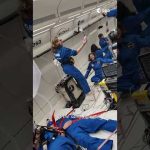
We know how microgravity impacts the brain thanks to astronauts on the ISS, but what about life on the Moon or Mars? Future explorers will also face hypoxia—low oxygen levels—which could affect their brain function and decision-making.
A team of students is tackling this challenge by conducting zero-gravity flight experiments to study how the brain responds to both microgravity and hypoxia. Their research could help improve astronaut safety for future lunar and Martian missions, ensuring they can explore safely beyond their spacecraft.
Could this be a key step in preparing humans for deep space exploration? Let us know your thoughts in the comments!
📹 ESA – European Space Agency 📸 ESA – European Space Agency
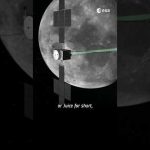
On 19–20 August 2024, Juice successfully completed a world-first lunar-Earth flyby, with flight controllers guiding the spacecraft first past the Moon, then past Earth. The gravity of the two changed Juice’s speed and direction, sending it on a shortcut to Jupiter via Venus.
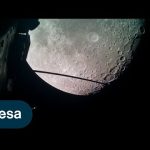
The closest approach to the Moon was at 23:15 CEST on 19 August, deflecting Juice towards a closest approach to Earth just over 24 hours later at 23:56 CEST on 20 August. In the hours before and after both close approaches, Juice’s two monitoring cameras captured photos, giving us a unique ‘Juice eye view’ of our home planet.
Juice’s two monitoring cameras provide 1024 x 1024 pixel snapshots that can be processed in colour. Their main purpose is to monitor the spacecraft’s various booms and antennas, especially during the challenging period after launch. The photos they captured of the Moon and Earth during the lunar-Earth flyby are a bonus.
The piece of music that accompanies the images is called 11,2 km/s. It was composed by Gautier Acher back in 2015, and selected as the official theme music for ESA’s Estrack ground station network to mark its 40th anniversary (more information). The music is available under a CC BY-NC-SA licence.
Processing notes: The Juice monitoring cameras provide 1024 x 1024 pixel images. Upscaling software was used to convert the images into 2160 x 2160 pixel images, which match the 3480 x2160 pixel resolution of the 4K movie format.
Credits: ESA – European Space Agency Acknowledgements: Simeon Schmauß & Mark McCaughrean
★ Subscribe: http://bit.ly/ESAsubscribe and click twice on the bell button to receive our notifications.
We are Europe’s gateway to space. Our mission is to shape the development of Europe’s space capability and ensure that investment in space continues to deliver benefits to the citizens of Europe and the world. Check out https://www.esa.int/ to get up to speed on everything space related.
Join us for Juice’s flyby of the Moon. We’ll be sharing images as soon as we can after Juice sends them down to Earth. Be among the first people in the world to see these images, and ask your questions about the mission and its lunar-Earth flyby to our panel of Juice team members.
The images will be captured using Juice’s two ‘monitoring cameras’, designed to watch the unfolding of Juice’s solar panels, antennas and booms in space in the weeks after the spacecraft launched into space in April 2023. The cameras have successfully completed their task. But we thought… what will we see if we point them at the Moon?
We don’t know how the images will look. It’s the first time the cameras will point at a big bright object in space. And we’re sharing them publicly before we’ve had a chance to process them at all.
We are Europe’s gateway to space. Our mission is to shape the development of Europe’s space capability and ensure that investment in space continues to deliver benefits to the citizens of Europe and the world. Check out https://www.esa.int/ to get up to speed on everything space related.
ESA’s Jupiter Icy Moons Explorer (Juice) returns to Earth on 19–20 August 2024, to complete the world’s first Lunar-Earth gravity assist. Flight controllers will guide the spacecraft past the Moon and then Earth itself, ‘braking’ the spacecraft. This manoeuvre may seem counterintuitive but will allow Juice to take a shortcut via Venus on it’s way to Jupiter.
Juice has already travelled more than 1000 million km to the giant planet but it still has a long way to go even though Jupiter is on average ‘just’ 800 million km away from Earth. Join us as we explain why Juice’s journey to Jupiter is taking sooo long.
We are Europe’s gateway to space. Our mission is to shape the development of Europe’s space capability and ensure that investment in space continues to deliver benefits to the citizens of Europe and the world. Check out https://www.esa.int/ to get up to speed on everything space related.
In 2016, scientists spotted Kamo’oalewa ,a 40 to 100 metre object, during a planetary defence survey to discover space rocks that could possibly hit our planet.
At first, the object appeared to orbit Earth in a similar way to our Moon. But astronomers found it was actually orbiting the Sun on a very similar path to Earth. So, Kamo’oalewa was demoted from a potential new moon to a near-Earth asteroid and a quasi-satellite to Earth.
However, the asteroid’s connection to the Moon could run deeper. The object’s Earth-like orbit and Moon-like composition may indicate that it was created when a chunk of the Moon was thrown into space by an asteroid impact.
The first ESA instrument to land on the Moon has detected the presence of negative ions on the lunar surface produced through interactions with the solar wind.
The European team working with the Negative Ions at the Lunar Surface (NILS) instrument confirmed the success of this scientific mission that flew to the far side of the Moon aboard the Chang’e-6 spacecraft.
The discovery of a new component of plasma at the surface of the Moon opens a new window for space physics and for human and robotic missions in an era of renewed lunar exploration.
Advancing Moon mobility for Artemis astronauts, getting ready for the total solar eclipse, and a milestone engine test for our Artemis Moon rocket … a few of the stories to tell you about – This Week at NASA!
Link to download this video: https://images.nasa.gov/details/Advancing%20Moon%20Mobility%20for%20Artemis%20Astronauts%20on%20This%20Week%20@NASA%20%E2%80%93%20April%205,%202024
Video Producer: Andre Valentine Video Editor: Andre Valentine Narrator: Emanuel Cooper Music: Universal Production Music Credit: NASA
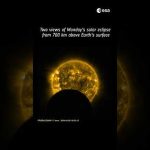
ESA’s Proba-2 captured two partial solar eclipses on 8 April 2024.
A solar eclipse occurs when the Moon passes between Earth and the Sun, totally or partially blocking the Sun from Earth’s point of view. On 8 April, lucky viewers across North America witnessed the Moon blocking out the Sun in its entirety for a few minutes, while those north and south of the ‘total eclipse path’ witnessed a partial eclipse.
Throughout the eclipse period, the Moon crossed Proba-2’s field of view twice, appearing as a partial solar eclipse. The satellite flies around 700 km above Earth’s surface in what is called a Sun-synchronous orbit, each orbit lasting around 100 minutes.
The video was produced from images taken by Proba-2’s SWAP telescope, which observes the Sun in extreme ultraviolet light. At these wavelengths, the turbulent nature of the Sun’s surface and corona – the Sun’s extended atmosphere – become visible. These measurements have to be made from space, because Earth’s atmosphere doesn’t allow such short wavelengths of light to pass through.
A total solar eclipse provides a unique opportunity to see the Sun’s corona from Earth’s surface, using visible light. As the Moon blocks most of the Sun’s bright light, the faint corona can be discerned. By comparing the SWAP ultraviolet images to what is seen by (visible light) telescopes on Earth, we can learn about the temperature and behaviour of different structures in the corona.
Other solar missions also made the most of the unique measurement opportunities provided by the eclipse. For example, ESA’s Solar Orbiter was positioned close to the Sun and at a 90-degree angle from Earth’s view throughout the eclipse. This allowed it to complement Earth-based observations by monitoring the Sun’s corona side-on, including any solar eruptions pointing in Earth’s direction.
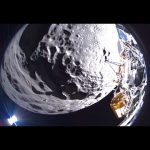
NASA and Intuitive Machines give an update from Johnson Space Center in Houston to highlight the company’s first mission, known as IM-1.
The lander, called Odysseus, carried six NASA science instruments to the South Pole region of the Moon as part of the agency’s Commercial Lunar Payload Services (CLPS) initiative, and Artemis campaign. The IM-1 mission is the first U.S. soft landing on the Moon in more than 50 years, successfully landing on Feb. 22, 2024.
Participants in the news conference include:
• Joel Kearns, deputy associate administrator, Exploration, Science Mission Directorate, NASA Headquarters in Washington • Sue Lederer, CLPS project scientist, NASA Johnson • Steve Altemus, chief executive officer and co-founder, Intuitive Machines • Tim Crain, chief technology officer and co-founder, Intuitive Machines
ESA uses terrestrial rocks to recreate the Moon’s surface!
Two state-of-the-art ESA facilities are working closely to develop a simulated lunar environment that will serve as a proving ground for future exploration technologies.
With Artemis missions, NASA will land the first woman and first person of color on the Moon, using innovative technologies to explore more of the lunar surface than ever before. We will collaborate with commercial and international partners and establish the first long-term presence on the Moon. Then, we will use what we learn on and around the Moon to take the next giant leap: sending the first astronauts to Mars.
Credit: NASA Music: Universal Production Music Video Producer: Sonnet Apple
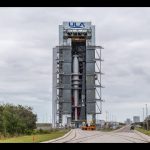
Watch Astrobotic’s Peregrine lunar lander lift off from NASA’s Kennedy Space Center in Florida on a United Launch Alliance (ULA) Vulcan rocket. ULA and Astrobotic are targeting 2:18 a.m. EST (0718 UTC) Monday, Jan. 8, 2024, for the first US commercial robotic launch to the Moon’s surface. The NASA payloads aboard the lander aim to help us develop capabilities needed to explore the Moon under Artemis and in advance of human missions on the lunar surface.
For more information about our Commercial Lunar Payload Services initiative, visit: https://go.nasa.gov/3RFR0A5
When astronauts return to the lunar surface they are probably going to be doing more driving than walking – but to keep billowing moondust at bay they are going to need roads. An ESA project reported in today’s Nature Scientific Reports tested the creation of roadworthy surfaces by melting simulated moondust with a powerful laser.
ESA is testing kombucha cultures, famous for their fermentative properties and potential health benefits, to assess their resilience in space. These cultures hold great promise for supporting humans on the Moon and Mars.
Explore the mysteries behind the Earth-Moon system’s origin with these four intriguing theories. 🌍🌕 Which one do you think holds the key to our celestial companion’s creation?
A solar eruption detected simultaneously at Earth, the Moon and Mars emphasises the need to prepare human exploration missions for the dangers of space radiation.
In the vast expanse of space, astronauts face a unique challenge – the need to share spacesuits during prolonged spacewalks. These suits, including their inner linings that come into direct contact with the astronauts’ skin, tend to accumulate bodily fluids over time. Drawing a rather relatable analogy, it’s akin to sharing underwear in space!
However, the practicality of washing these spacesuit interiors on lunar surfaces or beyond presents a significant hurdle. To counter this, a dedicated group of researchers is delving into innovative strategies to curb the growth of potentially harmful microbes within the inner layers of these suits.
Here’s where the solution gets intriguing: the world of microbiology offers a fascinating approach. Certain types of microbes possess ‘secondary metabolites’ that allow them to combat other microbes. These compounds are not only diverse in colour but also possess antibiotic properties. The ingenious idea involves integrating these microbial warriors into the very fabric of the spacesuit’s inner layer.
This pioneering research isn’t confined solely to the realm of spacesuits; its implications extend far beyond. The outcomes hold the potential to revolutionise the field of antimicrobial treatments and smart textile technologies right here on Earth. As we gear up for lunar expeditions and beyond, these microbial-fighting fabrics could play a pivotal role in ensuring astronauts’ health and well-being while opening new frontiers of innovation back home.
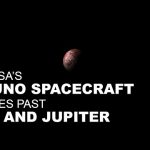
On May 16, 2023, NASA’s Juno spacecraft flew past Jupiter’s volcanic moon Io, and then the gas giant soon after. Io is the most volcanically active body in the solar system. Slightly larger than Earth’s moon, Io is a world in constant torment. Not only is the biggest planet in the solar system forever pulling at it gravitationally, but so are its Galilean siblings – Europa and the biggest moon in the solar system, Ganymede. The result is that Io is continuously stretched and squeezed, actions linked to the creation of the lava seen erupting from its many volcanoes.
This rendering provides a “starship captain” point of view of the flyby, using images from JunoCam. For both targets, Io and Jupiter, raw JunoCam images were reprojected into views similar to the perspective of a consumer camera. The Io flyby and the Jupiter approach movie were rendered separately and composed into a synchronous split-screen video.
Launched on Aug. 5, 2011, Juno embarked on a 5-year journey to Jupiter. Its mission: to probe beneath the planet’s dense clouds and answer questions about the origin and evolution of Jupiter, our solar system, and giant planets in general across the cosmos. Juno arrived at the gas giant on July 4, 2016, after a 1.7-billion-mile journey, and settled into a 53-day polar orbit stretching from just above Jupiter’s cloud tops to the outer reaches of the Jovian magnetosphere. Now in its extended mission, NASA’s most distant planetary orbiter continues doing flybys of Jupiter and its moons.
54 years ago on 20 July 1969, Apollo 11’s crew made history by being the first people to step foot on the moon.
Today, we’ll be sharing some fun facts about our celestial neighbour! 🌚🌝
1️⃣ Twelve people have walked on the Moon. Between 1969 and 1972, astronauts left scientific experiments on the lunar surface and came back to Earth with nearly 400 kg of rocks and soil. All 12 Apollo Moonwalkers reported symptoms similar to hay fever. Lunar dust is made of sharp, abrasive particles, and it is not known how toxic it is to humans.
2️⃣ You would also weigh less on the Moon! With only 1/6 the gravity, you would be able to jump higher and throw objects farther than on Earth.
3️⃣ If you look at the Moon through a telescope, you will see brilliant flashes of light. Nobody is sending you signals though – they are meteorites hitting our rocky neighbour at great speed.
4️⃣ If you were to live on the Moon, both day and night would be two weeks long! As humankind goes to the Moon, astronauts will need to work with this new day/night cycle
5️⃣ The Moon hides one ‘face’ from us, we call it the far side of the Moon, and we never get to see it from Earth. What do you think is on the far side of the Moon?
📹 ESA – European Space Agency
★ Subscribe: http://bit.ly/ESAsubscribe and click twice on the bell button to receive our notifications.
We are Europe’s gateway to space. Our mission is to shape the development of Europe’s space capability and ensure that investment in space continues to deliver benefits to the citizens of Europe and the world. Check out https://www.esa.int/ to get up to speed on everything space related.
The Artemis II Moon mission crew visits D.C., another partner to land humans on the Moon, and preparing to get to the heart of “cosmic matter” … a few of the stories to tell you about – This Week at NASA!
A new era of lunar exploration is on the rise, with dozens of Moon missions planned for the coming decade. As these missions will be operating on and around the Moon and needing to communicate together and fix their positions independently from Earth, this new era will require its own time.
Accordingly, space organisations have started considering how to keep time on the Moon. Having begun with a meeting at our technology centre in the Netherlands on November 2023, the discussion is part of a larger effort to agree a common ‘LunaNet’ architecture covering lunar communication and navigation services.
★ Subscribe: http://bit.ly/ESAsubscribe and click twice on the bell button to receive our notifications.
We are Europe’s gateway to space. Our mission is to shape the development of Europe’s space capability and ensure that investment in space continues to deliver benefits to the citizens of Europe and the world. Check out https://www.esa.int/ to get up to speed on everything space related.
The Artemis II Moon Rocket is Coming Together, a high honor for some space explorers, and an intriguing find for the Webb Space Telescope … a few of the stories to tell you about – This Week at NASA!
When a spacecraft launches on a mission to another planet it must first break free of the Earth’s gravitational field. Once it has done that, it enters interplanetary space, where the dominant force is the gravitational field of the Sun.
The spacecraft begins to follow a curving orbit, around the Sun, which is similar to the orbit of a comet. When this orbit brings it close to its target destination the spacecraft must fire a retrorocket to slow down and allow itself to be captured by the gravitational field of its target. The smaller the target, the more the spacecraft must slow down.
Sometimes passing a planet can result in the spacecraft being accelerated, even without the spacecraft firing any of its thrusters. This is known as the ‘slingshot’ effect. Such ‘gravity assist’ manoeuvres are now a standard part of spaceflight and are used by almost all our interplanetary missions. They take advantage of the fact that the gravitational attraction of the planets can be used to change the trajectory and speed of a spacecraft.
The amount by which the spacecraft speeds up or slows down is determined by whether it is passing behind or in front of the planet as the planet follows its orbit. When the spacecraft leaves the influence of the planet, it follows an orbit on a different course than before.
📹 @EuropeanSpaceAgency
★ Subscribe: http://bit.ly/ESAsubscribe and click twice on the bell button to receive our notifications.
We are Europe’s gateway to space. Our mission is to shape the development of Europe’s space capability and ensure that investment in space continues to deliver benefits to the citizens of Europe and the world. Check out https://www.esa.int/ to get up to speed on everything space related.
The ‘Enabling Lunar In-Situ Agriculture by Producing Fertilizer from Beneficiated Regolith’ project, involves studying a combination of mechanical, chemical and biological processes to extract mineral nutrients from the lunar soil. Valuable elements might need concentrating before use, while undesirable ones would be removed.
The current study represents a proof of principle using available lunar regolith simulants, opening the way to more detailed research in future.
★ Subscribe: http://bit.ly/ESAsubscribe and click twice on the bell button to receive our notifications.
We are Europe’s gateway to space. Our mission is to shape the development of Europe’s space capability and ensure that investment in space continues to deliver benefits to the citizens of Europe and the world. Check out https://www.esa.int/ to get up to speed on everything space related.
We are Europe’s gateway to space. Our mission is to shape the development of Europe’s space capability and ensure that investment in space continues to deliver benefits to the citizens of Europe and the world. Check out https://www.esa.int/ to get up to speed on everything space related.
Terrae Novae is not only literally about exploring new worlds, but by describing the limitless opportunities for discovery, economic growth and inspiration it also expresses our ambitions for Europe’s future innovators, scientists and explorers.
This video shows the many exploration activities ESA is conducting or has planned in our Solar System, from the International Space Station to the Moon with the European Service Module and lunar Gateway modules for Artemis, and on to Mars with the Mars Sample Return campaign.
We are Europe’s gateway to space. Our mission is to shape the development of Europe’s space capability and ensure that investment in space continues to deliver benefits to the citizens of Europe and the world. Check out https://www.esa.int/ to get up to speed on everything space related.
The “lunar hay fever”, as @NASA astronaut Harrison Schmitt described it during the Apollo 17 mission created symptoms in all 12 people who have stepped on the Moon. From sneezing to nasal congestion, in some cases it took days for the reactions to fade. Inside the spacecraft, the dust smelt like burnt gunpowder.
The Moon missions left an unanswered question of lunar exploration – one that could affect humanity’s next steps in the Solar System: can lunar dust jeopardise human health?
★ Subscribe: http://bit.ly/ESAsubscribe and click twice on the bell button to receive our notifications.
We are Europe’s gateway to space. Our mission is to shape the development of Europe’s space capability and ensure that investment in space continues to deliver benefits to the citizens of Europe and the world. Check out https://www.esa.int/ to get up to speed on everything space related.
These two mannequins occupy the passenger seats on Artemis I. Their their female-shaped, plastic bodies are filled with over 5600 sensors each to measure the radiation load during their trip around the Moon and back to Earth.
★ Subscribe: http://bit.ly/ESAsubscribe and click twice on the bell button to receive our notifications.
We are Europe’s gateway to space. Our mission is to shape the development of Europe’s space capability and ensure that investment in space continues to deliver benefits to the citizens of Europe and the world. Check out https://www.esa.int/ to get up to speed on everything space related.
After the uncrewed Artemis I test flight, the Artemis II mission will have astronauts demonstrate what the Orion spacecraft – powered by a European Service Module – can do on its voyage around the Moon.
Two astronauts will fly on the second Artemis mission and take over controls to show how Orion handles at close-quarter flying. While in Earth orbit the spacecraft will detach from its second stage, fly away, turn around, approach the second stage and then fly away again – all using the European Service Module’s 33 thrusters.
Whereas in the first Artemis mission the second stage fired Orion into its lunar orbit, for the second mission it will be the European Service Module that will give the spacecraft its final push to its voyage around the Moon.
The crew will fly Orion to 8889 km beyond the Moon before completing a lunar flyby and returning to Earth. The mission will take a minimum of eight days and will collect valuable flight test data.
The European Service Module is one of ESA’s many contributions to NASA’s Orion spacecraft and the Artemis programme that will send astronauts to the Moon and beyond. It provides electricity, water, oxygen and nitrogen as well as keeping the spacecraft at the right temperature and on course.
The European Service Module has 33 thrusters, 11 km of electrical wiring, four propellant and two pressure tanks that all work together to supply propulsion and everything needed to keep astronauts alive far from Earth – there is no room for error.
★ Subscribe: http://bit.ly/ESAsubscribe and click twice on the bell button to receive our notifications.
We are Europe’s gateway to space. Our mission is to shape the development of Europe’s space capability and ensure that investment in space continues to deliver benefits to the citizens of Europe and the world. Check out https://www.esa.int/ to get up to speed on everything space related.
NASA’s Commercial Lunar Payload Services (CLPS) initiative allows NASA to send science investigations and technology demonstrations to the lunar surface. Under Artemis, NASA will study more of the Moon than ever before, and CLPS will demonstrate how NASA is working with commercial companies to achieve robotic lunar exploration.
Cameras on NASA’s Space Launch System (SLS) rocket and Orion spacecraft give us amazing views of our adventure around the Moon. See up close views of the Moon from external cameras as well as the view from inside the capsule.
Orion is the only spacecraft capable of carrying humans from Earth on Artemis missions to deep space and bringing them back to Earth from the vicinity of the Moon. More than just a crew module, Orion has a launch abort system to keep astronauts safe if an emergency happens during launch, and a European-built service module that is the powerhouse that fuels and propels Orion and keeps astronauts alive with water, oxygen, power, and temperature control, as well as a heat shield that can handle high-speed returns from deep space. SLS is the most powerful rocket in the world and the only rocket capable of launching Orion with astronauts and their supplies on Artemis missions to the Moon.
Orion launched on the SLS rocket from Launch Pad 39B at NASA’s Kennedy Space Center in Florida Wednesday, Nov. 16, 2022. Artemis I is an uncrewed flight test of our SLS rocket, Orion spacecraft, and exploration ground systems for future Artemis missions—which will provide the foundation to send humans to the lunar surface, develop a long-term presence on and around the Moon, and pave the way for humanity to set foot on Mars.
On Dec. 11, our Orion spacecraft returns home to Earth. This live stream from Orion will end prior to splashdown, approximately at the time of crew module separation from the service module. Watch live splashdown coverage: https://youtu.be/xzZPzmMtQA8
This is a live, low-resolution video feed from cameras on NASA’s Orion spacecraft as it accomplishes the Artemis I mission around the Moon and back to Earth. Splashdown is expected on Dec. 11, 2022.
Viewers will see the Artemis logo, or the last frame of good video data, if there is a loss of signal, or if the bandwidth is needed for mission activities. Viewers may see what appears to be a black screen when the vehicle is in darkness. There is no audio.
The primary goals for Artemis I are to demonstrate Orion’s systems in a spaceflight environment and ensure a safe re-entry, descent, splashdown, and recovery.
NASA’s Artemis I mission lifted off on Nov. 16, 2022, from Kennedy Space Center’s Launch Complex 39B. This video includes highlights from the event.
With 8.8 million pounds of thrust, the Space Launch System (SLS), is NASA’s most powerful rocket. It will send the uncrewed Orion spacecraft beyond the Moon, 280,000 miles from Earth, farther than any human-rated spacecraft has ever flown.
After 26 days and a total distance of over a million miles, Orion will return home faster and hotter than any spacecraft has before.
The primary goals for Artemis I are to demonstrate Orion’s systems in a spaceflight environment and ensure a safe re-entry, descent, splashdown, and recovery prior to the first flight with crew on Artemis II.
The first in a series of increasingly complex missions, Artemis I will demonstrate our commitment and capability to build a long-term human presence at the Moon for decades to come.
The Space Launch System (SLS) rocket with the Orion spacecraft aboard lifted off at 07:47 CET from @NASA’s Kennedy Space Center in Florida, USA on 16 November 2022.
The most powerful rocket ever built sent NASA’s Orion spacecraft and ESA’s European Service Module (ESM) to a journey beyond the Moon and back. No crew will be on board Orion this time, and the spacecraft will be controlled by teams on Earth.
ESM provides for all astronauts’ basic needs, such as water, oxygen, nitrogen, temperature control, power and propulsion.
Much like a train engine pulls passenger carriages and supplies power, the European Service Module will take the Orion capsule to its destination and back.
We are Europe’s gateway to space. Our mission is to shape the development of Europe’s space capability and ensure that investment in space continues to deliver benefits to the citizens of Europe and the world. Check out https://www.esa.int/ to get up to speed on everything space related.