ESA’s European Astronaut Centre (EAC) in Cologne, Germany, trains and prepares astronauts for their missions into space. This video details how EAC is preparing astronauts and technology for missions to the Moon as part of their SpaceShip EAC programme.
Tag: Moon
-

ESA Moon Challenge 2015
The ESA Moon Challenge is an International Student Contest for Lunar Exploration, and this video contains parts of 22 different simulations that teams have submitted.
Universities from across the world participated in this challenge as part of the Symposium Moon 2020-2030: A new Era of Human and Robotic Exploration.
More information:
http://esamoonchallenge.spaceflight.esa.int/ -
Destination: Moon
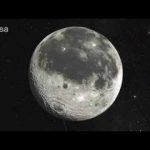
This 8-minute film gives an overview of the past, present, and future of Moon exploration, from the Lunar cataclysm to ESA’s vision of what Lunar exploration could be.
Why is the Moon important for science? What resources does the Moon have? Is there water? Why should we go back and how will we do it?
-
LADEE To The Moon and Remembering Gordon Fullerton on This Week @NASA
NASA prepares for the launch of the Lunar Atmosphere and Dust Environment Explorer or LADEE probe to the moon. Also, a new crew of ISS Astronauts meet the Media, and the Spitzer and WISE Telescopes get ready to help in the search for asteroids. These stories and more on This Week @NASA
-

How Much Does a Shadow Weigh?
Veritasium SLINKY video: http://bit.ly/SGD73o
Veritasium channel… SUBSCRIBE: http://bit.ly/RoMMH7
A great Veritasium episode about using video to teach: http://bit.ly/VOsZVxVsauce2 LEANBACK about shadows: http://bit.ly/VOt8rP
Vsauce3 explains how realistic SimCity is… SUBSCRIBE: http://bit.ly/PMThlp
ALL MUSIC BY: http://www.soundcloud.com/JakeChudnow
Jake’s YouTube channel: https://www.youtube.com/jakechudnowVsauce on Twitter (lots of extra mindblows): http://www.Twitter.com/TweetSauce
Vsauce on Facebook (your chance to blow MY MIND): http://www.Facebook.com/VsauceGamingHand shadow book: http://books.google.co.uk/books/about/Fun_with_Hand_Shadows.html?id=UhjBUYIUmO0C&redir_esc=y
Light “pushes” us: http://www.straightdope.com/columns/read/2987/do-shadows-weigh-anything
Solar Sail: http://www.jspec.jaxa.jp/e/activity/ikaros.html
solar sail GIF: http://www.jspec.jaxa.jp/e/activity/images/ikaros/pic_10.gif
Venutian Shadows: http://www.digitalsky.org.uk/venus/shadow-of-venus.html
Speed of light in different materials: http://cadlab6.mit.edu/2.009.wiki/anchor/index.php?title=Speed_of_light_in_vacuum%2C_air%2C_glass
sonic boom demonstration: http://demonstrations.wolfram.com/WavesFromAMovingSource/
Cherenkov radiation: http://profmattstrassler.com/articles-and-posts/particle-physics-basics/cerenkov-radiation/
and: http://en.wikipedia.org/wiki/Cherenkov_radiation
Photonic booms in your eyes: http://en.wikipedia.org/wiki/Cosmic_ray_visual_phenomena
Pushing a lightyear-long object: http://www.physicsforums.com/showthread.php?t=386687
compression / longitudinal waves: http://en.wikipedia.org/wiki/Longitudinal_waves
cool site for putting things in perspective (this link is for 1 sq. inch): http://www.bluebulbprojects.com/measureofthings/doShowResults.asp?comp=area&unit=in2&amt=1&sort=pr&p=1
Also this is important: http://animalsbeingdicks.com/post/23101742089/clean-get-away
-

JFK’s Rice Speech on NASA TV Sept. 12
50 years ago, President John F. Kennedy delivered his historic “Space Challenge” speech to students and faculty at Rice University in Houston that included this now-iconic statement, “We choose to go to the moon not because it is easy but because it is hard.” See and hear the speech in its entirety this Wednesday at 10:15 a.m. Central on NASA TV just as it was delivered that morning on September 12, 1962
-
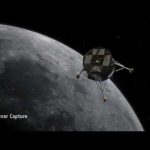
Lunar Lander mission
Lunar Lander mission, from launch to landing and exploring the Moon.
Lunar Lander is a robotic explorer that will demonstrate key European technologies and conduct science experiments.
The mission is a forerunner to future human and robotic exploration of the Moon and Mars. It will establish European expertise to allow strong international partnerships in exploration. -
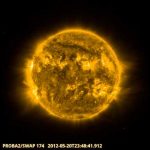
Proba-2 catches solar eclipse
ESA’s space weather microsatellite Proba-2 observed the solar eclipse on the evening of 20 May 2012. It passed through the Moon’s shadow a total of four times, imaging a sequence of partial solar eclipses in the process. The first contact was made on Sunday May 20 at 21:09 GMT. The last contact finished at 03:04 GMT.
Credits: ESA/ROB
-

NASA’s GRAIL Twins to Welcome 2012 at Moon
NASA’s two Gravity Recovery And Interior Laboratory (GRAIL) spacecraft are closing in on their quarry, the moon. The mission plans New Year’s Eve and New Year’s Day main engine burns to place the twin spacecraft in lunar orbit. http://www.nasa.gov/grail
-
NASA’s GRAIL Twins to Welcome 2012 at Moon
NASA’s two Gravity Recovery And Interior Laboratory (GRAIL) spacecraft are closing in on their quarry, the moon. The mission plans New Year’s Eve and New Year’s Day main engine burns to place the twin spacecraft in lunar orbit. http://www.nasa.gov/grail
-
NASA’s GRAIL Spacecraft Launches on Lunar Mission
NASA’s GRAIL spacecraft launched to the moon aboard a United Launch Alliance Delta II rocket on Sept. 10, 2011, from Cape Canaveral Air Force Station, Fla.
GRAIL’s primary science objectives are to determine the structure of the lunar interior, from crust to core, and to advance understanding of the thermal evolution of the moon.
-

New Shuttle Launch Date on This Week @NASA
NASA has re-targeted the liftoff of space shuttle Endeavour for Friday, April 29, at 3:47 p.m. EDT. The move comes to resolve a scheduling conflict with a Russian Progress supply vehicle scheduled to launch April 27 and arrive at the station two days later. Also, Goddard Memorial Symposium; “Wheels” rolls with big Shorty; cost-saving software summit; two honors for Ames; and, marking Odyssey’s beginning.
-
ESA Euronews: Europe and space exploration (Português)
Space exploration is a major global issue and Europe wants to be in the driving seat. It therefore needs to develop a global vision and a strategic action plan.
-
ESA Euronews: Europe and space exploration (Italiano)
Space exploration is a major global issue and Europe wants to be in the driving seat. It therefore needs to develop a global vision and a strategic action plan.
-
ESA Euronews: Europe and space exploration (Français)
Space exploration is a major global issue and Europe wants to be in the driving seat. It therefore needs to develop a global vision and a strategic action plan.
-
ESA Euronews: Europe and space exploration (Deutsch)
Space exploration is a major global issue and Europe wants to be in the driving seat. It therefore needs to develop a global vision and a strategic action plan.
-
ESA Euronews: Europe and space exploration
Space exploration is a major global issue and Europe wants to be in the driving seat. It therefore needs to develop a global vision and a strategic action plan.
-

ESA Space Scientist Detlef Koschny explains why he originally built Rosetta in LEGO®
Space missions are complicated pieces of orbital choreography. When planning a mission, spacecraft engineers must calculate how to point the solar panels towards the Sun, the main antenna towards Earth and the instruments towards the target. ESA Space Scientist Detlef Koschny build a LEGO model of Rosetta mission in order to visualise these precise orientations.
Copyright © Lightcurve Films/Maarten Roos, ESA, DLR, Europlanet, LEGO
-
ESA Space Scientist Detlef Koschny demonstrates the prototype LEGO® Philae lander
Built using LEGO Mindstorms, the Philae lander model can be controlled using a home computer. It can rotate and move the drill up and down to simulate the behaviour of the real lander. As part of ESA’s Rosetta space mission, Philae will land on comet Churyumov-Gerasimenko in November 2014 to study its composition.
Copyright © Lightcurve Films/Maarten Roos, ESA, DLR, Europlanet, LEGO
-

A New Era of Innovation and Discovery – President Obama’s Plan for NASA
President Barack Obama’s new plan for NASA.
-

NASA Science Briefing – A New Moon
Participants discuss new science data from the moon collected during national and international space missions.
-
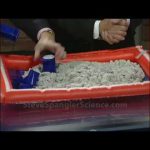
Moon Sand – Starter Kit
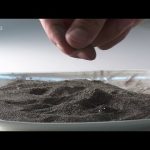
It’s like no other sand you’ve ever touched. Moon Sand looks and feels like regular sand yet it can be molded into any shape – almost like dough. Steve Spangler takes it to the 9News studio and talks about its unique properties.
-
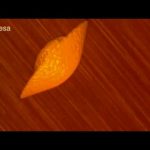
Cosmic Vision – See how Huygens landed on Titan
After an epic space journey, the European Huygens probe landed on Saturn’s moon Titan, a mysterious satellite that has perplexed astronomers for decades. On 14 January 2005, Huygens made the farthest touchdown of any human-built object sent to land on another world.
-
NASA Mission Update: New Horizon
Three billion miles away from Earth, near the farthest reaches of our solar system, is the heavenly body with an extreme orbit known for 76 years as Pluto. Discovered by astronomers in 1930, Pluto was considered the ninth planet in our solar system until 2006 — when, after much debate, it was reclassified by the International Astronomical Union as a “dwarf planet,” officially dropping its name — for a number.
Denis Bogan, New Horizons Program Scientist: “Well, it certainly doesnt affect Pluto. Pluto is the same thing it was before it was discovered, before it was given a name, and before the name was changed.”
Nor does Pluto’s reclassification change the importance of NASA’s first mission to study it.
Launch Announcer: “We have ignition and lift off of NASAs New Horizon spacecraft on a decade-long”
Launched in January 2006, the thousand-pound New Horizons spacecraft will travel through space for 9-1/2 years before meeting up with Pluto in the summer of 2015.
Denis Bogan: “The last time Pluto was in this position in its orbit was during the French and Indian War. It takes 248 Earth years to travel around its orbit and come back to the same place again. At the speed of light, sending a radio signal back from the spacecraft, from Pluto to Earth, will take 4-1/2 hours.”
Operating on less power than a pair of common 100-watt light bulbs, New Horizons will map the highest-interest areas of Pluto to a resolution of 50 meters, less than the length of a football field — three billion miles away. Itll then move on to survey Pluto’s neighborhood: the atmosphere, ancient materials and small bodies of the Kuiper Belt, a chaotic region astrophysicists believe can tell us how Earth, the planets, even our sun were made.
Denis Bogan: “We have primitive material chunks of rock and ice, millions of objects of objects out there in the Kuiper Belt and we know very little about it. We didnt discover it until 1992.”
Traveling 3 billion miles to frozen, rocky Pluto and its environs, New Horizon is, in a way, going back in time to the chemical building blocks of the solar system, and life.
To learn more about the New Horizons mission visit www.nasa.gov
-
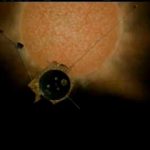
NASA Mission Update: ULYSSES
The sun is the source of life-sustaining energy here on Earth. Much of how it works – and affects us — remains a source of scientific mystery. Sunspots were first recorded by humans in the 16-hundreds. Astrophysicists have since linked heightened sunspot activity with the solar wind. It’s a million-mile-an-hour force of magnetically-charged particles emanating from the sun’s upper atmosphere. Ebbing and flowing in minimum and maximum intensities over eleven year cycles, this so-called space weather can seriously affect how things work here on Earth, such as disrupting satellite communications, telephone service and personal electronics.
Arik Posner, Program Scientist: “It would help our technology, to safeguard the technology by knowing when and in what intensity space weather occurs and where these effects might show up”
Launch Announcer : “2 -1 ignition and liftoff of Discovery and the Ulysses spacecraft bound for the polar regions of the sun.”
Until the launch of Ulysses from space shuttle Discovery in 1990, data for understanding and predicting space weather had come from a limited sampling area: the plane extending from the suns equator. Ulysses has since made three orbits above and below the poles of the sun, vastly expanding the territory from where raw space weather data are gathered.
Arik Posner: “So Ulysses was really the first spacecraft that leaped out of this confinement, and it gives us a view of the global heliosphere.”
Ulysses has found that the solar minimum were in right now is producing the lowest levels of solar wind seen since accurate readings became available a half-century ago. But for heliophysicists, these data raise as many questions as they answer.
Arik Posner: “The Space Age is only 50 years now, and the Sun just operates on longer time scales than these 50 years. So we might have just glimpsed just the surface of what is really going on.”
By expanding its reach, both in time and space, Ulysses is helping the discipline of space weather prediction grow beyond its infancy for the betterment of life here on Earth.
For more about Ulysses, the heliosphere, and space weather, log onto: www.nasa.gov/missions and click on ‘Ulysses.’
-
NASA Mission Update: CALIPSO
NASA Mission Update: CALIPSO
Clouds have forever held the imagination of skygazers who are captivated by their endless beauty and seeming randomness. But clouds, and whats in them, also hold fascination for scientists who seek to understand the many effects they have on life here on Earth.
Hal Maring, Program Scientist, CALIPSO: “Low clouds, which are white, can reflect sunlight and cause cooling of the Earth, and high clouds tend to warm the Earth by absorbing and re-radiating warmth back into the atmosphere.”
Launch Announcer: “2-1 We have ignition and we have lift-off of NASAs Calipso/Cloudsat spacecraft.”
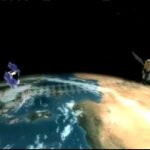
Since its launch in April 2006, the Cloud-Aerosol Lidar and Infrared Pathfinder Satellite Observation mission, CALIPSO, has provided new insight into the role that clouds play in regulating our climate. As CALIPSO orbits the Earth, its light detection and ranging, or lidar system, emits short pulses of green and infrared light, producing a 300-feet wide snapshot of what’s in the atmosphere from top to bottom — clouds and airborne particles. Snapshots collected along the same orbit are then streamed together to paint a picture of what a vertical slice of our atmosphere looks like.
Hal Maring: “Its basically a large laser range finder, and it shoots light down into the atmosphere. And, its able to detect and measure, clouds in the vertical .Not like a photograph, which tends to be two-dimensional, but gives us vertical curtains of measurements of clouds, i.e., their altitude.”
These critical cloud data from CALIPSO are used with information gathered by other satellites in NASAs A-train constellation of Earth-observing spacecraft to quantify just how much sunlight reaches the planet — and how much gets radiated back into space. This so-called energy budget is a key to documenting and understanding climate change.
Hal Maring: “We have found, it appears as though, the Earth is warming and its warming because of an imbalance or a change in the Earths energy budget.”
To see and learn more about CALIPSOs cloud images, or how CALIPSOs also helping scientists understand how climate may be changed by naturally-occurring and manmade particulates in the atmosphere called aerosols, go to www.nasa.gov/missions and click on “CALIPSO.”
-

“Fly Me To The Moon” at NASA’s 50th gala
A special live performance directed by Quincy Jones and performed by Frank Sinatra, Jr., at the AIAA 50th anniversary celebration for NASA. Learn more at www.nasa.gov.
-
NASA 50th Anniversary Moment – Richard Nafzger
The engineer in charge of bringing television images from the Apollo 11 moon landing to your living room talks about that nail-biting moment.