Tag: north

  • Lion of the North meets the Generalissimo – Battle of Alte Veste, 1632

    Lion of the North meets the Generalissimo – Battle of Alte Veste, 1632

    Go to https://surfshark.com/marche for 4 extra months of Surfshark
    Big thanks to Surfshark for supporting this video and for making the internet a safer place!

    🚩 In the late summer of 1632 the army of Swedish King Gustavus Adolphus met Albrecht von Wallenstein near Nürnberg. The earlier successes of Gustavus Adolphus over General Tilly, particularly at Breitenfeld, followed by Tilly’s death during the Battle of Rain, forced Holy Roman Emperor Ferdinand II to recall Albrecht von Wallenstein into military service from retirement. Wallenstein was unmatched in his ability to raise troops, and within a few weeks he took to the field with a fresh army.

    🚩 If you like what you see, consider supporting my work on Patreon and you get ad-free early access to my videos for as little as $1 https://www.patreon.com/historymarche — You can also show your support by subscribing to the channel and liking the video. Thank you for watching.

    šŸ“¢ Narrated by David McCallion

    šŸŽ¼ Music:
    EpidemicSound
    Filmstro

    šŸ“š Sources
    Clodfelter, M. – Warfare and Armed Conflicts: A Statistical Encyclopedia of Casualty and Other Figures – 4th edition (2017)
    Wilson, Peter H. – Europe’s Tragedy: A History of the Thirty Years War (2009)
    Wilson, Peter H. – Lützen: Great Battles Series (2018)
    Richard Brzezinski – The Army of Gustavus Adolphus Volume 1: Infantry
    Richard Brzezinski – The Army of Gustavus Adolphus Volume 2: Cavalry
    Henrik O. Lunde – The Rise and Fall of Sweden as a Military Superpower, 1611-1721
    Lars Erikson Wolke – Gustavus Adolphus, Sweden, and the Thirty Years War, 1630-1632
    Russell Frank Wreighley – The Age of Battles: The Quest for Decisive Warfare from Breitenfeld to Waterloo

    #history #documentary #surfshark

  • Earth from Space: North Sea bloom

    Earth from Space: North Sea bloom

    After a nice summer break, Earth from Space is back and is taking us over the North Sea with the Copernicus Sentinel-3A satellite and a new host.

    Go to our website to download this image: http://www.esa.int/spaceinimages/Images/2018/09/North_Sea_bloom

    ā˜… Subscribe: http://bit.ly/ESAsubscribe

    Check out our full video catalog: http://bit.ly/SpaceInVideos
    Follow ESA on Twitter: http://bit.ly/ESAonTwitter
    On Facebook: http://bit.ly/ESAonFacebook
    On Instagram: http://bit.ly/ESAonInstagram
    On Flickr: http://bit.ly/ESAonFlickr

    ESA is Europe’s gateway to space. Our mission is to shape the development of Europe’s space capability and ensure that investment in space continues to deliver benefits to the citizens of Europe and the world. Check out http://www.esa.int/ESA to get up to speed on everything space related.

    Copyright information about our videos is available here: http://www.esa.int/spaceinvideos/Terms_and_Conditions

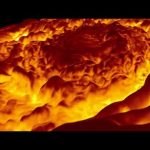
  • Low 3-D Flyover of Jupiter’s North Pole in Infrared

    Low 3-D Flyover of Jupiter’s North Pole in Infrared

    In this animation the viewer is taken low over Jupiter’s north pole to illustrate the 3-D aspects of the region’s central cyclone and the eight cyclones that encircle it.
    Read more: https://www.nasa.gov/feature/jpl/nasa-s-juno-mission-provides-infrared-tour-of-jupiter-s-north-pole
    The movie utilizes imagery derived from data collected by the Jovian Infrared Auroral Mapper (JIRAM) instrument aboard NASA’s Juno mission during its fourth pass over the massive planet. Infrared cameras are used to sense the temperature of Jupiter’s atmosphere and provide insight into how the powerful cyclones at Jupiter’s poles work. In the animation, the yellow areas are warmer (or deeper into Jupiter’s atmosphere) and the dark areas are colder (or higher up in Jupiter’s atmosphere). In this picture the highest ā€œbrightness temperatureā€ is around 260K (about -13°C) and the lowest around 190K (about -83°C). The ā€œbrightness temperatureā€ is a measurement of the radiance, at 5 µm, traveling upward from the top of the atmosphere towards Juno, expressed in units of temperature.
    Credit: NASA/JPL-Caltech/SwRI/ASI/INAF/JIRAM

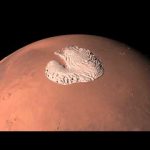
  • Mars 360: the north pole

    Mars 360: the north pole

    Enjoy views of the martian north pole from all angles in this new animation from ESA’s Mars Express.

    The ice cap has a diameter of about 1000 km and consists of many thin layers of ice mixed with dust that extend to a depth of around 2 km below the cap. The prominent gap in the ice cap is a 318 km-long, 2 km-deep chasm called Chasma Boreale.

    The layers result from variations in the orbit and rotation of Mars that affect the amount of sunlight received at the poles, and thus the amount of melting and deposition of materials over time. Meanwhile, strong prevailing winds are thought to be responsible for shaping the spiral troughs.

    The polar ice cap in this movie was constructed using data provided by the Mars Advanced Radar for Subsurface and Ionospheric Sounding instrument, MARSIS.

    Low-frequency radio waves beamed towards the surface are reflected back to Mars Express from the planet’s surface and from interfaces between layers of different materials underground.

    The strength and timing of the radar echoes are a gauge of the depths of different types of interfaces, such as between rock, water or ice. This information can then be translated into 3D views, as seen in this movie.

    Credit: ESA/ASI/NASA/JPL/La Sapienza University/INAF (A. Frigeri)