Tag: Orbit (Orbit Type)

  • Rosetta orbiting around the comet

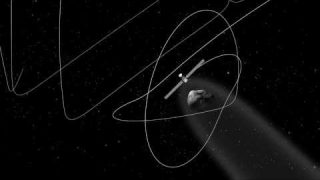
    Rosetta orbiting around the comet

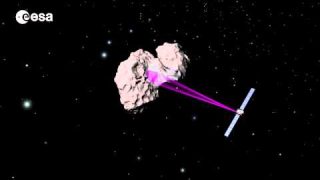
    Rosetta orbiting Comet 67P/Churyumov–Gerasimenko and scanning its surface to make scientific measurements. The colours of the beams and their shape on the surface represent two different instruments imaging and analysing the comet.

    The Rosetta orbiter has a total of 11 instruments to study the characteristics and environment of the comet. Rosetta is taking images of the comet at a variety of different wavelengths, measuring its gravity, mass, density, internal structure, shape and rotation, and assessing the properties of its gaseous, dust-laden atmosphere, or coma. It is also probing the surrounding plasma environment and analysing how it interacts with the solar wind.

    Rosetta also carries a small lander, Philae, which will descend to the surface of the comet and make in situ measurements using its suite of 10 instruments.

    The animation is not to scale; the comet is about 4.1 km wide and Rosetta is 32 m across including its solar wings, and it conducts scientific investigations at a range of altitudes. The comet shape is based on a true comet shape model.

    Credits: ESA

  • Rosetta: close orbits to lander deployment (annotated)

    Rosetta: close orbits to lander deployment (annotated)

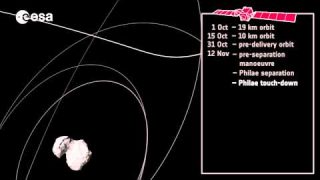
    Animation showing Rosetta’s orbit in the lead up to, during and after lander separation.

    The animation begins on 1 October 2014, when Rosetta is orbiting about 19 km from Comet 67P/Churyumov–Gerasimenko (all distances refer to the comet’s centre). The animation shows the transition to the close 10 km orbit by mid-October, and then the steps taken to move onto the pre-separation trajectory.

    On the day of landing, 12 November, Rosetta makes a further manoeuvre 2–3 hours before separation to move to 22.5 km from the comet centre to deploy the lander, Philae. While Philae descends to the surface over a period of seven hours, Rosetta makes another manoeuvre to maintain visibility with the lander. A series of ‘relay phase’ manoeuvres then move Rosetta out to a distance of about 50 km, before moving first to a 30 km orbit and later to an orbit at about 20 km by early December.

    The speed of the animation slows during the separation and lander phase to better highlight these events. The comet shape and rate of rotation is real – the comet rotates with a period of about 12.4 hours.

    Credits: ESA

  • How to orbit a comet

    How to orbit a comet

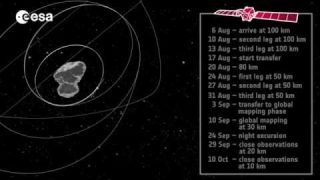
    What happens after Rosetta arrives at comet 67P/Churyumov–Gerasimenko? This animation describes the key dates for the next set of manoeuvres that will bring Rosetta even closer to the comet between August and October.

    After arriving on 6 August, Rosetta will follow a set of two, three-legged triangular trajectories that require a small thruster burn at each apex. The legs are about 100 km long and it will take Rosetta between three and four days to complete each one.

    The first triangle is conducted at a distance of about 100 km from the comet, the second at around 50 km. Then Rosetta will switch to a ‘global mapping phase’ at an altitude of about 30 km. During this period, it will make a ‘night excursion’, whereby the ground track of the spacecraft will be on the night-side of the comet (with the spacecraft still fully illuminated the Sun).

    In October Rosetta will transfer to a close mapping phase to observe the comet from a distance of 10 km. The spacecraft will move even closer to dispatch lander Philae to the surface in November.

    In this animation the comet is an artist’s impression and is not to scale with the spacecraft. The comet rotation is not representative (67P rotates once per 12.4 hours). Dates may be subject to change.

    Credits: ESA

  • ATV Johannes Kepler – Orbits and body motion in space

    ATV Johannes Kepler – Orbits and body motion in space

    This video is part of a series of educational videos that ESA is releasing based on the five visionaries that lent their name to Europe’s space freighters.

    Jules Verne, Johannes Kepler, Edoardo Amaldi, Albert Einstein and Georges Lemaître form the inspiration to explain the principles of physics to young and older audiences.

    Presented by Anu Ojha, this video offers a good basis to introduce schoolchildren and the general public to concepts of orbital mechanics.

    Accompanying these videos are also a new set of resources that ESA education is producing: Teach with Space, a large set of demonstrations and teacher guides intended to bring the excitement of space into the classroom to inspire the next generation.

    Classroom demos:
    http://www.esa.int/spaceinvideos/Videos/2014/07/Marble-ous_ellipses_-_classroom_demonstration_video_VP02
    http://www.esa.int/spaceinvideos/Videos/2014/07/Gravity_wells_-_classroom_demonstration_video_VP04

  • Rosetta’s orbit around the comet

    Rosetta’s orbit around the comet

    After a ten year journey through space, ESA’s Rosetta spacecraft will reach comet 67P/Churyumov-Gerasimenko in August 2014. After catching up with the comet Rosetta will slightly overtake and enter orbit from the ‘front’ of the comet as both the spacecraft and 67P/CG move along their orbits around the Sun. Rosetta will carry out a complex series of manoeuvres to reduce the separation between the spacecraft and comet from around 100 km to 25-30 km. From this close orbit, detailed mapping will allow scientists to determine the landing site for the mission’s Philae lander. Immediately prior to the deployment of Philae in November, Rosetta will come to within just 2.5 km of the comet’s nucleus.
    This animation is not to scale; Rosetta’s solar arrays span 32 m, and the comet is approximately 4 km wide.

    Credit: ESA — C. Carreau

  • Chasing a comet

    Chasing a comet

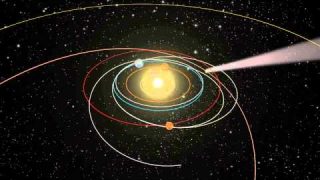
    Rosetta’s journey from launch in March 2004 to comet 67P/Churyumov-Gerasimenko in August 2014, including 3 flybys of Earth and 1 of Mars. By January 2014 Rosetta is about 9 million kilometres from comet 67P/CG. By early May, Rosetta will be 2 million kilometres from the comet and at the end of May the spacecraft will execute a major rendezvous manoeuvre to line it up for orbit insertion at the start of August.
    The comet and planets are not to scale.

    Credits: ESA — C. Carreau