The second data release of ESA’s Gaia mission has produced an extraordinary catalogue of over one and a half billion stars in our galaxy. Based on observations between July 2014 to May 2016, it includes the most accurate information yet on the positions, brightness, distance, motion, colour and temperature of stars in the Milky Way as well as information on asteroids and quasars.
Animated 3D view of the sky as observed by ESA’s Gaia satellite using information from the mission’s second data release.
The bright band in the left half of the image is the Milky Way, where most of the stars in our Galaxy reside. The animation starts with the Orion constellation at the centre; we then move towards the neighbouring Taurus constellation and to the Hyades star cluster, which is part of this constellation. Hyades is the closest open cluster to the Solar System, some 150 light-years away.
The animation first shows the 3D structure of the cluster, based on accurate position and distance information from Gaia. Then an animated view of the future motions of stars is shown – both in Hyades and beyond. This is based on Gaia’s measurements of the velocity of stars across the sky, also known as proper motion.
Credit: ESA/Gaia/DPAC, CC BY SA 3.0 IGO
Acknowledgement: Gaia Data Processing and Analysis Consortium (DPAC); Gaia Sky; S. Jordan / T. Sagristà, Astronomisches Rechen-Institut, Zentrum für Astronomie der Universität Heidelberg, Germany
Animated view of 14 099 asteroids in our Solar System, as viewed by ESA’s Gaia satellite using information from the mission’s second data release. The orbits of the 200 brightest asteroids are also shown, as determined using Gaia data.
In future data releases, Gaia will also provide asteroid spectra and enable a complete characterisation of the asteroid belt. The combination of dynamical and physical information that is being collected by Gaia provides an unprecedented opportunity to improve our understanding of the origin and the evolution of the Solar System.
Credit: ESA/Gaia/DPAC, CC BY SA 3.0 IGO
Acknowledgement: Gaia Data Processing and Analysis Consortium (DPAC); Orbits: Gaia Coordinating Unit 4; P. Tanga, Observatoire de la Côte d’Azur, France; F. Spoto, IMCCE, Observatoire de Paris, France; Animation: Gaia Sky; S. Jordan / T. Sagristà, Astronomisches Rechen-Institut, Zentrum für Astronomie der Universität Heidelberg, Germany
A 360° animated view of the entire sky on 25 April 2018.
After a few seconds, the stars start moving in the sky according to parallax, an apparent shift caused by Earth’s yearly motion around the Sun. Then, constellation outlines appear as visual aids. Finally, stars start moving according to their true motion through space, which is visible on the sky as proper motion. Parallaxes have been exaggerated by 100 000 and proper motions have been speeded up by one trillion (10^12) to make them visible in this animation. This animation is based on data from the second data release of ESA’s Gaia satellite, which has measured the positions, parallaxes and motions of more than one billion stars across the sky to unprecedented accuracy.
ESA/Gaia/DPAC, CC BY SA 3.0 IGO
Acknowledgement: Gaia Data Processing and Analysis Consortium (DPAC); Gaia Sky; S. Jordan / T. Sagristà, Astronomisches Rechen-Institut, Zentrum für Astronomie der Universität Heidelberg, Germany
Meet our new space explorers, the spacecraft of the BepiColombo mission, as they begin their adventure to planet Mercury. But first, they have to navigate through Amsterdam Schiphol airport to reach Europe’s spaceport in Kourou, French Guiana.
The spacecraft really do depart from Schiphol; along with essential ground-support equipment they are scheduled to fly in a series of Antonov aircraft during the last week of April and first week of May. Upon arrival at Kourou, an intensive six-months of preparations will prepare the mission for launch. The launch window opens 5 October until 29 November 2018.
Find out more about the BepiColombo mission on esa.int/bepicolombo
On 25 April 2018, ESA’s Gaia mission will publish its much awaited second data release, including high-precision measurements of nearly 1.7 billion stars in our Galaxy.
Scientists who have been working on creating and validating the data contained in the catalogue tell us why they are waiting for this extraordinary release.
Featured in the video: Antonella Vallenari (INAF, Astronomical Observatory of Padua), Anthony Brown (Leiden University), Timo Prusti (European Space Agency), Annie Robin (Institut UTINAM, OSU THETA Franche-Comté-Bourgogne), Laurent Eyer (University of Geneva) and Federica Spoto (IMCCE, Observatory of Paris).
A media briefing on the second Gaia data release will be held at the ILA Berlin Air and Space Show in Germany on 25 April 11:00-12:15 CEST. Watch the webstream at www.esa.int/live
We meet a surfing scientist and toxic algae hunters to see how Sentinel-3 satellite data is used to study the coastline of the English Channel in this month’s episode of Space.
Bob Brewin is pioneering a new technique in satellite oceanography – by going surfing. The Plymouth Marine Laboratory scientist uses his board to take sea surface temperature measurements, and then use them to better interpret data from European satellite Sentinel-3.
In this special edition of Earth from Space, senior project scientist at Gamma Remote Sensing, Dr Maurizio Santoro, joins the show to discuss how his team estimates forest biomass from space.
Our alien friend Paxi, ESA Education’s mascot, went to visit American astronaut Scott Tingle on board the International Space Station. Tingle tells Paxi about how astronauts sleep in weightlessness, an important aspect of living on the ISS.
Having a stressful day? We got you covered! Sit back, turn the volume up and enjoy a relaxing moment brought to you by ESA and Lufthansa exploring the countries which make up the European Space Agency with images taken by the Copernicus Sentinel-1A, Sentinel-2A and Sentinel-3A, Proba-V and Envisat satellites.
Don’t forget to favourite this video. You will always have a space to relax with us.
LINKS AND DETAILS:
More details:
#1. Speed of sound: Unlike light, sound needs a medium to travel through, and its speed depends on characteristics of that medium like density and temperature. In the extreme environment of a neutron star’s core, sound can travel extremely fast. But knowing that sound can’t surpass the speed of light, physicists can narrow down their models of neutron stars to include only those where “extremely fast” is less than light speed.
#3. Relativity rainbows: A team at MIT created a game called “A Slower Speed of Light” that lets you see the world as you would at near-light speeds. Their trailer: https://www.youtube.com/watch?v=uu7jA8EHi_0
Every week, on average, a substantial, inert satellite drops into our atmosphere and burns up. Monitoring these reentries and warning European civil authorities has become routine work for ESA’s space debris experts.
Each year, about 100 tonnes of defunct satellites, uncontrolled spacecraft, spent upper stages and discarded items like instrument covers are dragged down by Earth’s upper atmosphere, ending their lives in flaming arcs across the sky.
Some of these objects are big and chunky, and pieces of them survive the fiery reentry to reach the surface. Our planet, however, is a big place, mostly covered by water, and much of what falls down is never seen by anyone, sinking to the bottom of some ocean, or landing far from human habitation.
While still in orbit, these and many other objects are tracked by a US military radar network, which shares the data with ESA, since Europe has no such capability of its own.It’s the task of ESA’s Space Debris team to look at these data and issue updates to ESA Member States and partner civil authorities around the globe.
The video features footage taken of the parachute deployment as seen from the ground, as well as from onboard GoPros fixed to the drop test vehicle and looking up at the parachute. The test focused on the deployment and inflation of the second main stage 35m-wide parachute, which will be the largest to fly on Mars.
Discussing the test are Stephane Langlois, ESA ExoMars engineer, and John Underwood, principal engineer at Vorticity.
The test was carried out by Vorticity Ltd under supervision of Thales Alenia Space France, Thales Alenia Space Italy and ESA, in Kiruna, Sweden, on 2 March 2018.
Having a stressful day? We got you covered!Sit back, turn the volume up and enjoy a relaxing moment brought to you by ESA and Lufthansa getting lost in the beauty of our planet with images captured by Envisat, JAXA ALOS, KARI Kompsat-2, GeoEye Ikonos-2 and NASA Landsat-5 and Landsat-7 satellites.
Don’t forget to favourite this video. You will always have a space to relax with us.
Earth from Space is presented by Kelsea Brennan-Wessels from the ESA Web TV virtual studios. In this edition, Sentinel-2A satellite takes us over Japan’s capital, the world’s largest megacity.
Having a stressful day? We got you covered! Sit back, turn the volume up and enjoy a relaxing moment brought to you by ESA and Lufthansa exploring the coldest parts of our planet with a collection of ice images captured by the Envisat satellite.
Don’t forget to favourite this video. You will always have a space to relax with us.
This evidence seems to suggest that the dark matter is particles that are less than four times the mass of a proton and are moving at non-relativistic speeds. This is consistent with dark matter particles being so-called WIMPs: https://en.wikipedia.org/wiki/Weakly_interacting_massive_particles.
We did something a little different in this episode and answered questions from you, our viewers. If you have a questions about the universe, past videos, or life as a scientist, leave a comment below!
How can you train yourself to be a quantum detector? Quantum interactions happen at impossibly small scales. But the life-size effects are all around you. You can detect quantum mechanics all over — if you know how to look for it.
ADVANCED SCIENTIFIC NOTE: Quantum mechanics would be much more obvious if we had very sensitive eyes. If your eyes identified each photon individually, you would see them land as described in the video, and only build up to this wave pattern. The pattern that we see can be explained classically by waves, it is *ultimately* a quantum phenomenon. The only reason it’s hard to tell is because our light detectors (eyes) aren’t quite sensitive enough.
NOVA has teamed up with Cook’s Illustrated to cook up a recipe for stars and black holes – a culinary “course” on how the most mysterious objects in the universe are created.
The Moon is a destination, a laboratory for science, a place to learn the skills of planetary exploration, and a source of materials and energy for use on the Moon and in space to create new spacefaring capability.
Advocate of a human return on the Moon, Paul D. Spudis, Senior Staff Scientist at the Lunar and Planetary Institute in Houston (Texas, USA), takes us on a journey to rediscover the value of lunar exploration, a topic on which he has spent more than 40 years of study, thought and publications.
Space Bites hosts the best talks on space exploration from the most inspiring and knowledgeable speakers from the field. Held at the technical heart of the European Space Agency in the Netherlands, the lectures are now also available on YouTube. If you want to know about the present and future challenges of ESA, stay tuned for more.
We are Europe’s gateway to space. Our mission is to shape the development of Europe’s space capability and ensure that investment in space continues to deliver benefits to the citizens of Europe and the world. Check out https://www.esa.int/ to get up to speed on everything space related.
Scientific notes:
Stellar mass black holes vs. supermassive black holes
* Stellar mass black holes form from the collapse of massive stars at the ends of their lives, so they have roughly the same mass as a star. Supermassive black holes are physically identical to their smaller counterparts, except they are 10 thousand to a billion times the size of the sun. However, their formation is more of a mystery. They may form from the merging of smaller black holes. http://astronomy.swin.edu.au/cosmos/S/Supermassive+Black+Hole
Supermassive black holes at the center of galaxies
* Almost every large galaxy has a supermassive black hole at its center, but researchers are not yet sure (https://jila.colorado.edu/research/astrophysics/black-holes-galaxies) why that’s the case, how they originate, and what their role is in the creation and evolution of galaxies.
Why are stars different colors?
* The color of a star depends on its temperature (http://www.atnf.csiro.au/outreach/education/senior/astrophysics/photometry_colour.html). The hotter a star, the higher energy its light will be. Higher energy/temperature corresponds with the blue end of the visible spectrum and lower energy/temperature corresponds with the red end.
How does dark matter make stars spin faster?
* In the 1960s, astronomers Vera Rubin and Kent Ford noticed that stars at the edges of galaxies were moving just as fast as stars at the center, which surprised them: it appeared that the force of gravity causing stars to orbit the center of the galaxy was not weakening over distance. Their observation implied that something else, distributed throughout the galaxy, was exerting a gravitation pull. We now know that that “something else,” now named dark matter, accounts for about 85% of the matter in the universe. (It existence was inferred in the 1930s, when the astronomer Fritz Zwicky(http://www2.astro.psu.edu/users/rbc/a1/week_10.html) noticed that galaxies in clusters were moving faster than they should.)
Size of the universe
* The universe is only 13.8 billion years old, but has a radius of about 46 billion light-years. If nothing can travel faster than the speed of light, how can that be? The expansion of the universe, driven by dark energy, is causing distances between objects to grow. Note that it is not moving those objects apart; rather, it is increasing the amount of space between them. https://phys.org/news/2015-10-big-universe.html
Cosmic webs
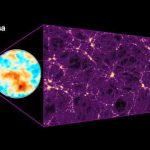
* Galaxies are not distributed randomly (http://skyserver.sdss.org/dr1/en/astro/structures/structures.asp) in space; instead, clusters of galaxies form web-like patterns. These webs consist of filaments, where dark matter and ordinary (baryonic) matter are concentrated, and voids, where galaxies are scarce. Researchers believe that these large-scale structures grew out of minor fluctuations in density at the beginning of the universe.
Composition of the early universe
* Moments after the Big Bang, the universe formed the nuclei for what would be come the universe’s hydrogen and helium atoms, with one helium nucleus for every 10 or 11 hydrogen (http://umich.edu/~gs265/bigbang.htm). When the first stars formed, there were no heavier elements — those elements formed inside stars.
String Theory Landscape
* The String Theory Landscape is a theory that the universe we live in is one of many universes. It attempts to explain how certain constants of nature seem “fine-tuned” for life, which contradicts the anthropic principle, or the notion that we humans hold a special place in the universe. https://www.scientificamerican.com/article/multiverse-the-case-for-parallel-universe/%0A
Disintegration of the universe
* In the future Degenerate Era of the universe, as space-time expands and stars burn up, all of the matter in stars will be consumed by black holes. But even black holes are not forever. Stephen Hawking theorized that black holes will slowly radiate away their mass in what is now called Hawking radiation until they too dissipate away. http://www.nytimes.com/books/first/a/adams-universe.html
______
MEDIA CREDITS:
Music provided by APM
Sound effects: Freesound.org
Additional Animations:
– Galaxy within Universe: Edgeworx;
– Stars at center of Milky Way – NASA/NCSA University of Illinois Visualization by Frank Summers, Space Telescope Science Institute, Simulation by Martin White and Lars Hernquist, Harvard University
What if everything in the universe came to your doorstep…in a box?! What The Physics is BACK! Future episodes will explore the universe—but first, let’s unbox it.
Subscribe: http://youtube.com/whatthephysics?sub…
↓Want more info?↓
SCIENTIFIC NOTES:
Explosive young stars
* The average lifetime of a star is about 10 billion years, but the bigger the star, the shorter its life. One rare type of star, called a hypergiant, can be tens, hundreds, or even a thousand times the mass of our sun. These stars burn out and explode into supernovae in just a few million years. http://www.guide-to-the-universe.com/hypergiant-star.html
Black holes
* Black holes form from the collapse of a massive star at the end of its life, but this only happens in stars about three times as massive as the sun. http://burro.case.edu/Academics/Astr201/EndofSun.pdf
How big is the universe?
* Probably infinite. No one knows the size of the universe for sure, and we may never know, but the latest thinking is that it probably goes on forever. https://map.gsfc.nasa.gov/universe/uni_shape.html
Standard cosmological model
* According to the standard cosmological model, the universe started with a big bang, underwent rapid inflation within the first fraction of a second, and continues to expand, driven by a vacuum energy called dark energy. All of the structure we see in the universe has come from interactions between dark energy and dark matter (which accounts for about 85% of the universe’s matter). This model describes and predicts many phenomena in the universe but is not perfect. https://physics.aps.org/articles/v8/108
False vacuum model
* The false vacuum model is a real, albeit unlikely theory. All the fundamental forces of nature have corresponding fields (e.g., gravitational fields, magnetic fields, etc.), and we generally believe that the universe is at rest in a global minimum of the potentials of those fields. But if we are instead at rest in a local minimum, or a “false vacuum,” the universe could potentially be nudged, catastrophically, into a lower minimum.
Recycling stars into life
* Before the first stars, the universe was all hydrogen and helium. All heavier elements, including the building blocks of life, were forged in stars.
Dark matter and dark energy
* Only 5% of the universe is made up of matter we can see. The “missing mass” later dubbed dark matter was first noticed in the 1930s; dark energy was discovered in the 1990s. In both cases, their existence was inferred by their effect on objects they interact with. However, they are still not directly observable, so nobody knows yet what they are made of.
Leftover light from the Big Bang
* The theory of the Big Bang predicted the existence of cool radiation pervading the universe, left over from its beginning. In an accidental discovery, two New Jersey scientists discovered the cosmic microwave background, a nearly uniform bath of radiation throughout the universe at a temperature of about 3 Kelvin, or -454 degrees Fahrenheit.
Gravitational waves
* Albert Einstein predicted the existence of gravitational waves in his theory of general relativity in 1916. According to his theory, the acceleration of massive objects, like black holes, should send ripples through space-time at the speed of light. A century after his prediction, two merging black holes sent a ripple through space-time that was detected on Earth as a signal that stretched the 4-kilometer arms of a detector by less than 1/1,000 the width of a proton.
Cosmic dust
* Cosmic dust is cast off from stars at the end of their lives and hovers in galaxies as clouds. These clouds of dust absorb ultraviolet and visible light, obscuring much of what lies behind them. This makes it notoriously difficult to study things like the dusty center of our galaxy.
The observable universe
* The universe is 13.8 billion years old. Since the distance we can observe is limited by the time it takes light to travel to Earth, we can only ever observe a fraction of the universe: an expanding sphere around us that is now about 46 billion years in radius. However, the universe is much larger than what we can observe.
CREDITS:
Host, Writer, Producer: Greg Kestin
Animation & Compositing: Danielle Gustitus
Contributing Writers: Lissy Herman, HCSUCS
Filming, Writing, & Editing Contributions from:
Samia Bouzid and David Goodliffe
Creation of Sad Star Image: Drew Ganon
Special thanks:
Julia Cort
Lauren Aguirre
Ari Daniel
Anna Rothschild
Allison Eck
Fernando Becerra
And the entire NOVA team
How did it all begin? What are the origins of our planet? To understand our place in the Universe we need to explore space. Find out how we’re doing this with ESA’s incredible fleet of space science missions to study our Sun and chart the stars around us, probe the dark matter and dark energy of the Universe, and tour various planets, moons and other small bodies in our Solar System.
Advanced scientific note about Doppler: If there is a light moving away from you at constant velocity in static flat (Minkowski) space-time, no matter how red it is, you will never conclude it is going faster than light. But, here I am discussing the conclusions one might come to if you mistakenly use Doppler in the context of the curved space-time of the universe (where there is expansion). Interpreting the huge redshift as a result of the doppler effect, could make one think that galaxies we see are moving away at speeds approaching light speed. And since what we are actually seeing is light from those galaxies from billions of years ago, and given that the universe is expanding, you might be tempted to say that they have since “accelerated” to faster than the speed of light. You might go further and say that there are more distant galaxies that we can’t see which are moving away even faster. So you might conclude there are galaxies moving faster than light in the universe. But the redshift isn’t from doppler and this “acceleration” of the expanding universe isn’t actually causing a true increase in velocity.
Sometimes astronomers do say there is a faster than light “recession speed” by pretending the expansion of the universe is causing distant galaxies to move away from each other at a corresponding velocity, but that’s misleading. In general relativity, you can actually have an increase in space between objects without causing a corresponding increase in the relatives velocities of those objects.
Special thanks:
Marissa Giustina
Nick Hutzler
Julie Elksy
Byron Drury
Jacob Barandes
Tyler Howe
Lissy Herman
Ari Daniel
Lauren Aguirre
Kristine Allington
Allison Eck
Anna Rotschild
MEDIA CREDITS:
Music provided by APM:
Deep_Science_No-perc
Mysteries_of_Science_B
Dreaming_of_the_Stars_a
Curiosity_Kills_the_Cat_2
Conundrum_a
Images:
Stars – Rene Barrios
Earth – Eirika
galaxy spiral (by coornio – diviantart)
Squirrel with scissors – 60811670 – Dollarphotoclub
Equations – 91613623 – Dollarphotoclub
Maxresdefault – Sean Stewart
Marissa Giustina – Lammerhuber
Tangled cat – David Swayze
Cat doll – Vicky Somma
Stock footage:
train-exits-tunnel – Pond5
Bin_pulsar_442 – Courtesy of Nasa
Expanding in space (40294) – Courtesy of Nasa
WMAP_archive – Courtesy of Nasa
ESA astronaut Samantha Cristoforetti photographs stunning Earth images of Lufthansa worldwide destinations during her Futura mission onboard the ISS. An ESA for Lufthansa inflight film.
This panel discussion from NASA headquarters focuses on recent discoveries of water and organics in our solar system, the role our sun plays in water-loss in neighboring planets, and our search for habitable worlds among the stars.
Has the universe a beginning or was it here since forever? Well, evidence suggests that there was indeed a starting point to this universe we are part of right now. But how can this be? How can something come from nothing? And what about time? We don’t have all the answers yet so let’s talk about what we know.
Also, we try to make this one not depressing. Tell us if we succeeded.
BY THE WAY. We have a website now. We’ll try to blog from time to time, show you guys how we make the videos and give more insight to our process. Also we sell stuff. We really don’t know where this whole kurzgesagt stuff leads us. But we are really thankful for all the attention and positive feedback and yeah, maybe we can make this our jobs — it would be pretty nice and we could do more content each month. But we’ll see. For now, thank you very much everybody for making this little adventure possible.
If you like the MUSIC of the video, you can get it here: http://bit.ly/1fCOlLI
Thomas did an aweful good job again. 🙂
Next Video: April. (as soon as we can but we kind of have to make a living and visit college) Topic: Nuclear Energy (probably, if we finish the research in time — if not something else)
Short videos, explaining things. For example Evolution, the Universe, Time, the Stock Exchange or controversial topics like Fracking. Because we love science.
We’re a bunch of Information designers from munich, visit us on our website, twitter, facebook or behance to say hi!
Gaia is ESA’s billion-star surveyor, designed to provide a precise 3D map of our Milky Way galaxy in order to understand its composition, formation and evolution.
This animation highlights some of the many discoveries made by ESA’s Planck space telescope over its 4.5 year observing career, from new discoveries in our home Milky Way Galaxy stretching back to the first few moments after the Big Bang 13.82 billion years ago.
Acquired by ESA’s Planck space telescope, the most detailed map ever created of the cosmic microwave background — the relic radiation from the Big Bang — was released today, revealing the existence of features that challenge the foundations of our current understanding of the Universe.
You, together with your 500 million fellow citizens from ESA’s 20* European member nations, are the collective owners of one of the world’s leading space agencies.
The European Space Agency is an intergovernmental organisation, a cooperative coming together of its Member States in their national interest and common good.
This new video offers a quick introduction: Europe, meet ESA.
A breathtaking collection of photos taken by ESA Astronaut Paolo Nespoli during his 6-month MagISStra mission on the International Space Station 25 December 2010 – 24 May 2011.
Music: Dream Elements by Green Sun licensed by Ambient Music Garden.
Video produced for Lufthansa inflight entertainment (released June 2011).