A first aboard the space station, some gear well-suited for the Artemis generation, and ensuring astronaut safety … a few of the stories to tell you about – This Week at NASA!
This video is available for download from NASA’s Image and Video Library: https://images.nasa.gov/details-NHQ_2019_1018_The%20First%20All-Woman%20Spacewalk%20Outside%20the%20Space%20Station%20on%20This%20Week%20@NASA%20%E2%80%93%20October%2018,%202019
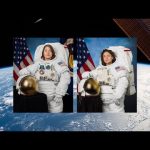
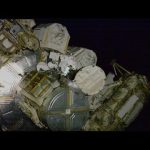
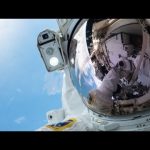
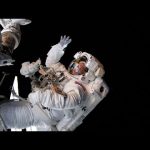
On Friday, Oct. 18, NASA astronauts Christina Koch and Jessica Meir completed NASA’s first all-woman spacewalk. During the 7-hour, 17-minute spacewalk, the pair replaced a failed power controller and completed several other tasks in preparation for future spacewalks.
This timelapse video from the International Space Station shows ESA astronaut Luca Parmitano helping NASA astronauts Andrew Morgan and Christina Koch prepare for a spacewalk on 6 October 2019.
Andrew and Christina worked outside in the vacuum of space for seven hours and one minute to begin the latest round of upgrading the station’s large nickel-hydrogen batteries with newer, more powerful lithium-ion batteries.
This spacewalk is one of many scheduled for October and November. The first all-female spacewalk is expected to take place during the week of 14 October and Luca is expected to complete his first spacewalk of the Beyond mission later in November.
During his November spacewalks, Luca will work to repair and enhance the Alpha Magnetic Spectrometer – a particle physics experiment module that was never designed to be maintained in orbit.
The music accompanying this timelapse is I Go Blind 2 sourced from Audio Network.
We are Europe’s gateway to space. Our mission is to shape the development of Europe’s space capability and ensure that investment in space continues to deliver benefits to the citizens of Europe and the world. Check out http://www.esa.int/ESA to get up to speed on everything space related.
Have you ever done a science experiment and wondered “What would this be like if it were HUGE?” Welcome to Science Max, the exciting new series that turbocharges all the science experiments you’ve done at home.
Chasing smoke is a round-the-clock business. Wildfire smoke can travel long distances and over several days, so #NASAExplorers with the Fire Influence on Regional to Global Environments and Air Quality (FIREX-AQ) mission took to the field to find where it goes. From a plane directly above the Shady Fire in the middle of the afternoon to a valley in the Sawtooth Mountains at 1 in the morning, explorers are gathering important data about how fire smoke affects communities near and far. #S3E2
At NASA Headquarters on Oct. 15, 2019, Administrator Jim Bridenstine introduced the Exploration Extravehicular Mobility Unit (xEMU) and Orion Crew Survival System suit which will be will be worn by first woman and next man as they explore the Moon as part of the #Artemis program.
Space travel is hard and unforgiving, but we have never been more ready to meet the unknown.
Team members from NASA’s #Artemis program share the risks and rewards of this next era of exploration. Artemis will push the boundaries of human exploration and send the first woman and next man to the Moon by 2024, preparing for missions to Mars and beyond.
ExoMars 2020 has passed a number of milestones. The European carrier module was delivered in March. The European rover, which contains nine instruments, has been assembled by Airbus UK and is under environmental testing in Toulouse. It should be integrated with the spacecraft by the end of the year. The spacecraft is now in the Thales Alenia Space test facilities in Cannes to start the environmental and performance verification test campaign that will last until February 2020.
However, there remain some important challenges ahead for the parachute system of the descent module. Recent balloon high-altitude drop tests were unsuccessful. As a result, the next and final two drop tests, scheduled between January and March 2020, must be fully successful otherwise the mission cannot launch in 2020.
The joint ESA and Russian mission consists of four elements: a carrier module to propel the spacecraft to Mars, a descent module, a surface science platform and the Rosalind Franklin rover, which will use its drill up to depths of two meters to search for signs of life.
We are Europe’s gateway to space. Our mission is to shape the development of Europe’s space capability and ensure that investment in space continues to deliver benefits to the citizens of Europe and the world. Check out http://www.esa.int/ESA to get up to speed on everything space related.
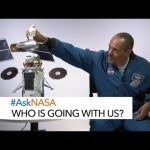
We’re going forward to the Moon, together. NASA astronaut Alvin Drew answers the question, “Who is going with us?”
He describes the purpose of the Gateway and how it helps with our plans to explore the Moon and Mars. Alvin also underlines how NASA partnerships will contribute to the Artemis Program.
Comment with your #AskNASA question and subscribe to learn more from our experts!
A pair of power plays aboard the space station, checking out progress of our Commercial Crew Program, and studying the frontier of space … a few of the stories to tell you about – This Week at NASA!
This video is available for download from NASA’s Image and Video Library: https://images.nasa.gov/details-NHQ_2019_1011_Power%20Play%20Spacewalks%20Aboard%20the%20Space%20Station%20on%20This%20Week%20@NASA%20%E2%80%93%20October%2011,%202019
On Friday, Oct. 11, NASA astronauts Andrew Morgan and Christina Koch ventured outside the International Space Station for a 6 hour, 45-minute spacewalk. This was the second in a series of five planned spacewalks to complete battery installation. The duo exited the station’s Quest airlock in their U.S. spacesuits and continued installation of new lithium-ion batteries on the station’s Port-6 truss structure.
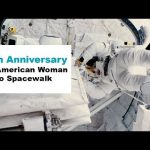
35 years ago, on October 11, 1984, NASA astronaut Kathy Sullivan became the first American woman to walk in space. We video chatted with Kathy to ask her about this historic feat as well as her thoughts on the upcoming all-female spacewalk scheduled to take place October 21, 2019, with NASA astronauts Christina Koch and Jessica Meir.
We are Europe’s gateway to space. Our mission is to shape the development of Europe’s space capability and ensure that investment in space continues to deliver benefits to the citizens of Europe and the world. Check out http://www.esa.int/ESA to get up to speed on everything space related.
Our Artemis program will return humans to the Moon by 2024. Artemis I, the first Artemis mission, will test all of the human rated systems in deep space — including the Orion spacecraft and Space Launch System rocket. This is its 26 day journey… in 30 seconds.
Have you ever done a science experiment and wondered “What would this be like if it were HUGE?” Welcome to Science Max, the exciting new series that turbocharges all the science experiments you’ve done at home.
To understand fires on Earth, you need a broad view — spanning from the poles to the equator and looking from high above the planet to down deep under the soil. That’s where #NASAExplorers come in! With satellites, with airplanes, with their own hands and with a data record spanning decades, Explorers are studying how our planet burns… and how that burning changes with the climate. This season, we’re headed to the western Pacific Ocean to the Northwest Territories and beyond to look fires on Earth.
A absolvit Colegiul Național „Alexandru Lahovari” din Râmnicu Vâlcea în 1990, Facultatea de Electrotehnica București în 1995, iar apoi Facultatea de Fizică a Universității din București în 1998. În 2002 a obținut doctoratul în fizică la Universitatea Groningen din Olanda, unde a caracterizat proprietățile optice ale sistemelor corelate de electroni. Rezultatele sale s-au concretizat în lucrări publicate în reviste de specialitate: Physical Review B, Physical Review Letters și Science. În prezent este cercetător la compania Philips, Olanda.
NASA Spacesuit Engineer Lindsay Aitchison answers the question “How are we going to the Moon?” Comment on this video using #AskNASA with your questions for upcoming episodes! She addresses key questions about our plans to explore the Moon and Mars in the Artemis Program. Lindsay also highlights how the Gateway will help in our missions to Mars.
On Sunday, Oct. 6, NASA astronauts Andrew Morgan and Christina Koch ventured outside the International Space Station for a 7 hour, 1 minute-long spacewalk. The duo exited the station’s Quest airlock in their U.S. spacesuits and began installation of new lithium-ion batteries on the Port-6 truss structure. This was the first in a series of five planned spacewalks to complete the battery installation.
Three years after the Rosetta mission officially ended in 2016, scientists met at ESA’s ESTEC facility in The Netherlands to discuss the latest findings at the final Science Working Team (SWT) meeting.
From the launch in 2004, to its arrival at comet 67P in 2014, Rosetta has been an emotional and inspiring mission. Its findings have furthered our understanding of comets and changed our perceptions of how the Solar System formed.
The mission produced an enormous amount of data which will keep many scientists busy for years. The OSIRIS camera, for example, took 100 000 images. These are archived – with the analysis of images recently providing further insight into the comet’s activity.
Rosetta’s legacy of cometary science and data is not just continuing to produce more work, however, it’s also inspiring the next generation of scientists. Some began working on Rosetta as students and are now taking their experience forward onto ESA’s future Comet Interceptor mission.
We are Europe’s gateway to space. Our mission is to shape the development of Europe’s space capability and ensure that investment in space continues to deliver benefits to the citizens of Europe and the world. Check out http://www.esa.int/ESA to get up to speed on everything space related.
Our alien friend Paxi went to visit American astronaut Christina Koch on board the International Space Station. Christina talks about the importance of teachers and shares a story about her favourite teacher at school.
We are Europe’s gateway to space. Our mission is to shape the development of Europe’s space capability and ensure that investment in space continues to deliver benefits to the citizens of Europe and the world. Check out http://www.esa.int/ESA to get up to speed on everything space related.
A safe conclusion to the latest long-duration spaceflight, calling on industry to help us accelerate our return to the Moon, and practice makes perfect – before the real thing … a few of the stories to tell you about – This Week at NASA!
We are Europe’s gateway to space. Our mission is to shape the development of Europe’s space capability and ensure that investment in space continues to deliver benefits to the citizens of Europe and the world. Check out http://www.esa.int/ESA to get up to speed on everything space related.
On Friday 27 September, ESRIN, our establishment in Italy welcomed members of the public on site as part of European Researchers’ Night. Joining research centres throughout Europe, European Researchers’ Night, promoted each year by the European Commission, is targeted at people of all ages who want to know more about science, research, and space exploration.
★ Subscribe: http://bit.ly/ESAsubscribe and click twice on the bell button to receive our notifications.
We are Europe’s gateway to space. Our mission is to shape the development of Europe’s space capability and ensure that investment in space continues to deliver benefits to the citizens of Europe and the world. Check out http://www.esa.int/ESA to get up to speed on everything space related.
Have you ever done a science experiment and wondered “What would this be like if it were HUGE?” Welcome to Science Max, the exciting new series that turbocharges all the science experiments you’ve done at home.
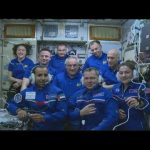
Russian Cosmonaut Aleksei Ovtchinin passes the command of the International Space Station to Luca Parmitano in an official ceremony held on 2 October 2019. The ESA astronaut is the third European and the first Italian to have such responsibilities on the Space Station. Luca is Commander for Expedition 61, and for the second part of his second space mission known as Beyond.
We are Europe’s gateway to space. Our mission is to shape the development of Europe’s space capability and ensure that investment in space continues to deliver benefits to the citizens of Europe and the world. Check out http://www.esa.int/ESA to get up to speed on everything space related.
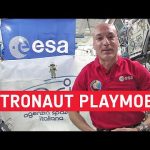
Playmobil figures are enjoyed by millions of children around the world, but now two very special figures, in the likeness of ESA’s Luca Parmitano, are flying around Earth with the astronaut himself.
Luca unpacked the two figures that arrived on the Cygnus NG-11 cargo ship in April 2019. The special edition figurines, limited to 25 000 can only be found with copies of the October 2019 Italian edition of Playmobil magazine.
This issue of the magazine is full of space-themed stories to inspire children and set their imaginations racing, while explaining about space exploration, the science behind the International Space Station and what we know about the Universe and what lies beyond our planet.
Playmobil toys are known for helping children develop their imaginations and concentration skills as they invent worlds for these little figures. The magazine and figure collaboration is a partnership between ESA, the Italian space agency ASI and the Italian publisher to celebrate Luca’s achievements and promote learning and foster curiosity and creativity in children.
The Playmobil Luca sports an astronaut ‘Snoopy’ hat, similar to that worn by the real Luca as he will prepare to don his spacesuit for a series of complex spacewalks later in his mission to repair the AMS-02 ‘antimatter hunter’ instrument outside the Space Station. The Snoopy cap holds the headphone and microphone communication so spacewalkers can talk to mission control and their colleagues inside the Space Station.
We are Europe’s gateway to space. Our mission is to shape the development of Europe’s space capability and ensure that investment in space continues to deliver benefits to the citizens of Europe and the world. Check out http://www.esa.int/ESA to get up to speed on everything space related.
A growing number of classrooms in China are equipped with artificial-intelligence cameras and brain-wave trackers. While many parents and teachers see them as tools to improve grades, they’ve become some children’s worst nightmare.
NASA Chief Scientist Jim Green answers the question “Why are we going to the Moon?” Comment on this video using #AskNASA with your questions for upcoming episodes!
He addresses key questions about our plans to explore the Moon and Mars, including where we will most likely find water on the Moon. Jim shares his extensive background in Planetary Science to explain the significance of returning with international and commercial partners. Jim also highlights how we are currently exploring Mars with the Curiosity rover.
New arrivals in low-Earth orbit – welcome aboard the space station! More research, supplies, and other cargo heads to the station, and a new partner for our Moon to Mars effort … a few of the stories to tell you about – This Week at NASA!
This video is available for download from NASA’s Image and Video Library:https://images.nasa.gov/details-NHQ_2019_0927_New%20Arrivals%20Welcomed%20Aboard%20the%20Space%20Station%20on%20This%20Week%20@NASA%20–%20September%2027,%202019.html
Fire. It’s one of the things that makes Earth so unusual. This season has been one of extremes, with large fires burning from the tropical rainforest to north of the Arctic circle. NASA Explorers have been there every step of the way, investigating the fires as they burn and tracking their effects down the line. From satellites, airplanes, on the ground and in the lab, NASA Explorers are working to understand our home planet and how it burns.
Join us this October as we take a closer look at fire and the people who study it. #S3E0
Have you ever done a science experiment and wondered “What would this be like if it were HUGE?” Welcome to Science Max, the exciting new series that turbocharges all the science experiments you’ve done at home.
The ESA Shop has it all!
Our classic logo and collectable designs printed on apparel, as well as publications, patches and gadgets. You can also explore themed designs that capture our activities of the moment.
See if something catches your eye, to ‘space up’ your life, or for the special space explorer in your life.
We are Europe’s gateway to space. Our mission is to shape the development of Europe’s space capability and ensure that investment in space continues to deliver benefits to the citizens of Europe and the world. Check out http://www.esa.int/ESA to get up to speed on everything space related.