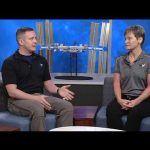
On Oct. 12, NASA’s Hispanic Outreach and Leadership Alliance (HOLA) celebrated Hispanic Heritage month with a panel discussion of the contributions of Hispanics to NASA’s mission and the importance of Hispanic representation in science, technology, engineering and mathematics (STEM) education and careers.
This video is available for download from NASA’s Image and Video Library: https://images.nasa.gov/#/details-NHQ_%202017_1012_NASA%20Hispanic%20Heritage%20Month%20Event,%20%C2%A1Latinos%20STEM%20Up!.html
This remarkable footage shows the flyby of asteroid 2012 TC4 during the night of 11/12 October 2017. At the time this was recorded, the estimated 10-20 m-diameter asteroid was approaching Earth. It made its closest approach at 07:41 CEST on 12 October, just 43 782 km away – much closer than the Moon and inside the orbit of some satellites.
This was captured by astronomers Peter Schlatter and Dominik Bodenmann working at the ZIMLAT telescope at the Swiss Optical Ground Station and Geodynamics Observatory operated by the Astronomical Institute of the University of Bern (AIUB).
Vice President Mike Pence called for renewed U.S. leadership in space during the first meeting of the National Space Council – outlining exploration goals that include returning American astronauts to the Moon, to build the foundation needed to send Americans to Mars and beyond. The October 5 council meeting, held at the Smithsonian National Air and Space Museum’s Steven F. Udvar-Hazy Center, outside Washington, brought together representatives from all aspects and sectors of the national space enterprise, for the first time in a quarter century – including NASA’s Acting Administrator, Robert Lightfoot. Also, U.S. Spacewalk aboard the Space Station, Eugene Parker Views Solar Probe Spacecraft, Scientists Find Giant Black Hole Pairs, and Parachute Test Platform Launched!
Have you ever done a science experiment and wondered “What would this be like if it were HUGE?” Welcome to Science Max, the exciting new series that turbocharges all the science experiments you’ve done at home.
Discover more about our planet with the Earth from Space video programme. In this special edition, senior scientist at France’s Collecte Localisation Satellites, Marie-Hélène Rio, joins the show to discuss how data on ocean surface currents by the Sentinel-3 satellite mission are used by people working at sea.
NASA tested a parachute platform during the flight of a Terrier-Black Brant IX suborbital sounding rocket on Oct. 4, from the agency’s Wallops Flight Facility in Virginia. The rocket carried the Advanced Supersonic Parachute Inflation Research Experiment (ASPIRE) from NASA’s Jet Propulsion Laboratory in Pasadena, Calif. The mission will evaluate the performance of the ASPIRE payload, which is designed to test parachute systems in a low-density, supersonic environment.
On Oct. 2, NASA held a briefing at the Johnson Space Center in Houston, to preview a trio of spacewalks in October to perform maintenance outside the International Space Station. Expedition 53 Commander Randy Bresnik of NASA will lead all three spacewalks, joined on Oct. 5 and 10 by Flight Engineer Mark Vande Hei, also of NASA. Flight Engineer Joe Acaba of NASA will join Bresnik on Oct. 18 for the third spacewalk. NASA TV coverage of the spacewalks will begin at 6:30 a.m. on Oct. 5, 10 and 18. Each spacewalk is scheduled to start at approximately 8:05 a.m., however, the spacewalks may begin earlier if the crew is running ahead of schedule.
jael.ai is a fully integrated real time artificial intelligence chatbot that can coordinate care for victims of domestic violence at the point of trauma. jael.ai is training to respond to men and women in dangerous situations by helping them find a safe place for themselves and their families, contact the nearest shelter, and understand the many resources that are available according to the time and location they are needing help. jael.ai is building a national database with heavily curated information about organizations and resources for victims of domestic violence. By having direct access to the most up-to-date data jael.ai can give the most relevant help to people reaching out for assistance.
Brian Davis
AXIOM88
Brian Russel Davis is the founder of Axiom88, an emerging business with a team of 20 developers in four offices worldwide. Previously, Brian was a Pandora engineer working exclusively for the Creative team. A child of Trinidadian-Guyanese parents, born in Brooklyn, New York, and raised in Sacramento, California, Brian started mixing art and technology early, coding in 5th grade and beginning formal art training at 12. He holds a BA in philosophy with a focus in analytical logic from Morehouse College in Atlanta, Georgia.
Have you ever done a science experiment and wondered “What would this be like if it were HUGE?” Welcome to Science Max, the exciting new series that turbocharges all the science experiments you’ve done at home.
On 12 September 2017, 710 photos were taken by ESA astronaut Paolo Nespoli to create this time-lapse of the Earth (from Africa to Russia) as seen from the International Space Station.
ESA astronaut Paolo Nespoli in currently working and living aboard the Station as part of his long duration Vita mission.
Vice President Mike Pence visited our Marshall Space Flight Center on Sept. 25 to thank employees working on NASA’s human spaceflight programs. He also spoke to the three NASA astronauts currently serving onboard the International Space Station. During a tour, the Vice President also saw progress being made on our Space Launch System rocket, that will send astronauts in our Orion spacecraft on missions around the Moon and ultimately to Mars. Also, NASA Data and Tech Aid in Disaster Relief, Congressional Hearing on August 21 Solar Eclipse, OSIRIS-REx Views Earth During Flyby, and “Bladed Terrain” on Pluto Made of Frozen Methane!
This video is available for download from NASA’s Image and Video Library: https://images.nasa.gov/#/details-NHQ_2017_0929_Vice%20President%20Visits%20Marshall%20Space%20Flight%20Center%20on%20This%20Week%20@NASA%20%E2%80%93%20September%2029,%202017.html
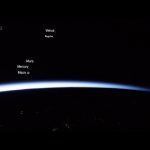
On 18 September 2017, ESA astronaut Paolo Nespoli shot this beautiful time-lapse showing the Moon rising above the Earth’s horizon together with Mercury, Mars, the star Regulus, and Venus.
ESA astronaut Paolo Nespoli is currently working and living on board the International Space Station as part of his long duration Vita mission.
At the 68th International Astronautical Congress, in Adelaide, Australia, IAC TV gets the chance to sit down with Johann-Dietrich Woerner, the Director General of the European Space Agency to talk about the focus of the ESA for the future of space exploration and why he thinks meetings like the IAC are crucial for the industry.
Vice President Mike Pence offered his thanks Monday to employees working on NASA’s human spaceflight programs during a tour of the agency’s Marshall Space Flight Center in Huntsville, Alabama. The Vice President saw the progress being made on NASA’s Space Launch System (SLS), the world’s most powerful deep space rocket, that will send astronauts on missions around the Moon and ultimately to Mars. He also visited Marshall’s Payload Operations Integration Center, where the agency manages all research aboard the International Space Station.
https://www.qualcomm.com/invention/5g
Artificial intelligence is making our devices more than just utilities. From smartphones to healthcare to autonomous cars, our own Gary Brotman explains the potential of AI to make our lives easier and more exciting.
360 video presentation of the EO Open Science conference in Frascati, Italy, 25-28 September 2017.
The conference will explore new challenges and opportunities for EO research created by the rapid advances in Information and Communications Technologies (ICT).
The video can be visualised on VR Cardboards, or can be played interactively on laptops using Firefox or Chrome.
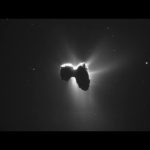
These 210 images reflect Rosetta’s ever-changing view of Comet 67P/Churyumov–Gerasimenko between July 2014 and September 2016.
The sequence begins in the month leading up to Rosetta’s arrival on 6 August, when the comet was barely a few pixels in the field of view. Suddenly, the curious shape was revealed and Rosetta raced to image its surface, coming within 10 km, to find a suitable place for Philae to land just three months later.
Philae’s landing is featured with the ‘farewell’ images taken by both spacecraft of each other shortly after separation, and by Philae as it drew closer to the surface at its first touchdown point. An image taken at the final landing site is also shown.The subsequent images, taken by Rosetta, reflect the varying distance from the comet as well as the comet’s rise and fall in activity as they orbited the Sun.
Before the comet reached its most active phase in August 2015, Rosetta was able to make some close flybys, including one in which the lighting geometry from the Sun was such that the spacecraft’s shadow could be seen on the surface.
Then, owing to the increase of dust in the local environment, Rosetta had to maintain a safer distance and carry out scientific observations from afar, but this also gave some impressive views of the comet’s global activity, including jets and outburst events.
Once the activity began to subside, Rosetta could come closer again and conduct science nearer to the nucleus, including capturing more high-resolution images of the surface, and looking out for changes after this active period.
Eventually, as the comet returned to the colder outer Solar System, so the available solar power to operate Rosetta fell. The mission concluded with Rosetta making its own dramatic descent to the surface on 30 September 2016, the final images taken reflected in the last images shown in this montage.
Credits: ESA/Rosetta/NavCam – CC BY-SA IGO 3.0; ESA/Rosetta/MPS for OSIRIS Team MPS/UPD/LAM/IAA/SSO/INTA/UPM/DASP/IDA; ESA/Rosetta/Philae/CIVA; ESA/Rosetta/Philae/ROLIS/DLR
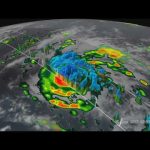
Satellite data continues to enable weather forecasters to look inside and outside of powerful hurricanes. Imagery from NOAA’s GOES East satellite, captured Sept. 17 to Sept. 20, shows Hurricane Jose along the U.S. east coast, and Hurricane Maria, as it moved through the Leeward Islands, strengthening to a Category 5 hurricane, and making landfall in Puerto Rico. Meanwhile, The Global Precipitation Measurement (GPM) satellite found rain falling inside Maria at a rate of over 6.44 inches per hour in powerful storms that reached above 9.7 miles high. Also, SpaceX Dragon Returns with Science, Katherine Johnson Research Facility Opened, Earth’s Gravity Assist to OSIRIS-REx, Hubble Spots Asteroids Orbiting Each Other, and Engineering the Future!
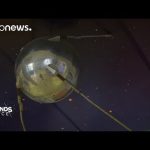
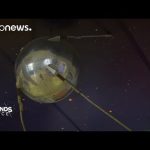
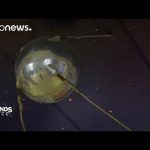
Sixty years ago, Sputnik became the first satellite in space and changed the world forever.
Launched by the Soviet Union on 4 October 1957, this shiny orb kick-started the space race, and opened up the heavens for mankind to explore.
To mark the occasion ESA Euronews arranged access to the private museum of RSC Energia, the Russian state company that actually built the world’s first satellite, officially called Sputnik-1. Hanging in this Moscow treasure trove of pioneering space probes is one of the original Sputnik flight spares, built in 1957. Compact, at just over 80 kilogrammes, its polished surfaces and distinctive antennae are now unmistakable – look at this satellite, and the first word in your mind is ‘Sputnik’.
Il y a soixante ans, le premier satellite artificiel Spoutnik était mis en orbite devançant la chienne Laïka, Youri Gagarine et Alexeï Leonov dans la longue liste des légendes soviétiques de l’espace. Aujourd’hui, ce minuscule engin est encore dans toutes les mémoires comme notre reporter Jeremy Wilks a pu le constater à Moscou auprès de vétérans de l’époque comme Alexeï Leonov et de représentants du secteur spatial russe.
Nous avons eu l’autorisation exceptionnelle de visiter un lieu unique : le musée privé de RSC Energia, la société d’Etat russe à l’origine du premier satellite artificiel. Son nom officiel Spoutnik-1. L’un de ses exemplaires originaux construit en 1957 trône parmi les trésors de l’espace exposés sur place.
Hatvan évvel ezelőtt állt Föld körüli pályára a Szputnyik, az első ember készítette űrjármű. Szovjet űrlegendák sora követte: Lajka kutya, Jurij Gagarin, Alekszej Leonov – akiknek az öröksége ma is él.
Minisorozatunkban, az űrkutatás legendáiban rendszeresen megemlékeztünk erről, és most a Space teljes adását ennek az apró szerkezetnek szenteltük, ami megváltoztatta a világot.
Az RSC Energija múzeumában vagyunk, ez az állami vállalat építette a világ első műholdját, a Szputnyik1-et. Ebben az űrkutatási relikviákkal teli kincsesraktárban van egy 1957-ben készült tartalék Szputnyik is.
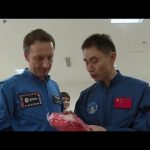
ESA astronauts Samantha Cristoforetti and Matthias Maurer joined Chinese astronauts last month for nine days of sea survival training off China’s coastal city of Yantai.
This is the first time ESA astronauts have trained in China and stems from the 2015 agreement to boost collaboration between ESA and China Manned Space Agency, with the goal of flying European astronauts on the Chinese space station from 2022.
This video, filmed by the Astronaut Center of China, shows the first joint training, with interviews of ESA participants in English, French, German, Italian and Spanish.
Phil builds a balloon powered car in the lab. Then he tries to make one big enough to ride. Can the Science Max build team find a big enough balloon? Or are balloons the way to go? Plus, Newton’s Cradle out of bowling balls, how Guinea Pigs got their name and Newton’s 3rd Law.
Have you ever done a science experiment and wondered “What would this be like if it were HUGE?” Welcome to Science Max, the exciting new series that turbocharges all the science experiments you’ve done at home.
In season 1, join Phil as he builds rocket cars, uses elastic energy to hurl pumpkins on a giant catapult, builds a bridge out of pasta that can hold a human, find magnets powerful enough to float Phil off the ground, and many more experiments taken to the MAX!
The preparations of ESA’s latest Earth observation satellite Sentinel-5P, also known as Sentinel-5 Precursor, are finished, and the satellite has been shipped to the Plesetsk Cosmodrome in Russia for launch in October 2017.
Sentinel-5P will ensure continued data is gathering on Earth’s atmosphere and is the intermediary satellite to fill the gap between the past generation of atmospheric monitoring satellites and the future generation of Sentinel-4 and 5, which will be launched early in the next decade. Sentinel-5P is part of Copernicus,the world’s largest environmental monitoring programme which is operated bythe European Commission.
This video contains interviews with: Josef Aschbacher, ESA Director of Earth observation programmes, Kevin McMullan, ESA Sentinel-5P Project Manager and Claus Zehner, ESA Sentinel-5P Mission Manager
8 puzzle | 8 puzzle Problem In Artificial Intelligence[Bangla Tutorial]
**********************************************************************
This tutorial help for basic concept of 8 puzzle and it also help gather knowledge of 8 puzzle
i will provide very basic level concept to advance level concept of Artificial Intelligence if you watching this tutorial i think you will be learn about 8 puzzle. If you want to learn more then you must watch this playlist, playlist name Artificial Intelligence if there are any query in 8 puzzle in Artificial Intelligence please comment the comment section below,if you want more videos than you subscribe my channel for get update notification,
if this video are helping any kind of you than please share my video and like this video and also subscribe my channel
ESA astronaut Paolo Nespoli is currently living and working on the International Space Station as part of his VITA mission. This video shows highlights from his first month.
The mission is part of ESA’s vision to use Earth-orbiting spacecraft as a place to live and work for the benefit of European society while using the experience to prepare for future voyages of exploration further into the Solar System.
On Sept. 15, our Cassini spacecraft concluded its remarkable mission with a plunge into Saturn’s atmosphere. This was the last of 22 close orbits Cassini made between Saturn and its rings as part of the mission’s Grand Finale. No other spacecraft has ever explored this unique region. Although the spacecraft may be gone after the finale, the enormous amount of data collected about Saturn, its magnetosphere, rings and moons during this last dive is expected to yield new discoveries for decades. Also, Recovering from Irma, New Crew Launches to the Space Station, Successful Orion Chute Test and Shane Kimbrough in Washington!
More info: Aperture Value: 2,971 Color Space: sRGB Contrast: Normal Custom Rendered: Normal process Date Time Digitized: 20 Aug 2017 19:55:00 Digital Zoom Ratio: 1 Exif Version: 2.2.1 Exposure Bias Value: 0 Exposure Mode: Manual exposure Exposure Program: Manual Exposure Time: 1/0 File Source: DSC Flash: No Flash FNumber: 2,8 Focal Length: 16 Focal Length In 35mm Film: 16 Focal Plane Resolution Unit: centimeters Focal Plane X Resolution: 1.368,889 Focal Plane Y Resolution: 1.368,889 Gain Control: High gain up ISO Speed Ratings: 5.000 Lens Model: 16.0 mm f/2.8 Lens Specification: 16, 16, 2,8, 2,8 Light Source: unknown Max Aperture Value: 3 Metering Mode: Pattern Pixel X Dimension: 4.928 Pixel Y Dimension: 3.280 Saturation: Normal Scene Capture Type: Standard Scene Type: A directly photographed image Sensing Method: One-chip color area sensor SensitivityType: Recommended exposure index (REI) Sharpness: Normal Shutter Speed Value: 1/0 Subject Distance Range: unknown Sub-second Time: 00 Sub-second Time Digitized: 00 Sub-second Time Original: 00 User Comment: NASA 2071135 77.8F White Balance: Auto white balance Image Number: 96.021 Lens ID: 52 Lens Info: 16, 16, 2,8, 2,8 Lens Model: 16.0 mm f/2.8
On Sept. 15, NASA’s Cassini spacecraft completed its remarkable story of exploration with an intentional plunge into Saturn’s atmosphere, ending its mission after nearly 20 years in space. Live commentary of Cassini’s end of mission activities was shown on NASA TV and the agency’s website. Launched in 1997, Cassini arrived in orbit around Saturn in 2004 on a mission to study the giant planet, its rings, moons and magnetosphere.
From the internationally renowned maker of robotics building sets arises a new model of impressive proportions. Unlike anything else Meccano has created, M.A.X. combines Artificial Intelligence (AI) with customizable programming. The result is a one-of-a-kind robot of your own creation! Budding engineers, innovators and creators can expand their knowledge of programming as they personalize this robot to their specifications. Once built, M.A.X measures 12” in tall. Control it using voice commands, buttons on the MeccaBrain, or the free app! You’ll know exactly what its thinking based on its expressive facial graphics. As a S.T.E.M robotics platform, M.A.X is designed to engage kids in intellectually stimulating play, drawing on their knowledge of science, technology, engineering and math. Not just a learning tool, this robot loves fun! Try playing on M.A.X’s built-in gaming platform; test your knowledge in a trivia game or listen to some funny jokes! With a multitude of features, kids will want to bring their new friend everywhere! This robot comes with built-in infrared sensors, enabling it to move with agility and avoid obstacles in its path. If you know a young mind in need of a challenge, introduce them to their new friend, M.A.X!
On Sept. 13, NASA held a news conference from the agency’s Jet Propulsion Laboratory, in Pasadena, California to discuss details of final mission activities for the agency’s Cassini mission to Saturn. On Sept. 15, the Cassini spacecraft will complete its remarkable story of exploration with an intentional plunge into Saturn’s atmosphere, ending its mission after nearly 20 years in space.
http://themysticalspiral.com Ra talks of his encounters as a child with A.I. Shadow children traveling thru the electricity, electric elixir, soul exchange drag you into the shade where in the still you can see the electricity, in the center of eyes, inside the screen, inside the electricity, in blinking recollections, i know what you mean……..dragonflys and remembrance……
Science Max – What makes boats float? Tinfoil doesn’t float, but a boat made of tinfoil does. It’s all about how you build it. Watch as Phil builds his human-sized tinfoil boat wrong several times before he figures it out. Plus, Phil gets into a tub full of the main ingredient in diapers. Why would he do such a thing? For Science!
Have you ever done a science experiment and wondered “What would this be like if it were HUGE?” Welcome to Science Max, the exciting new series that turbocharges all the science experiments you’ve done at home.
In season 1, join Phil as he builds rocket cars, uses elastic energy to hurl pumpkins on a giant catapult, builds a bridge out of pasta that can hold a human, find magnets powerful enough to float Phil off the ground, and many more experiments taken to the MAX!
According to a recent PricewaterhouseCoopers (PwC) report, Artificial Intelligence (AI) is expected to contribute an additional $ 15.7 trillion to the global GDP by 2030. Notably, the number of AI startup companies in India has increased from 21 in 2013 to 128 in 2016. In this episode of Heads Up, we discuss the scope and potential of this much talked about space with the winners of Global Hackweek 2017, which was recently organised by NITI Aayog.
NDTV is one of the leaders in the production and broadcasting of un-biased and comprehensive news and entertainment programmes in India and abroad. NDTV delivers reliable information across all platforms: TV, Internet and Mobile.
Following over a decade of ground-breaking discoveries, Cassini is now approaching its mission end.
With little fuel left to correct the NASA’s spacecraft trajectory, it has been decided to end the mission by plunging it into Saturn’s atmosphere on 15 September 2017. In the process, Cassini will burn up, satisfying planetary protection requirements to avoid possible contamination of any moons of Saturn that could have conditions suitable for life. These include Saturn’s largest moon Titan and Enceladus, which has a liquid ocean under its icy crust.
The grand finale is not only a spectacular way to complete this extraordinary mission, but will also return a bounty of unique scientific data that was not possible to collect during the previous phases of the mission. Cassini has never ventured into the area between Saturn and its rings before, so the new set of orbits is almost like a whole new mission.
These close orbits will provide the highest resolution observations ever achieved of the inner rings and the planet’s clouds. The orbits will also give the chance to examine in situ the material in the rings and plasma environment of Saturn. It will also probe the planet’s magnetic field at close distances.
This video explains Cassini ‘s final operations, what the Cassini-Huygens mission has taught us about Saturn, the potential for life on its moons and the promise of more science to come.
NASA astronauts Peggy Whitson and Jack Fischer, who returned to Earth on Sept. 2 after spending months aboard the International Space Station, discussed their mission during a news conference on Sept. 11 at the agency’s Johnson Space Center.
Although Whitson and Fischer returned to Earth together, they arrived at the space station separately. Whitson launched from the Baikonur Cosmodrome in Kazakhstan on Nov. 17 and spent more than nine months in space. She now holds the U.S. record for cumulative time in space, with 665 days in orbit during three long-duration missions. Fischer launched to the space station on April 20 and spent 136 days in orbit on his first space mission, during which he took part in two spacewalks that total just under seven hours.
ESA astronaut Paolo Nespoli on the International Space Station sends a video greeting to everyone at the European Space Operations Centre, ESA’s mission control centre in Darmstadt, Germany, on the occasion of its 50th anniversary celebration. The 8th day of September is a special date in the centre’s history: it’s the day in 1967 when it was inaugurated to serve as ‘mission control’ for what later became the European Space Agency. Today, it hosted 5000 visitors in an open house that included tours of the mission control facilities, presentations by ESA experts on a wide range of topics and a stage programme produced in cooperation with Hessischer Rundfunk (HR) radio and the Darmstädter Echo newspaper. The sold-out event also included numerous educational, informational and fun activities for all ages presented by DLR SchoolLab, the Astronomy and Space Technology Club of Darmstadt (AAW), the German Research Centre for Artificial Intelligence (DFKI) and the Berlin-based ‘new-space’ company Part-Time Scientists. The video greeting from the Space Station was shown during the stage programme and displayed for the visitors on screens around the centre. Paolo Nespoli is on a five-month mission to the Station, dubbed the #VITAmission, between July and December this year. Vita’s extensive scientific programme includes experiments in biology, human physiology as well as space environment monitoring, materials science and technology demonstrations. Learn more and follow Paolo in social media via http://paolonespoli.esa.int/More information on ESOC and its 50th anniversary year via #ESOC50
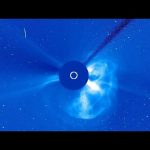
The Sun unleashed powerful solar flares on 6 September, one of which was the strongest in over a decade. An X2.2-class flare was launched at 09:10 GMT and an X9.3 flare was observed at 12:02 GMT. An M-class flare was also observed two days earlier on 4 September.
The images were captured by the ESA/NASA Solar and Heliospheric Observatory, SOHO. The flares were launched from a group of sunspots classified as active region 2673.The shaded disc at the centre of the image is a mask in SOHO’s LASCO instrument that blocks out direct sunlight to allow study of the faint details in the Sun’s corona. The white circle added within the disc shows the size and position of the visible Sun.







![8 puzzle | 8 puzzle Problem In Artificial Intelligence[Bangla Tutorial]](https://video.kidibot.ro/wp-content/uploads/2020/01/4397/8-puzzle-8-puzzle-problem-in-artificial-intelligencebangla-tutorial-150x150.jpg)