Live interviews and highlights from the ESA Open Day at ESTEC, featuring ESA astronauts Andreas Mogensen and André Kuipers, NASA astronaut Anna Fisher, The Expanse actor Steven Strait and more.
The ESA Open Day is an annual event where ESA opens the doors of the European Space Research and Technology Centre in the Netherlands to the public.
We are Europe’s gateway to space. Our mission is to shape the development of Europe’s space capability and ensure that investment in space continues to deliver benefits to the citizens of Europe and the world. Check out https://www.esa.int/ to get up to speed on everything space related.
Stress is a common response when the body finds itself in unfamiliar environments, such as space. Prolonged exposure to stress can weaken the body’s defensive mechanisms, making it more susceptible to illness.
Our astronaut Andreas Mogensen was in space, was part of a study to explore how space travel affects the human immune system.
Before, during and after his Huginn mission, Andreas collected both blood and saliva samples to reveal how the body’s defences adjust to space.
This research is crucial for developing strategies to manage the health challenges faced by astronauts on long missions.
📹 ESA/NASA – Andreas Mogensen 📸 CADMOS, Ludwig-Maximilians-Universität
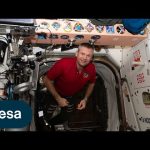
On the last day of his Huginn mission, ESA astronaut Andreas Mogensen takes us on a tour of the place he called home for 6 months: the International Space Station. From the beautiful views of Cupola to the kitchen in Node 1 filled with food and friends and all the way to the science of Columbus, the Space Station is the work and living place for astronauts as they help push science forward.
Credits: ESA – European Space Agency
★ Subscribe: http://bit.ly/ESAsubscribe and click twice on the bell button to receive our notifications.
We are Europe’s gateway to space. Our mission is to shape the development of Europe’s space capability and ensure that investment in space continues to deliver benefits to the citizens of Europe and the world. Check out https://www.esa.int/ to get up to speed on everything space related.
European Space Agency astronaut Andreas Mogensen shared this video on social media with the caption:
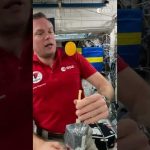
“On the weekends, we have time off and and while I like to call my friends and family or sit in the Cupola and take pictures of Earth, I sometimes like to play around a bit. I recorded this video a few weeks ago and finally got around to sharing it with you.
The way a liquid, in this case orange juice, moves around on the Space Station is fascinating, rippling when I blow on it and how sticks to me as I drink it.”
After more than 6 months on the International Space Station, ESA astronaut Andreas Mogensen returned to Earth, marking the end of his Huginn mission. It was his second mission to the Space Station and his first long-duration, where he was the pilot of Crew-7, which consisted of Jasmin Moghbeli (NASA), Satoshi Furukawa (JAXA), and Konstantin Borisov (Roscosmos).
Credits: ESA/NASA/SpaceX
★ Subscribe: http://bit.ly/ESAsubscribe and click twice on the bell button to receive our notifications.
We are Europe’s gateway to space. Our mission is to shape the development of Europe’s space capability and ensure that investment in space continues to deliver benefits to the citizens of Europe and the world. Check out https://www.esa.int/ to get up to speed on everything space related.
Andreas Mogensen launched on his Huginn mission in August 2023 to the International Space Station, becoming the first non-US astronaut to pilot SpaceX’s Crew Dragon spacecraft. Andreas became commander of the International Space Station in September 2023, becoming the longest serving European commander in January 2024. His mission was spent on more than 30 European experiments and plenty of international ones as well, ranging from water purification to studies of human physiology and thunderclouds. After 6 months on the International Space Station, Andreas will come down to Earth together with his Crew-7 crewmates Jasmin Moghbeli (NASA), Satoshi Furukawa (JAXA), and Konstantin Borisov (Roscosmos).
★ Subscribe: http://bit.ly/ESAsubscribe and click twice on the bell button to receive our notifications.
We are Europe’s gateway to space. Our mission is to shape the development of Europe’s space capability and ensure that investment in space continues to deliver benefits to the citizens of Europe and the world. Check out https://www.esa.int/ to get up to speed on everything space related.
ESA astronaut Andreas Mogensen explains how two experiments involving virtual reality makes on International Space Station. The first is Virtual Assistance Mental Balance (VAMB) where Andreas gets to enjoy a calm setting in nature that helps him relax. The second one is VR for Exercise, where he cycles on the Space Station’s exercise bike and through different bike routes in Denmark on the VR headset, which has quickly become a favourite for Andreas.
Timestaps of the video: 00:00 – 00:09 Intro 00:10 – 02:13 First experiment 02:14 – 04:48 Second experiment 04:49 – 05:09 Outro
Credits: ESA/NASA
★ Subscribe: http://bit.ly/ESAsubscribe and click twice on the bell button to receive our notifications.
We are Europe’s gateway to space. Our mission is to shape the development of Europe’s space capability and ensure that investment in space continues to deliver benefits to the citizens of Europe and the world. Check out https://www.esa.int/ to get up to speed on everything space related.
After almost 20 days on the International Space Station, ESA project astronaut Marcus Wandt is coming home.
The trip back to Earth will take the Axiom Mission 3 crew around 47 hours. Marcus will serve as a mission specialist during the journey, sharing the ride with Walter Villadei from Italy, Alper Gezeravcı from Türkiye and Michael López-Alegría, a dual US-Spanish citizen.
After a series of burns to lower its orbit, the spacecraft will enter Earth’s atmosphere and deploy its parachutes for a water-landing. Marcus and crew are expected to splash down off the coast of Florida, USA, on 9 February 2024 at 13:30 GMT/14:30 CET. This will mark the end of Marcus’s mission, called Muninn.
We are Europe’s gateway to space. Our mission is to shape the development of Europe’s space capability and ensure that investment in space continues to deliver benefits to the citizens of Europe and the world. Check out https://www.esa.int/ to get up to speed on everything space related.
After almost 20 days on the International Space Station, ESA project astronaut Marcus Wandt is coming home.
The trip back to Earth will take the Axiom Mission 3 crew around 47 hours. Marcus will serve as a mission specialist during the journey, sharing the ride with Walter Villadei from Italy, Alper Gezeravcı from Türkiye and Michael López-Alegría, a dual US-Spanish citizen.
We are Europe’s gateway to space. Our mission is to shape the development of Europe’s space capability and ensure that investment in space continues to deliver benefits to the citizens of Europe and the world. Check out https://www.esa.int/ to get up to speed on everything space related.
Watch as Marcus Wandt and his crewmates arrived to the Space Station around 36 hours after liftoff.
Marcus is the first of a new generation of European astronauts to fly on a commercial human spaceflight opportunity with Axiom Space. His mission is supported by ESA and the Swedish National Space Agency (SNSA). Marcus’s mission is called Muninn.
During his two-week mission, Marcus will devote much of his time to scientific activities and technology demonstrations that could shape the way we live and work on Earth. In total, he will run around 20 experiments.
Marcus Wandt was selected in November 2022 as a member of the ESA astronaut reserve after a year-long selection process. The 2022 ESA recruitment campaign received over 22 5000 applications from across its Member States.
Timestaps of the video: 00:00:00 – 01:55:44 – Pre-Docking programme 01:55:45 – 03:14:29 – Complete docking to the Space Station 03:14:30 – 03:16:00 – Hatching opening 03:16:01 – 03:37:24 – Axiom 3 Mission crew entering the Space Station 03:37:25 – 03:49:00 – Welcoming ceremony
Follow Marcus’s journey on the Muninn website, check our launch kit and connect with him on his Instagram and X accounts.
We are Europe’s gateway to space. Our mission is to shape the development of Europe’s space capability and ensure that investment in space continues to deliver benefits to the citizens of Europe and the world. Check out https://www.esa.int/ to get up to speed on everything space related.
ESA project astronaut Marcus Wandt took off on 18 January 2024 as part of the Axiom-3 crew for a 14-day mission to the International Space Station. After 36 hours catching up to the Space Station, the Dragon docked to the Space Station, the seal between the two tested and finally Marcus started his Muninn mission as he entered the International Space Station. ESA astronaut Andreas Mogensen along with the rest of the crew of Expedition 70 was waiting to welcome them to space!
Follow Marcus’s journey on the Muninn website, check our launch kit and connect with him on his Instagram and X accounts.
We are Europe’s gateway to space. Our mission is to shape the development of Europe’s space capability and ensure that investment in space continues to deliver benefits to the citizens of Europe and the world. Check out https://www.esa.int/ to get up to speed on everything space related.
From the International Space Station to Earth, ESA astronaut Andreas Mogensen talks about what kind of person his fellow Scandinavian and ESA project astronaut Marcus Wandt is. The Axiom-3 mission with Marcus onboard is planned to launch in mid-January 2024 to the International Space Station for a 14-day mission, where Marcus will join Andreas, marking the first time two Scandinavians are in space together.
Credits: ESA – European Space Agency
★ Subscribe: http://bit.ly/ESAsubscribe and click twice on the bell button to receive our notifications.
We are Europe’s gateway to space. Our mission is to shape the development of Europe’s space capability and ensure that investment in space continues to deliver benefits to the citizens of Europe and the world. Check out https://www.esa.int/ to get up to speed on everything space related.
2023’s highlight was the highly anticipated launch of Juice, Europe’s Jupiter Icy Moon Explorer. The Juice spacecraft was placed on course to Jupiter on the second-to-last Ariane 5 launch vehicle in April. After an eight-year journey, Juice will begin observing the giant gas planet and its three large ocean-bearing moons – Ganymede, Calisto and Europa.
The Euclid space telescope was launched in July with the aim of unravelling the enigmas of ‘dark matter’ and ‘dark energy’. Euclid’s first images were released in November, revealing razor-sharp astronomical images with detail never before seen by a telescope across such a large patch of the sky.
After almost five years in space, ESA’s Aeolus wind mission was retired. This trailblazing mission was tasked with observing wind patterns from space thereby improving weather forecasts and climate models.. Aeolus data and technology will have an important role to play in the accuracy of future weather forecasting. On 28 July, it burned up in an assisted re-entry – the first assisted re-entry by a mission which was not designed to do so.
As space debris becomes an increasingly serious issue, ESA is determined to search for solutions. Together with its commercial and institutional partners, ESA has developed the ‘Zero Debris Charter’, launched this year. By signing the Charter, space entities worldwide can register their intent to work together towards the sustainable use of Earth’s orbital environment.
Earlier in in 2023, MTG-I1, the first of the Meteosat Third Generation missions, sent back its first images. The satellite was launched in 2022 and carries two instruments: a flexible combined imager and a lighting imager. Both instruments performed beyond expectation and a stunning combined image from both was revealed.
Earth observation is key to keeping our planet and the population as a whole, safe. Today, monitoring earthquakes, forest fires or flooding from space already helps to coordinate rescue response but the data can also be used to better understand phenomena such as climate change and support the IPCC climate reports.
Last year, NASA’s Dart mission impacted on a small moonlet of the asteroid Didymos, changing its course. We’ll soon be launching ESA’s Hera spacecraft to collect data on the aftermath of this collision. The Hera spacecraft was integrated and underwent testing this year in ESA ESTEC’s test centre in the Netherlands.
2023 also saw the first hardware tests for the second generation of Galileo satellites but even more importantly the Galileo High Accuracy Service was launched in January. This new service delivers centimetre accuracy from space further cementing Galileo’s reputation as the most accurate satellite navigation system in the world.
★ Subscribe: http://bit.ly/ESAsubscribe and click twice on the bell button to receive our notifications.
We are Europe’s gateway to space. Our mission is to shape the development of Europe’s space capability and ensure that investment in space continues to deliver benefits to the citizens of Europe and the world. Check out https://www.esa.int/ to get up to speed on everything space related.
Don’t miss the live conversation between ESA astronaut and commander of the International Space Station (ISS) Andreas Mogensen and the 2023 Nobel Prize laureates Ferenc Krausz (in physics) and Moungi Bawendi (in chemistry). The event will take place at the Nobel Prize Museum in Oslo which will be connected to the ISS. Andreas will show a Nobel Prize he brought with him to the Space Station.
★ Subscribe: http://bit.ly/ESAsubscribe and click twice on the bell button to receive our notifications.
We are Europe’s gateway to space. Our mission is to shape the development of Europe’s space capability and ensure that investment in space continues to deliver benefits to the citizens of Europe and the world. Check out https://www.esa.int/ to get up to speed on everything space related.
An educational in-flight call with ESA astronaut Andreas Mogensen on board the International Space Station for teachers and students in Europe, connecting live with local events organised by ESERO Denmark, ESERO Finland, ESERO Sweden and ESERO Norway.
★ Subscribe: http://bit.ly/ESAsubscribe and click twice on the bell button to receive our notifications.
We are Europe’s gateway to space. Our mission is to shape the development of Europe’s space capability and ensure that investment in space continues to deliver benefits to the citizens of Europe and the world. Check out https://www.esa.int/ to get up to speed on everything space related.
Astronauts on the International Space Station do a full circle of Earth every 90 minutes and experience 16 sunsets and sunrises every day.
With this unearthly routine, astronauts can struggle to find a natural daily rhythm in space.
The Space Station follows Greenwich Mean Time (GMT), which helps keep a consistent schedule, along with regular wake-up and bedtime routines.
During his Huginn mission, our astronaut Andreas Mogensen will run two experiments focusing on sleeping in space with real world applications: Circadian Light and Sleep in Orbit.
📹 ESA – European Space Agency 📸 SAGA Space Architects
ESA astronaut Andreas Mogensen became commander of the International Space Station (ISS) on September 26, 2023, in a traditional ceremony in which the departing commander, Sergey Prokopyev, handed over the symbolic key of the Space Station. Mogensen is the sixth European to take on the role of ISS commander.
Mogensen will serve as commander for the rest of his Huginn mission until early 2024. During his command, he will be responsible for overseeing the crew’s activities and ensuring the safety and operation of the Space Station.
Credits: ESA/NASA
★ Subscribe: http://bit.ly/ESAsubscribe and click twice on the bell button to receive our notifications.
We are Europe’s gateway to space. Our mission is to shape the development of Europe’s space capability and ensure that investment in space continues to deliver benefits to the citizens of Europe and the world. Check out https://www.esa.int/ to get up to speed on everything space related.
ESA astronaut Andreas Mogensen has begun his Huginn mission, turning the International Space Station into his home and workplace. After piloting on Crew Dragon Endurance as the first non-US pilot, Andreas has started performing European experiments and technology demonstrations with many more to come throughout the mission.
Credits: ESA – European Space Agency
★ Subscribe: http://bit.ly/ESAsubscribe and click twice on the bell button to receive our notifications.
We are Europe’s gateway to space. Our mission is to shape the development of Europe’s space capability and ensure that investment in space continues to deliver benefits to the citizens of Europe and the world. Check out https://www.esa.int/ to get up to speed on everything space related.
Huginn, ESA astronaut Andreas Mogensen’s second mission to the International Space Station, is now under way. Together with Crew-7, the ESA astronaut was launched on the Crew Dragon spacecraft Endurance on 26 August 2023, at 08:27 BST (09:27 CEST).
Alongside him are NASA’s Jasmin Moghbeli, Satoshi Furukawa from JAXA, and Konstantin Borisov from Roscosmos. The crew will spend approximately six months on the Space Station, 420 km above Earth.
This isn’t Andreas’s first journey into space. In 2015, he participated in the 10-day ‘iriss’ mission. However, Huginn marks his first launch from NASA’s Kennedy Space Center in Florida, USA, and his first flight with a Crew Dragon.
Watch the replay of pivotal moments such as the crew’s arrival at the Kennedy Space Center on 20 August, liftoff, as well as Andreas piloting Crew Dragon on its 11th crewed flight.
The journey also included a special passenger, who served as microgravity indicators. After approximately 30 hours, the Crew Dragon approached and docked with the Space Station, where Andreas and his colleagues were greeted by the resident astronauts.
We are Europe’s gateway to space. Our mission is to shape the development of Europe’s space capability and ensure that investment in space continues to deliver benefits to the citizens of Europe and the world. Check out https://www.esa.int/ to get up to speed on everything space related.
The name of Andreas’s second mission to the Space Station is ‘Huginn’. Inspired by Norse mythology, the name is taken from one of two ravens who serve the god Odin. Called Huginn and Muninn, these two birds sit on Odin’s shoulders and are sent flying across the world at dawn. They return at night to inform him of the many events they have seen and heard. In Old Norse, ‘Huginn’ means ‘thought’ and ‘Muninn’ means ‘mind’ or ‘memory’.
ESA astronaut Andreas Mogensen is going on his first long-duration mission to the International Space Station. Andreas will be the pilot on the SpaceX Crew Dragon that will carry him and the rest of Crew-7 to the Space Station – a first for a European! Representing Europe in space, Andreas will carry out science throughout his mission and bring back the knowledge to Earth, for the benefit of humankind.
Visit esa.int/huginn for more information on the Huginn mission.
★ Subscribe: http://bit.ly/ESAsubscribe and click twice on the bell button to receive our notifications.
We are Europe’s gateway to space. Our mission is to shape the development of Europe’s space capability and ensure that investment in space continues to deliver benefits to the citizens of Europe and the world. Check out https://www.esa.int/ to get up to speed on everything space related.
At the start of 2023 the European Space Agency ESA is happily looking forward to another year filled with a host of thrilling new missions, cutting edge science and the continued effort to guarantee independent access to space for Europe. We will see the first images of the first Meteosat Third Generation satellite, the launch of the Jupiter Icy Moons Explorer, and of Euclid and another Sentinel-1 satellite launch. It will also be the year of Ariane 6 which will make its inaugural flight and the first Dane in space, Andreas Mogensen will return to the ISS as the new astronaut-candidates commence their training. Near the end of the year the second Space Summit will further cement ESA’s ambitions for Space in Europe.
★ Subscribe: http://bit.ly/ESAsubscribe and click twice on the bell button to receive our notifications.
We are Europe’s gateway to space. Our mission is to shape the development of Europe’s space capability and ensure that investment in space continues to deliver benefits to the citizens of Europe and the world. Check out https://www.esa.int/ to get up to speed on everything space related.
Recently, Andreas Mogensen, now getting ready for his ‘Huginn’ mission to the ISS in 2023, stopped by ESA’s ESOC mission control centre in Darmstadt, Germany, to meet with some of the experts who keep our satellites flying.
Andreas usually works at NASA’s Johnson Space Center in Houston as an ISS ‘capcom’, and we don’t often see him in Europe. A few months back, while returning to Germany for some training at ESA’s Astronaut Centre in Cologne, we seized the opportunity to ask him if he’d like to stop over in Darmstadt for a look behind the scenes at mission control, and he immediately answered, ‘yes’!
Andreas’ studied aeronautical engineering with a focus on ‘guidance, navigation and control of spacecraft’ and we thought he’d be delighted to meet with the teams at mission control doing precisely that sort of work for our robotic missions.
We figured he’d also enjoy meeting colleagues from our Space Safety programme, especially the ones working on space debris and space weather, as these are crucial areas that influence the daily life of astronauts on the ISS.
Andreas met with Bruno Sousa and Julia Schwartz, who help keep Solar Orbiter healthy and on track on its mission to gather the closest-ever images of the Sun, observe the solar wind and our Star’s polar regions, helping unravel the mysteries of the solar cycle.
He also met with Stijn Lemmens, one of the analysts keeping tabs on the space debris situation in orbit, and Melanie Heil, a scientist helping ESA understand how space weather and our active Sun can affect missions in orbit and crucial infrastructure – like power grids – on ground.
We hope you enjoy this lively and informative day at mission control as much as Andreas and the teams at ESOC did!
★ Subscribe: http://bit.ly/ESAsubscribe and click twice on the bell button to receive our notifications.
We are Europe’s gateway to space. Our mission is to shape the development of Europe’s space capability and ensure that investment in space continues to deliver benefits to the citizens of Europe and the world. Check out https://www.esa.int/ to get up to speed on everything space related.
ESA astronauts Thomas Pesquet, Luca Parmitano, Alexander Gerst, and Matthias Maurer, together with the ESA Director General, will answer questions from journalists from the IAC in Paris. Andreas Mogensen will join remotely and Samantha Cristoforetti will connect directly from the ISS. A live not to be missed!
We are Europe’s gateway to space. Our mission is to shape the development of Europe’s space capability and ensure that investment in space continues to deliver benefits to the citizens of Europe and the world. Check out https://www.esa.int/ to get up to speed on everything space related.
ESA astronauts Thomas Pesquet, Luca Parmitano, Alexander Gerst, and Matthias Maurer, together with the ESA Director General, will answer questions from journalists from the IAC in Paris. Andreas Mogensen will join remotely and Samantha Cristoforetti will connect directly from the ISS. A live not to be missed!
We are Europe’s gateway to space. Our mission is to shape the development of Europe’s space capability and ensure that investment in space continues to deliver benefits to the citizens of Europe and the world. Check out https://www.esa.int/ to get up to speed on everything space related.
ESA and NASA are working hand in hand before the first Artemis mission to the Moon through a series of joint mission simulations. Teams based at the Erasmus Support Facility (ESF) at ESA’s ESTEC facility in The Netherlands, the German Space Operations Centre at ESA’s Columbus Control Centre in Oberphfaffenhofen and NASA’s Johnson Space Center in Houston are combining their expertise in a series of exercises to ensure a successful launch.
When it comes to simulations, it’s important that not everything goes perfectly right as it recreates – in real time – different stages of the mission to monitor the spacecraft’s position, propulsion, power, avionics and thermal properties. The European team, consisting of 40 people from ESA and industry, apply their considerable expertise from working on the European Service Module (ESM) to any unexpected problems. The ESM will provide power for the Orion spacecraft and propel it along its orbit to the Moon.
We are Europe’s gateway to space. Our mission is to shape the development of Europe’s space capability and ensure that investment in space continues to deliver benefits to the citizens of Europe and the world. Check out https://www.esa.int/ to get up to speed on everything space related.
On 19 April, 2001, Umberto Guidoni was launched to the International Space Station, becoming the first European astronaut on board. In April 2021, ESA celebrates 20 years of European astronaut missions to this unique orbital outpost.
In this video, ESA astronauts past and present share their experiences of the International Space Station and spaceflight more generally. They identify some of their favourite moments and voice their hopes for the future of space exploration.
Here are the timestamps for each message:
0:00 – Intro 0:39 – Umberto Guidoni 3:31 – Claudie Haigneré 6:31 – Frank De Winnie 7:42 – Pedro Duque 10:36 – André Kuipers 11:38 – Thomas Reiter 14:38 – Christer Fuglesang 16:58 – Hans Schlegel 19:39 – Luca Parmitano 20:29 – Alexander Gerst 22:29 – Samantha Cristoforetti 28:20 –Thomas Pesquet 29:07 – Andreas Mogensen 30:05 – Tim Peake 31:02 – Matthias Maurer 32:57 – Jean François Clervoy 38:49 – Michel Tognini 42:23 – Reinhold Ewald
The International Space Station is humankind’s science laboratory in space. Its unique microgravity environment enables researchers to study phenomena and carry out experiments that would not be possible on Earth. Around 400 ESA investigations have been performed since the first module was launched and thousands more are led by the four other space agencies that work together to keep the Space Station aloft: @NASA, Russia’s @Роскосмос ТВ, Japan’s @JAXA | 宇宙航空研究開発機構, and the @Canadian Space Agency.
Scientific discoveries made on Station are applied widely from health to metallurgy, while the increased knowledge we gain about our solar system helps build a deeper understanding of Earth and life itself.
We are Europe’s gateway to space. Our mission is to shape the development of Europe’s space capability and ensure that investment in space continues to deliver benefits to the citizens of Europe and the world. Check out https://www.esa.int/ to get up to speed on everything space related.
For the fourth time since 1978, ESA is recruiting new astronauts. Applications open 31 March and close 28 May 2021. Four new members of the European astronaut corps will be selected. Around 20 of the best remaining candidates will also be selected to a newly-established astronaut reserve, whose members may be called upon to fulfil specific missions. ESA’s last call for new astronauts was in 2008, when six candidates were appointed. They were joined by a further one candidate in 2015.
We are Europe’s gateway to space. Our mission is to shape the development of Europe’s space capability and ensure that investment in space continues to deliver benefits to the citizens of Europe and the world. Check out https://www.esa.int/ to get up to speed on everything space related.
Monday 2 November, 2020 marks 20 years since the first crew took up residence on the International Space Station. Since then, 240 people including 18 ESA astronauts have lived and worked on the orbital outpost, carrying out essential research to benefit life on Earth.
In this clip, ESA astronauts Luca Parmitano, Alexander Gerst, Thomas Pesquet, Tim Peake, Andreas Mogensen, André Kuipers, Christer Fuglesang, Frank De Winne and Reinhold Ewald pay tribute to the Station. ESA Director General Jan Wörner and NASA Administrator Jim Bridenstine also speak about the Station’s significance for space exploration and international collaboration.
The next ESA mission to the International Space Station is set for 2021, when Thomas Pesquet will become the first European to fly on a SpaceX Crew Dragon spacecraft for his Alpha mission.
★ Subscribe: http://bit.ly/ESAsubscribe and click twice on the bell button to receive our notifications.
We are Europe’s gateway to space. Our mission is to shape the development of Europe’s space capability and ensure that investment in space continues to deliver benefits to the citizens of Europe and the world. Check out https://www.esa.int/ to get up to speed on everything space related.
ESA astronaut Andreas Mogensen narrates this re-edited video on the inspiring endeavours of human spaceflight and how it changes our daily lives.
Andreas covers the first flight in Earth-orbit and the permanent inhabitation of space on the International Space Station to future exploration of our Solar System – and how these events inspired his work as an engineer and later astronaut.
The video touches on the amazing research done in space and for space and the technological impact this has making life on Earth better.
ESA astronaut Andreas Mogensen narrates this video on the inspiring endeavours of human spaceflight and how it changes our daily lives.
Andreas covers the first flight in Earth-orbit and the permanent inhabitation of space on the International Space Station to future exploration of our Solar System – and how these events inspired his work as an engineer and later astronaut.
The video touches on the amazing research done in space and for space and the technological impact this has making life on Earth better.
Danish ESA astronaut Andreas Mogensen congratulates the European Space Camp on its 20th Anniversary. The first Space Camp took place at the Andøya Space Center, Norway, in 1996, with 20 participants from across Scandinavia in attendance. After this initial success, the European Space Camp quickly became an annual event and over the past 20 years, has attracted over 440 participants from over 30 countries across the world.
During the space camp, students go through every aspect of a rocket launch campaign, including building internal circuitry for a rocket, telemetry, and launching a fully-fledged sounding rocket at the end of the week. Participants attend lectures from some of Europe’s top scientists and researchers on topics as diverse as the Large Hadron Collider at CERN to the physics behind aurora. At the end of an unforgettable week, a multitude of social activities await the participants, including a sea safari, mountain hiking or swimming under the midnight sun.
Two ESA scholarships are available for the European Space Camp 2016 for all applicants with a nationality from an ESA Member State or Cooperating State.Apply now at http://www.spacecamp.no/.
This timelapse video shows the Soyuz TMA-18M spacecraft moving from its integration facility to it launch pad in Baikonur Cosmodrome and the launch on 2 September 2015 with commander Sergei Volkov, ESA astronaut Andreas Mogensen and Aidyn Aimbetov to the International Space Station.
Andreas became Denmark’s first astronaut when he left our planet on his 10-day ‘iriss’ mission. ESA used the mission to test new technologies and conduct a series of scientific experiments.
Andreas returned to Earth with Soyuz spacecraft commander Gennady Padalka and Kazakh cosmonaut Aidyn Aimbetov on 12 September.
ESA astronaut Andreas Mogensen, the first astronaut from Denmark, explains the deployment of the student-built AAUSAT5 CubeSat – the first ESA student CubeSat mission launched from space and the pilot project of ESA’s ‘Fly Your Satellite from the ISS!’ education programme.
AAUSAT5, a CubeSat entirely built by a university team with ESA’s support, was launched to the International Space Station aboard the Japanese HTV-5 cargo vehicle 19 August 2015. Andreas gives a brief tour of the Japanese cargo vehicle’s storage space, where AAUSAT5 was housed during its flight to the Station. AAUSAT5 was taken to the Japanese Kibo Laboratory, put in a Nanoracks deployer, and placed into the airlock to be launched into space.
AAUSAT5 will be deployed into orbit 5 October 2015. Aalborg University will host a special event in Aalborg, Denmark entitled “ESA CubeSats from the Space Station: a new path for education and technology” to celebrate the deployment.
Aboard the International Space Station, the Expedition 45 crew – including new Commander Scott Kelly and Kjell Lindgren of NASA, said goodbye to Gennady Padalka of the Russian Federal Space Agency, Andreas Mogensen of ESA (European Space Agency) and Aidyn Aimbetov of the Kazakh Space Agency (Kazcosmos) as the trio climbed aboard their Soyuz spacecraft for the return trip to Earth. The Soyuz landed safely in Kazakhstan on Sept. 11 Eastern time, Sept. 12 in Kazakhstan — closing out a 168-day mission for Padalka and an 8-day stay on the station for Mogensen and Aimbetov. Also, First Orion crew module segments welded, SLS Launch Vehicle Stage Adapter, New Ceres imagery, New Horizons update, 9/11 tribute and National Preparedness Month!
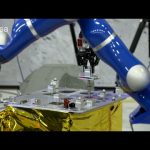
Putting a round peg in a round hole is not hard to do by someone standing next to it. But on 7 September 2015 ESA astronaut Andreas Mogensen did this while orbiting 400 km up aboard the International Space Station, remotely operating a rover and its robotic arm on the ground.
Andreas used a force-feedback control system developed at ESA, letting him feel for himself whenever the rover’s flexible arm met resistance.
These tactile sensations were essential for the success of the experiment, which involved placing a metal peg into a round hole in a ‘task board’ that offered less than a sixth of a millimetre of clearance. The peg needed to be inserted 4 cm to make an electrical connection.
Andreas managed two complete drive, approach, park and peg-in-hole insertions, demonstrating precision force-feedback from orbit for the very first time in the history of spaceflight.
The Interact Centaur rover used in the experiment was based at ESA’s technical centre ESTEC in Noordwijk, the Netherlands. It was designed and built by ESA’s Telerobotics & Haptics Laboratory in collaboration with graduate students from Delft University of Technology.
The Interact experiment is a first step towards developing robots that provide their operators with much wider sensory input than currently available. In this way, ESA is literally ‘extending human reach’ down to Earth from space.
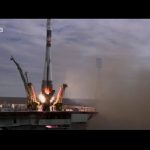
ESA astronaut Andreas Mogensen, commander Sergei Volkov and Aidyn Aimbetov were launched into space this morning 2 September at 04:37:43 GMT (06:37:43 CEST) from Baikonur cosmodrome, Kazakhstan.
The launch marks the start of ESA’s 10-day ‘iriss’ mission that will focus on testing new technologies and ways of running complex space missions.
The astronaut’s Soyuz TMA-18M spacecraft was pushed into Earth orbit as planned accelerating 50 km/h on every second for the first nine minutes of their launch.
The spacecraft separated from the Soyuz launcher at 04:46 GMT (06:46 CEST)
The fourth of ESA’s ‘Class of 2009’ astronauts to fly, Andreas Mogensen from Denmark will soon undertake a ten day mission to the International Space Station. With a background in aerospace engineering, he has spent the last six years training with the Station’s international partners for his inaugural spaceflight, taking part in a wide variety of activities to prepare him for the mission.
(L-115 days) ESA astronaut Andreas Mogensen and Russian cosmonaut Sergei Volkov take us inside the Soyuz simulator at Star City where they are training for off-nominal situations they could face during their spaceflight. In practice, this includes anything their Soyuz instructor decides to throw at them – including scenarios such as fire or depressurisation.
Andreas is currently training for his 10-day Iriss mission to the International Space Station, set for launch in September 2015.
In his latest video diary, ESA astronaut Andreas Mogensen is back at Star City where he takes a spin in the centrifuge as part of the training for his mission to the International Space Station. In the centrifuge Andreas gets to experience 4G and 8G – a ballistic reentry profile.
Andreas is currently training for his 10-day Iriss mission to the International Space Station, set for launch in September 2015.