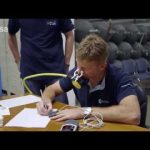
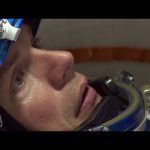
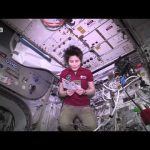
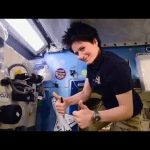
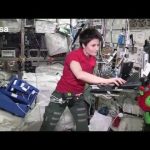
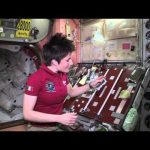
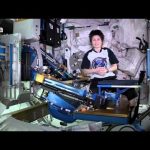
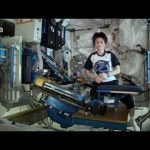
Join ESA astronaut Samantha Cristoforetti for a guided tour of the International Space Station’s crew quarters – the bedroom.
After a day’s work running experiments and maintaining the weightless research centre astronauts can retreat to their private quarters that is no larger than a changing room. In this small space they can store personal items, use a laptop for internet and float to sleep in their sleeping bag.
Tim Peake is the first British astronaut to be selected as a member of ESA’s European Astronaut Corps. With a background in flight dynamics, he served in the British Air Corps as flight commander, helicopter instructor and test pilot.
Scheduled to fly to the ISS in late 2015, he’ll be staying in orbit for five months. He also has close ties with the UK Space Agency, working on the development of its microgravity research programme.
The fourth of ESA’s ‘Class of 2009’ astronauts to fly, Andreas Mogensen from Denmark will soon undertake a ten day mission to the International Space Station. With a background in aerospace engineering, he has spent the last six years training with the Station’s international partners for his inaugural spaceflight, taking part in a wide variety of activities to prepare him for the mission.
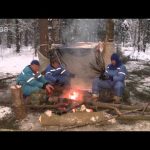
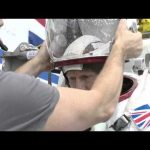
ESA astronaut Tim Peake during winter survival training in Russia.
All astronauts go through winter survival training. There is always the possibility that a Soyuz spacecraft could land in a remote, cold area. Tim has to learn to survive in harsh climates while waiting for rescue.
Tim is training for his mission to the International Space Station set to be launched on a Soyuz spacecraft from Baikonur Cosmodrome in Kazakhstan in December 2015.
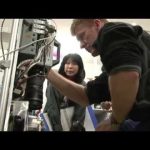
ESA astronauts train with all International Space Station partners including onsite training in USA, Europe, Canada and Japan.
ESA astronaut Tim trained in Tsukuba at the Japanese Aerospace Exploration Centre on Japanes experiments and the Japanese space laboratory Kibo.
Tim is preparing for his mission to the International Space Station set to be launched on a Soyuz spacecraft from Baikonur Cosmodrome in Kazakhstan in December 2015.
ESA astronaut Tim Peake during spacewalk training in Houston, USA.
Training underwater on life-size mockups of the Space Station is one way astronauts prepare for their missions as working in water resembles working in space.
Tim is training for his mission to the International Space Station set to be launched on a Soyuz spacecraft from Baikonur Cosmodrome in Kazakhstan in December 2015.
NASA Headquarters employees joined Astronaut Reid Wiseman, Expedition 41 flight engineer, for a post-flight presentation on Tuesday, June 23, to learn about his time onboard the space station as part of Expedition 40 and 41. As a member of the ISS Expedition 41 crew, Wiseman began his stay aboard the orbiting laboratory in May 2014 and returned to Earth in November 2014. This mission was his first spaceflight and included almost 13 hours of spacewalking to perform work outside the orbital complex. He and his crewmates also spent hundreds of hours conducting valuable scientific research in areas such as human physiology, medicine, physical science, Earth science and astrophysics.
Join ESA astronaut Samantha Cristoforetti for a guided tour of the International Space Station’s crew quarters – the bedroom.
After a day’s work running experiments and maintaining the weightless research centre astronauts can retreat to their private quarters that is no larger than a changing room. In this small space they can store personal items, use a laptop for internet and float to sleep in their sleeping bag.
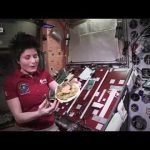
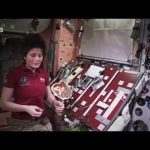
L’astronauta dell’ESA Samantha Cristoforetti sta attualmente vivendo e lavorando a bordo della Stazione Spaziale Internazionale per la missione di lunga durata dell’ASI “Futura”. Vivendo nello spazio a centinaia di km dalla Terra e da casa il cibo è uno degli aspetti fondamentali per un astronauta, anche dal punto di vista psicologico; per questo motivo gli è concesso portare con loro una certa quantità del cosiddetto “bonus food”: piatti e ingredienti di loro scelta che ricordino i loro gusti e i sapori di casa. Abbiamo chiesto a Samantha di mostrarci come riesce a cucinare in microgravità uno di questi piatti: del pollo alla curcuma con riso integrale e piselli.
ESA astronaut Samantha Cristoforetti is currently living on board the International Space Station for her long duration mission Futura. Food is an important item in space, also on the psychological side; that’s why astronauts are allowed a certain quantity of the so-called “bonus food” of their choice that reminds them of their home cooking tastes. We asked Samantha to show us how she manages to cook one of her bonus food recipes in microgravity: whole red rice with peas and chicken turmeric.
ESA astronaut Samantha Cristoforetti is currently living on board the International Space Station for her long duration mission Futura. Food is an important item in space, also on the psychological side; that’s why astronauts are allowed a certain quantity of the so-called “bonus food” of their choice that reminds them of their home cooking tastes. We asked Samantha to show us how she manages to cook one of her bonus food recipes in microgravity: a quinoa salad with dried tomatoes, mackerel and leek cream, all wrapped in a warm tortilla.
Don’t panic! This is the story of a book, a book called The Hitchiker’s Guide to the Galaxy, a wholly remarkable book.
ESA astronaut Samantha Cristoforetti reads from Douglas Adam’s “The Hitchhiker’s Guide to the Galaxy” for towel day from the European laboratory Columbus on the International Space Station.
The Guide has a few things to say on the subject of towels. A towel, it says, is about the most massively useful thing an interstellar hitchhiker can have.
To all you froods on the mostly harmless planet Earth, happy towel day!
Towel Day is an annual celebration on 25 May, as a tribute to the late author Douglas Adams when fans around the universe proudly carry a towel in his honour.
Fra i libri che l’astronauta Samantha Cristoforetti ha portato a bordo della Stazione Spaziale Internazionale c’è anche “I Viaggi di Giovannino Perdigiorno” di Gianni Rodari.
Sono tante le filastrocche di questa raccolta e Samantha ha deciso di leggerne alcune iniziando questa serie di letture spaziali da “Il pianeta di cioccolato”. Buon ascolto… dallo spazio!
ESA astronaut Samantha Cristoforetti shows how to use the most unglamorous but often asked-about part of living on the International Space Station: the toilet.
A fan creates suction to avoid smells and floating waste. Solid waste is stored and put in cargo ferries to burn up when the spacecraft leaves the Space Station. The astronaut urine is recycled – into drinking water.
ESA astronaut Samantha Cristoforetti, from Italy, will shortly be ending her long-duration stay onboard the International Space Station. Launched in November 2014, the Futura mission is the result of a special agreement between NASA and the Italian Space Agency ASI.
During her time in orbit Samantha Cristoforetti has undergone an intensive programme of scientific research, educational and maintenance activities, as well as overseeing the undocking of ESA’s fifth – and last – Automated Transfer Vehicle.
ESA astronaut Samantha Cristoforetti running experiments in weightlessness during her Futura mission for scientists from all over the world. The International Space Station offers three state-of-the-art laboratories where research can be done without gravity. The European Columbus laboratory, the Japanese Kibo and the American Destiny module offer facilities for physics, biology, geophysics and medicine.
Samantha’s 40-hour work week is devoted to science and maintaining the weightless research centre. This video gives a fast-track impression of some of the experiments she worked on. In quick succession we see Samantha working on: exercise machine ARED, measuring her body mass, the robotic droids SPHERES, ESA’s microgravity glovebox, muscle-measurement machine MARES, centrifuge-incubator Kubik, Biolab, Materials Science Laboratory and ejecting miniature satellites called Cubesats into space.
The astronauts on board the International Space Station get hungry from time to time during their long day of work in microgravity. We asked Samantha Cristoforetti, ESA astronaut on board the ISS for the Futura mission, to tell us about the kind of healthy snack she likes to eat during her breaks.
Anche a bordo della Stazione Spaziale Internazionale gli astronauti hanno ogni tanto bisogno di una pausa tra esperimenti, esercizio fisico e lavori di manutenzione. Samantha Cristoforetti, astronauta dell’Agenzia Spaziale Europea in missione per l’Agenzia Spaziale Italiana, ci mostra qualche esempio di uno snack sano in microgravitá.
ESA astronaut Paolo Nespoli talks about his career as an astronaut. From being inspired by the Moon landings as a child, to his missions to the International Space Station in 2007 and 2010. Paolo also has some advice on how to achieve your dreams.
Replay of our ‘Out of this world’ Google hangout between ESA astronaut Tim Peake and pupils from Rode Heath Primary from Cheshire, UK.
On Wednesday 25 February at 11:00 CET (10:00 GMT) Tim spoke to Rode Heath as part of their ‘Out of this world’ project. Hosted by Manchester Metropolitan University, representatives from all year groups at Rode Heath asked Tim their questions.
Tim is currently training for launch to the International Space Station on 20 November 2015. He will spend six months living and working on the ISS for his Principia mission.
L’astronauta ESA Samantha Cristoforetti, attualmente sulla Stazione Spaziale Internazionale per la missione Futura dell’Agenzia Spaziale Italiana, ci mostra come funziona la “palestra spaziale” iniziando da ARED, l’Advanced Resistive Exercise Device.
ESA astronaut Samantha Cristoforetti, currently living and working on the International Space Station, shows us the ‘space gym’. Starting with ARED, the Advanced Resistive Exercise Device.
Watch Earth roll by through the perspective of ESA astronaut Alexander Gerst in this six-minute timelapse video from space. Combining 12 500 images taken by Alexander during his six-month Blue Dot mission on the International Space Station this Ultra High Definition video shows the best our beautiful planet has to offer.
Marvel at the auroras, sunrises, clouds, stars, oceans, the Milky Way, the International Space Station, lightning, cities at night, spacecraft and the thin band of atmosphere that protects us from space.
Often while conducting scientific experiments or docking spacecraft Alexander would set cameras to automatically take pictures at regular intervals. Combining these images gives the timelapse effect seen in this video.
Watch the video in 4K resolution for the best effect and find out more about Alexander Gerst’s Blue Dot mission here: http://www.esa.int/BlueDot
Audio via the Audio Network library:
1. Into The Matrix (1899/6) Jason Pedder / Ben Ziapour
2. We Are Delirious (2073/6) Annie Drury / Bob Bradley / Matt Sanchez / Matt Parker
The Soyuz TMA-15M spacecraft approaches the International Space Station. The spacecraft lifted off at 20:59 GMT on 23 November (21:59 CET; 02:59 local time 24 November) and reached orbit nine minutes later.
Their spacecraft docked as planned at 02:49 GMT (03:49 CET), and the hatch to their new home in space was opened at 05:00 GMT (06:00 CET).
Follow the Futura mission with live updates from Samantha and the mission directors themselves on the mission blog ‘Outpost 42’ via http://outpost42.esa.int
ESA astronaut Alexander Gerst spent 166 days in space with NASA astronaut Reid Wiseman and Roscosmos commander Max Suraev in 2014.
This ten-minute video shows highlights of his Blue Dot mission, from docking spacecraft to science and spacewalks Alexander worked to improve the International Space Station and life on Earth.
From launch to landing, look at the experiments and beautiful images Alexander shared with us.
Samantha Cristoforetti from Italy will shortly fly to the International Space Station. The final stage of her preparations happens in Star City, near Moscow, training alongside three other members of ESA’s Astronaut Corps. The third of ESA’s new generation of astronauts to fly, she’ll be undergoing a long-duration stay in orbit – replacing Alexander Gerst from Germany as part of the Station’s permanent onboard crew.
Russian ISS commander, cosmonaut Maxim Suraev, NASA astronaut Reid Wiseman and ESA astronaut Alexander Gerst send a peace message from space. They remind us that the International Space Station serves as a shining example of how people can live and work together for the benefit of all humankind. It’s the hallmark of international cooperation – a milestone in human history.
ESA astronaut Alexander Gerst sends his greetings to the Euro-Space-Day in Saarbrücken, Germany. The tri-national (FR-LU-DE) event will bring together students, scientific institutions and space industry.
This timelapse video from space has it all: an orbit of Earth with lightning and aurora, followed by a space sunrise and daytime views of our cloudy planet. The images were taken by ESA astronaut Alexander Gerst as he orbited Earth on the International Space Station at around 400 km altitude. The nighttime video shows a Soyuz spacecraft that ferries the astronauts to the outpost. At the end of the video green aurora can be seen as Earth’s interacts with solar radiation.
The International Space Station travels at 28 800 km/h meaning that it only takes 90 minutes to circle Earth completely. Each orbit the Station moves around 2200 km to the West in relation to 90 minutes before.
Astronauts often use normal consumer digital cameras to take pictures of Earth through Europe’s observatory module Cupola in their spare time. Setting the camera to take an image every few seconds and then playing the images back quickly create this timelapse effect.
Alexander worked as a geophysicist and volcanologist before he was chosen as an ESA astronaut in 2009. His Blue Dot mission includes an extensive scientific programme of experiments in physical science, biology, and human physiology as well as radiation research and technology demonstrations. All experiments chosen make use of the out-of-this-world laboratory to improve life on Earth or prepare for further human exploration of our Solar System.
Due giovani terrestri hanno mandato una domanda per Samantha Cristoforetti per chiederle, secondo lei, quale parte del già’ difficile allenamento da astronauta e’ la più impegnativa.
On 25 July, several German planetariums connected with ESA’s Astronaut Centre in Cologne, Germany, for a Google Hangout session.
Usually, visitors to a planetarium are explore the starry night sky. But on the evening of 25 July eight German planetariums organised an event to talk about Alexander Gerst’s Blue Dot mission on the International Space Station, the European Astronaut Centre and about human spaceflight in general. A highlight of the evening was this message from Alexander Gerst in space.
ESA astronauts have to train with all International Space Station partners: we often see images of them training at Star City in Russia or in Houston, in the US, but they also have to go to Japan during the preparations for their mission.
ESA astronauts Alexander Gerst and Samantha Cristoforetti were recently in Tsukuba, at the Japanese Aerospace Exploration Centre.
ESA astronaut Alexander Gerst recounts his training for his Blue Dot mission to the International Space Station in May 2014. Alexander spent over four years learning science, survival techniques, new languages, robotic operations and Space Station systems to prepare for his mission.
Alexander discusses basic training, overseeing docking of ESA’s Automated Transfer Vehicle space freighter, spacewalk training in swimming pools, the merits of US and Russian spacesuits and the scientific experiments he will conduct.
Alexander will spend six months on the Space Station performing experiments and maintaining the weightless laboratory. He is part of Expedition 40/41 to be launched May 2014 on a Soyuz spacecraft with cosmonaut commander Maxim Surayev and NASA astronaut Reid Wiseman.
Learning to fly the Soyuz with ESA astronauts Andreas Mogensen and Thomas Pesquet in the Soyuz simulator at Star City, near Moscow. Latest installment from Andreas’ video diary during his training for a mission to the International Space Station in 2015.
Italian astronaut Luca Parmitano and NASA astronaut Chris Cassidy were hard at work outside the International Space Station (ISS) for the second time, when water started to leak into Luca Parmitano’s space suit helmet, immediately resulting in the duo heading back to the Quest Airlock to terminate the EVA. Luca and Chris explain the events that happened during EVA # 23.