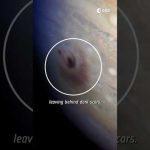
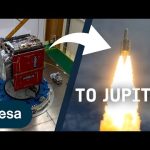
In 2013, our Herschel telescope solved the mystery of water in Jupiter’s upper atmosphere, tracing it back to the impact of comet Shoemaker-Levy 9 in July 1994.
This finding paved the way for our Juice mission, set to reach Jupiter in 2031. Juice’s observations will give us a better chance of understanding how Jupiter’s atmosphere responds to such events.
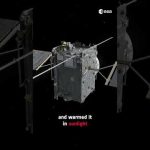
ESA’s Jupiter Icy Moons Explorer (Juice), is on an epic eight-year journey to Jupiter. This first episode of ‘The journey of Juice’ tells the story of Juice’s first months in space, from its launch on 14 April 2023 to its lunar-Earth gravity assist (LEGA for short) in August 2024. This flyby was not only the first double gravity assist manoeuvre of its kind, it was also a perfect opportunity to test out the spacecraft’s cameras and science instruments.
In this episode, Juice’s Mission Manager Nicolas Altobelli explains how the spacecraft will become the first ever human-made machine to orbit a moon of another planet, in this case Jupiter’s largest moon Ganymede.
You’ll also hear from Claire Vallat and Marc Costa at the European Space Astronomy Centre (ESAC) near Madrid, Spain. Juice will perform incredibly complex measurements once it reaches Jupiter, and the Science Operations team at ESAC is making sure we get the most out of every instrument.
Meanwhile, the Flight Control team at the European Space Operations Centre (ESOC) in Darmstadt, Germany, makes sure Juice is and stays on the right path. This episode shows what happened ‘behind the scenes’ before and during the lunar-Earth flyby, and stars Ignacio Tanco, Angela Dietz and members of the Juice Flight Control team as they do what they do best.
Finally, we highlight the ESA tracking station network (Estrack), another crucial component for Juice. Maintenance and Operations Engineer Belén Goméz gives a tour of the facility at Cebreros.
Following the very successful lunar-Earth flyby, Juice is now on its way to planet Venus for its next flyby. On 31 August 2025, this flyby will give Juice its second gravity boost. Tune back in next year for episode two of this series!
This series follows on from ‘The making of Juice’ series, which covered the planning, testing and launch of this once-in-a-generation mission.
Credit: ESA/Lightcurve Films, original music by William Zeitler
Acknowledgments: Direction, main camera, sound, editing, post-production: Maarten Roos. Camera at Cebreros during LEGA: Mikel Larequi. LEGA timelapse: Mark McCaughrean and Simeon Schmauß. Special thanks to Marc Costa (ESA – ESAC) and Jorge Fauste (ESA – Estrack)
★ Subscribe: http://bit.ly/ESAsubscribe and click twice on the bell button to receive our notifications.
We are Europe’s gateway to space. Our mission is to shape the development of Europe’s space capability and ensure that investment in space continues to deliver benefits to the citizens of Europe and the world. Check out https://www.esa.int/ to get up to speed on everything space related.
On 17 November 2023, our Juice spacecraft carried out one of the largest and most important manoeuvres in its eight-year journey to Jupiter.
Why does it take so long? Well, the short answer is that its less to do with the distance between Earth and Jupiter and more to do with fighting the Sun’s massive gravitational pull as you venture to the outer Solar System.
If spacecraft like Juice had to carry all the fuel needed to battle the Sun’s gravity alone, they’d be nothing more than colossal tanks. Instead, they use ‘gravity-assist’ tricks – they swing by planets to receive a boost on the way.
Using its main engine, Juice changed its orbit around the Sun to put itself on the correct trajectory for next summer’s Earth-Moon double gravity assist – the first of its kind.
The manoeuvre lasted 43 minutes and burned almost 10% of the spacecraft’s entire fuel reserve. It’s the first part of a two-part manoeuvre that could mark the final time that Juice’s main engine is used until its arrival in the Jupiter system in 2031.
One giant planet. Three icy moons. An eight-year journey. One special spacecraft.
Building a mission to Jupiter took years of planning and thousands of people. Now that Juice is finally en route to its destination, we take a look behind the scenes to discover the story behind the making of Juice. Featuring exclusive interviews with scientists and engineers from across Europe, as well as backstage footage from the planning, testing and launch of this once-in-a-generation mission.
ESA presents ‘The making of Juice’, a documentary by Maarten Roos (Lightcurve Films), starring the Juice spacecraft and the people who made it.
Release date: Thursday 23 November.
Credit: ESA/Lightcurve Films
★ Subscribe: http://bit.ly/ESAsubscribe and click twice on the bell button to receive our notifications.
We are Europe’s gateway to space. Our mission is to shape the development of Europe’s space capability and ensure that investment in space continues to deliver benefits to the citizens of Europe and the world. Check out https://www.esa.int/ to get up to speed on everything space related.
We are Europe’s gateway to space. Our mission is to shape the development of Europe’s space capability and ensure that investment in space continues to deliver benefits to the citizens of Europe and the world. Check out https://www.esa.int/ to get up to speed on everything space related.
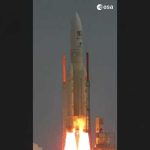
ESA’s latest interplanetary mission, Juice, lifted off on an Ariane 5 rocket from Europe’s Spaceport in French 09:14 local time/14:14CEST on 14 April 2023 to begin its eight-year journey to Jupiter, where it will study in detail the gas giant planet’s three large ocean-bearing moons: Ganymede, Callisto and Europa.
Juice – Jupiter Icy Moons Explorer – is humankind’s next bold mission to the outer Solar System. This ambitious mission will characterise Ganymede, Callisto and Europa with a powerful suite of remote sensing, geophysical and in situ instruments to discover more about these compelling destinations as potential habitats for past or present life. Juice will monitor Jupiter’s complex magnetic, radiation and plasma environment in depth and its interplay with the moons, studying the Jupiter system as an archetype for gas giant systems across the Universe.
Following launch, Juice will embark on an eight-year journey to Jupiter, arriving in July 2031 with the aid of momentum and direction gained from four gravity-assist fly-bys of the Earth-Moon system, Venus and, twice, Earth.
Flight VA260 is the final Ariane 5 flight to carry an ESA mission to space.
“Correction:” 03:45 Audio: Hubrid
★ Subscribe: http://bit.ly/ESAsubscribe and click twice on the bell button to receive our notifications.
We are Europe’s gateway to space. Our mission is to shape the development of Europe’s space capability and ensure that investment in space continues to deliver benefits to the citizens of Europe and the world. Check out https://www.esa.int/ to get up to speed on everything space related.
An eight-year cruise with four gravity-assist flybys at Earth and Venus will slingshot the spacecraft towards the outer Solar System. The first flyby in April 2024 will mark a space exploration first: Juice will perform a lunar-Earth gravity-assist – a flyby of the Moon followed 1.5 days later by one of Earth.
★ Subscribe: http://bit.ly/ESAsubscribe and click twice on the bell button to receive our notifications.
We are Europe’s gateway to space. Our mission is to shape the development of Europe’s space capability and ensure that investment in space continues to deliver benefits to the citizens of Europe and the world. Check out https://www.esa.int/ to get up to speed on everything space related.
Ariane 5 for flight VA260 carrying ESA’s Juice mission is seen here fully integrated and ready for rollout for its planned 13 April 2023 launch from Europe’s Spaceport in French Guiana.
Juice – JUpiter ICy Moons Explorer – is humankind’s next bold mission to the outer Solar System. After an eight-year journey to Jupiter, it will make detailed observations of the gas giant and its three large ocean-bearing moons: Ganymede, Callisto and Europa. This ambitious mission will characterise these moons with a powerful suite of remote sensing, geophysical and in situ instruments to discover more about these compelling destinations as potential habitats for past or present life. Juice will monitor Jupiter’s complex magnetic, radiation and plasma environment in depth and its interplay with the moons, studying the Jupiter system as an archetype for gas giant systems across the Universe.
We are Europe’s gateway to space. Our mission is to shape the development of Europe’s space capability and ensure that investment in space continues to deliver benefits to the citizens of Europe and the world. Check out https://www.esa.int/ to get up to speed on everything space related.
Our Jupiter Icy Moons Explorer, Juice, lifted off on an Ariane 5 rocket from Europe’s Spaceport in French Guiana at 14:14 CEST on 14 April 2023. The successful launch marks the beginning of an ambitious voyage to uncover the secrets of the ocean worlds around giant planet Jupiter.
Following launch and separation from the rocket, our European Space Operations Centre in Darmstadt, Germany, confirmed acquisition of signal via the New Norcia ground station in Australia at 15:04 CEST. The spacecraft’s vast 27 m long solar arrays unfurled into their distinctive cross shapes at 15:33 CEST, ensuring Juice can travel to the outer Solar System. The completion of this critical operation marked the launch a success.
Over the next two-and-half weeks Juice will deploy its various antennas and instrument booms, including the 16 m long radar antenna, 10.6 m long magnetometer boom, and various other instruments that will study the environment of Jupiter and the subsurface of the icy moons.
An eight-year cruise with four gravity-assist flybys at Earth and Venus will slingshot the spacecraft towards the outer Solar System. The first flyby in April 2024 will mark a space exploration first: Juice will perform a lunar-Earth gravity-assist – a flyby of the Moon followed 1.5 days later by one of Earth.
Juice is a mission under our leadership with contributions from @NASA, @JAXA-HQ and Israel Space Agency.
★ Subscribe: http://bit.ly/ESAsubscribe and click twice on the bell button to receive our notifications.
We are Europe’s gateway to space. Our mission is to shape the development of Europe’s space capability and ensure that investment in space continues to deliver benefits to the citizens of Europe and the world. Check out https://www.esa.int/ to get up to speed on everything space related.
We’re going to Jupiter – and three of its moons! The Juice spacecraft is now securely fastened to an Ariane 5 rocket and ready for launch. Juice, for Jupiter Icy Moons Explorer, will explore Jupiter’s complex environment in depth after an eight-year journey.
– Liftoff: 29:45 – Juice launch separation: 57:40 – Acquisition of signal: 1:20:45 – Solar Array deployment: 1:48:30
★ Subscribe: http://bit.ly/ESAsubscribe and click twice on the bell button to receive our notifications.
We are Europe’s gateway to space. Our mission is to shape the development of Europe’s space capability and ensure that investment in space continues to deliver benefits to the citizens of Europe and the world. Check out https://www.esa.int/ to get up to speed on everything space related.
Determining whether the Jovian moons provide the right conditions for habitability is one of the Jupiter Icy Moons Explorer, Juice, core objectives. Could life have appeared somewhere there? Do any of the Galilean moons have the building blocks needed for life?
By studying the Galilean moons’ hidden oceans, magnetism, heating processes, tidal effects, orbits, surface activity, cores and compositions, atmospheres and space environments, Juice will investigate whether the conditions necessary for life could ever have emerged on Ganymede, Europa or Callisto. Juice will help us to understand these worlds not only as planetary bodies but also as possible habitats for life. Juice’s high-resolution mapping will hunt for biologically essential and important elements (such as carbon, oxygen, nitrogen, magnesium and iron).
These moons are especially exciting prospects for life given their hidden subsurface oceans. Characterising their habitability will have far-reaching scientific implications well beyond the Jupiter system itself, and will help us understand the general habitability of icy worlds across the Universe. Importantly, Juice’s second target of the wider Jupiter system will reveal more about the general prospects for habitability in similar planetary systems around other stars.
★ Subscribe: http://bit.ly/ESAsubscribe and click twice on the bell button to receive our notifications.
We are Europe’s gateway to space. Our mission is to shape the development of Europe’s space capability and ensure that investment in space continues to deliver benefits to the citizens of Europe and the world. Check out https://www.esa.int/ to get up to speed on everything space related.
The main goal of the Jupiter Icy Moons Explorer, Juice, is to characterise Jupiter’s icy moons as both planetary objects and possible habitats. But by observing Jupiter’s atmosphere, magnetosphere, and system of moons and rings, the mission will also reveal how different aspects of the planet’s environment affect one another. In this way, Juice will improve our knowledge of Jupiter as a unique planet and as a whole system.
With Jupiter being like a ‘mini solar system’, we will be able to apply this knowledge to our own Solar System and other planetary systems in the Universe, improving our understanding of how gas giants form and behave, and the potential for life to exist on their orbiting worlds. This knowledge will feed into our exoplanet monitoring programme, which currently consists of a trifecta of dedicated missions – Cheops, Plato and Ariel – complemented by Webb.
★ Subscribe: http://bit.ly/ESAsubscribe and click twice on the bell button to receive our notifications.
We are Europe’s gateway to space. Our mission is to shape the development of Europe’s space capability and ensure that investment in space continues to deliver benefits to the citizens of Europe and the world. Check out https://www.esa.int/ to get up to speed on everything space related.
Juice will complete two flybys of Europa in July 2032, approaching the moon at a closest approach of 400 km. During these close encounters, Juice will explore the geology, surface, subsurface, activity and environment of the moon, which appears to have a young, active, colourful and distinctively marked surface.
The mission will characterise the composition and chemistry of Europa’s surface, hunting for substances that are essential to support life and determining the source of the moon’s material. Europa may vent water vapour to space via ‘plumes’ and geysers; Juice will search for pockets of water in the moon’s shallow subsurface using unprecedented ice-penetrating radar, and reveal locations where the transfer of material between subsurface, surface and space may be especially intense.
Juice will complete its first flyby of Callisto in June 2032; the spacecraft will complete a total of 21 flybys of this moon from 2032–2034 (both to explore the moon and to adjust the energy and orientation of Juice’s orbit), coming as close as 200 km from Callisto at nearest approach.
Callisto is also the least geologically evolved Galilean satellite, and therefore offers a unique glimpse into the environment around early Jupiter. As the moon does not seem to have evolved much over time, it stands to reveal unique information about how it initially formed, and about the origin of the wider Jupiter system.
📹 @EuropeanSpaceAgency
★ Subscribe: http://bit.ly/ESAsubscribe and click twice on the bell button to receive our notifications.
We are Europe’s gateway to space. Our mission is to shape the development of Europe’s space capability and ensure that investment in space continues to deliver benefits to the citizens of Europe and the world. Check out https://www.esa.int/ to get up to speed on everything space related.
Ganymede is the primary scientific target of the Jupiter Icy Moons Explorer, Juice, mission. With a diameter of about 5260 km, larger than that of Pluto and Mercury, Ganymede tops the Solar-System moons’ size chart. It is the seventh moon from the gas giant (and the third among the Galilean satellites) and orbits Jupiter at a distance of more than 1 million kilometres. Researchers believe there is tidal heating on Ganymede, although to a much smaller degree than on Io and Europa. This heat could drive some tectonic activity and provide one of the necessary conditions for life to emerge: a source of energy.
This high-resolution mapping of the surface can help constrain the moon’s composition and mineralogy, and assess how habitable Ganymede could be by searching for biosignatures. Observations at various wavelengths will allow astronomers to study non-water-ice material to determine the distribution of biologically essential elements—such as carbon or oxygen—and other important elements—such as magnesium and iron—on the planetary body. The mission will also shed light on the origin and evolution of the materials on the surface by exploring which substances form at Ganymede and which are brought in from the plasma environment around the moon.
To study Ganymede in detail, Juice will enter orbit around it, becoming the first spacecraft to orbit a moon in the outer Solar System. The dedicated orbital tour is expected to last about eight months and will be the final stage of the mission.
📹 @EuropeanSpaceAgency
★ Subscribe: http://bit.ly/ESAsubscribe and click twice on the bell button to receive our notifications.
We are Europe’s gateway to space. Our mission is to shape the development of Europe’s space capability and ensure that investment in space continues to deliver benefits to the citizens of Europe and the world. Check out https://www.esa.int/ to get up to speed on everything space related.
When a spacecraft launches on a mission to another planet it must first break free of the Earth’s gravitational field. Once it has done that, it enters interplanetary space, where the dominant force is the gravitational field of the Sun.
The spacecraft begins to follow a curving orbit, around the Sun, which is similar to the orbit of a comet. When this orbit brings it close to its target destination the spacecraft must fire a retrorocket to slow down and allow itself to be captured by the gravitational field of its target. The smaller the target, the more the spacecraft must slow down.
Sometimes passing a planet can result in the spacecraft being accelerated, even without the spacecraft firing any of its thrusters. This is known as the ‘slingshot’ effect. Such ‘gravity assist’ manoeuvres are now a standard part of spaceflight and are used by almost all our interplanetary missions. They take advantage of the fact that the gravitational attraction of the planets can be used to change the trajectory and speed of a spacecraft.
The amount by which the spacecraft speeds up or slows down is determined by whether it is passing behind or in front of the planet as the planet follows its orbit. When the spacecraft leaves the influence of the planet, it follows an orbit on a different course than before.
📹 @EuropeanSpaceAgency
★ Subscribe: http://bit.ly/ESAsubscribe and click twice on the bell button to receive our notifications.
We are Europe’s gateway to space. Our mission is to shape the development of Europe’s space capability and ensure that investment in space continues to deliver benefits to the citizens of Europe and the world. Check out https://www.esa.int/ to get up to speed on everything space related.
Our Jupiter Icy Moons Explorer, Juice, will make detailed observations of the giant gas planet and its three large ocean-bearing moons – Ganymede, Callisto and Europa – with a suite of remote sensing, geophysical and in situ instruments. The mission will characterise these moons as both planetary objects and possible habitats, explore Jupiter’s complex environment in depth, and study the wider Jupiter system as an archetype for gas giants across the Universe.
Juliet will be taking us to Jupiter and its moons in the coming weeks. So stay tuned for more!
📹 @europeanspaceagency
★ Subscribe: http://bit.ly/ESAsubscribe and click twice on the bell button to receive our notifications.
We are Europe’s gateway to space. Our mission is to shape the development of Europe’s space capability and ensure that investment in space continues to deliver benefits to the citizens of Europe and the world. Check out https://www.esa.int/ to get up to speed on everything space related.
After many years of study, development, building and testing, ESA’s Jupiter Icy Moons Explorer, Juice, has finally arrived at Europe’s Spaceport in Kourou, French Guiana. At the end of 2022 the spacecraft underwent its final thermal vacuum test at an Airbus Defence and Space facility in Toulouse, as well as its final software verification tests, whereby it was controlled from the ESOC mission control centre in Darmstadt, Germany.
Soon, an Ariane 5 will lift Juice into orbit and send it on its journey to explore the largest planet in our Solar System and its three icy moons, Europa, Callisto and in particular Ganymede. By exploring and studying the Jovian system, the mission neatly fullfills its role in ESA’s Cosmic Vision programme, teaching us about our Universe and the origins of life.
Stay tuned: www.esa.int/juice
★ Subscribe: http://bit.ly/ESAsubscribe and click twice on the bell button to receive our notifications.
We are Europe’s gateway to space. Our mission is to shape the development of Europe’s space capability and ensure that investment in space continues to deliver benefits to the citizens of Europe and the world. Check out https://www.esa.int/ to get up to speed on everything space related.
A grand odyssey of exploration is about to begin. Humankind’s next bold mission to the outer Solar System, ESA’s Jupiter Icy Moons Explorer, Juice, is poised to explore giant planet Jupiter and its largest moons. These intriguing worlds have piqued our curiosity ever since Galileo first raised his telescope to the planet and discovered its four largest moons: Io, Europa, Ganymede and Callisto, three of which are thought to harbour underground oceans.
Early space probes visiting the Jovian system have raised more questions than answers. But thanks to Juice, many of those answers are now within reach. ESA is launching the spacecraft in April 2023 on an eight-year journey to the distant planet.
To uncover the hidden secrets of these mysterious worlds, Juice is equipped with the most powerful science instruments ever sent to the outer Solar System. The spacecraft will face many dangers along the way: radiation, extreme temperatures, and the vast gravitational pull of Jupiter, all while operating hundreds of millions of kilometres from Earth. But in the safe hands of ESA’s operators to guide it safely through these challenges, the dangers will be worth it for the science that Juice is destined to uncover.
The countdown to this new era of Jupiter system exploration has begun. Stay tuned: www.esa.int/juice
Credit: Produced by ESA/ATG medialab
★ Subscribe: http://bit.ly/ESAsubscribe and click twice on the bell button to receive our notifications.
We are Europe’s gateway to space. Our mission is to shape the development of Europe’s space capability and ensure that investment in space continues to deliver benefits to the citizens of Europe and the world. Check out https://www.esa.int/ to get up to speed on everything space related.
ESA’s Juice mission has entered its final phase of development, with the spacecraft moving to an @Airbus Defence and Space facility in Toulouse, France, for the next round of testing. The spacecraft has been fully integrated, and these tests will be done in full flight configuration, as Juice is scheduled for launch from Europe’s Spaceport in Kourou, French Guiana, in April 2023.
The Juice mission is a perfect example of collaboration between several national space agencies and European industry. Its objective is to explore the gas giant Jupiter, its environment, and three of its moons: Europa, Callisto and Ganymede. By studying this planetary system, ESA hopes to learn more about the icy worlds around Jupiter and the origins and possibility of life in our Universe
We are Europe’s gateway to space. Our mission is to shape the development of Europe’s space capability and ensure that investment in space continues to deliver benefits to the citizens of Europe and the world. Check out https://www.esa.int/ to get up to speed on everything space related.
ESA’s Jupiter Icy Moons Explorer, Juice, is set to embark on an eight-year cruise to Jupiter starting April 2023. The mission will investigate the emergence of habitable worlds around gas giants and the Jupiter system as an archetype for the numerous giant planets now known to orbit other stars.
This animation depicts Juice’s journey to Jupiter and highlights from its foreseen tour of the giant planet and its large ocean-bearing moons. It depicts Juice’s journey from leaving Earth’s surface in a launch window 5–25 April 2023 and performing multiple gravity assist flybys in the inner Solar System, to arrival at Jupiter (July 2031), flybys of the Jovian moons Europa, Callisto and Ganymede, orbital insertion at Ganymede (December 2034), and eventual impact on this moon’s surface (late 2035).
An Ariane 5 will lift Juice into space from Europe’s Spaceport in Kourou. A series of gravity assist flybys of Earth, the Earth-Moon system and Venus will set the spacecraft on course for its July 2031 arrival at Jupiter. These flybys are shown here in order – Earth-Moon (August 2024), Venus (August 2025), Earth (September 2026, January 2029) – interspersed by Juice’s continuing orbits around the Sun. Juice’s flyby of the Earth-Moon system, known as a Lunar-Earth gravity assist (LEGA), is a world first: by performing this manoeuvre – a gravity assist flyby of the Moon followed just 1.5 days later by one of Earth – Juice will save a significant amount of propellant on its journey.
Juice will start its science mission about six months prior to entering orbit around Jupiter, making observations as it approaches its destination. Once in the Jovian system, a gravity assist flyby of Jupiter’s largest moon Ganymede – also the largest moon in the Solar System – will help Juice enter orbit around Jupiter, where the spacecraft will spend four years observing the gas giant and three of its moons: Ganymede, Callisto and Europa.
Juice will make two flybys of Europa (July 2032), which has strong evidence for an ocean of liquid water under its icy shell. Juice will look at the moon’s active zones, its surface composition and geology, search for pockets of liquid water under the surface, and study the plasma environment around Europa, also exploring the moon’s tiny atmosphere and hunting for plumes of water vapour (as have been previously detected erupting to space).
A sequence of Callisto flybys will be used to study this ancient, cratered world that may too harbour a subsurface ocean, also changing the angle of Juice’s orbit with respect to Jupiter’s equator, making it possible to explore Jupiter’s higher latitudes (2032–2034).
A sequence of Ganymede and Callisto flybys will adjust Juice’s orbit – properly orienting it while minimising the amount of propellant expended – so that it can enter orbit around Ganymede in December 2034, making it the first spacecraft to orbit another planet’s moon. Juice’s initial elliptical orbit will be followed by a 5000 km-altitude circular orbit, and later a 500 km-altitude circular orbit.
Ganymede is the only moon in the Solar System to have a magnetosphere. Juice will investigate this phenomenon and the moon’s internal magnetic field, and explore how its plasma environment interacts with that of Jupiter. Juice will also study Ganymede’s atmosphere, surface, subsurface, interior and internal ocean, investigating the moon as not only a planetary object but also a possible habitat.
Over time, Juice’s orbit around Ganymede will naturally decay due to lack of propellant, and it will make a grazing impact onto the surface (late 2035).
The Juice launch itself will be a historical milestone for more reasons than one. It will be the final launch for Ariane 5, ending the launcher’s nearly three-decade run as one of the world’s most successful heavy-lift rockets. Its duties are being taken over by Ariane 6.
We are Europe’s gateway to space. Our mission is to shape the development of Europe’s space capability and ensure that investment in space continues to deliver benefits to the citizens of Europe and the world. Check out https://www.esa.int/ to get up to speed on everything space related.
ESA’s Jupiter Icy moons Explorer, Juice, has successfully completed rigorous thermal tests simulating the extreme coldness of space and the warmth of the Sun at ESA’s test centre ESTEC, in The Netherlands.
The spacecraft underwent a month of round-the-clock testing and monitoring in the Large Space Simulator, which recreates the vacuum of space and is able to simulate both hot and cold space environments. The spacecraft was subjected to temperatures ranging from 250 degrees to minus 180 degrees Celsius, showing that it can survive its journey in space.
Juice will launch in 2022 to our Solar System’s largest planet. It will spend over four years studying Jupiter’s atmosphere, magnetosphere and its icy moons Europa, Callisto and Ganymede, investigating whether the moons’ subsurface oceans are habitable for life.
We are Europe’s gateway to space. Our mission is to shape the development of Europe’s space capability and ensure that investment in space continues to deliver benefits to the citizens of Europe and the world. Check out https://www.esa.int/ to get up to speed on everything space related.
The ESA Jupiter Icy Moons Explorer (Juice) team has been working very hard to prepare the spacecraft for the first test in the one-year long environmental test campaign. This is the so-called Thermal Balance Thermal Vacuum (TBTV) test.
Juice is in the Large Space Simulator (LSS), a unique facility in Europe (run by the European Test Center, at ESA/ESTEC in the Netherlands) that can simulate the vacuum and cold and hot temperature conditions in space, and also the Sun itself!
The TBTV started on 17 June with the closure of the LSS and the “pumping-down”, meaning the removal of air within the chamber to a pressure level of 10nbar (1/100 000 000th of the outside air pressure). This is the closest Juice will come to space conditions while on Earth. It will undergo 24/7 testing, ending on 16 July 2021.
In this episode this process is followed and several team members comment on the different moments.
Produced for ESA by Lightcurve Films. GoPro footage by ESA. Original music by William Zeitler.
★ Subscribe: http://bit.ly/ESAsubscribe and click twice on the bell button to receive our notifications.
We are Europe’s gateway to space. Our mission is to shape the development of Europe’s space capability and ensure that investment in space continues to deliver benefits to the citizens of Europe and the world. Check out https://www.esa.int/ to get up to speed on everything space related.
An instrument destined for Jupiter orbit undergoes eight days of cryogenic radio-frequency testing using a new test facility at ESA’s ESTEC technical centre in the Netherlands. The Submillimetre Wave Instrument of ESA’s Juice mission will survey the churning atmosphere of Jupiter and the scanty atmospheres of its Galilean moons.
Testing took place in ESA’s custom-built Low-temperature Near-field Terahertz chamber, or Lorentz. The first chamber of its kind, the 2.8-m diameter Lorentz chamber can perform high-frequency radio-frequency testing in realistic space conditions, combining space-quality vacuum with ultra-low temperatures.
★ Subscribe: http://bit.ly/ESAsubscribe and click twice on the bell button to receive our notifications.
We are Europe’s gateway to space. Our mission is to shape the development of Europe’s space capability and ensure that investment in space continues to deliver benefits to the citizens of Europe and the world. Check out https://www.esa.int/ to get up to speed on everything space related.
In this edition of Space we set a course for Jupiter, destination of the next European Space Agency mission.
The aim of JUICE (JUpiter ICy moon Explorer) is to provide the most comprehensive exploration of the giant planet and, in particular, of its moons; supposedly hiding habitable zones under their icy crusts.
Jupiter is more than eleven times larger than Earth but is mainly made of gas. During its three and a half year mission, which blasts off in 2022, JUICE will travel around the giant planet, studying its atmosphere and three of its planet-sized satellites: Ganymede, Europa, and Callisto.