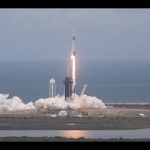
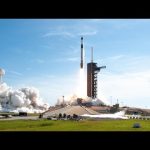
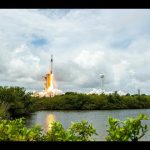
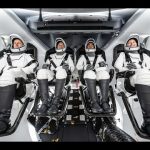
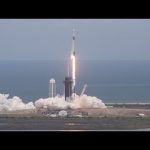
SpaceX’s CRS-26 cargo mission is now targeted to lift off at 2:20 p.m. EST (1920 UTC) Saturday, Nov. 26 from Launch Complex 39A at NASA’s Kennedy Space Center in Florida. A Nov. 22 launch attempt was scrubbed due to poor weather conditions along Florida’s Space Coast. The Dragon spacecraft will deliver a variety of NASA investigations, including the next pair of International Space Station Roll Out Solar Arrays (iROSAs), which will augment power to the orbiting laboratory.
The spacecraft also will carry a study to grow dwarf tomatoes to help create a continuous fresh-food production system in space, as well as an experiment that tests an on-demand method to create specific quantities of key nutrients.
SpaceX’s CRS-26 cargo mission is set to lift off at 3:54 p.m. EST (2054 UTC) Tuesday, Nov. 22 from Launch Complex 39A at NASA’s Kennedy Space Center in Florida. The Dragon spacecraft will deliver a variety of NASA investigations, including the next pair of International Space Station Roll Out Solar Arrays (iROSAs), which will augment power to the orbiting laboratory.
The spacecraft also will carry a study to grow dwarf tomatoes to help create a continuous fresh-food production system in space, as well as an experiment that tests an on-demand method to create specific quantities of key nutrients.
Raw NASA camera footage, taken from the Space Launch System’s (SLS) core stage, shows the SLS separation of the solid rocket boosters two minutes and 11 seconds after liftoff.
At 1:47 am EST (6:47 UTC) on November 16, NASA’s Orion spacecraft launched aboard the SLS rocket from historic Launch Complex 39B at NASA’s Kennedy Space Center on a path to the Moon, officially beginning the Artemis I mission.
This mission is the first integrated test of NASA’s deep space exploration systems: the Orion spacecraft, the SLS rocket, and Kennedy Space Center ground systems.
NASA’s Artemis I mission lifted off on Nov. 16, 2022, from Kennedy Space Center’s Launch Complex 39B. This video includes highlights from the event.
With 8.8 million pounds of thrust, the Space Launch System (SLS), is NASA’s most powerful rocket. It will send the uncrewed Orion spacecraft beyond the Moon, 280,000 miles from Earth, farther than any human-rated spacecraft has ever flown.
After 26 days and a total distance of over a million miles, Orion will return home faster and hotter than any spacecraft has before.
The primary goals for Artemis I are to demonstrate Orion’s systems in a spaceflight environment and ensure a safe re-entry, descent, splashdown, and recovery prior to the first flight with crew on Artemis II.
The first in a series of increasingly complex missions, Artemis I will demonstrate our commitment and capability to build a long-term human presence at the Moon for decades to come.
The Space Launch System (SLS) rocket with the Orion spacecraft aboard lifted off at 07:47 CET from @NASA’s Kennedy Space Center in Florida, USA on 16 November 2022.
The most powerful rocket ever built sent NASA’s Orion spacecraft and ESA’s European Service Module (ESM) to a journey beyond the Moon and back. No crew will be on board Orion this time, and the spacecraft will be controlled by teams on Earth.
ESM provides for all astronauts’ basic needs, such as water, oxygen, nitrogen, temperature control, power and propulsion.
Much like a train engine pulls passenger carriages and supplies power, the European Service Module will take the Orion capsule to its destination and back.
We are Europe’s gateway to space. Our mission is to shape the development of Europe’s space capability and ensure that investment in space continues to deliver benefits to the citizens of Europe and the world. Check out https://www.esa.int/ to get up to speed on everything space related.
A quick recap of NASA’s history in space exploration segueing to Artemis serves as the opening video for the launch broadcast for the agency’s Artemis I mission. The broadcast originates from Kennedy Space Center in Florida, where NASA’s Space Launch System rocket and Orion spacecraft will lift off from Launch Complex 39B no earlier than November 16 on a mission beyond the Moon and back to Earth.
Credits: Music Courtesy of Gothic Storm Music Produced and Edited by Oxcart and Sami Aziz
The move to the launch pad for Artemis I, a visual treat in the sky, and a NASA tech demo hitches a ride to space … a few of the stories to tell you about – This Week at NASA!
Watch live as a new weather forecasting satellite and experimental Mars technology take to the skies.
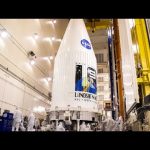
The National Oceanic and Atmospheric Administration (NOAA)’s Joint Polar Satellite System-2 (JPSS-2) is now set for launch Thursday, Nov. 10 at 4:25 a.m. EST (0925 UTC).
The mission will lift off aboard a United Launch Alliance (ULA) Atlas V 401 rocket from Space Launch Complex-3 at Vandenberg Space Force Base in California. JPSS-2 is a new generation polar-orbiting operational environmental satellite system.
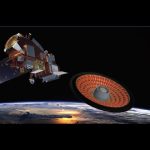
Also aboard the Atlas V 401 rocket will be the secondary payload, NASA’s Low-Earth Orbit Flight Test of an Inflatable Decelerator (LOFTID). LOFTID will demonstrate inflatable heat shield technology for atmospheric entry and re-entry. This technology could enable a variety of proposed NASA missions to destinations such as Mars, Venus, and Titan, as well as returning heavier payloads from low-Earth orbit.
Watch live as scientific investigations on ovarian cell development, climate change’s effects on mudflow structures, a study on how plants adapt to grow space, the first satellites from Uganda and Zimbabwe, and a bioprinter all travel aboard the 18th Northrop Grumman commercial resupply services mission to the International Space Station.
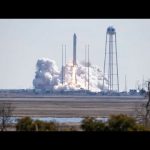
The Cygnus spacecraft, named S.S. Sally Ride in dedication to the first American woman in space, is scheduled for liftoff no earlier than Monday, Nov. 7, 2022, at 5:27 a.m. EST (10:27 UTC) from NASA’s Wallops Flight Facility on Wallops Island, Virginia. The first launch attempt on Nov. 6 was postponed due to a fire alarm at the mission operations control center.
NASA leads provide a news update on the Sept. 3 launch attempt of the #Artemis I flight test.
The launch director waived off the launch at approximately 11:17 a.m. EDT (15:17 UTC). Teams encountered a liquid hydrogen leak while loading the propellant into the core stage of the Space Launch System rocket. Engineers are continuing to gather additional data. Briefing participants include:
NASA Administrator Bill Nelson Jim Free, associate administrator for Exploration Systems Development Mission Directorate, NASA Headquarters Mike Sarafin, Artemis mission manager, NASA Headquarters
Artemis I is the first integrated flight test of the Space Launch System (SLS) and Orion spacecraft that will return humanity to the Moon. As NASA’s most powerful rocket ever built, SLS will launch the uncrewed Orion spacecraft on a six-to-eight-week mission around the Moon and back to Earth. Orion will travel 280,000 miles (450,000 km) from Earth and 40,000 miles (64,000 km) beyond the far side of the Moon, carrying science and technology payloads to expand our understanding of lunar science, technology developments, and deep space radiation.
At 1 p.m. EDT on Monday, Aug. 29, NASA leaders gave an update on the launch of the Artemis I flight test. Following tanking operations, engineers were troubleshooting an issue conditioning one of the RS-25 engines (engine 3) on the bottom of the rocket’s core stage. All engines must reach a proper temperature range before they can be started. Teams are poring through the data and will set a new launch date and time.
Artemis I is the first integrated flight test of the Space Launch System (SLS) and Orion spacecraft that will return humanity to the Moon. As NASA’s most powerful rocket ever built, SLS will launch the uncrewed Orion spacecraft on a six-to-eight-week mission around the Moon and back to Earth. Orion will travel 280,000 miles (450,000 km) from Earth and 40,000 miles (64,000 km) beyond the far side of the Moon, carrying science and technology payloads to expand our understanding of lunar science, technology developments, and deep space radiation.
Managers and engineers from NASA’s Marshall Space Flight Center in Alabama share their thoughts about the Space Launch System (SLS) rocket for #Artemis I. Van L. Strickland, SLS program operations manager; John Blevins, SLS chief engineer; and Sharon Cobb, SLS associate program manager, commend a diverse workforce for its effort and dedication to prepare the backbone of NASA’s return to the Moon. SLS will launch the Orion spacecraft on its mission beyond the Moon and back to Earth. Artemis I is scheduled to launch no earlier than Aug. 29, 2022, at 8:33 a.m. EDT from Kennedy Space Center’s Launch Complex 39B in Florida.
Watch live as our mega Moon rocket launches an uncrewed Orion spacecraft on a six-week mission around the Moon and back to Earth. During #Artemis I, Orion will lift off aboard the Space Launch System (SLS) rocket, and travel 280,000 miles (450,000 km) from Earth and 40,000 miles (64,000 km) beyond the far side of the Moon, carrying science and technology payloads to expand our understanding of lunar science, technology developments, and deep space radiation.
Through Artemis missions, NASA will land the first woman and the first person of color on the Moon, paving the way for a long-term lunar presence and serving as a steppingstone to send astronauts to Mars. We are going.
ESA’s new Vega-C rocket lifted off for its inaugural flight VV21 at 15:13 CEST/13:13 UTC/10:13 local time from Europe’s Spaceport in French Guiana. With new first and second stages and an uprated fourth stage, Vega-C increases performance to about 2.3 t in a reference 700 km polar orbit, from the 1.5 t capability of its predecessor, Vega. For flight VV21, Vega-C’s payload is LARES-2, a scientific mission of @AsiTVit and six research CubeSats from France, Italy and Slovenia.
We are Europe’s gateway to space. Our mission is to shape the development of Europe’s space capability and ensure that investment in space continues to deliver benefits to the citizens of Europe and the world. Check out https://www.esa.int/ to get up to speed on everything space related.
ESA’s new Vega-C rocket lifted off for its inaugural flight VV21 on 13 July 2022 at 15:13 CEST/13:13 UTC/10:13 local time from Europe’s Spaceport in French Guiana. This video features shots of the launch from different angles.
With new first and second stages and an uprated fourth stage, Vega-C increases performance to about 2.3 t in a reference 700 km polar orbit, from the 1.5 t capability of its predecessor, Vega.
For flight VV21, Vega-C’s payload is LARES-2, a scientific mission of the Italian space agency ASI and six research CubeSats from France, Italy and Slovenia.
We are Europe’s gateway to space. Our mission is to shape the development of Europe’s space capability and ensure that investment in space continues to deliver benefits to the citizens of Europe and the world. Check out https://www.esa.int/ to get up to speed on everything space related.
SpaceX’s CRS-25 mission is set to lift off atop a Falcon 9 rocket from launchpad 39-A at the Kennedy Space Center in Cape Canaveral, Florida. Launch is targeted for 8:44 p.m. EDT (00:44 UTC), Friday, July 14. The Dragon spacecraft will deliver new science investigations, supplies, and equipment for the international crew, including an image spectrometer to be mounted on the exterior of the station to better understand how dust plumes affect our climate, and a study of immune aging and potential for reversing those effects. It also will carry an investigation from a team of students at Stanford University that will test the process of creating biopolymer soil composite, a concrete alternative, in microgravity. https://www.nasa.gov/mission_pages/station/research/news/spacex-25-research-highlights
Enjoy the inaugural flight of ESA’s new Vega-C rocket. The principal payload of this flight is LARES-2, a scientific mission of @AsiTV. Also onboard are six European research CubeSats.
We are Europe’s gateway to space. Our mission is to shape the development of Europe’s space capability and ensure that investment in space continues to deliver benefits to the citizens of Europe and the world. Check out https://www.esa.int/ to get up to speed on everything space related.
Enjoy the inaugural flight of ESA’s new Vega-C rocket. The principal payload of this flight is LARES-2, a scientific mission of the @AsiTV. Also onboard are six European research CubeSats.
We are Europe’s gateway to space. Our mission is to shape the development of Europe’s space capability and ensure that investment in space continues to deliver benefits to the citizens of Europe and the world. Check out https://www.esa.int/ to get up to speed on everything space related.
Watch the launch from New Zealand of CAPSTONE, a new pathfinder CubeSat that will explore a unique orbit around the Moon!
The Cislunar Autonomous Positioning System Technology Operations and Navigation Experiment, or CAPSTONE, will be the first spacecraft to fly a near rectilinear halo orbit (NRHO) around the Moon, where the pull of gravity from Earth and the Moon interact to allow for a nearly-stable orbit. CAPSTONE’s test of this orbit will lead the way for our future Artemis lunar outpost called Gateway.
CAPSTONE is targeted to launch at 5:55 a.m. EDT (9:55 UTC) Tuesday, June 28 on Rocket Lab’s Electron rocket from the company’s Launch Complex 1 in New Zealand.
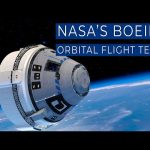
Set to lift off on May 19, 2022, Starliner will launch on NASA’s Boeing Orbital Flight Test-2 (OFT-2) headed for the International Space Station. OFT-2 will test end-to-end capabilities of the Starliner spacecraft and Atlas V rocket from launch to docking to a return to Earth in the desert of the western United States.
Starliner is expected to arrive at the space station for docking about 24 hours after launch with about 500 pounds of NASA cargo and crew supplies. After a successful docking, Starliner will spend five to 10 days aboard the orbiting laboratory before returning to Earth. The spacecraft will return with nearly 600 pounds of cargo, including reusable Nitrogen Oxygen Recharge System (NORS) tanks that provide breathable air to station crew members.
Following a successful completion of OFT-2, NASA and Boeing will determine a launch window for NASA’s Boeing Crew Flight Test, Starliner’s first flight with astronauts aboard.
This is the second uncrewed flight test of the company’s CST-100 Starliner spacecraft for NASA’s Commercial Crew Program.
#Starliner is preparing for liftoff! At 6:54 p.m. EDT (22:54 UTC) on Thursday, May 19, Boeing’s spacecraft launches aboard a United Launch Alliance Atlas V rocket on a demonstration flight that gets it one step closer to certification to carry astronauts to and from the International Space Station.
The Orbital Flight Test-2 (OFT) launch is from Space Launch Complex-41 on Cape Canaveral Space Force Station in Florida. OFT-2 will demonstrate the end-to-end capabilities of the Starliner spacecraft and Atlas V rocket, from launch to docking to a return to Earth in the desert of the western United States. This is the second uncrewed flight test of Boeing’s CST-100 Starliner spacecraft for our Commercial Crew Program.
NASA and SpaceX are targeting 3:52 a.m. EDT Wednesday, April 27, for launch of the agency’s SpaceX Crew-4 mission to the International Space Station from Launch Complex 39A at NASA’s Kennedy Space Center in Florida.
NASA astronauts Kjell Lindgren, Bob Hines, and Jessica Watkins, as well as ESA (European Space Agency) astronaut Samantha Cristoforetti, will launch aboard a Crew Dragon spacecraft atop a SpaceX Falcon 9 rocket. For the latest updates: https://blogs.nasa.gov/commercialcrew/
One of the many milestones in the leadup to the launch of Artemis is its rollout: this is when a crawler will carry the SLS rocket with Orion and ESM from the Vehicle Assembly Building to launchpad 39B. @NASA’s John Giles gives us a tour of the crawler and explains the adaptations made to this “wonderful piece of machinery” since it was first built for the Apollo programme in the 1960s. ESA is playing a key role in NASA’s Artemis programme, which will bring astronauts back to the Moon. The European Service Module – or ESM – will provide propulsion, power and thermal control for the Orion spacecraft.
We are Europe’s gateway to space. Our mission is to shape the development of Europe’s space capability and ensure that investment in space continues to deliver benefits to the citizens of Europe and the world. Check out https://www.esa.int/ to get up to speed on everything space related.
Twenty years ago, on the first of March 2002, ESA launched a new satellite to monitor our planet from space: Envisat. This research mission, which carried 10 instruments, would become a beacon for the development of future Earth observation satellites. In orbit for 10 years, double its projected lifespan, this flagship mission provided science with a wealth of data on the health of our planet and climate change – a treasure trove of data that is still used today. Thanks to the Heritage Space Programme, ESA ensures these precious data are preserved and made accessible for future generations.
We are Europe’s gateway to space. Our mission is to shape the development of Europe’s space capability and ensure that investment in space continues to deliver benefits to the citizens of Europe and the world. Check out https://www.esa.int/ to get up to speed on everything space related.
Embark on a mission with ESA astronomers Mark McCaughrean and Giovanna Giardino to learn more about the James Webb Space Telescope and the early Universe. This programme is suitable for primary and secondary students. Join the quest!
We are Europe’s gateway to space. Our mission is to shape the development of Europe’s space capability and ensure that investment in space continues to deliver benefits to the citizens of Europe and the world. Check out https://www.esa.int/ to get up to speed on everything space related.
Highlights of the launch campaign for the James Webb Space Telescope, from its arrival at Europe’s Spaceport in Kourou, French Guiana, weeks of launch preparations, to launch on board an Ariane 5, and separation of the spacecraft and solar panel deployment.
Now in space and on its way to L2, Webb will undergo a complex unfolding sequence. In the months after, the instruments will be turned on and their capabilities tested. After half a year in space, Webb will start its routine science observations.
Webb will see farther into our origins: from the Universe’s first galaxies, to the birth of stars and planets, to exoplanets with the potential for life, and our own Solar System.
We are Europe’s gateway to space. Our mission is to shape the development of Europe’s space capability and ensure that investment in space continues to deliver benefits to the citizens of Europe and the world. Check out https://www.esa.int/ to get up to speed on everything space related.
Watch the 24th SpaceX cargo resupply mission to the International Space Station lift off from NASA’s Kennedy Space Center.
Launch is targeted for 5:07 a.m. (10:07 UTC). On board are a variety of scientific investigations, including a protein crystal growth study that could improve how cancer treatment drugs are delivered to patients and a handheld bioprinter that could one day be used to print tissue directly onto wounds for faster healing.
There are also experiments from students at several universities as part of the Student Payload Opportunity with Citizen Science (SPOCS) program and an investigation that examines using clothes detergent in microgravity. Dragon will arrive to the space station the following day at about 4:30 a.m. (09:30 EST).
Watch the liftoff of our Laser Communications Relay Demonstration (LCRD) from Cape Canaveral Space Force Station in Florida. The two-hour launch window opens Dec. 5, 2021 at 4:04 a.m. EST.
Laser communications offer data rates higher than traditional radio frequency systems, allowing more data per transmission. Once in orbit, LCRD will demonstrate the benefits of using infrared lasers to communicate information from space, including reduced size, weight, and power requirements for a communications system on a spacecraft. A smaller size means more room for science instruments. Less weight means a less expensive launch. Less power means less drain on the spacecraft’s batteries. All of this enables further exploration.
LCRD is a NASA payload aboard the Department of Defense’s Space Test Program Satellite-6 (STPSat-6). STPSat-6, part of the Space Test Program 3 (STP-3) mission, will launch on a United Launch Alliance Atlas V 551 rocket from the Cape Canaveral Space Force Station in Florida. STP is operated by the United States Space Force’s Space Systems Command.
The launch of our first planetary defense test mission, a new docking module for the space station, and shielding the Orion spacecraft from the heat … a few of the stories to tell you about – This Week at NASA!
ESA astronaut Matthias Maurer and @NASA astronauts Raja Chari, Tom Marshburn and Kayla Barron liftoff to the International Space Station in the @SpaceX Crew Dragon spacecraft “Endurance”.
Collectively known as “Crew-3”, the astronauts were launched from launchpad 39A at @NASAKennedy in Florida, USA at 02:03 GMT/03:03 CET Thursday 11 November.
The spacecraft docked to the International Space Station at 00:32 CET Friday, 12 November/23:32 GMT Thursday, 11 November, marking the official start of Matthias’s first mission ‘Cosmic Kiss’.
Crew-3 will spend around six months living and working aboard the orbital outpost before returning to Earth. It is the first space mission for Matthias, who’s become the 600th human to fly to space. He chose the name “Cosmic Kiss” for his mission as a declaration of love for space.
Matthias has a background in materials science and looks forward to supporting a wide range of science and research in orbit. The work he carries out throughout his mission will contribute to the success of future space missions and help enhance life on Earth.
We are Europe’s gateway to space. Our mission is to shape the development of Europe’s space capability and ensure that investment in space continues to deliver benefits to the citizens of Europe and the world. Check out https://www.esa.int/ to get up to speed on everything space related.
NASA’s SpaceX Crew-3 mission is set to lift off on Wednesday, Nov. 3 at 1:10 a.m. EDT (0510 UTC) from Kennedy Space Center in Florida. Astronauts Kayla Barron, Raja Chari, and Thomas Marshburn of NASA will fly to the International Space Station alongside astronaut Matthias Maurer of the European Space Agency. Once there, the crew of four will spend about six months conducting science experiments and performing maintenance upgrades aboard the orbiting laboratory. For Barron, Chari, and Maurer, this will be their first spaceflight, and the third for Marshburn.
The Crew Dragon ‘Endurance’ spacecraft will dock to the space station on Wednesday, Nov. 3 at 11:00 p.m. EDT (0300 UTC Thursday). Watch continuous coverage of their entire ride, on NASA TV: https://youtu.be/21X5lGlDOfg
Set a reminder: Our Lucy mission is scheduled to launch on Sat., Oct. 16 at 5:34 a.m. EDT (9:34 UTC) to ancient asteroids called Trojans.
The Trojan asteroids are rocky worlds as old as our solar system, and they share an orbit with Jupiter around the Sun. They’re thought to be remnants of the primordial material that formed the outer planets. On Oct. 16, NASA’s Lucy mission is scheduled to launch from Cape Canaveral, Florida, to explore these small worlds for the first time. Lucy was named after the fossilized human ancestor (called “Lucy” by her discoverers) whose skeleton expanded our understanding of human evolution. The Lucy Mission hopes to expand our understanding of solar system evolution by visiting these 4.5-billion-year-old planetary “fossils.”
🚀 Watch the newest #Landsat satellite lift off! This joint NASA-U.S. Geological Survey mission will contribute to the longest data record of Earth’s landscapes taken from space. Landsat 9 continues the nearly 50-year legacy of the Landsat Program: observing our changing home planet, monitoring its land and coastal regions, helping us manage its essential resources, and providing free, publicly available images and data.
Landsat 9 will launch Mon., Sept. 27 at 2:12 p.m. EDT (18:12 UTC) aboard a United Launch Alliance Atlas V rocket from Space Launch Complex 3 at Vandenberg Space Force Base in California. Landsat 9 will join its sister satellite, Landsat 8, in orbit in collecting images from across the planet every eight days.
Join us on Tues., Aug. 10 at 5:30 p.m. EDT (21:30 UTC) for live coverage of the launch of Northrop Grumman’s Antares rocket and Cygnus cargo spacecraft. Liftoff from our Wallops Flight Facility in Virginia is scheduled at 6:01 p.m. EDT (22:01 UTC). This Cygnus is named the SS Ellison Onizuka, in honor of the first Asian American astronaut.
What’s on board the spacecraft? Over 8,200 pounds (3,720 kg) of research, technology demonstrations, and crew supplies for the astronauts living and working on the station. Experiments heading to space will demonstrate 3D printing with dust, use engineered tissue to study muscle loss, analyze growth of slime mold, and more:https://youtu.be/R-jc-dTdK5g
Launching Soon: Starliner will launch on NASA’s Boeing Orbital Flight Test-2 mission headed for the International Space Station. The uncrewed mission will test end-to-end capabilities of the Starliner spacecraft and Atlas V rocket from launch to docking to a return to Earth in the desert of the western United States.
This is the second uncrewed flight test of the company’s CST-100 Starliner spacecraft for NASA’s Commercial Crew Program.
Producer/Editor: Lacey Young Music: Universal Production Music
Starting at 1 p.m. EDT (17:00 UTC), Thurs., June 3, tune in for coverage of the 22nd SpaceX cargo resupply mission to the International Space Station. Liftoff is scheduled at 1:29 p.m. EDT (17:29 UTC) for the Falcon 9 rocket and Cargo Dragon spacecraft from Launch Complex 39A at Kennedy Space Center in Florida.
What’s on board? Science heading to the space station includes an experiment that could help develop better treatments for kidney disease on Earth, and a study of cotton root systems that could identify varieties of plants that require less water and pesticides. A study of bobtail squid will examine the effects of spaceflight on interactions between beneficial microbes and their animal hosts, while another will examine the adaptation of microscopic tardigrades (water bears) to conditions in low-Earth orbit, which could help us better understand stress factors affecting humans in space.
Dragon’s unpressurized trunk section will deliver the first two of six new roll-out solar arrays, based on a design tested on the station in 2017. A robotic arm will extract them and astronauts will install them during a series of spacewalks this summer.
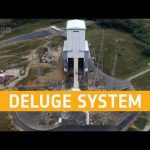
The water deluge system, which is activated at liftoff, was put to the test on the Ariane 6 launch pad at Europe’s Spaceport in April 2021. This is one of the qualification tests to prepare for the arrival of Ariane 6, Europe’s next generation heavy-lift launch vehicle.
Spraying huge volumes of water on the launch pad and beneath the launch table protects both the launch vehicle and its payloads by absorbing and deflecting the tremendous acoustic energy generated at liftoff. Shockwaves created as engine exhaust gases exceed the speed of sound and collide with ambient air cause noise levels to reach 180 decibels.
Three areas are deluged with water during launch, this is done in sequence.
At 20 seconds before liftoff, water sprays over the steel deflector 25 metres below the launch table. This deflector channels the engine exhaust into the two trenches.
At 6 seconds before liftoff, the exhaust tunnel under the launch table is deluged. This channels the engine exhaust below the launch table and into the underground trenches leading away from the launch pad.
Finally, as Ariane 6 lifts off the ground four arrays of pipes around the sides of the launch table will flood the launch pad.
This water also serves to cool and protect the ground installations, mainly the steel launch table.
About 700 cubic metres of water will be released during launch. This comes from the nearby tower which holds 1200 cubic metres of water. After launch it is refilled with water from a nearby lake.
After launch, any remaining water below the launch table is pumped away.
Credits: ESA- @CNES – @arianespace
★ Subscribe: http://bit.ly/ESAsubscribe and click twice on the bell button to receive our notifications.
We are Europe’s gateway to space. Our mission is to shape the development of Europe’s space capability and ensure that investment in space continues to deliver benefits to the citizens of Europe and the world. Check out https://www.esa.int/ to get up to speed on everything space related.
A timelapse from various angles of the launch of @SpaceX Falcon 9 with Crew Dragon Endeavour leaving Earth from Kennedy Space Center in Florida, USA.
The rocket lifted off at 10:49 BST (11:49 CEST, 05:49 local time) on 23 April 2021 from Launchpad 39A in Cape Canaveral with ESA astronaut Thomas Pesquet, @NASA astronauts Megan McArthur and Shane Kimbrough, and @JAXA | 宇宙航空研究開発機構 astronaut Akihiko Hoshide. On 24 April at 11:08 CEST the Crew-2 caught up with the International Space Station and docked with its Harmony module, marking the start of Thomas’ Alpha mission.
Thomas is the first ESA astronaut to fly in space in a vehicle other than the Russian Soyuz or the US Space Shuttle, and the first ESA astronaut to leave Earth from Florida, USA, in over a decade. This is his second flight, his first mission called Proxima saw Thomas fly to the Space Station on a Soyuz from Baikonur in Kazakhstan and his expedition broke records for amount of hours spent on research at the time.
We are Europe’s gateway to space. Our mission is to shape the development of Europe’s space capability and ensure that investment in space continues to deliver benefits to the citizens of Europe and the world. Check out https://www.esa.int/ to get up to speed on everything space related.
Highlights of the launch and first day in space of ESA astronaut Thomas Pesquet on the Alpha mission.
On 24 April at 11:08 CEST the Crew Dragon spacecraft with ESA astronaut Thomas Pesquet, @NASA astronauts Megan McArthur and Shane Kimbrough, and @JAXA | 宇宙航空研究開発機構 astronaut Akihiko Hoshide docked with the International Space Station’s Node-2 Harmony module, marking the start of ESA’s six-month mission Alpha.
The crew spent around 23 hours orbiting Earth and catching up with the International Space Station after their launch on 23 April at 10:49 BST (11:49 CEST, 05:49 local time). The launch to docking went smoothly in Crew Dragon Endeavour.
Thomas is the first ESA astronaut to fly in space in a vehicle other than the Russian Soyuz or the US Space Shuttle, and the first ESA astronaut to leave Earth from Florida, USA, in over a decade. This is his second flight, his first mission called Proxima saw Thomas fly to the Space Station on a Soyuz from Baikonur in Kazakhstan and his expedition broke records for amount of hours spent on research at the time.
We are Europe’s gateway to space. Our mission is to shape the development of Europe’s space capability and ensure that investment in space continues to deliver benefits to the citizens of Europe and the world. Check out https://www.esa.int/ to get up to speed on everything space related.
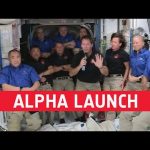
ESA Director General Josef Aschbacher congratulates the Dragon Crew 2 shortly after they enter the Space Station. ESA astronaut Thomas Pesquet, @NASA astronauts Megan McArthur and Shane Kimbrough, and @JAXA-HQ astronaut Akihiko Hoshide arrived at the Station one day after their launch on 23 April at 10:49 BST (11:49 CEST, 05:49 local time).
Thomas is the first ESA astronaut to fly in space in a vehicle other than the Russian Soyuz or the US Space Shuttle, and the first ESA astronaut to leave Earth from Florida, USA, in over a decade. This is his second flight, his first mission called Proxima saw Thomas fly to the Space Station on a Soyuz from Baikonur in Kazakhstan and his expedition broke records for amount of hours spent on research at the time.
We are Europe’s gateway to space. Our mission is to shape the development of Europe’s space capability and ensure that investment in space continues to deliver benefits to the citizens of Europe and the world. Check out https://www.esa.int/ to get up to speed on everything space related.