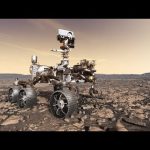
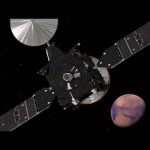
A landing site is selected for our next Mars rover, our InSight mission is in the home stretch of its journey to the Red Planet, and a week of celebration on the space station … a few of the stories to tell you about – This Week at NASA!
This video is available for download from NASA’s Image and Video Library: https://images.nasa.gov/details-NHQ_2018_1123_Landing%20Site%20Selected%20for%20Mars%202020%20Mission%20on%20This%20Week%20@NASA%20%E2%80%93%20November%2023,%202018.html
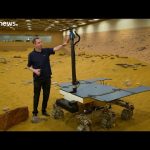
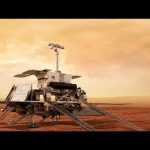
ExoMars is the first mission to head to the Red Planet to seek signs of life, now or in the past. It’s a massive scientific and technical challenge, and Euronews meets some of the team involved in this joint ESA-Roscosmos project in this month’s edition of Space.
ESA is Europe’s gateway to space. Our mission is to shape the development of Europe’s space capability and ensure that investment in space continues to deliver benefits to the citizens of Europe and the world. Check out http://www.esa.int/ESA to get up to speed on everything space related.
Bei der ExoMars-Mission, die nach Leben auf dem roten Planeten sucht, wächst die Spannung: Denn bereits der erste Satellit dieses europäisch-russischen Projekts entdeckte viel mehr Wassereis knapp unter der Marsoberfläche, als irgendjemand erwartet hatte. Jetzt arbeiten die Ingenieure fieberhaft daran, den Rover rechtzeitig zum Start im Jahr 2020 fertigzustellen.
ESA is Europe’s gateway to space. Our mission is to shape the development of Europe’s space capability and ensure that investment in space continues to deliver benefits to the citizens of Europe and the world. Check out http://www.esa.int/ESA to get up to speed on everything space related.
Space fait le point sur l’avancée de la mission ExoMars dont le deuxième volet consistera à envoyer prochainement un rover capable de forer le sol martien à la recherche d’éventuelles traces de vie.
ESA is Europe’s gateway to space. Our mission is to shape the development of Europe’s space capability and ensure that investment in space continues to deliver benefits to the citizens of Europe and the world. Check out http://www.esa.int/ESA to get up to speed on everything space related.
On Monday, Nov. 26, 2018, our InSight spacecraft is set to land on Mars: https://go.nasa.gov/2Qcl8lq. This new documentary from NASA Launch Services follows InSight’s road to launch earlier this year & May 5, 2018 liftoff from Vandenberg Air Force Base, California.
You have heard of astronaut ice-cream? Well, these trick-or-treaters are loaded up with “NASA candy.” Watch as these kids marvel at the special Halloween treats in store for them. Also, as the kids will be doing, check out NASA’s InSight landing on Mars on November 26, 2018, at www.nasa.gov/insight.
A week full of Moon to Mars and more for administrator Bridenstine, seeking ideas for future cargo deliveries to our Gateway, and an oddity of an iceberg … a few of the stories to tell you about – This Week at NASA!
This video is available for download from NASA’s Image and Video Library: https://images.nasa.gov/details-NHQ_2018_1026_Talking%20Moon%20to%20Mars%20and%20more%20on%20This%20Week%20@NASA%20%E2%80%93%20October%2026,%202018.html
A new crew aboard the space station, Curiosity rover’s new science findings on Mars, and – Celebrating 60 years of NASA … a few of the stories to tell you about – This Week at NASA!
This video is available for download from NASA’s Image and Video Library: https://images.nasa.gov/details-NHQ_2018_0608_Curiosity%E2%80%99s%20New%20Mars%20Science%20Results%20on%20This%20Week%20@NASA%20%E2%80%93%20June%208,%202018.html
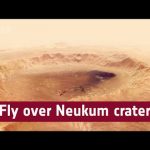
This movie, based on images taken by ESA’s Mars Express, showcases the 102 km wide Neukum Crater in the southern hemisphere of Mars.
The crater is named for the German physicist and planetary scientist, Gerhard Neukum, one of the founders of ESA’s Mars Express mission who inspired and led the development of the high-resolution stereo camera on Mars Express.
This complex impact crater has a diverse geologic history, as indicated by various features on the crater rim and floor. Particularly striking are the dark dune fields, likely made up of volcanic material blown in and shaped by strong winds.
The crater’s shallow interior has been infilled by sediments over its history. It is also marked with two irregular depressions that may be a sign of a weaker material that has since eroded away, leaving behind some islands of more resistant material.
Over time the crater rim has undergone varying degrees of collapse, with landslides and slumped material visible in the crater walls. Many smaller craters have also overprinted the rim and pockmarked the interior since Neukum Crater was formed, highlighting its long history.
Neukum Crater is situated in Noachis Terra, one of the oldest known regions on Mars, dating back to at least 3.9 billion years.
Credits: Animation: ESA/DLR/FU Berlin, CC BY-SA 3.0 IGO; Music: Coldnoise, CC BY-SA 4.0 and Adrian Neesemann
InSight, NASA’s next Mars explorer, has arrived at Vandenberg Air Force Base in California – a big step forward in the countdown to T-zero on May 5, 2018. The spacecraft is called InSight – short for Interior Exploration using Seismic Investigations, Geodesy and Heat Transport – and it’s being tested, fueled and encapsulated for launch aboard the powerful United Launch Alliance Atlas V rocket. The upcoming liftoff will mark the first time an interplanetary mission has launched from the West Coast.
Spacecraft in orbit and on Mars’s surface have made many exciting discoveries, transforming our understanding of the planet and unveiling clues to the formation of our Solar System, as well as helping us understand our home planet. The next step is to bring samples to Earth for detailed analysis in sophisticated laboratories where results can be verified independently and samples can be reanalysed as laboratory techniques continue to improve.
Bringing Mars to Earth is no simple undertaking—it would require at least three missions from Earth and one never-been-done-before rocket launch from Mars.
A first mission, NASA’s 2020 Mars Rover, is set to collect surface samples in pen-sized canisters as it explores the Red Planet. Up to 31 canisters will be filled and readied for a later pickup – geocaching gone interplanetary.
In the same period, ESA’s ExoMars rover, which is also set to land on Mars in 2021, will be drilling up to two meters below the surface to search for evidence of life.
A second mission with a small fetch rover would land nearby and retrieve the samples in a Martian search-and-rescue operation. This rover would bring the samples back to its lander and place them in a Mars Ascent Vehicle – a small rocket to launch the football-sized container into Mars orbit.
A third launch from Earth would provide a spacecraft sent to orbit Mars and rendezvous with the sample containers. Once the samples are safely collected and loaded into an Earth entry vehicle, the spacecraft would return to Earth, release the vehicle to land in the United States, where the samples will be retrieved and placed in quarantine for detailed analysis by a team of international scientists.
A safe return from the International Space Station, a new weather satellite launched into orbit, and our next mission to Mars moves closer to launch … a few of the stories to tell you about – This Week at NASA!
This video is available for download from NASA’s Image and Video Library: https://images.nasa.gov/details-NHQ_2018_0305_Space%20Station%20Crew%20Returns%20Safely%20on%20This%20Week%20@NASA%20%E2%80%93%20March%205,%202018.html
Vice President Mike Pence led the second meeting of the National Space Council, Next Space Station Crew Trains for Launch, and Webb Telescope to Reveal Secrets of Mars … a few of the stories to tell you about – This Week at NASA!
This video is available for download from NASA’s Image and Video Library: https://images.nasa.gov/details-NHQ_2018_0223_The%20Second%20Meeting%20of%20the%20National%20Space%20Council%20on%20This%20Week%20@NASA%20%E2%80%93%20February%2023,%202018.html
A Euronews esteve em Huelva, onde conheceu o Rio Tinto, cujas margens e sedimentos se parecem em todos os aspetos aos do Planeta Vermelho. Um grupo de cientistas procura sinais de vida noutros planetas do nosso sistema solar. E fazem-no com a recolha de amostras dos lugares mais inesperados.
The Rio Tinto river snakes through the Spanish countryside for 100 kilometres, a dark, blood-red stain of acid water and rusty-looking rocks that scientists love to study. Both ESA and NASA experts regularly spend weeks in the Rio Tinto, examining the life underground, and using it as a test bed to look for life on Mars.
NASA’s Kennedy Space Center in Florida hosted a meeting of the National Space Council, chaired by Vice President Mike Pence on Wednesday, Feb. 21. This was the second meeting of the council, which President Trump reestablished last year. “Moon, Mars, and Worlds Beyond: Winning the Next Frontier” included testimonials from leaders in the civil, commercial, and national security sectors about the importance of the United States’ space enterprise.
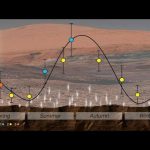
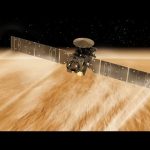
Since arriving at Mars in October 2016, the ExoMars Trace Gas Orbiter has been aerobraking its way into a close orbit of the Red Planet by using the top of the atmosphere to create drag and slow down. It is almost in the right orbit to begin observations – only a few hundred kilometres to go! With aerobraking complete, additional manoeuvres will bring the craft into a near-circular two-hour orbit, about 400 km above the planet, by the end of April. The mission’s main goal is to take a detailed inventory of the atmosphere, sniffing out gases like methane, which may be an indicator of active geological or biological activity. The camera will help to identify surface features that may be related to gas emissions. The spacecraft will also look for water-ice hidden below the surface, which could influence the choice of landing sites for future exploration. It will also relay large volumes of science data from NASA’s rovers on the surface back to Earth and from the ESA–Roscosmos ExoMars rover, which is planned for launch in 2020.
This is NASA’s 2018 ‘To Do’ list.
The work we do, which will continue in 2018, helps the United States maintain its world leadership in space exploration and scientific discovery.
Launches, discoveries and more exploration await in the year ahead.
This video is available for download from NASA’s Image and Video Library:
images-assets.nasa.gov/video/NHQ_2017_1219_NASA 2018 TO DO LIST_FINAL/NHQ_2017_1219_NASA 2018 TO DO LIST_FINAL~orig.mp4
On Oct. 26, Vice President Mike Pence joined our Associate Administrator for Science, Thomas Zurbuchen for a close-up view of the agency’s Mars InSight spacecraft, during a visit to the Littleton, Colorado facilities of Lockheed Martin. InSight is being prepped for a May 2018 launch to the Red Planet, with landing targeted for next November. The mission will study the deep interior of Mars, with a primary goal of helping scientists understand how rocky planets – including Earth – formed and evolved. The vice president also visited a Virtual Reality lab that featured demos of the company’s human exploration efforts, including our Orion spacecraft. Orion will launch on the agency’s Space Launch System rocket, and take humans farther into the solar system than ever before. Also, Interstellar Visitor from Beyond the Solar System, Space Station Crew Talks with Pope Francis, Dawn Finds Possible Ancient Ocean Remnants at Ceres, and Take a Walk on Mars!
This video is available for download from NASA’s Image and Video Library: https://images.nasa.gov/#/details-NHQ_2017_1027_Pence%20Visits%20Mars%20InSight%20Facility%20on%20This%20Week%20@NASA%20%E2%80%93%20October%2027,%202017.html
The Oct. 10th spacewalk outside the International Space Station was the second in less than a week by NASA’s Randy Bresnik and Mark Vande Hei – and one of three U.S. spacewalks planned for October. The astronauts lubricated the new latching end effector they installed on the Canadarm2 robotic arm on Oct. 5. They also replaced a faulty camera system and completed several other tasks. Joe Acaba will join Bresnik for the next spacewalk – currently scheduled for Oct. 20. Also, California Wildfires Seen from Space, NASA Pinpoints Cause of Earth’s Record CO2 Levels, Send Your Name to Mars, Celebrating the First Piloted Supersonic Flight, and Potential Asteroid Warning Network Tested!
This video is available for download from NASA’s Image and Video Library: https://images.nasa.gov/#/details-NHQ_2017_1013_October%20Spacewalks%20Aboard%20the%20Space%20Station%20on%20This%20Week%20@NASA%20%E2%80%93%20October%2013,%202017.html
On 18 September 2017, ESA astronaut Paolo Nespoli shot this beautiful time-lapse showing the Moon rising above the Earth’s horizon together with Mercury, Mars, the star Regulus, and Venus.
ESA astronaut Paolo Nespoli is currently working and living on board the International Space Station as part of his long duration Vita mission.
Visions and clips from ESA’s future for human spaceflight and robotic exploration. Exploring is about visiting new places and coming back with new experiences and knowledge to help us on Earth.
Our strategy includes three destinations where humans will work with robots to gather new knowledge: low-Earth orbit on the International Space Station, the Moon – our closest neighbour, and our third destination Mars.
The exploration programme includes Europe’s service module for NASA’s Orion spacecraft around the Moon, a landing on the Moon with Roscomos’ Luna lander and ESA’s Exomars rover on Mars.
A deep-space gateway farther afield than the International Space Station is considered as a springboard for exploration beyond the Moon.
NASA helped the town of Mars, Pennsylvania ring in the Martian New Year, May 5-6. Citizens of the town, just north of Pittsburgh, invited the agency to help celebrate Mars New Year, which happens about every two Earth years. Activities included two days of science, technology, engineering, arts and mathematics or (STEAM) activities, to encourage young people to pursue careers in these fields of study, which are critical to NASA’s journey to Mars.
2016 has been an eventful and promising year for ESA’s ExoMars mission. After successfully placing the Trace Gas Orbiter into Mars’ orbit on 19 October, the orbiter has sent back its first images, tested its instruments and performed in orbit calibration measurements and health checks.
The Schiaparelli lander collected almost all of its expected data before its unexpected crash landing on the Martian surface. Crucial lessons will be learnt from this for the recently approved 2020 ExoMars mission, which will put Europe’s first rover on Mars.
The precise cause of the lander loss is still being investigated but preliminary technical investigations have found that the atmospheric entry and slowing down in the early phases went exactly as planned.
In all, since its launch in March 2016, the ExoMars mission has been a mixture of successes and one unexpected set back. Looking ahead, the Trace Gas Orbiter will start aerobraking in March 2017 to gradually slow down over the following months. By the end of 2017, the orbiter will be in a lower, near circular orbit of 400 kms and ExoMars’ primary science mission can begin.
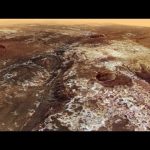
This movie, based on images taken by ESA’s Mars Express, highlights Mawrth Vallis, a 600 km-long, 2 km-deep outflow channel at the boundary of the southern highlands and the northern lowlands of Mars.
The movie begins at the mouth of the channel in Chryse Planitia, and heads towards the apparent source region in the Arabia Terra highlands.
The 4 billion year-old plateau is characterised by many impact craters, indicative of its great age.
Zooming in, patches of light and dark deposits are revealed. The light-toned layered sediments are among the largest outcrops of clay minerals – phyllosilicates – on Mars. Their presence indicates the presence of liquid water in the past.
The variety of water-bearing minerals and the possibility that they might contain a record of an ancient, habitable environment on Mars led scientists to propose Mawrth Vallis as a candidate landing site for the ExoMars 2020 mission.
The animation is based on a colour mosaic and digital terrain model derived from data collected by the high-resolution stereo camera on Mars Express and released earlier this year.
Scientists and engineers on the ExoMars project had their hearts in their mouths as the ExoMars mission reached the red planet, with the Schiaparelli probe going missing in action at the end of its descent just as the TGO mothership swept into a perfectly timed orbit.
The rollercoaster ride of arrival at Mars is the first installment in this ambitious Russian and European project that aims for the first time to directly search for signs of life on Mars.
The plight of Schiaparelli remains unclear. It is certainly on the Martian surface, but may well have hit the red dust much harder then engineers had planned, and nothing has been heard from it since.
Data relayed during the lander’s descent shows the initial high-speed entry to the Martian atmosphere went well, with the heatshield slowing the craft and the parachute deploying. However once the back heat shield and parachute were ejected the flow of events did not go to plan.
Visualisation of the ExoMars Schiaparelli module entering and descending through the atmosphere to land on Mars. The animation follows a simulated timeline of the module, starting when it enters the atmosphere at an altitude of 121 km at 14:42 GMT. In six minutes it will use a heatshield, parachute and thrusters to brake from 21 000 km/h to a near standstill 2 m above the surface, where a crushable structure on its underside will absorb the final shock.
The key operational milestones are highlighted in the animation at the predicted times at which they have been calculated to occur. However, the actual times may vary depending on the atmospheric conditions on the day, the final path through the atmosphere and the speed at which the module descends.
The times indicated in the animation are onboard spacecraft times at Mars. The one-way signal travel time on 19 October is just under 10 minutes, meaning that signals relayed by spacecraft at Mars are received on Earth about 10 minutes after the event itself has happened on the Red Planet.
Both Schiaparelli and the Mars scenery in this animation are computer-generated.
An Oct. 11 opinion article written by President Barack Obama and published by CNN, outlined a vision for the future of space exploration. In it, the president echoed the words in his 2015 State of the Union address about the importance of sending humans on a roundtrip mission to Mars by the 2030s, and developing technology to help us stay on the Red Planet for an extended time. That same day in a blog post, NASA Administrator Charlie Bolden and John Holdren, assistant to the President for Science and Technology, discussed two NASA initiatives that build on the president’s vision and use public-private partnerships to enable humans to live and work in space in a sustainable way. The first was the selection of six companies to develop habitation systems as part of the agency’s Next Space Technologies for Exploration Partnerships or “NextSTEP” program, designed to lay the groundwork for deep space missions. And this fall as part of the second initiative, NASA will start the process of providing companies with a potential opportunity to add their own modules and other capabilities to the International Space Station. The move is in-line with NASA’s plan to support and foster the growing community of scientists and entrepreneurs conducting research and growing businesses in space. Also, White House Frontiers Conference, Kennedy Reopens After Hurricane Matthew, Orion Service Module Vibration Tests, SLS Liquid Hydrogen Fuel Tank Completed, and Aviation Safety Reporting System Turns 40!
On 16 October, seven months and 500 million km after launching from Baikonur in Kazakhstan, the joint European and Russian ExoMars 2016 mission reaches a crucial phase.
The Trace Gas Orbiter will release its Schiaparelli lander for a three day coast and a six minute descent to the Martian surface.The lander, which was designed to demonstrate technologies for entry, descent and landing on Mars, is heading for the Meridiani Planum. This is an area that is currently being studied by NASA’s Opportunity rover and Europe’s Mars Express orbiter.
On 19 October, the Schiaparelli lander will be activated a few hours before reaching the Martian atmosphere, when it will be travelling at some 21 000 km/h. The front heatshield – covered with 90 insulating tiles – will be subjected to temperatures of up to 1500 degrees Celsius.
This video covers the separation, descent and landing procedures, as well as the orbiter’s critical burn to avoid crashing on the surface of Mars.
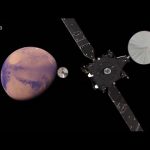
Three days before arriving at Mars on 19 October 2016, the ExoMars Trace Gas Orbiter (TGO) will release its entry, descent and landing demonstrator, Schiaparelli, towards the Red Planet. ExoMars is several missions in one. Its orbiter is a science and relay mission. The TGO will search for evidence of gases, such as methane, that may be associated with geological or biological processes. The Schiaparelli lander is a technology demonstrator to test key technologies for future missions to Mars.
The landing site is an elliptical region close to the equator about 100 km long and 15 km wide in the planet’s Meridiani Planum area. It is relatively flat, smooth and well studied as NASA’s Opportunity rover is on the ground and ESA’s Mars Express spacecraft, which will also act as one of the data relay orbiters, has been overhead since 2003.
This video covers the landing and orbital manoeuvres, including the use of aerobraking – which ESA is using for the first time at Mars.
Visualisation of the ExoMars Schiaparelli module entering and descending through the martian atmosphere to land on Mars.
Schiaparelli will enter the atmosphere at about 21 000 km/h and in less than six minutes it will use a heatshield, a parachute and thrusters to slow its descent before touching down in the Meridiani Planum region close to the equator, absorbing the final contact with a crushable structure.
The entire process will take less than six minutes: the animation has been sped up.
Schiaparelli is set to separate from the Trace Gas Orbiter on 16 October, after a seven-month cruise together through space, and will enter the atmosphere on 19 October at 14:42 GMT.
Følg Paxi til randen av solsystemet, oppdag kometenes verden og lær om det fantastiske Rosetta har på kometen 67P/Churyumov-Gerasimenko.
I videoen, som retter seg mot barn mellom 6–12 år, tar Paxi barna med seg for å oppdage kometer og Rosetta – det fantastiske ESA-romfartøyet som flyr langs kometen 67P/Churyumov-Gerasimenko. 12.11.2014 skal det prøve å slippe en lander på denne.
Videoen er den tredje i en serie av animasjoner hvor Paxi, ESAs utdannelsesmaskot, kommer i kontakt med forskjellige sider ved solsystemet, universet, jordens hemmeligheter og mye mer.
Följ med Paxi på hans resa till den röda planeten för att undersöka om det finns marsmänniskor och lär dig samtidigt om europeiska rymdsamarbetets ExoMars-projekt.