Here’s a classic science demonstration that is sure to wake you up… and the people down the street… and every dog in the neighborhood! With a little practice and some science know-how, you’ll turn an ordinary piece of aluminum rod into a singing virtuoso.
A rusted iron ball bearing seems like it might be past its prime, as far as uses go. Thankfully, all you need to do is wrap one of the bearings in some aluminum foil. You’re almost ready to create a thermite reaction. BANG!
We’ll admit, we take a little bit of offense when someone says, “Snow only comes in white.” Apparently, they’ve never seen the Rainbow Snow activity. If you’ve ever played with our Insta-Snow® powder, especially with our Color Fizzers, you know exactly how superabsorbent polymers can create a colorful blizzard of the most realistic fake snow out there.
Sugar is delicious, sweet and… perfect for creating colorful, beautiful ornaments? This holiday season, grab a bag of Imperial Sugar or Dixie Crystals granulated sugar and mix yourself a supersaturated solution. Don’t know how to make a supersaturated solution? We’ll teach you! Once you’ve learned the science behind Sugar Crystal Ornaments, you’re tree, house, or classroom will have some of the most awesome (and scientific) ornaments around.
Sugar is tasty, but it can also be beautiful. Learn about awesome science like crystallization while creating a delicious and colorful treat! Stained Glass Sugar takes a tried and true recipe for sugar glass and creates vibrant, edible stained glass. The recipe is simple and easy, but by the end you’ll have made sugar glass that’s awesome enough for use on a movie set!
Food always tastes better when it’s homemade, and the same is true for ice cream. We went out and got some brown sugar from Imperial Sugar and Dixie Crystals to concoct a tasty ice cream creation. You can make your own ice cream, too! With the easy-to-follow steps below, you’ll have Brown Sugar Homemade Ice Cream in less than 30 minutes!
You’ve let your friend in on a secret: you bought some magical Imperial Sugar or Dixie Crystals sugar cubes. Seriously! This Sugar Cube Magic will blow the socks off of your friends. Have your friend pick a number between 1 and 10, then write it on the sugar cube. From there, it’s a fun experience in misdirection and magic as you dissolve the sugar cube in water!
Discovering density has never been more colorful, or fun! The Sugar Rainbow is a creative and engaging method of teaching about how different densities will stack atop each other. There’s even an additional lesson about adhesion and cohesion! Combine gorgeous colors and awesome science with a little bit of sugar and water!
Many people have wondered exactly how a Magic Pumpkin is created. Well, sorry to burst your bubble, but the secret it animation. It’s a cartoon. Want to create your own illustrated Magic Pumpkin? Check out the amazing Magic Pumpkin designed by our team of scientists. It’s an activity that will have you spinning… literally!
Steve Spangler is a celebrity teacher, science toy designer, speaker, author and an Emmy award-winning television personality. Spangler is probably best known for his Mentos and Diet Coke geyser experiment that went viral in. Spangler is the founder of www.SteveSpanglerScience.com, a Denver-based company specializing in the creation of science toys, classroom science demonstrations, teacher resources and home for Spangler’s popular science experiment archive and video collection. Spangler is a frequent guest on the Ellen DeGeneres Show and Denver 9 News where he takes classroom science experiments to the extreme. For teachers, parents or DIY Science ideas – check out other sources of learning:
There’s nothing better than having a bowl full of worms without the hassle of digging them out of the ground… and all by using fascinating polymer science. Now our worm-ologists have made an exciting new kind of Insta-Worms that are heat sensitive! You won’t believe your eyes as temperature changes the appearance of this special kind of Insta-Worms.
This activity will prove that Mom was right… “Wash your hands with soap and warm water!” A Petri dish prepared with nutrient agar (a seaweed derivative with beef nutrients) is an ideal food source for the bacteria you’ll be growing. In this experiment, Steve Spangler collected samples from items around the office – you will not believe what he found.
Science staples involve things that go boom and things that blast off. With the Ping Pong Popper kids’ science experiment, you’ll take both the booming and blasting to new, hands-on levels. You get to construct popper toy and learn about combustion!
Drop one weight into the tube and, no surprise here, the weight drops to the ground with a thud. Go figure… it’s gravity at work! The second weight might bend your mind a little, though. Drop this weight into the aluminum tube and… wait… why didn’t it come out the bottom? Give it a second, that weight just takes a while longer, but figuring it out may be a bit tricky. That’s why we call it Newton’s Nightmare!
Air pressure is one of our favorite invisible forces, especially when Bernoulli’s Principle is involved. The Soda Can Jump utilizes this awesome principle to launch an empty soda can out of a coffee mug. It’s a hands-on experience in physics that you won’t want to miss.
When it comes to scientific muses, Sir Isaac Newton is definitely near the top of our list. Our favorite laws to break involve physics, movement, and motion! That’s why we came up with the Coin Tower demonstration. Using a butter knife, you’ll remove the bottom coin from an entire tower of coins. What’s the secret? Perform the project to find out!
Graffiti Research Lab first introduced us to the awesome throwie idea, and we loved it. Ever since, we’ve been playing around with the idea of using light-emitting diodes (LED) and throwies as a great hands-on method to teaching science. You can do it, too, and we’ll show you how!
Notebooks are a necessity in every science setting. Graphs, observations, procedures… all of science falls by the wayside without a way of recording the information. Here’s a fun fact: two notebooks are even better than one! When you intertwine two notebooks, page by page, they become Inseparable Books! Check out this hands-on activity and see if you can overpower the friction between the books!
You’ve seen Steve use a giant smoke ring launcher made from a modified trash can, but there’s a way you can construct a smaller version at home! Using an empty coffee container and a smoke bomb, you’ll be creating swirling vortexes of smoke in under 10 minutes. In addition to the awesome smoke ring launcher you’ll have, you will also gain a new understanding of the movement of air and vortexes!
If you’ve ever needed to clean a coin like a nickel or a dime, you might have used vinegar. That’s a perfect combination, unless you forget to dry the vinegar off of the coin! With the Colorful Coins activity, you’ll see how there is more to a shiny nickel or dime that initially meets the eyes.
You may have seen your favorite circus performers or magicians perform the classic Bed of Nails Trick… but what is the secret? Using a smaller version of the bed and a clear balloon, you can see the science behind the trick.
When you swing a bucket of water over your head, you probably expect a big, wet rush of water to soak you as the bucket goes upside down. However, if you were swinging the bucket fast enough, nothing happens. What in the world?!? Well, we have a pretty incredible physics demonstration to help you understand just why you remain dry. It’s called the Centripetal Force Board, and it will help you experience the physics and forces at play when three plastic cups of water leave you high, dry, and with new hands-on science topics in mind.
One balloon is blown up inside of another when you use a magnifying glass to focus light onto their surfaces. You expect the balloons to pop, but only the balloon on the inside bursts. What’s going on here? The Mystery Balloon Pop is a tremendous lesson in the power of the sun’s rays and the absorption of light and heat. Did we mention you’re popping balloons for science? Get started!
Science is often referred to as the most fun subject in school, but it can be the most delicious subject, too! When you create Homemade Rock Candy, you’ll be diving “string-first” into a science experiment and project that easy enough to do right at home! Young scientists will engage with principles like sedimentation and supersaturated solutions. How tasty does that sound?
We’ve found a method to take our famous Naked Egg experiment to a new level. By dropping your Naked Eggs into Karo corn syrup or water, you’ll witness eggs that have the strange ability to grow and shrink. It’s all an investigation into chemical reactions and permeability that is fun and engaging.
Amuse the neighbors for hours as you make objects float in midair. Believe it or not, the secret to this mystery of levitation is right in front of your nose. All you’ll need is a hairdryer and a ping pong ball to experience the power of air.
When Sick Science! first got its start, we introduced an experiment called the Color Mixing Wheel. This spinning science toy was a great way to show you what happens when the primary colors blend together to make secondary colors. Our Sick Scientists have taken it a step further. What happens when you spin a wheel that has all 6 primary and secondary colors?
The human body is a magnificent machine. Every part serves a purpose that seems to work like magic (except maybe the appendix). The more science discovers and understands about the human body, the more opportunities we have to replicate their processes. With the Homemade Lung science project, you’ll learn how you can replicate a working lung with household objects. You’ll have a blast recreating this bodily function, and you don’t have to give up a lung to do it!
Kaleidoscopes are an incredible tool for witnessing the effects of refracting light, but putting your own kaleidoscope together can be a pain. We’ve simplified the process using our famous Rainbow Peepholes. Witness a literal rainbow of colors when you build your own kaleidoscope with the Homemade Kaleidoscope experiment.
White flowers are beautiful, and so are pink flowers, but what if you could have flowers that changed from white to pink and back again? That’s exactly what happens with the Magic Color Changing Flowers. The chemistry behind these magnificent flowers will boggle your mind and create stunning visuals that will have you, and your audience, wanting to repeat the process all day.
A bottle balances precariously on it’s mouth. Nothing special, right? Well… put a dollar bill underneath the bottles mouth. Now, bet your friends a dollar that they can’t pull the dollar out from under the bottle without knocking it over. Sit back and enjoy their futile attempts as friend after friend knocks the bottle over. What’s the secret? Read on to find out!
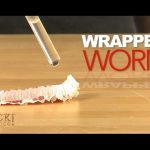
You can have a ton of science fun with a straw. You can make it into a blow gun, using the properties of air, or it can double as a pipette when your lab has run out. But did you know you can perform some awesome hands-on science with the straw’s wrapper, too? It’s true. With the Wrapper Worm, we’ll reveal how to turn an ordinary straw wrapper into a growing worm!
Plug the drain, fill the sink with water, and take the plunge with Steve Spangler’s floating science challenge. We all know that certain things float in water while other things sink, but why? Do all heavy things sink? Why does a penny sink and an aircraft carrier float? Think you know the answers? Well, get ready for a few amazing surprises!