Tag: Space Science

  • Catching speeding stars

    Catching speeding stars

    This video reveals the evolution of stars in our Galaxy over the past million of years.

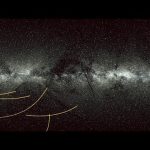
    It starts from the positions of stars in the sky 1 035 000 years ago, which were calculated using data from the Tycho-Gaia Astrometric Solution, or TGAS, one of the products of the first Gaia data release. The video follows the evolution of stellar positions until the present day, ending with a view of the sky as measured by Gaia between 2014 and 2015.

    Highlighted in yellow are the trajectories of six special stars: these are hypervelocity stars, moving through the Galaxy at several hundred of km/s. While it might not be apparent from the video, which shows the motions of stars as projected on the sky, they are moving through space much faster than the galactic average.

    Scientists spotted these speeding stars from the TGAS data set of two million stars with the help of an artificial neural network – software that mimics a human brain – and they are looking forward to finding many more in future Gaia data releases.

    These stars owe their high speeds to past interactions with the supermassive black hole that sits at the centre of the Milky Way and, with a mass of four million Suns, governs the orbits of stars in its vicinity. Having travelled great distances through the Galaxy, they provide crucial information about the gravitational field of the Milky Way from the centre to its outskirts.

    One of the six stars (labelled 1 at the end of the video) seems to be speeding so fast, at over 500 km/s, that it is no longer bound by the gravity of the Galaxy and will eventually leave. The other five stars are somewhat slower (over 400 km/s for the stars labelled 2, 3, 4 and 6, and 360 km/s for the star labelled 5) and are still bound to the Galaxy.

    These slightly slower stars are perhaps even more fascinating, as scientists are eager to learn what slowed them down – the invisible dark matter that is thought to pervade the Milky Way might also have played a role.

    The stars are plotted in Galactic coordinates and using a rectangular projection: in this, the plane of the Milky Way stands out as the horizontal band with greater density of stars. The stripes visible in the final frames reflect the way Gaia scans the sky and the preliminary nature of the first data release; these artefacts are gradually washed out in the video as stars move across the sky.

    Read more on our website:
    Artificial brain helps Gaia catch speeding stars –
    http://www.esa.int/Our_Activities/Space_Science/Gaia/Artificial_brain_helps_Gaia_catch_speeding_stars

    More about Gaia:
    http://sci.esa.int/gaia/

    Credit: ESA/Gaia/DPAC CC BY-SA 3.0 IGO: https://creativecommons.org/licenses/by-sa/3.0/igo/
  • The future of the Orion constellation

    The future of the Orion constellation

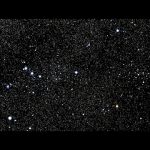
    This video reveals how our view of the Orion constellation will evolve over the next 450 000 years.

    Amid a myriad of drifting stars, the shape of Orion as defined by its brightest stars is slowly rearranged into a new pattern as time goes by.

    The portion of the sky depicted in the video measures 40 x 20º – as a comparison, the diameter of the full Moon in the sky is about half a degree.

    The video is based on data from ESA’s Gaia and Hipparcos satellites, as well as additional information from ground-based observations.

    A speeded-up version of the video is available here: http://sci.esa.int/gaia/59209

    Full story: The future of the Orion constellation http://www.esa.int/Our_Activities/Space_Science/Gaia/The_future_of_the_Orion_constellation

    The evolution of two million stellar positions on the entire sky is shown here: https://www.youtube.com/watch?v=87lgSRVUSxM

    Copyright: ESA/Gaia/DPAC CC BY-SA 3.0 IGO: https://creativecommons.org/licenses/by-sa/3.0/igo/

  • The motion of two million stars

    The motion of two million stars

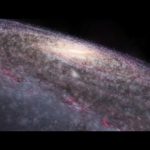
    This video reveals the changing face of our Galaxy, tracing the motion of two million stars five million years into the future using data from the Tycho-Gaia Astrometric Solution, one of the products of the first Gaia data release. This provides a preview of the stellar motions that will be revealed in Gaia’s future data releases, which will enable scientists to investigate the formation history of our Galaxy.

    The stars are plotted in Galactic coordinates and using a rectangular projection: in this, the plane of the Milky Way stands out as the horizontal band with greater density of stars.

    The video starts from the positions of stars as measured by Gaia between 2014 and 2015, and shows how these positions are expected to evolve. The frames in the video are separated by 750 years, and the overall sequence covers five million years. The stripes visible in the early frames reflect the way Gaia scans the sky and the preliminary nature of the first data release; these artefacts are gradually washed out in the video as stars move across the sky.

    The shape of the Orion constellation can be spotted towards the right edge of the frame, just below the Galactic Plane, at the beginning of the video. As the sequence proceeds, the familiar shape of this constellation (and others) evolves into a new pattern. Two stellar clusters – groups of stars that were born together and consequently move together – can be seen towards the left edge of the frame: these are the alpha Persei (Per OB3) and Pleiades open clusters.

    More about this video:
    http://sci.esa.int/gaia/59004-two-million-stars-on-the-move/

    Credit: ESA/Gaia/DPAC CC BY-SA 3.0 IGO: https://creativecommons.org/licenses/by-sa/3.0/igo/
  • Juice’s journey to Jupiter

    Juice’s journey to Jupiter

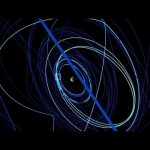
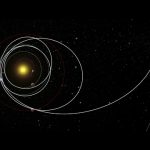
    This animation shows the proposed trajectory of ESA’s Jupiter Icy Moons Explore (Juice) mission to Jupiter.

    Based on a launch in June 2022, the spacecraft will make a series of gravity-assist flybys at Earth (May 2023, September 2024 and November 2026), Venus (October 2023) and Mars (February 2025) before arriving in the Jupiter system in October 2029.

    The animation ends at the Jupiter orbit insertion point, but the planned 3.5 year mission will see Juice not only orbit Jupiter, but also make dedicated flybys of the moons Europa, Callisto and Ganymede, before orbiting the largest moon, Ganymede.

    More about Juice:
    http://sci.esa.int/juice/

  • Gaia: The Visualisation of Gaia Data

    Gaia: The Visualisation of Gaia Data

    André Moitinho – Lisbon University

    Presentation recorded during the first Gaia data workshop at ESA’s European Space Astronomy Centre (ESAC) 2-4 November 2016.

    The slides to this presentation are available here: http://www.cosmos.esa.int/documents/915837/915858/Moitinho_visualisation_v2.pdf

  • Gaia: Science-driven introduction to the archive

    Gaia: Science-driven introduction to the archive

    Alcione Mora – ESA

    Presentation recorded during the first Gaia data workshop at ESA’s European Space Astronomy Centre (ESAC) 2-4 November 2016.

    The slides to this presentation are available here:
    http://www.cosmos.esa.int/documents/915837/915858/2016_11_02_dr1Workshop_AlcioneMora.pdf

  • Gaia: Mission Overview

    Gaia: Mission Overview

    Timo Prusti – ESA

    Presentation recorded during the first Gaia data workshop at ESA’s European Space Astronomy Centre (ESAC) 2-4 November 2016.

    The slides to this presentation are available here:
    http://www.cosmos.esa.int/documents/915837/915858/20161102_Gaia_TPrusti_web.pdf

  • ESA Euronews: Τα «παγωμένα» μυστικά του Πλούτωνα

    ESA Euronews: Τα «παγωμένα» μυστικά του Πλούτωνα

    Αυτόν τον μήνα η εκπομπή το Space σας μεταφέρει στα απώτερα όρια του ηλιακού μας συστήματος, στον Πλούτωνα.

    Αποδεικνύεται πολύ πιο εξωτικός από ότι θα περίμενε κανείς, με πολλά είδη ανεξήγητων φαινομένων στην επιφάνειά του.

    Η εκπομπή Space συνάντησε μερικούς από τους κορυφαίους εμπειρογνώμονες της Ευρώπης στον πάγο για να μάθει περισσότερα για τα μυστικά του.

    Ο Πλούτωνας αποτελούσε μυστήριο για την ανθρωπότητα από τότε που ανακαλύφθηκε, το 1930.

    Αρχικά είναι χαρακτηριστεί ως πλανήτης. Το 2006 αναθεωρήθηκε η άποψη αυτή και ονομάστηκε πλανήτης- νάνος του ηλιακού μας συστήματος.

  • ESA Euronews: Plútó – a rejtélyes törpebolygó

    ESA Euronews: Plútó – a rejtélyes törpebolygó

    A Plútóról 2015-ben készített részletes felvételeket a New Horizons űrszonda, ezek a felvételek felbolygatták a tudományos közösséget. A törpebolygó több a furcsaságot tartogat, mint arra bárki számított, felszínén olyan jelenségek zajlanak, amire egyelőre nincs magyarázatunk. A fenti videóban a téma legjobb európai szakértői beszélnek arról, mit tudunk a Plútóról, és miértérdekes ez a probléma tudományos szempontból.

    A Plutó 1930-as felfedezése óta rejtély volt az emberiség számára. Először bolygónak nevezték, 2006-ban átsorolták a törpe-bolygók közé. Minél többet tudunk meg róla, annál jobban megragadja tudósok fantáziáját.

  • BepiColombo status

    BepiColombo status

    BepiColombo, Europe’s first mission to Mercury, is currently being put through its paces at ESA’s European Space Research and Technology Centre (ESTEC) in the Netherlands. Mechanical and vibration tests will get underway in April with a view to a launch in October 2018. BepiColombo will arrive at Mercury, the smallest planet in our Solar System, in December 2025.

    The ESA-led joint European and Japanese mission consists of two spacecraft – the Mercury Planetary Orbiter (MPO) and the Mercury Magnetospheric Orbiter (MMO) – as well as a sunshield and a Mercury Transfer Module, which will power its seven year journey using its solar electric propulsion engine. It will be a mission of further discovery after NASA’s Messenger spacecraft uncovered a number of surprises – including evidence of water ice at the closest planet to the Sun and a magnetic dipole field.

    This video covers the mission status as well and its plan to follow up on Mercury’s unexpected features and properties. It includes an interview with Johannes Benkhoff, ESA BepiColombo project scientist.

    More about BepiColombo on our website: http://www.esa.int/Our_Activities/Space_Science/BepiColombo_overview2

  • ESA Euronews: Hunting Earth-like exoplanets

    ESA Euronews: Hunting Earth-like exoplanets

    In this edition of Space, Euronews correspondent Jeremy Wilks reports from the Observatory of Geneva – home to experts in exoplanets, the name given to planets outside our solar system.

    So far they have managed to find more than 3500, but they believe there could be literally billions of them across the Milky Way.

    The first exoplanet to be discovered was what’s known as a hot Jupiter, a giant gas planet orbiting close to its star. That discovery, made by University of Geneva professor Michel Mayor in 1995, kick-started a revolution in astronomy, one which at the time of our interview put the number of exoplanets at 3559 and counting.

    This video is also available in the following languages:
    French https://www.youtube.com/watch?v=0BzHpdyp3wY />German https://www.youtube.com/watch?v=_RQjMsL5RM4 />Italian https://www.youtube.com/watch?v=iiwWd932k-Y />Spanish https://www.youtube.com/watch?v=To-sKEx2kgY />Portuguese https://www.youtube.com/watch?v=YloRlQQS-eU />Hungarian https://www.youtube.com/watch?v=Ki_Cuz-Vjzo />Greek https://www.youtube.com/watch?v=mA-ymp2ZvbE

  • ESA Euronews: Voyage au coeur du mystère des exoplanètes

    ESA Euronews: Voyage au coeur du mystère des exoplanètes

    Dans Space, Jérémy Wilks vous emmène ce mois-ci à l’observatoire de Genève, la “maison” des experts en exoplanètes, ces planètes qui sont en dehors de notre système solaire. A ce jour, 3.559 d’entre elles ont été découvertes, mais les scientifiques pensent qu’il en existe des millions dans la Voie Lactée.

    La première exoplanète qui a été découverte est une planète géante gazeuse similaire à Jupiter, en orbite autour de son étoile. Cette découverte, faite en 1995 par le professeur Michel Mayor de l’Université de Genève, a donné le coup d’envoi d’une révolution en astronomie. Une révolution qui part de l’existence prouvée d’une exoplanète, à la découverte de 3.559 exoplanètes aujourd’hui.

  • ESA Euronews: Vadászat az emberiség lehetséges következő otthonára

    ESA Euronews: Vadászat az emberiség lehetséges következő otthonára

    Az exobolygók, vagyis a Naprendszeren kívüli bolygók keresése azon az emberi álmon alapszik, hogy a homo sapiens valaha elhagyhatja a Földet, és új hazát fog keresni. A bolygókat megtalálni azonban rendkívül nehéz, hiszen nem bocsátanak ki fényt, és olyan messze vannak, hogy a legerősebb távcsővel sem láthatók. Ezért sokáig a létezésükre sem volt bizonyíték.

    Az első felfedezett exobolygó egy hatalmas gázbolygó volt, a genfi egyetemi professzor, Michel Mayor és csapatának 1995-ös felfedezése forradalmat hozott a csillagászatban. Húsz év alatt egyetlen exobolygótól eljutottunk 3599-ig.

  • First data from ESA’s Gaia mission

    First data from ESA’s Gaia mission

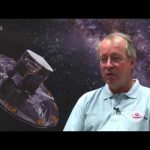
    Launched in December 2013, Gaia is destined to create the most accurate map yet of the Milky Way.

    By making accurate measurements of the positions and motions of roughly 1% of the total population of stars in the Milky Way, it will answer questions about the origin and evolution of our home galaxy.

    The first intermediate data release, containing, among other things, three-dimensional positions and two dimensional motions of a subset of two million stars, demonstrates that Gaia’s measurements are as precise as planned, paving the way to create the full map of one billion stars to be released towards the end of 2017.

    Find out more about Gaia:
    http://www.esa.int/gaia

  • From the Solar System to the Hyades cluster

    From the Solar System to the Hyades cluster

    A virtual journey, from our Solar System through the Milky Way, based on data from the first release of ESA’s Gaia satellite.

    The journey starts by looking back at the Sun, surrounded by its eight planets. We then move away from the Sun and travel towards and around the Hyades star cluster, the closest open cluster to the Solar System, some 150 light-years away.

    The 3D positions of the stars shown in the animation are drawn from the Tycho-Gaia Astrometric Solution (TGAS), which combines information from Gaia’s first year of observations with the earlier Hipparcos and Tycho-2 Catalogues, both based on data from ESA’s Hipparcos mission.

    This new dataset contains positions on the sky, distances and proper motions of over two million stars. It is twice as precise and contains almost 20 times as many stars as the previous reference for astrometry, the Hipparcos Catalogue.

    The journey continues showing the full extent size of the stars contained in the Tycho-Gaia Astrometric Solution, all relatively near to the Sun, in the overall context of our Milky Way galaxy.

    The final Gaia catalogue will contain the most detailed 3D map ever made of the Galaxy, charting a billion stars – about 1% of the Milky Way’s stellar content – to unprecedented accuracy.

    For more information about Gaia, visit: http://www.esa.int/gaia

    Credit: ESA/Gaia/DPAC; Acknowledgement: S. Jordan & T. Sagristà Sellés (Zentrum für Astronomie der Universität Heidelberg)

  • Rosetta’s journey around the comet

    Rosetta’s journey around the comet

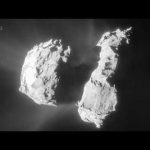
    Animation visualising Rosetta’s two-year journey around Comet 67P/Churyumov–Gerasimenko.

    The animation begins on 31 July 2014, during Rosetta’s final approach to the comet after its ten-year journey through space. The spacecraft arrived at a distance of 100 km on 6 August whereupon it gradually approached the comet and entered initial mapping orbits that were needed to select a landing site for Philae. These observations also enabled the first comet science of the mission. The manoeuvres in the lead up to, during and after Philae’s deployment on 12 November are seen, before Rosetta settled into longer-term science orbits.

    In February and March 2015 the spacecraft made several flybys. One of the closest flybys triggered a ‘safe mode’ event that forced it to retreat temporarily until it was safe to gradually draw closer again. The comet’s increased activity in the lead up to and after perihelion in August 2015 meant that Rosetta remained well beyond 100 km distances for several months.

    In June 2015, contact was restored with Philae again – albeit temporary, with no permanent link able to be maintained, despite a series of dedicated trajectories flown by Rosetta for several weeks.

    Following perihelion, Rosetta performed a dayside far excursion some 1500 km from the comet, before re-approaching to closer orbits again, enabled by the reduction in the comet’s activity. In March–April 2016 Rosetta went on another far excursion, this time on the night side, followed by a close flyby and orbits dedicated to a range of science observations.

    The animation finishes at 9 August 2016, before the details of the end of mission orbits were known. A visualisation of the trajectories leading to the final descent to the surface of the comet on 30 September will be provided once available.

    The trajectory shown in this animation is created from real data, but the comet rotation is not. An arrow indicates the direction to the Sun as the camera viewpoint changes during the animation.

  • Once upon a time… Rosetta’s second year at the comet

    Once upon a time… Rosetta’s second year at the comet

    Rosetta describes the exciting discoveries she made during her second year at Comet 67P/Churyumov-Gerasimenko, after the comet made its closest approach to the Sun along its orbit. She also tells us about her efforts to contact Philae, and starts counting down to her own mission finale.

    This video is available in the following languages:
    English https://www.youtube.com/watch?v=lxdDx8frN_Y
    Spanish https://www.youtube.com/watch?v=zM-ZJBinuBk
    French https://www.youtube.com/watch?v=bFF1izh10PM
    Italian https://www.youtube.com/watch?v=3aS1pgOU8Gs
    German https://www.youtube.com/watch?v=ne_PvPJZYL4

  • ESA Director General marks Asteroid Day 2016

    ESA Director General marks Asteroid Day 2016

    ESA Director General Jan Woerner sends a message to mark Asteroid Day 2016, an annual global movement to increase public awareness of potential asteroid impacts with Earth, and the importance of guarding against them. It is held each year on 30 June, the anniversary of the largest impact in recent history, the 1908 Tunguska event in Siberia.

  • Rosetta status

    Rosetta status

    Rosetta has another three months of science to collect before its historic mission comes to an end. But the mission is not resting on its laurels. It has just broken a new record by flying an orbit 7 kms from the comet’s centre – just 5 kms from the surface – and there are more breathtaking manoeuvres to come.

    This film describes the orbits that Rosetta will undertake around comet 67P/Churyumov-Gerasimenko, the changes in the amount of gas coming off the comet, and examines the importance of finding phosphorus and glycine – an amino acid that is essential for life.

    It also discusses the mission’s most recent discoveries of Xenon and Krypton, together with most of their isotopes. These noble gases were detected by the ROSINA instrument during the period when Rosetta was flying extremely close to the comet. More important science is expected to be released during the next few months.

    More about Rosetta:
    http://blogs.esa.int/rosetta

  • LISA Pathfinder results

    LISA Pathfinder results

    Launched in December 2015, LISA Pathfinder travelled to its operational orbit, 1.5 million km from earth towards the Sun, where it started its scientific mission on 1 March.

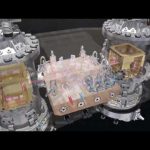
    At the core of the spacecraft, two identical gold-platinum cubes, are being held in the most precise free-fall ever produced in space.

    Placing the test masses in a motion subject only to gravity is the challenging condition needed to build and operate a future space mission to observe gravitational waves. Predicted by Albert Einstein a century ago, gravitational waves are fluctuations in the fabric of space-time, which were recently detected directly for the first time by the Laser Interferometer Gravitational-Wave Observatory.

    Over the first two months of scientific operations, the LISA Pathfinder team has performed a number of experiments on the test masses to prove the feasibility of gravitational wave observation from space.

    These results are explained in this video with interviews of Paul McNamara, LISA Pathfinder Project scientist, ESA and two LISA Pathfinder Principal investigators : Rita DOLES, University of Trento and Martin Hewitson, University of Hannover.

    Read more in LISA Pathfinder exceeds expectations: http://www.esa.int/Our_Activities/Space_Science/LISA_Pathfinder_exceeds_expectations

  • ExoMars is on its way

    ExoMars is on its way

    After a successful launch from Kazakhstan’s Baikonur Cosmodrome in March, the ExoMars spacecraft is making good progress on its 500 million km trip to Mars.

    The joint European and Russian mission will perform science, test lander and descent technology, and may help solve the mystery of why there is methane on Mars. The gas could indicate a geological origin or past or present life – most likely from microbes. The mission carries four scientific packages with Russia developing one of the three spectrometers on board the orbiter’s Atmospheric Chemistry Suite.

    This film provides an update of ExoMars’ journey. It includes the first test image from the Trace Gas Orbiter’s high-resolution camera and looks ahead to a major course correction manoeuvre in July. The spacecraft will then be lined up for arrival at Mars on 19 October 2016.

    Includes interviews with Thomas Passvogel, Head of Science Projects, ESA (English); Oleg Korablev, ACS Experiment Principal Investigator (Russian); Nicolas Thomas, CaSSIS Experiment Principal Investigator, University of Bern (English).

    More about ExoMars:
    http://www.esa.int/exomars

  • ESA’s Asteroid Impact Mission: the reason why

    ESA’s Asteroid Impact Mission: the reason why

    ESA’s Asteroid Impact Mission, currently under study for launch in 2020 and arrival in 2022, would be humanity’s first probe to a double asteroid system. Targeting an approximately 180-m diameter asteroid – around the same size as the Great Pyramid of Giza – AIM would spend a busy six months gathering data on its surface and inner structure.

    It would then perform before-and-after measurements as the NASA-led Double Asteroid Redirection Test spacecraft impacts straight into it, in an attempt to change the asteroid’s orbital period – marking the very first time that humanity shifts a Solar System object in a measurable way. Success would make it possible to consider carrying out such an operation again if an incoming asteroid ever threatened our planet. The two missions combined are called the Asteroid Impact & Deflection Assessment, or ‘AIDA’ for short.

    But why do we need to plan such a ground-breaking experiment? Astrophysicist and Queen guitarist Brian May, ESA astronaut Luca Parmitano, the UK’s Astronomer Royal Sir Martin Rees and Canadian astronaut Chris Hadfield share their own thoughts.

    For more information on AIM and AIDA, go to http://www.esa.int/AIM

  • The art of AIM

    The art of AIM

    ESA’s Asteroid Impact Mission and the US Double Asteroid Redirection Test together make up AIDA – the Asteroid Impact and Deflection Assessment (AIDA), a pioneering planetary defence test that will attempt to shift the orbit of an asteroid in 2022. Artist Didi Rodan performed a unique depiction of this initiative in sand, a highlight of a recent conference on AIM hosted by the GMV company in Madrid.

    Credit: ESA/GMV-Didi Rodan

  • LISA Pathfinder prepares for liftoff (4K timelapse replay)

    LISA Pathfinder prepares for liftoff (4K timelapse replay)

    This timelapse video shows the preparations for LISA Pathfinder’s launch at Europe’s Spaceport in Kourou, French Guiana. The video spans three weeks, starting on 12 November 2015 with the completed and fuelled spacecraft and ending on the 3 December launch day.

    Over this period, the spacecraft was attached to the payload adaptor of the Vega launcher, encapsulated within the half-shells of the rocket fairing, transferred to the launcher assembly area, and installed on top of Vega inside the mobile gantry, which was rolled back shortly before liftoff.

    LISA Pathfinder will test key technologies for space-based observation of gravitational waves – ripples in the fabric of spacetime that are predicted by Albert Einstein’s general theory of relativity.

    Credit/Copyrights: Directed by Stephane Corvaja, ESA; Edited by Manuel Pedoussaut, Zetapress; Music: Hubrid-Gravity

  • ESA Euronews: CubeSat, a satellite in a shoe box

    ESA Euronews: CubeSat, a satellite in a shoe box

    Tiny satellites the size of a small cube, jam-packed with the most advanced nanotechnologies: is this the future of Space missions?

    To find out, ESA Euronews went to Tallin, Estonia, where students at the Mektory Space Centre are preparing the launch of their first nanosatellite.

    Nanosatellites – tiny cubes of 10cm x 10cm x 10cm, full of nanotechnologies — are going to be more and more important in the future of space exploration, from Mars missions, to the surveillance of asteroids, which could potentially be dangerous for our planet.

    Also known as ‘CubeSats’ these tiny satellites open up a whole world of possibilities for those who want to explore space.

    This video is also available in the following languages:
    French: https://www.youtube.com/watch?v=RFVJ0ZGW2nI
    German: https://www.youtube.com/watch?v=rOdjO5bhoiU
    Italian: https://www.youtube.com/watch?v=5cP0baTNDYo
    Spanish: https://www.youtube.com/watch?v=NlZSt0WfMTo
    Portuguese: https://www.youtube.com/watch?v=6tM5AXZtY18
    Greek: https://www.youtube.com/watch?v=WIIVLxcOlT0
    Hungarian: https://www.youtube.com/watch?v=XAlfhpzadWc

  • ESA Euronews: De mi az a nanoműhold?

    ESA Euronews: De mi az a nanoműhold?

    A nanoműholdak egyre fontosabbak lesznek az űrkutatásban, a Mars megfigyelésétől a Földre veszélyt jelentő aszteroidák felkutatásáig. A bennük rejlő potenciált mindenki igyekszik kiaknázni, a nagy űrügynökségektől a tudományos diákkörökig. Ez a helyzet a Mektory Űrközpontban, az észt főváros, Talinn műszaki egyetemén, ahol a diákok az első nanoműholdjuk Föld körüli pályára állítását készítik elő.

    – Azt hittem, soha nem fogok műholdat építeni, hiszen ilyesmit csak a NASA-nál csinálnak. Most meg műholdat építek az egyetemi laborban – hitetlenkedett az Euronewsnak Marta Hang, az űrközpont programasszisztense.

    A Mektory nanoműhold-programja egy nemzetközi egyetemi kezdeményezés, amelyben az oktatók és a hallgatók együttműködnek az űrkutatásban érdekelt és más technológiai cégekkel. A cél az, hogy felkészítsék a hallgatókat arra, hogy az űriparban helyezkedjenek el. A csapat jelenleg az első űrküldetését tervezi.

    – Egy kockaműholdat fejlesztünk, amely egy egységből áll, és távérzékelési célokat szolgál, vagyis képeket készít majd a Földről – magyarázza a Mektory Űrközpont igazgatója, Mart Vihmand.

  • Inside LISA Pathfinder, with narration

    Inside LISA Pathfinder, with narration

    ESA’s LISA Pathfinder mission is a technology demonstrator that will pave the way for future spaceborne gravitational-wave observatories. It will operate about 1.5 million km from Earth towards the Sun, orbiting the first Sun–Earth ‘Lagrangian point’, L1.

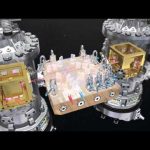
    The animation of the spacecraft build-up begins with two freely falling test masses. Between them lies the central component of LISA Pathfinder’s payload: the 20 x 20 cm optical bench interferometer. A set of 22 mirrors and beam-splitters directs laser beams across the bench. There are two beams: one reflects off the two free-falling test masses while the other is confined to the bench. By comparing the length of the different paths covered by the beams, it is possible to monitor changes accurately in distance and orientation between the two test masses.

    A box surrounds the two masses without touching them, shielding them from outside influence and constantly applying tiny adjustments to its position. This internal payload is housed in a central cylinder, isolating the test masses from the other components of the science payload and spacecraft.

    The solar array provides power to the instrumentation and acts as a thermal shield. Microthrusters control the spacecraft to keep the master test mass centred in its housing, opposing the force of the solar radiation pressure – the main source of ‘noise’ – impinging on the solar array.

    Although LISA Pathfinder is not aimed at the detection of gravitational waves themselves, it will prove the innovative technologies needed to do so. It will demonstrate that the two independent masses can be monitored as they free-fall through space, reducing external and internal disturbances to the point where the relative test mass positions would be more stable than the expected change caused by a passing gravitational wave, equal to much less than the size of an atom.

    Animated sequence without narration: Inside LISA Pathfinder: https://www.youtube.com/watch?v=YyZJ1JC_URc

    More about LISA Pathfinder: http://sci.esa.int/lisa-pathfinder/

  • ESA – Space to Relax / Fly with Samantha to…

    ESA – Space to Relax / Fly with Samantha to…

    ESA astronaut Samantha Cristoforetti photographs stunning Earth images of Lufthansa worldwide destinations during her Futura mission onboard the ISS. An ESA for Lufthansa inflight film.

    Music by Jeff Woodall.

    Images: ESA/NASA.

  • LISA Pathfinder launch animation

    LISA Pathfinder launch animation

    Artist’s impression of the launch of LISA Pathfinder, ESA’s technology demonstration mission that will pave the way for future gravitational-wave observatories in space.

    Scheduled to lift off on a Vega rocket from Europe’s Spaceport in French Guiana in late 2015, LISA Pathfinder will operate at the Lagrange point L1, 1.5 million km from Earth towards the Sun. After launch, the spacecraft will take about eight weeks to reach its operational orbit around L1.

    The Vega rocket is designed to take small payloads into low-Earth orbit. The animation shows the rocket shortly after launch, rising above our planet and releasing the fairing.

    Vega will place the spacecraft onto an elliptical orbit with perigee at 200 km, apogee at 1540 km and angled at about 6.5° to the equator. Then, LISA Pathfinder will continue on its own, using its separable propulsion module to perform a series of six manoeuvres and gradually raise the apogee of the initial orbit.

    Eventually, LISA Pathfinder will cruise towards its final orbiting location, discarding the propulsion system along the way, one month after the last burn. Once in orbit around L1, the spacecraft will begin its six months of operations devised to demonstrate key technologies for space-based observation of gravitational waves.

    More about LISA Pathfinder:
    http://www.esa.int/Our_Activities/Space_Science/LISA_Pathfinder_overview

    Credit: ESA/ATG medialab

  • ESAHangout: Rosetta mission’s day in the Sun

    ESAHangout: Rosetta mission’s day in the Sun

    A Google hangout with Rosetta mission experts to celebrate perihelion – the closest point to the Sun along the comet’s orbit – which occurred on the morning of on 13 August 2015.

    Joining our host Emily Baldwin (ESA Space Science Editor) were:
    Nico Altobelli – Acting Rosetta Project Scientist, ESAC
    Michael Küppers – Rosetta Science Operations Coordinator, ESAC
    Sylvain Lodiot – Rosetta Spacecraft Operations Manager, ESOC
    Armelle Hubault – Rosetta spacecraft operations engineer, ESOC
    Barbara Cozzoni – Philae Lander engineer, DLR
    Holger Sierks – OSIRIS Principal Investigator, MPS
    Joel Parker – Alice instrument Deputy-PI, SwRI
    Colin Snodgrass – Professional ground-based observing campaign coordinator, Open University
    Aurelie Moussi-Soffys – Science activities manager SONC (Philae)

    Date: 13 August 2015
    Time: 15:00-17:00 CEST (13:00-15:00 GMT)

    Background info on perihelion: http://www.esa.int/Our_Activities/Space_Science/Rosetta/Rosetta_preparing_for_perihelion

    #Perihelion2015 #Rosetta #hangoutsonair

  • ESA Euronews: Empieza la construcción del telescopio óptico-infrarrojo más grande del mundo

    ESA Euronews: Empieza la construcción del telescopio óptico-infrarrojo más grande del mundo

    Esta zona remota del desierto de Atacama, en Chile, es famosa porque aquí no hay nada. No hay agua, ni plantas, ni animales. Esto hace que sea un lugar perfecto para un proyecto realmente innovador, el Telescopio Europeo Extremadamente Grande, E-ELT.

    Credits: ESA/Euronews

  • ESA Euronews: Um Telescópio Extremamente Grande para um Universo Infinito

    ESA Euronews: Um Telescópio Extremamente Grande para um Universo Infinito

    O deserto de Atacama, no Chile é famoso por não ter nada – não tem água, nem plantas, nem animais. O que faz dele o local perfeito para acolher projeto verdadeiramente inovador, a construção do E-ELT, o European Extremely LargeTelescope ou o Telescópio Europeu Extremamente Grande.

    Credits: ESA/Euronews

  • ESA Euronews: E-ELT: Das riesige Teleskop soll unbekannte Gebiete des Universums erforschen

    ESA Euronews: E-ELT: Das riesige Teleskop soll unbekannte Gebiete des Universums erforschen

    Das E-ELT ist ein europäisches Projekt, um das weltweit größte optische Infrarot-Teleskop zu bauen. Die bahnbrechende Konstruktion in der Atacamawüste in Chile wird ferne Exoplaneten mit einer nie gekannten Detailschärfe untersuchen.

    Credits: ESA/Euronews

  • ESA Euronews: E-ELT : le télescope européen de l’extrême

    ESA Euronews: E-ELT : le télescope européen de l’extrême

    Dans le désert d’Atacama au Chili, la construction du Télescope géant européen, l’E-ELT est entrée dans sa phase concrète avec la création d’une plate-forme au sommet d’une montagne à 3000 mètres d’altitude. C’est là que cet instrument optique / infrarouge le plus grand au monde sera mis en service au début de la prochaine décennie. Ses performances permettront notamment d’en savoir plus sur les exoplanètes et éventuellement, de faire avancer la vaste quête vers une autre forme de vie.

    Credits: ESA/Euronews

  • ESA Euronews: E-ELT: Europe’s extreme new telescope

    ESA Euronews: E-ELT: Europe’s extreme new telescope

    Work is underway to build the E-ELT, a telescope that could one day find signs of life on distant planets. With a 39-metre mirror, it will be the world’s biggest optical and infrared telescope.

    Other languages available:
    Italian: http://youtu.be/vrQZEBOWqsM
    French: http://youtu.be/5enycnYuVR8
    German: http://youtu.be/sCTKGGmHp2s
    Spanish: http://youtu.be/_0jcfXKxjLI
    Greek: http://youtu.be/e1y3FNZK9h0
    Portuguese: http://youtu.be/ZX-srt2dlr8
    Hungarian: http://youtu.be/nGyRcuk4ydk

    Credits: ESA/Euronews

  • ESA – Space to Relax / Earth & Mars: 2 Planets, 1 Blueprint

    ESA – Space to Relax / Earth & Mars: 2 Planets, 1 Blueprint

    Watch landscapes easily blend from one world to the other in this gallery of Earth and Mars images taken from space.

    Images: ESA/DLR/FU Berlin
    Music: Crystals licensed by Ambient Music Garden.

  • ESA – Space to Relax / MagISStra City Views: Photos by Paolo Nespoli

    ESA – Space to Relax / MagISStra City Views: Photos by Paolo Nespoli

    A breathtaking collection of photos taken by ESA Astronaut Paolo Nespoli during his 6-month MagISStra mission on the International Space Station 25 December 2010 – 24 May 2011.

    Music: Dream Elements by Green Sun licensed by Ambient Music Garden.
    Video produced for Lufthansa inflight entertainment (released June 2011).

  • The ISS: a work in progress!

    The ISS: a work in progress!

    Highlights of ESA astronaut Christer Fuglesang’s 14-day Alissé mission to the International Space Station between 29 August and 12 September 2009. Fuglesang was part of the seven-strong STS-128 crew launched to the ISS with Space Shuttle Discovery. STS-128 delivered new supplies and equipment to the ISS. The crew also performed three spacewalks to continue Station construction.

  • ESA astronauts working on the ISS

    ESA astronauts working on the ISS

    ESA astronauts Frank De Winne and Christer Fuglesang met up on the International Space Station in September 2009. Fuglesang was visiting the ISS during his 14-day Alissé mission. De Winne, on his six-month OasISS mission, was already on the ISS as part of the resident ISS Expedition 20 crew.