ESA project astronaut Marcus Wandt took off on 18 January 2024 as part of the Axiom-3 crew for a 14-day mission to the International Space Station. After 36 hours catching up to the Space Station, the Dragon docked to the Space Station, the seal between the two tested and finally Marcus started his Muninn mission as he entered the International Space Station. ESA astronaut Andreas Mogensen along with the rest of the crew of Expedition 70 was waiting to welcome them to space!
Follow Marcus’s journey on the Muninn website, check our launch kit and connect with him on his Instagram and X accounts.
We are Europe’s gateway to space. Our mission is to shape the development of Europe’s space capability and ensure that investment in space continues to deliver benefits to the citizens of Europe and the world. Check out https://www.esa.int/ to get up to speed on everything space related.
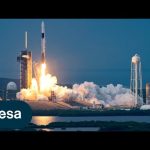
ESA project astronaut Marcus Wandt launched together with the rest of the Axiom-3 crew at 23:11 CET on 17 January 2024, from launch pad 39A, NASA’s Kennedy Space Center, Florida, USA.
Marcus will start his Muninn mission when he enters the International Space Station on Saturday 20 January, where he will spend up to 14 days conducting science and testing technology that can one day help people on Earth.
Follow Marcus’s journey on the Muninn website, check our launch kit and connect with him on his Instagram and X accounts.
We are Europe’s gateway to space. Our mission is to shape the development of Europe’s space capability and ensure that investment in space continues to deliver benefits to the citizens of Europe and the world. Check out https://www.esa.int/ to get up to speed on everything space related.
The launch of ESA project astronaut Marcus Wandt to the International Space Station on Axiom Mission 3 (Ax-3). Marcus’s mission is called Muninn.
A SpaceX Falcon 9 rocket will lift off from launch pad 39A at NASA’s Kennedy Space Center in Florida, USA, on 18 January 2024. Marcus will fly as a mission specialist on the Dragon spacecraft. The other Axiom 3 crew members are Walter Villadei from Italy and Alper Gezeravcı from Türkiye. They will fly under the command of Michael López-Alegría, representing both USA and Spain as a dual-citizen.
Marcus is the first of a new generation of European astronauts to fly on a commercial human spaceflight opportunity with Axiom Space. His mission is supported by ESA and the Swedish National Space Agency (SNSA).
During his two-week mission, Marcus will devote much of his time to scientific activities and technology demonstrations that could shape the way we live and work on Earth. In total, he will run around 20 experiments.
Marcus Wandt was selected in November 2022 as a member of the ESA astronaut reserve after a year-long selection process. The 2022 ESA recruitment campaign received over 22 5000 applications from across its Member States.
Timestaps of the video: 00:00:00 – 02:10:44 – Pre-Launch programme 02:10:45 – 02:35:38 – Liftoff
Follow Marcus’s journey on the Muninn website, check our launch kit and connect with him on his Instagram and X accounts.
We are Europe’s gateway to space. Our mission is to shape the development of Europe’s space capability and ensure that investment in space continues to deliver benefits to the citizens of Europe and the world. Check out https://www.esa.int/ to get up to speed on everything space related.
From the International Space Station to Earth, ESA astronaut Andreas Mogensen talks about what kind of person his fellow Scandinavian and ESA project astronaut Marcus Wandt is. The Axiom-3 mission with Marcus onboard is planned to launch in mid-January 2024 to the International Space Station for a 14-day mission, where Marcus will join Andreas, marking the first time two Scandinavians are in space together.
Credits: ESA – European Space Agency
★ Subscribe: http://bit.ly/ESAsubscribe and click twice on the bell button to receive our notifications.
We are Europe’s gateway to space. Our mission is to shape the development of Europe’s space capability and ensure that investment in space continues to deliver benefits to the citizens of Europe and the world. Check out https://www.esa.int/ to get up to speed on everything space related.
19 years ago, on 25 December 2004, ESA’s Huygens probe was released from the Cassini spacecraft. Huygens continued on to Titan, Saturn’s largest and most interesting moon, descending via parachute and touching-down at 11:30 UTC, 14 January 2005. The descent phase lasted around 2 hours, 27 minutes, with a further 1 hour and 10 minutes of operation on the surface.
This video has been accelerated to 200% speed, showing the descent from an altitude of 62 km at 9:41 UTC to the touchdown.
As 2024 kicks into gear, we invite you to look ahead with ESA and see what awaits us in the coming 12 months.
After Ariane 5’s retirement in 2023, Europe’s new and versatile heavy-duty launcher Ariane 6 will continue the Ariane legacy of excellence and reliability. After years of development and construction, Ariane 6 will be ready for its first flight from Europe’s Spaceport in Kourou.
In 2024, we’ll see a return-to-flight for Vega-C. Vega-C will continue to provide Europe with its own affordable lightweight launcher. Together both projects guarantee Europe’s independent access to space.
We also continue to collaborate internationally with NASA on the Artemis lunar programme. This Spring, another European Service Module, ESM-3, for the third Artemis mission will be shipped to the United States for mating with its Orion capsule.
In 2024, Proba-3 will be launched, the first precision formation-flying mission. The Coronagraph and Occulter spacecraft will fly together forming a 144 m coronagraph studying the Sun’s corona closer to the solar rim than ever before.
At the beginning of the year, the first scientific data gathered by our latest space telescope, Euclid, will be revealed. Euclid was designed to explore the composition and evolution of dark matter and dark energy.
Another exciting mission that will launch later in 2024 is the Hera mission. This mission will fly to the binary asteroid system of Dimorphos and Didymos to observe the aftermath of the impact made by NASA’s Dart mission.
In Earth observation, there are several satellites ready to be launched: the ESA/JAXA mission EarthCARE mission, the Arctic Weather Satellite mission and the European Union’s Copernicus Sentinel-1C and Sentinel-2C satellites.
2024 will bring new developments as well for Galileo: two more first-generation satellites are to be launched in April, followed by two more later in the year. These will expand the constellation and help guarantee Galileo’s optimal performance. Meanwhile, the first hardware deliveries will take place for the second-generation Galileo satellites.
The five career astronauts from the 2022 astronaut class will finish their basic training this year and then be ready for mission assignments.
For Swedish project astronaut Marcus Wandt, there is no such wait. In January, he will be launched to the Space Station as a mission specialist on the Axiom-3 commercial mission – just time to catch up in space with his Danish colleague, ESA astronaut Andreas Mogensen, who is scheduled to return to Earth after a six-month stay on the Space Station in February.
Credits: ESA – European Space Agency
★ Subscribe: http://bit.ly/ESAsubscribe and click twice on the bell button to receive our notifications.
We are Europe’s gateway to space. Our mission is to shape the development of Europe’s space capability and ensure that investment in space continues to deliver benefits to the citizens of Europe and the world. Check out https://www.esa.int/ to get up to speed on everything space related.
For 40 years, ESA has been shaping the future in space, while delivering crucial access to space for Europe. That work continues, as brand-new rockets are set to take flight: some reusable, some carbon-neutral, with hybrid propulsion, two and three stages, small, large, crewed and uncrewed, to Earth orbit and deep space, the journey continues.
All of these missions are currently in development in Europe and will ensure our continued ability to explore beyond our own home, while looking back to learn more about it.
This, is the future of space exploration.
★ Subscribe: http://bit.ly/ESAsubscribe and click twice on the bell button to receive our notifications.
We are Europe’s gateway to space. Our mission is to shape the development of Europe’s space capability and ensure that investment in space continues to deliver benefits to the citizens of Europe and the world. Check out https://www.esa.int/ to get up to speed on everything space related.
Embark on a cosmic journey with ESA as we explore the universe through the lens of ‘One Million’. From the scorching temperatures of the Sun’s corona to the cosmic gaze of the NASA/ESA/CSA James Webb Space Telescope — discover the astronomical wonders that surround us. 🚀
🎉 Join our space community in celebrating a momentous occasion — 1 MILLION subscribers on YouTube! 🌟 Thank you for your enthusiasm and support. ✨
★ Subscribe: http://bit.ly/ESAsubscribe and click twice on the bell button to receive our notifications.
We are Europe’s gateway to space. Our mission is to shape the development of Europe’s space capability and ensure that investment in space continues to deliver benefits to the citizens of Europe and the world. Check out https://www.esa.int/ to get up to speed on everything space related.
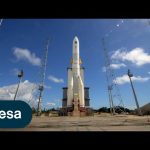
Teams across Europe and at Europe’s Spaceport in French Guiana, have been tirelessly conducting a test campaign that will, in 2024, end with the first launch of Europe’s newest heavy-lift rocket, Ariane 6.
In the summer, the mobile gantry was rolled back at the launchpad, revealing the huge rocket to the elements. Then, the main stage’s Vulcain 2.1 engine roared into life in a series of ‘hot fire’ tests for the rocket and entire ground system, including tank filling rehearsals, countdowns, vibration-damping water systems and more.
Tests continued on the upper-stage reignitable Vinci engine and Auxiliary Power Unit at the German Aerospace Center (DLR) test site in Lampoldshausen.
Very soon, tests will be complete, and Europe’s heavy-lift rocket will take flight.
★ Subscribe: http://bit.ly/ESAsubscribe and click twice on the bell button to receive our notifications.
We are Europe’s gateway to space. Our mission is to shape the development of Europe’s space capability and ensure that investment in space continues to deliver benefits to the citizens of Europe and the world. Check out https://www.esa.int/ to get up to speed on everything space related.
Ten years ago, on 19 December 2013, our billion star-mapping satellite Gaia launched.
Since then, Gaia has been scanning the sky and gathering an enormous amount of data on the positions and motions of 1.8 billion stars, enabling discoveries about the history of our galaxy.
Gaia is creating an extraordinarily precise three-dimensional map of more than a billion stars throughout our Milky Way galaxy and beyond, mapping their motions, luminosity, temperature and composition.
This huge stellar census will provide the data needed to tackle an enormous range of important questions related to the origin, structure and evolutionary history of our galaxy.
Gaia’s catalogue is ever-growing containing data on stars and other cosmic objects such as galaxies, exoplanets, and binary stars. Here’s to more discoveries!
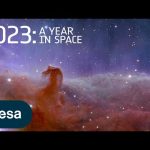
2023’s highlight was the highly anticipated launch of Juice, Europe’s Jupiter Icy Moon Explorer. The Juice spacecraft was placed on course to Jupiter on the second-to-last Ariane 5 launch vehicle in April. After an eight-year journey, Juice will begin observing the giant gas planet and its three large ocean-bearing moons – Ganymede, Calisto and Europa.
The Euclid space telescope was launched in July with the aim of unravelling the enigmas of ‘dark matter’ and ‘dark energy’. Euclid’s first images were released in November, revealing razor-sharp astronomical images with detail never before seen by a telescope across such a large patch of the sky.
After almost five years in space, ESA’s Aeolus wind mission was retired. This trailblazing mission was tasked with observing wind patterns from space thereby improving weather forecasts and climate models.. Aeolus data and technology will have an important role to play in the accuracy of future weather forecasting. On 28 July, it burned up in an assisted re-entry – the first assisted re-entry by a mission which was not designed to do so.
As space debris becomes an increasingly serious issue, ESA is determined to search for solutions. Together with its commercial and institutional partners, ESA has developed the ‘Zero Debris Charter’, launched this year. By signing the Charter, space entities worldwide can register their intent to work together towards the sustainable use of Earth’s orbital environment.
Earlier in in 2023, MTG-I1, the first of the Meteosat Third Generation missions, sent back its first images. The satellite was launched in 2022 and carries two instruments: a flexible combined imager and a lighting imager. Both instruments performed beyond expectation and a stunning combined image from both was revealed.
Earth observation is key to keeping our planet and the population as a whole, safe. Today, monitoring earthquakes, forest fires or flooding from space already helps to coordinate rescue response but the data can also be used to better understand phenomena such as climate change and support the IPCC climate reports.
Last year, NASA’s Dart mission impacted on a small moonlet of the asteroid Didymos, changing its course. We’ll soon be launching ESA’s Hera spacecraft to collect data on the aftermath of this collision. The Hera spacecraft was integrated and underwent testing this year in ESA ESTEC’s test centre in the Netherlands.
2023 also saw the first hardware tests for the second generation of Galileo satellites but even more importantly the Galileo High Accuracy Service was launched in January. This new service delivers centimetre accuracy from space further cementing Galileo’s reputation as the most accurate satellite navigation system in the world.
★ Subscribe: http://bit.ly/ESAsubscribe and click twice on the bell button to receive our notifications.
We are Europe’s gateway to space. Our mission is to shape the development of Europe’s space capability and ensure that investment in space continues to deliver benefits to the citizens of Europe and the world. Check out https://www.esa.int/ to get up to speed on everything space related.
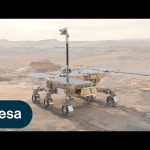
In 2028, ESA will launch its most ambitious exploration mission to search for past and present signs of life on Mars.
Enjoy the ExoMars Rosalind Franklin mission in minute detail – everything down to the colour and size of the wires, sticky tape and scratches. The spacecraft, the rover and martian landscapes are as true to reality as possible for a simulation. The visuals show the spacecraft structural engineering with a faithful robotic appearance. The martian landscape has been simulated with meticulous realism.
The story begins with the rover exploring the surface of the Red Planet. There is science to be done. Join the adventure.
This trailer provides a first taste for the most accurate animation series made so far of a Mars mission.
ESA’s Rosalind Franklin rover has unique scientific potential to search for evidence of past life on Mars thanks to its drill and scientific instruments. It will be the first rover to reach a depth of up to two metres deep below the surface, acquiring samples that have been protected from surface radiation and extreme temperatures. The drill will retrieve soils from ancient parts of Mars and analyse them in situ with its onboard laboratory.
The mission will also serve to demonstrate key technologies that Europe needs to master for future planetary exploration missions. This includes the capability to land safely on a planet, to move autonomously on the surface, and to perform drilling and sample processing and analysis automatically. The rover will use novel driving techniques including wheel-walking to overcome difficult terrains, as well as autonomous navigation software.
We are Europe’s gateway to space. Our mission is to shape the development of Europe’s space capability and ensure that investment in space continues to deliver benefits to the citizens of Europe and the world. Check out https://www.esa.int/ to get up to speed on everything space related.
As we look ahead to long-term space missions, one of the big challenges is figuring out how to provide healthy and sustainable food for astronauts. To tackle this, ESA supported two research teams to investigate the possibility of cultivating meat in space.
An enormous burst of gamma rays was detected by our Integral space telescope, in October 2022. Such disturbances are usually associated with energetic particle events on the Sun but this one was the result of an exploding star almost two billion light-years away.
The blast caused a significant disturbance to our planet’s outer layer, the ionosphere. During the 800 seconds that the gamma rays were impacting, the burst delivered enough energy to activate lightning detectors in India. Instruments in Germany picked up signs that Earth’s ionosphere was disturbed for several hours by the blast.
The blast even triggered instruments generally reserved for studying the immense explosions in the Sun’s atmosphere known as solar flares.
Such an effect has been speculated to be a possible cause of some of the mass extinction events known to have taken place on Earth in the past. But to investigate the idea, we will need a lot more data.
The Copernicus Anthropogenic Carbon Dioxide Monitoring (CO2M) mission will be the first satellite mission to measure how much carbon dioxide is released into the atmosphere through human activity.
CO2M isn’t just a mission; it’s a crucial step in our commitment to understanding and mitigating climate change. It will offer unprecedented precision in monitoring carbon dioxide emissions from the combustion of fossil fuel at national and regional scales.
Its data will provide the EU with a unique and independent source of information to assess the effectiveness of policy measures and to track their impact towards decarbonising Europe ahead of the next Global Stocktake set to place in 2028.
The video features interviews with Valerie Fernandez, CO2M Mission Project Manager, Yannig Durand, CO2M Payload Manager and Yasjka Meijer, CO2M Mission Scientist.
We are Europe’s gateway to space. Our mission is to shape the development of Europe’s space capability and ensure that investment in space continues to deliver benefits to the citizens of Europe and the world. Check out https://www.esa.int/ to get up to speed on everything space related.
Don’t miss the live conversation between ESA astronaut and commander of the International Space Station (ISS) Andreas Mogensen and the 2023 Nobel Prize laureates Ferenc Krausz (in physics) and Moungi Bawendi (in chemistry). The event will take place at the Nobel Prize Museum in Oslo which will be connected to the ISS. Andreas will show a Nobel Prize he brought with him to the Space Station.
★ Subscribe: http://bit.ly/ESAsubscribe and click twice on the bell button to receive our notifications.
We are Europe’s gateway to space. Our mission is to shape the development of Europe’s space capability and ensure that investment in space continues to deliver benefits to the citizens of Europe and the world. Check out https://www.esa.int/ to get up to speed on everything space related.
An educational in-flight call with ESA astronaut Andreas Mogensen on board the International Space Station for teachers and students in Europe, connecting live with local events organised by ESERO Denmark, ESERO Finland, ESERO Sweden and ESERO Norway.
★ Subscribe: http://bit.ly/ESAsubscribe and click twice on the bell button to receive our notifications.
We are Europe’s gateway to space. Our mission is to shape the development of Europe’s space capability and ensure that investment in space continues to deliver benefits to the citizens of Europe and the world. Check out https://www.esa.int/ to get up to speed on everything space related.
Animation of the first launch of the Ariane 6 rocket with two boosters.
Ariane 6 is an all-new design, created to succeed Ariane 5 as Europe’s heavy-lift launch system. With Ariane 6’s upper stage and its reignitable Vinci engine, Europe’s launch capability will be tailored to the needs of multiple payloads, for example to orbit satellite constellations. This autonomous capability to reach Earth orbit and deep space supports Europe’s navigation, Earth observation, scientific and security programmes. Ongoing development of Europe’s space transportation capabilities is made possible by the sustained dedication of thousands of talented people working in ESA’s 22 Member States.
At over 60 metres tall, Ariane 6 will weigh almost 900 tonnes when launched with a full payload – roughly equivalent to one and a half Airbus A380 passenger aircraft.
Vinci, the upper stage engine of Ariane 6 fed by liquid hydrogen and oxygen, can be stopped and restarted multiple times – to place satellites into different orbits and then de-orbit the upper stage, so it is not left behind as hazardous debris in space.
For the development of Ariane 6, ESA is working with an industrial network of several hundred companies in 13 European countries, led by prime contractor ArianeGroup.
France’s space agency, CNES, is preparing the Ariane 6 launch facilities at Europe’s Spaceport in French Guiana.
Credits: ESA – European Space Agency
★ Subscribe: http://bit.ly/ESAsubscribe and click twice on the bell button to receive our notifications.
We are Europe’s gateway to space. Our mission is to shape the development of Europe’s space capability and ensure that investment in space continues to deliver benefits to the citizens of Europe and the world. Check out https://www.esa.int/ to get up to speed on everything space related.
On 17 November 2023, our Juice spacecraft carried out one of the largest and most important manoeuvres in its eight-year journey to Jupiter.
Why does it take so long? Well, the short answer is that its less to do with the distance between Earth and Jupiter and more to do with fighting the Sun’s massive gravitational pull as you venture to the outer Solar System.
If spacecraft like Juice had to carry all the fuel needed to battle the Sun’s gravity alone, they’d be nothing more than colossal tanks. Instead, they use ‘gravity-assist’ tricks – they swing by planets to receive a boost on the way.
Using its main engine, Juice changed its orbit around the Sun to put itself on the correct trajectory for next summer’s Earth-Moon double gravity assist – the first of its kind.
The manoeuvre lasted 43 minutes and burned almost 10% of the spacecraft’s entire fuel reserve. It’s the first part of a two-part manoeuvre that could mark the final time that Juice’s main engine is used until its arrival in the Jupiter system in 2031.
Cinq, quatre, trois, deux, un. Allumage Vulcain! This is the moment Ariane 6’s main engine was sparked into life, and the entire main stage of the new rocket and the many parts of the launch pad in Kourou, French Guiana, practised for the full duration of a launch. Of course, as planned, the test model did not leave the ground.
Without its boosters, instead of piercing the clouds Ariane 6’ created its own on Earth: a clean byproduct of the Vulcain 2.1 engine’s oxygen and hydrogen propellants, which came together to send out impressive swirls of H2O.
After the almost 150 tonnes of propellant was burnt through and the clouds dispersed, the curtains closed on the successful rehearsal. The data from thousands of monitors around the rocket will be crunched in the coming weeks to learn all that’s needed for Ariane’s next, real, flight.
Credits: ESA – European Space Agency
★ Subscribe: http://bit.ly/ESAsubscribe and click twice on the bell button to receive our notifications.
We are Europe’s gateway to space. Our mission is to shape the development of Europe’s space capability and ensure that investment in space continues to deliver benefits to the citizens of Europe and the world. Check out https://www.esa.int/ to get up to speed on everything space related.
On 28 November 1983, the first European-built Spacelab was launched from @NASAKennedy aboard Space Shuttle Columbia.
Also on board was Ulf Merbold, who became our first astronaut in space. The 10-day Spacelab-1 mission marked our entry into human spaceflight activities.
Under a cooperation agreement with @NASA, we were to build a modular research laboratory that would fit inside the Shuttle’s cargo bay.
In 17 years, European Spacelab equipment flew on 36 missions. The two Spacelab modules eventually made 16 flights with five different Shuttle Orbiters.
Many of Spacelab’s features live on in space hardware that is flying today. Europe’s Columbus laboratory on the Station evolved from Spacelab.
★ Subscribe: http://bit.ly/ESAsubscribe and click twice on the bell button to receive our notifications.
We are Europe’s gateway to space. Our mission is to shape the development of Europe’s space capability and ensure that investment in space continues to deliver benefits to the citizens of Europe and the world. Check out https://www.esa.int/ to get up to speed on everything space related.
Have you ever dreamt of flying your own satellite?
A team of university students from @universitycollegedublin have done just that!
Meet EIRSAT-1, the Educational Irish Research Satellite, Ireland’s first ever satellite to go to space.
The journey wasn’t easy, but over six years, the students worked with our experts and in our state-of-the-art labs as part of our Academy’s Fly Your Satellite! programme to overcome challenges. They even set up their own clean room and mission control at the University.
EIRSAT-1 is scheduled to launch at the end of November. Stay tuned to learn more about Ireland’s historic space moment!
🎥 ESA – European Space Agency
★ Subscribe: http://bit.ly/ESAsubscribe and click twice on the bell button to receive our notifications.
We are Europe’s gateway to space. Our mission is to shape the development of Europe’s space capability and ensure that investment in space continues to deliver benefits to the citizens of Europe and the world. Check out https://www.esa.int/ to get up to speed on everything space related.
Watch as Europe’s new Ariane 6 rocket goes through a full-scale rehearsal in preparation for its first flight, when teams from @ArianeGroup, @CnesFrance and ESA on the ground will complete a launch countdown rehearsal. The test includes the ignition of the core stage Vulcain 2.1 engine, followed by 470 seconds of stabilised operation covering the entire core stage flight phase, as it would function on a launch into space.
Coverage started 19:40 UTC (20:40 CET) on 23 November 2023, 20 minutes before engine ignition and continue five minutes after core stage operation, once the engine burns through all its propellant.
Timestaps of the video: 00:00 – 16:18 – Stay tuned 16:19 – 47:49 – Countdown and stop of countdown 47:50 – 01:14:19 – Stay tuned 01:14:20 – 01:30:43 – Restart of countdown and hot-fire test
For this rehearsal, the boosters were not ignited, so Ariane 6 stayed firmly on the launch pad at Europe’s Spaceport in French Guiana.
The eight-minute engine-fire trial reenacts how the Ariane 6 core stage will fire during a normal flight into space. The trial, conducted with a test model on the launch pad at Europe’s Spaceport will be the longest ‘full-stack’ run yet for Ariane 6’s lower liquid propulsion module equipped with a Vulcain 2.1 engine.
The Vulcain 2.1 engine will burn through almost 150 tonnes of propellant supplied from the Ariane 6 core stage tanks – liquid oxygen and liquid hydrogen – supercooled to temperatures below -250°C.
The Vulcain 2.1 engine is an evolution of the Vulcain 2 engine that made Ariane 5 Europe’s most successful launch system ever. The upgrade has a simplified and cheaper design and features new technology in the engine nozzle, while the ignition system has been moved from the engine to the launch pad to make the core stage perform better and cost less.
Credits: ESA – European Space Agency
★ Subscribe: http://bit.ly/ESAsubscribe and click twice on the bell button to receive our notifications.
We are Europe’s gateway to space. Our mission is to shape the development of Europe’s space capability and ensure that investment in space continues to deliver benefits to the citizens of Europe and the world. Check out https://www.esa.int/ to get up to speed on everything space related.
Watch live as Ireland goes to space, for the first time, with the launch of EIRSAT-1. Built by students at @universitycollegedublin under the guidance of ESA’s Education Office, EIRSAT-1 is a 2-unit CubeSat carrying three experiments, including a novel gamma ray detector that will study some of the most luminous explosions in the universe. Irish broadcaster Rick O’Shea, with guests from ESA and the EIRSAT-1 team, will take viewers through the mission’s development and major launch milestones including liftoff, separation and acquisition of signal, from outside the EIRSAT-1 Mission Control Room in Dublin. Níl aon satailít mar do shatailít féin! [There’s no satellite like your own satellite!]
We are Europe’s gateway to space. Our mission is to shape the development of Europe’s space capability and ensure that investment in space continues to deliver benefits to the citizens of Europe and the world. Check out https://www.esa.int/ to get up to speed on everything space related.
Have you ever dreamt of flying your own satellite?
A team of university students from @universitycollegedublin have done just that!
Meet EIRSAT-1, the Educational Irish Research Satellite, Ireland’s first ever satellite to go to space.
The journey wasn’t easy, but over six years, the students worked with our experts and in our state-of-the-art labs as part of our Academy’s Fly Your Satellite! programme to overcome challenges. They even set up their own clean room and mission control at the University.
EIRSAT-1 is scheduled to launch at the end of November. Stay tuned to learn more about Ireland’s historic space moment!
🎥 ESA – European Space Agency
★ Subscribe: http://bit.ly/ESAsubscribe and click twice on the bell button to receive our notifications.
We are Europe’s gateway to space. Our mission is to shape the development of Europe’s space capability and ensure that investment in space continues to deliver benefits to the citizens of Europe and the world. Check out https://www.esa.int/ to get up to speed on everything space related.
Missions to Mars have made many exciting discoveries that have transformed our understanding of the planet, but the next step is to bring samples to Earth for detailed analysis in sophisticated laboratories.
Methane is the second most important greenhouse gas contributor to climate change after carbon dioxide. Curbing methane emissions could deliver immediate and long-lasting benefits for the climate, seeing as the gas only lingers in the atmosphere for a relatively short time. Satellites have a really important role to play in reducing greenhouse gas emissions. The Tropomi instrument onboard the Copernicus Sentinel-5P satellite is the only instrument that maps global methane concentrations every single day. This lets scientists detect hotspots for large methane sources around the world – allowing us to address the consequences of methane emissions on our climate and environment.
Credits: ESA – European Space Agency
★ Subscribe: http://bit.ly/ESAsubscribe and click twice on the bell button to receive our notifications.
We are Europe’s gateway to space. Our mission is to shape the development of Europe’s space capability and ensure that investment in space continues to deliver benefits to the citizens of Europe and the world. Check out https://www.esa.int/ to get up to speed on everything space related.
ESA is releasing the first full-colour images of the cosmos captured by its recently launched space telescope Euclid. Follow live a broadcast of the reveal on Tuesday 7 November at 13:15 GMT / 14:15 CET.
Never before has a telescope been able to create such razor-sharp astronomical images across such a large patch of the sky. Five images show that the telescope is ready for its mission to create the most extensive 3D map of the Universe yet and uncover some of its hidden secrets.
Credits: ESA – European Space Agency
★ Subscribe: http://bit.ly/ESAsubscribe and click twice on the bell button to receive our notifications.
We are Europe’s gateway to space. Our mission is to shape the development of Europe’s space capability and ensure that investment in space continues to deliver benefits to the citizens of Europe and the world. Check out https://www.esa.int/ to get up to speed on everything space related.
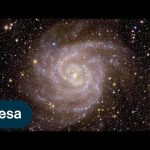
Today, ESA’s Euclid space mission reveals its first full-colour images of the cosmos. Never before has a telescope been able to create such razor-sharp astronomical images across such a large patch of the sky, and looking so far into the distant Universe. These five images illustrate Euclid’s full potential; they show that the telescope is ready to create the most extensive 3D map of the Universe yet, to uncover some of its hidden secrets.
Credits: ESA/Euclid/Euclid Consortium/NASA, image processing by J.-C. Cuillandre (CEA Paris-Saclay), G. Anselmi, CC BY-SA 3.0 IGO
★ Subscribe: http://bit.ly/ESAsubscribe and click twice on the bell button to receive our notifications.
We are Europe’s gateway to space. Our mission is to shape the development of Europe’s space capability and ensure that investment in space continues to deliver benefits to the citizens of Europe and the world. Check out https://www.esa.int/ to get up to speed on everything space related.
There is no point in sending human explorers on long voyages around the solar system if they arrive at their destination in poor physical shape. Long stays in zero gravity are not good for the human body.
We already know that astronauts lose bone mass at around 1% for every month they are in space; muscles – including heart muscles – atrophy despite hours of exercise; and there are a host of other problems.
Never before has a telescope been able to create such razor-sharp astronomical images across such a large patch of the sky.
On Tuesday 7 November, ESA will release the first full-colour images captured by its recently launched Euclid space telescope. These images form part of the mission’s ‘Early Release Observations’ – where Euclid was tasked with scrutinising a set of celestial targets chosen for their public appeal and scientific value.
The five images are full of cosmic secrets waiting to be revealed. And this is just the beginning. During its six-year mission, Euclid will generate the equivalent of a million DVDs of data. These data will be used to create the biggest ever 3D map of the Universe and uncover the secrets of dark matter and dark energy.
In this video, hear from the experts about how Euclid has reached this milestone. Discover how they felt when they saw the first images, and find out what these images will reveal about the cosmos.
Watch the reveal of the images live through ESA Web TV or YouTube on 7 November, 13:15 GMT / 14:15 CET. At the same time, an ESA press release including all images will be published at esa.int/euclid.
Credits: ESA – European Space Agency Music: Carollyn Eden – 2 Million stars
★ Subscribe: http://bit.ly/ESAsubscribe and click twice on the bell button to receive our notifications.
We are Europe’s gateway to space. Our mission is to shape the development of Europe’s space capability and ensure that investment in space continues to deliver benefits to the citizens of Europe and the world. Check out https://www.esa.int/ to get up to speed on everything space related.
ESA’s Euclid mission is on a quest to unveil the nature of two elusive ‘dark’ entities. As the renowned theoretical physicist Stephen Hawking remarked in 2013, “The missing link in cosmology is the nature of dark matter and dark energy”.
During the last 70 years, scientists have made enormous progress in understanding the very initial phases of the Universe and its evolution to the present day. Thanks to advances in observations and theoretical modelling, a clear picture has emerged of how stars form, and how galaxies grow and interact with each other, coming together to form groups and clusters.
Yet, fundamental mysteries remain. 95% of the Universe appears to be made up of unknown ‘dark’ matter and energy. Dark matter and energy affect the motion and distribution of visible sources but do not emit, reflect or absorb any light. And scientists do not know what these dark entities actually are.
To address this question, Euclid will create a great map of the large-scale structure of the Universe across space and time by observing with unprecedented accuracy billions of galaxies out to 10 billion light-years. This is not easy, and making sure that Euclid is up to the task has required the expertise and dedication of many people over several years of work.
This video captures the journey behind the Euclid mission, from a human and intensely visual perspective. It shows tiny screws, winding cables and shiny surfaces in a whole new light, revealing how each piece comes together to form the space telescope. Be drawn in by awe-inspiring photos of the cosmos, and stay for the seemingly choreographed ballet of teamwork necessary to assemble and test the spacecraft, before being swept away by the emotion of the launch into space.
Euclid’s adventure has begun. With its observations during the coming years, it will help us uncover the missing link in cosmology and open the gate to the ‘dark’ side of the Universe.
Credit: ESA/Studio Redgrove CC BY-SA 3.0 IGO
★ Subscribe: http://bit.ly/ESAsubscribe and click twice on the bell button to receive our notifications.
We are Europe’s gateway to space. Our mission is to shape the development of Europe’s space capability and ensure that investment in space continues to deliver benefits to the citizens of Europe and the world. Check out https://www.esa.int/ to get up to speed on everything space related.
The giant planet shines bright in the night sky this week as it reaches opposition on Thursday (2 November.)
This means it is at its biggest when seen from Earth, and spends much of the night above the horizon – so it’s the perfect time to observe Jupiter yourself!
If you don’t have a telescope handy, don’t worry. You will be able to spot the planet with just your eyes. Look for a bright orange star-like dot just above the eastern horizon that is not twinkling. This is our big friendly giant! You can also use a stargazing app to help you find the planet.
Through a pair of binoculars, Jupiter will look like a white disk. Peer closely and you will see a line of three or four tiny white dots. These dots are Jupiter’s largest moons: Ganymede, Callisto, Io and Europa. These will soon be visited by our Jupiter Icy Moons Explorer, or Juice for short.
Use a telescope if you’re curious to see Jupiter’s famous red spot and brown bands.
Try to find a clear sky this week and say… hello Jupiter!
Humans are adaptable beings. Wear glasses that turn your view of the world upside-down and within two weeks your brain will have adapted to the topsy-turvy world.
Researchers suspect that astronauts’ brains adapt to living in weightlessness by using previously untapped links between neurons. As the astronauts learn to float around in their spacecraft, left–right and up–down become second nature as these neuronal connections are activated.
To confirm this theory, up to 16 astronauts will be put through advanced Magnetic Resonance Imaging (MRI) scanners before and after their flights to study any changes in their brain structure. A control group on ground will undergo the same scans for further comparison.
The research is providing scientists on Earth clues where to look in the brains of people who suffer from disorders based on previous traumatic experiences such as vertigo.
On Saturday 7 and Sunday 8 October 2023, the European Space Agency opened the doors to the European Space Research and Technology Centre, ESTEC, in the Netherlands. Where science meets science fiction, the theme of this year’s open day was ‘Science Fiction Gets Real’, highlighting how science fiction has inspired scientists and engineers to join ESA, and turn once imaginary concepts into science fact. The single largest ESA establishment invited the public to meet astronauts, view spacecraft – including a rare chance to view ESA’s asteroid mission Hera as it undergoes testing – and peer behind the scenes of Europe’s space adventure, along with a full schedule of events and talks from Space Rocks, celebrating the art and culture of science and space.
0:30 – NL Space Tent, showcasing the Netherlands in space, organised by the Netherlands Space Office, NSO 1:00 – ESA Earth Observation Stand in the Rainbow Corridor 1:08 – Dutch ESA astronaut André Kuipers takes to the Space Rocks stage to announce that the annual Association of Space Explorers ASC Planetary Congress will take place at ESTEC in 2024 1:21 – Spanish ESA astronaut Pedro Duque joins the Mayor of Noordwijk Wendy Verkeij; ESA Director of Technology, Engineering and Quality and Head of ESTEC Dietmar Pilz; ESA Director General Josef Aschbacher; NSO Director Harm van de Wetering; a Moonshots NL 24 student, André Kuipers on a panel discussing the ASE Planetary Congress in 2024 1:24 – John McFall, member of ESA’s Astronaut Reserve 1:46 – The ESTEC Test Centre, Europe’s largest satellite testing facility 1:51 – ESTEC’s Erasmus Innovation Centre, including a showcase on human spaceflight 2:00 – The formal opening of the new Earth to Space exhibit at ESTEC’s visitor centre Space Expo wth Dietmar Pilz; Space Expo Director Barbara Hoppel and Josef Aschbacher
Credits: ESA – European Space Agency
★ Subscribe: http://bit.ly/ESAsubscribe and click twice on the bell button to receive our notifications.
We are Europe’s gateway to space. Our mission is to shape the development of Europe’s space capability and ensure that investment in space continues to deliver benefits to the citizens of Europe and the world. Check out https://www.esa.int/ to get up to speed on everything space related.
When astronauts return to the lunar surface they are probably going to be doing more driving than walking – but to keep billowing moondust at bay they are going to need roads. An ESA project reported in today’s Nature Scientific Reports tested the creation of roadworthy surfaces by melting simulated moondust with a powerful laser.
Like every other living creature we know of, humans evolved at the bottom of a gravity well. We take the Earth’s tug for granted, and so do our bodies. So it’s not surprising that our bodies behave oddly in orbit. What is surprising is that humans turn out to adapt remarkably well to zero-g (more precisely, microgravity).
At some point, statistically speaking, a large asteroid will impact Earth. Whether that’s tomorrow, in ten years, or a problem for our descendants, ESA is getting prepared.
As part of the world’s first test of asteroid deflection, ESA’s Hera mission will perform a detailed post-impact survey of Dimorphos – the 160-metre asteroid struck, and successfully deflected, by NASA’s DART spacecraft.
Hera will soon study the aftermath. Launching in October 2024, Hera will turn this grand-scale experiment into a well-understood and hopefully repeatable planetary defence technique.
But before Hera and its two CubeSats fly, they’re rigorously tested at ESA’s ESTEC test centre in Noordwijk, the Netherlands. From the force and noise of the rocket take-off to the sustained vacuum and temperature extremes of deep space, all aspects of Hera’s functioning are checked before they begin their journey, alone in space.
Credits: ESA – European Space Agency
★ Subscribe: http://bit.ly/ESAsubscribe and click twice on the bell button to receive our notifications.
We are Europe’s gateway to space. Our mission is to shape the development of Europe’s space capability and ensure that investment in space continues to deliver benefits to the citizens of Europe and the world. Check out https://www.esa.int/ to get up to speed on everything space related.