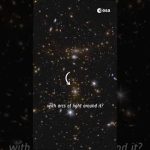
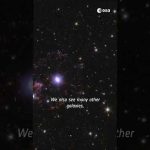
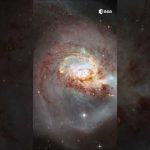
On 19 March 2025, our Euclid mission released its first batch of survey data, including a preview of its deep fields. Here, hundreds of thousands of galaxies in different shapes and sizes take centre stage and show a glimpse of their large-scale organisation in the cosmic web.
📹 ESA – European Space Agency 📸 ESA /Euclid/Euclid Consortium/@NASA, image processing by J.-C. Cuillandre, E. Bertin, G. Anselmi Euclid Deep Field South, 70x zoom: ESA/Euclid/Euclid Consortium/NASA, image processing by J.-C. Cuillandre, E. Bertin, G. Anselmi
On 19 March 2025, our Euclid mission released its first batch of survey data, revealing an astonishing view of the cosmic web.
With just one scan of its deep fields, Euclid has already detected 26 million galaxies, some as far as 10.5 billion light-years away! This is just a preview of what’s to come, as Euclid will continue mapping the Universe in unprecedented detail.
What’s in this first release? – Three vast mosaics covering 63 square degrees of the sky – A catalogue of 380 000 galaxies, classified with AI + citizen scientists – 500 new gravitational lens candidates, almost all never seen before – The first hints of Euclid’s full cosmic atlas, which will eventually cover one-third of the sky
This data is a huge leap forward in understanding how galaxies are distributed across the Universe and how dark matter and dark energy shape the cosmos.
Over the next six years, Euclid will revisit these deep fields 30 to 52 times, uncovering billions of galaxies and pushing the astrophysics’ boundaries.
📹 @europeanspaceagency 📸 ESA /Euclid/Euclid Consortium/@NASA, image processing by J.-C. Cuillandre, E. Bertin, G. Anselmi Euclid Deep Field South, 70x zoom: ESA/Euclid/Euclid Consortium/NASA, image processing by J.-C. Cuillandre, E. Bertin, G. Anselmi
This image was captured by NIRCam, Webb’s primary near-infrared camera, and contains the lensing galaxy cluster SDSS J1226+2149. It lies at a distance of around 6.3 billion light-years from Earth, in the constellation Coma Berenices. By combining Webb’s sensitivity with the magnifying effect of gravitational lensing, astronomers were able to use this gravitational lens to explore the earliest stages of star formation in distant galaxies. To do so, they relied on earlier studies by the NASA/ESA Hubble Space Telescope, which provided the ‘prescription’ for this gravitational lens.
Credit: ESA/Webb, NASA & CSA, J. Rigby Music: Stellardrone – Twilight
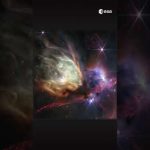
This video takes the viewer on a journey through space to the Rho Ophiuchi cloud complex.
From our cosmic backyard in the Solar System to distant galaxies near the dawn of time, the NASA/ESA/CSA James Webb Space Telescope has delivered on its promise of revealing the Universe like never before in its first year of science operations. To celebrate the completion of a successful first year, a new Webb image has been released of a small star-forming region in the Rho Ophiuchi cloud complex. While the region is relatively quiet, its proximity at 390 light-years makes for a highly detailed close-up, with no foreground stars in the intervening space.
Credits: ESA/Webb, NASA, ESA, CSA, JPL-Caltech/Harvard-Smithsonian CfA, DSS2, N. Bartmann (ESA/Webb), E. Slawik, N. Risinger, D. de Martin, M. Zamani (ESA/Webb), K. Pontoppidan (STScI), A. Pagan (STScI)
Music: Tonelabs – The Red North
★ Subscribe: http://bit.ly/ESAsubscribe and click twice on the bell button to receive our notifications.
We are Europe’s gateway to space. Our mission is to shape the development of Europe’s space capability and ensure that investment in space continues to deliver benefits to the citizens of Europe and the world. Check out https://www.esa.int/ to get up to speed on everything space related.
This video takes the viewer on a journey through space to the peculiar galaxy NGC 3256.
This distorted galaxy is the wreckage of a head-on collision between two spiral galaxies which likely occurred 500 million years ago, and it is studded with clumps of young stars which were formed as gas and dust from the two galaxies collided.
We are Europe’s gateway to space. Our mission is to shape the development of Europe’s space capability and ensure that investment in space continues to deliver benefits to the citizens of Europe and the world. Check out https://www.esa.int/ to get up to speed on everything space related.
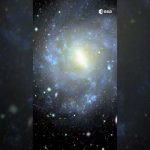
This video takes the viewers on a journey to the barred spiral galaxy NGC 5068, whose bright central bar is visible in the upper left of this image. NGC 5068 lies around 17 million light-years from Earth in the constellation Virgo.
With its ability to peer through the gas and dust enshrouding newborn stars, the NASA/ESA/CSA James Webb Space Telescope is the perfect telescope to explore the processes governing star formation. Stars and planetary systems are born amongst swirling clouds of gas and dust that are opaque to visible-light observatories like Hubble or the VLT. The keen vision at infrared wavelengths of two of Webb’s instruments — MIRI and NIRCam — allowed astronomers to see right through the gargantuan clouds of dust in NGC 5068 and capture the processes of star formation as they happened. This image combines the capabilities of these two instruments, providing a truly unique look at the composition of NGC 5068.
Credit: ESA/Webb, NASA, CSA, J. Lee and the PHANGS-JWST Team, Dark Energy Survey/DOE/FNAL/NOIRLab/NSF/AURA, DSS, N. Bartmann (ESA/Webb), E. Slawik, N. Risinger, D. de Martin (ESA/Webb), M. Zamani (ESA/Webb)
Music: Tonelabs – The Red North
★ Subscribe: http://bit.ly/ESAsubscribe and click twice on the bell button to receive our notifications.
We are Europe’s gateway to space. Our mission is to shape the development of Europe’s space capability and ensure that investment in space continues to deliver benefits to the citizens of Europe and the world. Check out https://www.esa.int/ to get up to speed on everything space related.
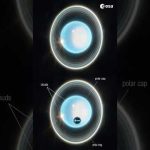
The NASA/ESA/CSA James Webb Space Telescope has taken a stunning image of the Solar System’s other ice giant, the planet Uranus. The new image features dramatic rings as well as bright features in the planet’s atmosphere. The new Webb data of Uranus offer exquisite sensitivity, revealing the faintest dusty rings.
The seventh planet from the Sun, Uranus is strange: it rotates on its side, at a nearly 90-degree angle from the plane of its orbit. This causes unusual seasons since the planet’s poles experience 42 years of constant sunlight and 42 years of complete darkness (Uranus takes 84 years to orbit the Sun). Currently, it is late spring at the northern pole, which is on the right side of this image; Uranus’s northern summer will be in 2028.
Credit: NASA, ESA, CSA, STScI, J. DePasquale (STScI), N. Bartmann Music: Stellardrone – The Belt of Orion
★ Subscribe: http://bit.ly/ESAsubscribe and click twice on the bell button to receive our notifications.
We are Europe’s gateway to space. Our mission is to shape the development of Europe’s space capability and ensure that investment in space continues to deliver benefits to the citizens of Europe and the world. Check out https://www.esa.int/ to get up to speed on everything space related.
This image takes the viewer to space to finish at Webb’s view of the galaxy merger II ZW 96.
This pair of galaxies is roughly 500 million light-years from Earth and lies in the constellation Delphinus, close to the celestial equator. As well as the wild swirl of the merging galaxies, a menagerie of background galaxies are dotted throughout the image. Learn more about the object here.
Credit: ESA/Webb, NASA, CSA, L. Armus, A. Evans, SDSS, E. Slawik, N. Risinger, M. Zamani (ESA/Webb), N. Bartmann (ESA/Webb) Music: Tonelabs – The Red North
★ Subscribe: http://bit.ly/ESAsubscribe and click twice on the bell button to receive our notifications.
We are Europe’s gateway to space. Our mission is to shape the development of Europe’s space capability and ensure that investment in space continues to deliver benefits to the citizens of Europe and the world. Check out https://www.esa.int/ to get up to speed on everything space related.
This video takes the viewer on a journey to NGC 346, one of the most dynamic star-forming regions in nearby galaxies, as seen by the NASA/ESA/CSA James Webb Space Telescope.
NCG 346 is located in the Small Magellanic Cloud (SMC), a dwarf galaxy close to our Milky Way.
Credit: ESA/Webb, NASA, CSA, ESO, ESA/Hubble, Digitized Sky Survey 2, A. Nota, N. Bartmann, M. Zamani Music: Music for the Zoom: Tonelabs – The Red North
★ Subscribe: http://bit.ly/ESAsubscribe and click twice on the bell button to receive our notifications.
We are Europe’s gateway to space. Our mission is to shape the development of Europe’s space capability and ensure that investment in space continues to deliver benefits to the citizens of Europe and the world. Check out https://www.esa.int/ to get up to speed on everything space related.
The Webb Telescope is closer to starting its mission of science, an historic look at the center of our galaxy, and the Crew-3 astronauts reflect on their mission … a few of the stories to tell you about – This Week at NASA!
A powerful space telescope, due for launch from Europe’s Spaceport in French Guiana on 17 December 2019, will give scientists a new insight into the nature of planets outside our Solar System.
Cheops, the ‘Characterising Exoplanet Satellite’, will study known exoplanets that are orbiting bright stars.
More than 4000 exoplanets have been discovered and Cheops will be targeting known planets between the size of Earth and Neptune, to find out more about their composition, internal structure and whether they might be able to support life.
Cheops’ mission is a partnership between ESA and Switzerland with additional contributions from Austria, Belgium, France, Germany, Hungary, Italy, Portugal, Spain, Sweden and the UK.
This film examines the nature of exoplanets, the challenge of exoplanet exploration and features the Cheops Science Operations Centre in Geneva, it includes interviews with Didier Queloz, Chair of the Cheops Science Team and 2019 Nobel Physics Laureate, University of Geneva; Willy Benz, Cheops Principal Investigator, University of Bern; and Matthias Beck, Cheops Ground Segment Manager, University of Geneva).
We are Europe’s gateway to space. Our mission is to shape the development of Europe’s space capability and ensure that investment in space continues to deliver benefits to the citizens of Europe and the world. Check out http://www.esa.int/ESA to get up to speed on everything space related.
ESA’s first mission dedicated to investigating planets outside our solar system is scheduled for launch on a Soyuz rocket from the European spaceport in French Guiana on 17 December 2019.
Cheops – Characterising ExOPlanet Satellite – will study known exoplanets that are orbiting bright stars. The aim is to obtain detailed information about these planets to find out more about their composition and internal structure.
The mission is a partnership between ESA and Switzerland with additional contributions from Austria, Belgium, France, Germany, Hungary, Italy, Portugal, Spain, Sweden and the UK.
We are Europe’s gateway to space. Our mission is to shape the development of Europe’s space capability and ensure that investment in space continues to deliver benefits to the citizens of Europe and the world. Check out http://www.esa.int/ESA to get up to speed on everything space related.
Scientists at the Geneva Observatory in Switzerland will be processing data from Cheops, ESA’s Characterising Exoplanet Satellite, scheduled to launch soon to study planets orbiting stars outside our Solar System.
The Observatory has a rich history studying exoplanets. In 1995, Michel Mayor and Didier Queloz discovered the first exoplanet orbiting a Sun-like star. Now, over 4000 planets are known around stars other than the Sun.
By observing stars that are already known to host exoplanets, Cheops will make measure very precisely the sizes of planets in the super-Earth to Neptune size range. Combined with existing measurements of planet masses, the Cheops data will make it possible to determine the density of these planets, giving us vital clues about its composition and structure, indicating for example if it is predominantly rocky or gassy, or perhaps harbours significant oceans.
The Cheops mission is a partnership between ESA and Switzerland with important contributions from Austria, Belgium, France, Germany, Hungary, Italy, Portugal, Spain, Sweden, and the United Kingdom. The Cheops launch slot is scheduled for the last quarter of 2019. This film contains contributions from Didier Queloz, Chair of the Cheops Science Team (University of Geneva); Willy Benz, the Cheops Principal Investigator (University of Bern); and the Cheops Ground Segment Manager, Matthias Beck (University of Geneva).
We are Europe’s gateway to space. Our mission is to shape the development of Europe’s space capability and ensure that investment in space continues to deliver benefits to the citizens of Europe and the world. Check out http://www.esa.int/ESA to get up to speed on everything space related.
ESA’s Earth Explorer Aeolus satellite will be launched later this year to measure the world’s winds from space. The satellite carries one of the most sophisticated instruments ever to be put into orbit: Aladin, which includes two powerful lasers, a large telescope and very sensitive receivers. The laser generates ultraviolet light that is beamed down into the atmosphere to profile the world’s winds – a completely new approach to measuring the wind from space. These vertical slices through the atmosphere, along with information it gathers on aerosols and clouds, will improve our understanding of atmospheric dynamics and contribute to climate research. As well as advancing science, Aeolus will play an important role in improving weather forecasts. The mission will also complement information about the atmosphere being provided by the Copernicus Sentinel missions.
The James Webb Space Telescope’s cryogenic vacuum testing at our Johnson Space Center verified it’s ready for the cold, harsh environment of space, and its mission to uncover a part of the universe we have not seen. From distant worlds orbiting other stars, to mysterious cosmic structures, Webb could help answer questions about our universe and our place in it. Launch of Webb is set for 2019. Also, Flight through Orion Nebula, 360 Degree View from the Center of the Galaxy, and Raging Water on Launch Pad!
This video is available for download from NASA’s Image and Video Library: https://images.nasa.gov/details-NHQ_2018_0112_Webb%20Space%20Telescope%20Update%20on%20This%20Week%20@NASA%20%E2%80%93%20January%2012,%202018.html
Stella, an astrophysicist from Estonia, shares her experience as a YGT at ESA working with data provided by the Gaia mission’s team to model the movements of stars.
NASA’s James Webb Space Telescope (JWST) has successfully passed the center of curvature test at Goddard Space Flight Center, in Greenbelt, Md. This important optical measurement of Webb’s fully assembled primary mirror was the final test held at Goddard before the telescope is shipped off for end-to-end cryogenic testing at Johnson Space Center in Houston. When that’s complete, the world’s most advanced observatory goes to Northrop Grumman Aerospace Systems in Redondo Beach, California, for final assembly and testing. Webb is targeted for launch in 2018 on a mission to help unravel some of the greatest mysteries of the universe. Also, Cassini Update, NASA Visits Midwest Company Helping Build Orion, Orion’s Launch Abort System Motor Tested, Wind Tunnel Tests Continue with SLS, and Community College Aerospace Scholars!
In this edition of Space, Euronews correspondent Jeremy Wilks reports from the Observatory of Geneva – home to experts in exoplanets, the name given to planets outside our solar system.
So far they have managed to find more than 3500, but they believe there could be literally billions of them across the Milky Way.
The first exoplanet to be discovered was what’s known as a hot Jupiter, a giant gas planet orbiting close to its star. That discovery, made by University of Geneva professor Michel Mayor in 1995, kick-started a revolution in astronomy, one which at the time of our interview put the number of exoplanets at 3559 and counting.
Dans Space, Jérémy Wilks vous emmène ce mois-ci à l’observatoire de Genève, la “maison” des experts en exoplanètes, ces planètes qui sont en dehors de notre système solaire. A ce jour, 3.559 d’entre elles ont été découvertes, mais les scientifiques pensent qu’il en existe des millions dans la Voie Lactée.
La première exoplanète qui a été découverte est une planète géante gazeuse similaire à Jupiter, en orbite autour de son étoile. Cette découverte, faite en 1995 par le professeur Michel Mayor de l’Université de Genève, a donné le coup d’envoi d’une révolution en astronomie. Une révolution qui part de l’existence prouvée d’une exoplanète, à la découverte de 3.559 exoplanètes aujourd’hui.
Az exobolygók, vagyis a Naprendszeren kívüli bolygók keresése azon az emberi álmon alapszik, hogy a homo sapiens valaha elhagyhatja a Földet, és új hazát fog keresni. A bolygókat megtalálni azonban rendkívül nehéz, hiszen nem bocsátanak ki fényt, és olyan messze vannak, hogy a legerősebb távcsővel sem láthatók. Ezért sokáig a létezésükre sem volt bizonyíték.
Az első felfedezett exobolygó egy hatalmas gázbolygó volt, a genfi egyetemi professzor, Michel Mayor és csapatának 1995-ös felfedezése forradalmat hozott a csillagászatban. Húsz év alatt egyetlen exobolygótól eljutottunk 3599-ig.
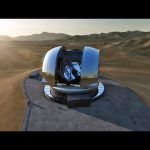
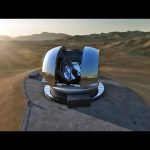
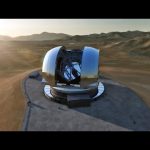
Esta zona remota del desierto de Atacama, en Chile, es famosa porque aquí no hay nada. No hay agua, ni plantas, ni animales. Esto hace que sea un lugar perfecto para un proyecto realmente innovador, el Telescopio Europeo Extremadamente Grande, E-ELT.
O deserto de Atacama, no Chile é famoso por não ter nada – não tem água, nem plantas, nem animais. O que faz dele o local perfeito para acolher projeto verdadeiramente inovador, a construção do E-ELT, o European Extremely LargeTelescope ou o Telescópio Europeu Extremamente Grande.
Das E-ELT ist ein europäisches Projekt, um das weltweit größte optische Infrarot-Teleskop zu bauen. Die bahnbrechende Konstruktion in der Atacamawüste in Chile wird ferne Exoplaneten mit einer nie gekannten Detailschärfe untersuchen.
Dans le désert d’Atacama au Chili, la construction du Télescope géant européen, l’E-ELT est entrée dans sa phase concrète avec la création d’une plate-forme au sommet d’une montagne à 3000 mètres d’altitude. C’est là que cet instrument optique / infrarouge le plus grand au monde sera mis en service au début de la prochaine décennie. Ses performances permettront notamment d’en savoir plus sur les exoplanètes et éventuellement, de faire avancer la vaste quête vers une autre forme de vie.
Work is underway to build the E-ELT, a telescope that could one day find signs of life on distant planets. With a 39-metre mirror, it will be the world’s biggest optical and infrared telescope.
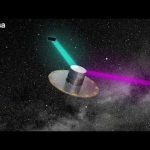
ESA’s Gaia mission will produce an unprecedented 3D map of our Galaxy by mapping, with exquisite precision, the position and motion of a billion stars. The key to this is the billion-pixel camera at the heart of its dual telescope. This animation illustrates how the camera works.
Journey through galaxies, past star-forming clouds, around mammoth stars, and inside gas and dust nebulas. A relaxation programme of astronomical wonders by the European Space Agency.
Originally produced for Lufthansa inflight entertainment (released June 2011).
Credit images: XMM-Newton, Herschel, Planck, Cluster, Integral, Joint ESA/NASA Hubble Space Telescope and ESA amateur ground-based cameras.
Credit music: “Dream Elements” by Green Sun, licensed by AmbientMusicGarden.com
This stunning movie shows the Eagle Nebula from the iconic 1995 Hubble image of the Pillars of Creation through to the latest multi-wavelength composite.
Dr. Ed Weiler is considered by many as the face of the Hubble Space Telescope. He is presently serving his second tour as head of NASA’s Science Mission Directorate in Washington. His scientific expertise and commitment to excellence have earned him numerous distinctions over the years. His relationship with the observatory spans three decades. From his beginning role as chief scientist to numerous management responsibilities, Weiler has been involved with the telescope for 33 years, well before Hubble’s 1990 launch, subsequent technical challenges, and eventual place in history as one of humankind’s greatest scientific achievements.
“Kepler is a critical component in NASA’s broader efforts to ultimately find and study planets where Earth-like conditions may be present,” said Jon Morse, the Astrophysics Division director at NASA Headquarters in Washington. “The planetary census Kepler takes will be very important for understanding the frequency of Earth-size planets in our galaxy and planning future missions that directly detect and characterize such worlds around nearby stars.”
The mission will spend three and a half years surveying more than 100,000 sun-like stars in the Cygnus-Lyra region of our Milky Way galaxy. It is expected to find hundreds of planets the size of Earth and larger at various distances from their stars. If Earth-size planets are common in the habitable zone, Kepler could find dozens; if those planets are rare, Kepler might find none.
In the end, the mission will be our first step toward answering a question posed by the ancient Greeks: are there other worlds like ours or are we alone?
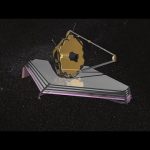
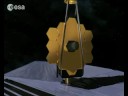
Seen here in this short movie, the JWST is the successor to the NASA/ESA Hubble Space Telescope and, with a six-metre mirror, it will be almost three times the size of Hubble.