We are Europe’s gateway to space. Our mission is to shape the development of Europe’s space capability and ensure that investment in space continues to deliver benefits to the citizens of Europe and the world. Check out https://www.esa.int/ to get up to speed on everything space related.
On 19 April, 2001, Umberto Guidoni was launched to the International Space Station, becoming the first European astronaut on board. In April 2021, ESA celebrates 20 years of European astronaut missions to this unique orbital outpost.
In this video, ESA astronauts past and present share their experiences of the International Space Station and spaceflight more generally. They identify some of their favourite moments and voice their hopes for the future of space exploration.
Here are the timestamps for each message:
0:00 – Intro 0:39 – Umberto Guidoni 3:31 – Claudie Haigneré 6:31 – Frank De Winnie 7:42 – Pedro Duque 10:36 – André Kuipers 11:38 – Thomas Reiter 14:38 – Christer Fuglesang 16:58 – Hans Schlegel 19:39 – Luca Parmitano 20:29 – Alexander Gerst 22:29 – Samantha Cristoforetti 28:20 –Thomas Pesquet 29:07 – Andreas Mogensen 30:05 – Tim Peake 31:02 – Matthias Maurer 32:57 – Jean François Clervoy 38:49 – Michel Tognini 42:23 – Reinhold Ewald
The International Space Station is humankind’s science laboratory in space. Its unique microgravity environment enables researchers to study phenomena and carry out experiments that would not be possible on Earth. Around 400 ESA investigations have been performed since the first module was launched and thousands more are led by the four other space agencies that work together to keep the Space Station aloft: @NASA, Russia’s @Роскосмос ТВ, Japan’s @JAXA | 宇宙航空研究開発機構, and the @Canadian Space Agency.
Scientific discoveries made on Station are applied widely from health to metallurgy, while the increased knowledge we gain about our solar system helps build a deeper understanding of Earth and life itself.
We are Europe’s gateway to space. Our mission is to shape the development of Europe’s space capability and ensure that investment in space continues to deliver benefits to the citizens of Europe and the world. Check out https://www.esa.int/ to get up to speed on everything space related.
For the first time in over a decade, the European Space Agency (ESA) is seeking new astronauts. This one-hour-long briefing with ESA experts and astronauts outlines the selection criteria and desirable traits for astronauts. It also provides further detail around the Parastronaut Feasibility Project and astronaut reserve, as well as ESA’s vision for the next 10 years of human and robotic exploration.
Participants: Jan Wörner, ESA Director General Samantha Cristoforetti, ESA astronaut Tim Peake, ESA astronaut David Parker, ESA Director of Human and Robotic Exploration Frank De Winne, Head of the European Astronaut Centre Jennifer Ngo-Anh, ESA Research and Payloads Programme Coordinator Lucy van der Tas, ESA Head of Talent Acquisition
Moderator: Ninja Menning, Communication Department
We are Europe’s gateway to space. Our mission is to shape the development of Europe’s space capability and ensure that investment in space continues to deliver benefits to the citizens of Europe and the world. Check out https://www.esa.int/ to get up to speed on everything space related.
Monday 2 November, 2020 marks 20 years since the first crew took up residence on the International Space Station. Since then, 240 people including 18 ESA astronauts have lived and worked on the orbital outpost, carrying out essential research to benefit life on Earth.
In this clip, ESA astronauts Luca Parmitano, Alexander Gerst, Thomas Pesquet, Tim Peake, Andreas Mogensen, André Kuipers, Christer Fuglesang, Frank De Winne and Reinhold Ewald pay tribute to the Station. ESA Director General Jan Wörner and NASA Administrator Jim Bridenstine also speak about the Station’s significance for space exploration and international collaboration.
The next ESA mission to the International Space Station is set for 2021, when Thomas Pesquet will become the first European to fly on a SpaceX Crew Dragon spacecraft for his Alpha mission.
★ Subscribe: http://bit.ly/ESAsubscribe and click twice on the bell button to receive our notifications.
We are Europe’s gateway to space. Our mission is to shape the development of Europe’s space capability and ensure that investment in space continues to deliver benefits to the citizens of Europe and the world. Check out https://www.esa.int/ to get up to speed on everything space related.
Space was the theme of the 2019 Stockholm Culture Festival, a mass event that took over central Stockholm, Sweden, from 13 to 17 August.
Art, music, films and science activities for all ages took to the streets to satisfy the audience’s curiosity about space.
At the festival’s interactive planet exhibition, the whole family could feel and learn more about our galaxy and how space can improve our lives on Earth. Iconic images of the Moon and some rare shots of the preparations behind the scenes were on display in the exhibition ‘A Swedish camera on the Moon’ at Brunkebergstorg Square in Stockholm.
ESA’s astrophysicist Matt Taylor shared the fascinating space adventure of Rosetta, the first ever mission to land on a comet. ESA astronaut Luca Parmitano talked to thousands of festival-goers on 13 August to share his experiences in orbit, less than a month into his mission Beyond. Fellow astronauts Tim Peake and Thomas Reiter were on stage to host the event and bring the audience closer to space.
A stunning new film, called ‘Space Station Earth’, featuring images from space set to music by composer Ilan Eshkeri, made its world premiere on the opening night of the festival supported by a large orchestra, a choir and electronic instruments.
Combining images taken by ESA astronauts aboard the International Space Station with new footage created with the latest video techniques, the whole multimedia experience allowed the audience to see through astronauts’ eyes.
★ Subscribe: http://bit.ly/ESAsubscribe and click twice on the bell button to receive our notifications.
We are Europe’s gateway to space. Our mission is to shape the development of Europe’s space capability and ensure that investment in space continues to deliver benefits to the citizens of Europe and the world. Check out http://www.esa.int/ESA to get up to speed on everything space related.
When people think about the big players of the space industry, they don’t tend to think about Europe. But believe it or not the European Space Agency or ESA has the second highest budget out of any space agency. So what are they doing with all that money?
Matthias Maurer, ESA’s newest astronaut, has been training with Tim Peake at the Johnson Space Centre in Houston, Texas. During practical and theory classes they’ve learned skills necessary to perform a spacewalk, also known as EVA, or Extra Vehicular Activity – much of which is already familiar to Tim, who worked outside the Station in January 2016. They also spent time in the Neutral Buoyancy Lab, a pool housing replica International Space Station modules which allows astronauts to experience near weightless conditions.
Four ESA astronauts have recently been training at NASA’s Johnson Space Centre (JSC) in Houston, Texas. For ESA’s newest astronaut Matthias Maurer, it was a chance to inspect a mock-up of NASA’s future space vehicle Orion alongside Tim Peake and Luca Parmitano, both experienced astronauts. Tim and Matthias have undergone spacewalk training in the neutral buoyancy pool. Alexander Gerst is also at JSC, training for his 2018 long-duration mission to the ISS.
This interview with ESA astronaut Tim Peake was recorded in Cologne, Germany, one day after his return from a six-month stay on the International Space Station.
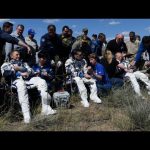
Tim Peake, NASA astronaut Tim Kopra and commander Yuri Malenchenko landed in the steppe of Kazakhstan on Saturday, 18 June in their Soyuz TMA-19M spacecraft at 09:15 GMT. The trio spent 186 days on the International Space Station.
The landing brings Tim Peake’s Principia mission to an end but the research continues. Tim is the eighth ESA astronaut to complete a long-duration mission in space. He was the third after Alexander Gerst and Andreas Mogensen to fly directly to ESA’s astronaut home base in Cologne, Germany, for medical checks and for researchers to collect more data on how Tim’s body and mind have adapted to living in space.
The first news conference with ESA astronaut Tim Peake on return to Earth after spending 186 days in space on the International Space Station on his Principia mission.
The media event was held at ESA’s astronaut centre in Cologne, Germany, 21 July just three days after landing on Earth. The European Astronaut Centre is the home base of all ESA astronauts
Tim Peake, NASA astronaut Tim Kopra and commander Yuri Malenchenko landed in the steppe of Kazakhstan on Saturday, 18 June in their Soyuz TMA-19M spacecraft.
The landing brings Tim Peake’s Principia mission to an end but the research continues. Tim is the eighth ESA astronaut to complete a long-duration mission in space. He is the third after Alexander Gerst and Andreas Mogensen to fly directly to the European Astronaut Centre for medical checks and for researchers to collect more data on how Tim’s body and mind have adapted to living in space.
ESA astronaut Tim Peake, NASA astronaut Tim Kopra and commander Yuri Malenchenko landed in the steppe of Kazakhstan on Saturday, 18 June in their Soyuz TMA-19M spacecraft. The trio spent 186 days on the International Space Station. The landing brings Tim Peake’s Principia mission to an end but the research continues. Tim is the eighth ESA astronaut to complete a long-duration mission in space. He is the third after Alexander Gerst and Andreas Mogensen to fly directly to ESA’s astronaut home base in Cologne, Germany, for medical checks and for researchers to collect more data on how Tim’s body and mind have adapted to living in space.
Expedition 47 Commander Tim Kopra of NASA, Soyuz Commander Yuri Malenchenko of Roscosmos and Flight Engineer Tim Peake of ESA (European Space Agency) were greeted in a traditional ceremony in Kazakhstan June 18, a few hours after their safe return to Earth from a 186 day mission on the International Space Station.
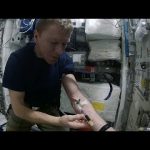
ESA astronaut Tim Peake shows how to draw blood for research on the International Space Station. Researchers often request samples before, during and after a spaceflight to examine differences.
The tubes of blood are put in a refrigerated centrifuge and then stored in the International Space Station’s –80°C freezer called MELFI for later analysis on Earth.
ESA astronaut Tim Peake set out to discover if he could make himself dizzy on board the International Space Station. His NASA crewmate Tim Kopra lent a hand to put Tim in a spin.
When astronauts first arrive in space, they usually feel pretty rough for about the first 24 hours. They report feeling dizzy, disorientated and sometimes nauseous. This has to do with the vestibular system. In microgravity the fluid in the inner ear is floating and so the brain is getting mixed signals compared to what the eyes are seeing. After about 24 to 48 hours, the brain starts relying more on information that is coming from the eyes. Once this happens, in theory, their brain is better able to cope with all kinds of different orientations and of course spinning…
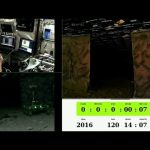
On 29 April 2016, ESA astronaut Tim Peake on the International Space Station took control of a rover, nicknamed ‘Bridget’, in the UK and over two hours drove it into a simulated cave and found and identified targets despite the dark and limited feedback information.
Before and after Tim came online from the orbiting Station, control of the rover was passed several times between engineers at the Airbus D&S ‘Mars Yard’ in Stevenage, UK, Belgium’s ISS User Support Centre in Brussels and ESA’s ESOC operations centre in Darmstadt, Germany. This complex real-time choreography was possible thanks to the ‘Internet in space’ – a network that tolerates disruptions – put in place by teams at ESOC. This network enables remote control of rovers or other devices in the difficult environment of space, with its long distances and frequent connection blackouts inevitable with orbital motion.
During the experiment, a representative mission scenario was set up in which the rover was commanded to go from a lit environment into a challenging dark location (simulating a cave or a shaded crater) and identified a number of science targets. The Mars yard (30 x 13 m) was split into two areas, one lit and one in the dark. From one end of the yard, Bridget was commanded from ESOC until it reached the edge of the shaded area. Then at the edge of the ‘cave’, control was passed to astronaut Tim Peake, on board the Station, who controlled Bridget to drive across the yard, avoiding obstacles and identifying potential science targets, which were marked with a distinctive ultraviolet fluorescent marker. Once the targets were identified and mapped, Tim drove the rover out of the shaded area and handed control back to ESOC, who drove the rover back to its starting point.
This video is a compressed extract that includes highlights of the experiment and includes scenes of the network control centre at ESOC, the Mars Yard at Stevenage and Tim Peake on the ISS. On audio, the voices of astronaut Time Peake, Lionel Ferra, the Eurocom ‘capcom’ controller at ESA’s Astronaut Centre in Cologne, Germany, and Kim Nergaard, the ground segment manager at ESOC, can be heard periodically.
ESA astronaut Tim Peake shares his views of Earth and his six-month Principia mission while on the International Space Station. Narrated by Tim himself taken from interviews while in space, this video shows the best views, experiments and shares the experience of Tim’s life in space.
Gyroscopes form an important in keeping the International Space Station and satellites pointing the right way as they orbit our planet.
ESA astronaut Tim Peake shows how gyroscopes can be used to keep spacecraft stable during his six-month Principia mission.
There is no up or down in space. Satellites track their pointing direction using the same approach as on submarines and aircraft: fast-spinning gyroscopes that maintain a fixed orientation in the same way as a child’s spinning top. The International Space Station has four big gyroscopes which are used for stabilization of the Station.
“If I have seen further, it is by standing on the shoulders of giants” is the famous quote by renowned scientist Sir Isaac Newton. This is particularly apt as a title for this video summary of ESA astronaut Tim Peake’s Principia mission – named after Newton’s monumental work Philosophiae Naturalis Principia and now building on the work of previous European astronaut missions, while being supported by a huge team of scientists and engineers on the ground.
The music accompanying this video was chosen by Tim, coming from the soundtrack of one of his favourite films, the 2004 movie Layer Cake. This piece is called ‘Drive to the Boatyard’, by internationally known British film composer Ilan Eshkeri. Ilan provided a slightly extended piece specially for ESA.
Tim comments: “I’m delighted with this video, which captures the essence of human spaceflight and natural beauty of our planet from space – all put to Ilan’s inspiring soundtrack!”
Ever wondered what happens inside the International Space Station during a reboost? ESA astronaut Tim Peake filmed inside during last week’s firing of the Progress thrusters.
Even at 400 km, there are still enough molecules of the atmosphere to create some ‘atmospheric drag’, which causes the Station to drop by about 2 km a month. Because of this we need to raise the Station’s orbit every so often. On 17 February the engines of the Progress M-29M spacecraft that is docked to the aft port of the Zvezda module were fired for 11 minutes.
The burn primarily focused on raising the Station’s perigee, making the orbit more circular.
Pre-reboost: 398.2 x 407.4 km – inclination 51.64° – Period: 92.62min
Post-reboost: 402.1 x 406.9 km – inclination 51.64° – Period: 92.66min
ESA astronaut Tim Peake shows the cleaning duties on the International Space Station. Every Saturday all astronauts living in the weightless research laboratory spend the morning cleaning.
Tim’s six-month mission in space is called Principia: www.esa.int/Principia
ESA astronaut Tim Peake brushing his teeth in space during his six-month Principia mission on the International Space Station. A morning and evening ritual even astronauts cannot escape.
On 15 January ESA astronaut Tim Peake and NASA astronaut Tim Kopra stepped outside of the International Space Station to replace a failed power regulator and install cabling.
The meticulously planned and executed sortie was stopped early after Tim Kopra reported a small amount of water building up in his helmet. The two Tims worked in close cooperation with each other to return to the Space Station, with NASA commander Scott Kelly and cosmonaut Sergei Volkov waiting inside to help them out of their suits.
They left the confines of the weightless research laboratory at 12:48 GMT after their five-hour preparations to don their spacesuits and purge their bodies of nitrogen to avoid decompression sickness.
Tim Kopra went first to the far end of the Station’s starboard truss, with Tim Peake following with the replacement Sequential Shunt Unit. Swapping the suitcase-sized box was a relatively simple task but one that needed to be done safely while the clock was ticking.
With their main task complete, the Tims separated for individual jobs for the remainder of their time outside but was told by Mission Control to return to the airlock earlier than planned.
The 4 hour 43 minute spacewalk was the first for a British astronaut. The spacewalk officially ended at 17:31 GMT when the Tims began the repressurisation of the Quest airlock.
ESA astronaut Tim Peake, NASA astronaut Tim Kopra and commander Yuri Malenchenko were launched into space 15 Decemeber 11:03 GMT from Baikonur cosmodrome, Kazakhstan.The launch marks the start of Tim Peake’s six-month Principia mission on the International Space Station running over 30 scientific experiments for ESA.Follow Tim Peake viatimpeake.esa.int and follow the whole mission on ESA’sPrincipia blog.
Replay of our ‘Out of this world’ Google hangout between ESA astronaut Tim Peake and pupils from Rode Heath Primary from Cheshire, UK.
On Wednesday 25 February at 11:00 CET (10:00 GMT) Tim spoke to Rode Heath as part of their ‘Out of this world’ project. Hosted by Manchester Metropolitan University, representatives from all year groups at Rode Heath asked Tim their questions.
Tim is currently training for launch to the International Space Station on 20 November 2015. He will spend six months living and working on the ISS for his Principia mission.