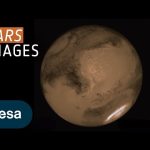
On 12 March 2025, ESA’s Hera spacecraft soared just 5000 km above Mars and passed within 300 km of its distant moon, Deimos. Captured by Hera’s 1020×1020 pixel Asteroid Framing Camera, this video sequence offers a rare view of the red planet and its enigmatic moon. The original greyscale images have been colour-enhanced based on known surface features.
We are Europe’s gateway to space. Our mission is to shape the development of Europe’s space capability and ensure that investment in space continues to deliver benefits to the citizens of Europe and the world. Check out https://www.esa.int/ to get up to speed on everything space related.
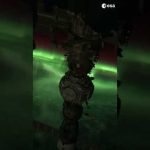
Timelapse of the International Space Station flying into a stunning aurora borealis. Shared by ESA astronaut Samantha Cristoforetti on her TikTok on 18 September 2022.
Fly over Mercury with BepiColombo for the final time during the mission’s epic expedition around the Sun. The ESA/JAXA spacecraft captured these images of the Solar System’s smallest planet on 7 and 8 January 2025, before and during its sixth encounter with Mercury. This was its final planetary flyby until it enters orbit around the planet in late 2026.
The video begins with BepiColombo’s approach to Mercury, showing images taken by onboard monitoring cameras 1 and 2 (M-CAM 1 and M-CAM 2) between 16:59 CET on 7 January and 01:45 CET on 8 January. During this time, the spacecraft moved from 106 019 to 42 513 km from Mercury’s surface. The view from M-CAM 1 is along a 15-metre-long solar array, whereas M-CAM 2 images show an antenna and boom in the foreground.
After emerging into view from behind the solar array, Mercury appears to jump to the right. Both the spacecraft and its solar arrays rotated in preparation for passing through Mercury’s cold, dark shadow.
For several hours after these first images were taken, the part of Mercury’s surface illuminated by the Sun was no longer visible from the M-CAMs. BepiColombo’s closest approach to Mercury took place in darkness at 06:58:52 CET on 8 January, when it got as close as 295 km.
Shortly after re-emerging into the intense sunlight, the spacecraft peered down onto the planet’s north pole, imaging several craters whose floors are in permanent shadow. The long shadows in this region are particularly striking on the floor of Prokofiev crater (the largest crater to the right of centre) – the central peak of that crater casts spiky shadows that exaggerate the shape of this mountain.
Next, we have a beautiful view of Mercury crossing the field of view from left to right, seen first by M-CAM 1 then by M-CAM 2 between 07:06 and 07:49 CET. These images showcase the planet’s northern plains, which were smoothed over billions of years ago when massive amounts of runny lava flowed across Mercury’s cratered surface.
The background music is The Hebrides overture, composed by Felix Mendelssohn in 1830 after being inspired by a visit to Fingal’s Cave, a sea cave created by ancient lava flows on the island of Staffa, Scotland. Similarly shaped by lava is Mercury’s Mendelssohn crater, one of the large craters visible passing from left to right above the solar array in M-CAM 1’s views, and at the very bottom of M-CAM 2’s views. The Mendelssohn crater was flooded with lava after an impact originally created it.
The end of the video lingers on the final three close-up images that the M-CAMs will ever obtain of Mercury. The cameras will continue to operate until September 2026, fulfilling their role of monitoring various parts of the spacecraft. After that point, the spacecraft module carrying the M-CAMs will separate from BepiColombo’s other two parts, ESA’s Mercury Planetary Orbiter (MPO) and JAXA’s Mercury Magnetospheric Orbiter (Mio). MPO’s much more powerful science cameras will take over from the M-CAMs, mapping Mercury over a range of colours in visible and infrared light.
Credits: ESA/BepiColombo/MTM Acknowledgements: Thank you to external collaborators Emanuele Simioni (INAF), Valentina Galluzzi (INAF), Jack Wright (Open University), and David Rothery (Open University) for their involvement in image sequence planning.
★ Subscribe: http://bit.ly/ESAsubscribe and click twice on the bell button to receive our notifications.
We are Europe’s gateway to space. Our mission is to shape the development of Europe’s space capability and ensure that investment in space continues to deliver benefits to the citizens of Europe and the world. Check out https://www.esa.int/ to get up to speed on everything space related.
Watch the closest flyby of a planet ever, as the ESA/JAXA BepiColombo spacecraft sped past Mercury during its latest encounter on 4 September 2024.
This flyby marked BepiColombo’s closest approach to Mercury yet, and for the first time, the spacecraft had a clear view of Mercury’s south pole.
This timelapse is made up of 128 different images captured by all three of BepiColombo’s monitoring cameras, M-CAM 1, 2 and 3. We see the planet move in and out of the fields of view of M-CAM 2 and 3, before M-CAM 1 sees the planet receding into the distance at the end of the video. The first few images are taken in the days and weeks before the flyby. Mercury first appears in an image taken at 23:50 CEST (21:50 UTC) on 4 September, at a distance of 191 km. Closest approach was at 23:48 CEST at a distance of 165 km.
The sequence ends around 24 hours later, on 5 September 2024, when BepiColombo was about 243 000 km from Mercury.
During the flyby it was possible to identify various geological features that BepiColombo will study in more detail once in orbit around the planet. Four minutes after closest approach, a large ‘peak ring basin’ called Vivaldi came into view.
This crater was named after the famous Italian composer Antonio Vivaldi (1678–1741). The flyover of Vivaldi crater was the inspiration for using Antonio Vivaldi’s ‘Four Seasons’ as the soundtrack for this timelapse.
Peak ring basins are mysterious craters created by powerful asteroid or comet impacts, so-called because of the inner ring of peaks on an otherwise flattish floor.
A couple of minutes later, another peak ring basin came into view: newly named Stoddart. The name was recently assigned following a request from the M-CAM team, who realised that this crater would be visible in these images and decided it would be worth naming considering its potential interest for scientists in the future.
BepiColombo’s three monitoring cameras provided 1024 x 1024 pixel snapshots. Their main purpose is to monitor the spacecraft’s various booms and antennas, hence why we see parts of the spacecraft in the foreground. The photos that they capture of Mercury during the flybys are a bonus.
The 4 September gravity assist flyby was the fourth at Mercury and the seventh of nine planetary flybys overall. During its eight-year cruise to the smallest and innermost planet of the Solar System, BepiColombo makes one flyby at Earth, two at Venus and six at Mercury, to help steer itself on course for entering orbit around Mercury in 2026.
BepiColombo is an international collaboration between ESA and JAXA.
Processing notes: The BepiColombo monitoring cameras provide 1024 x 1024 pixel images. These raw images have been lightly processed. The M-CAM 1 images have been cropped to 995 x 995 pixels.
Credits: ESA/BepiColombo/MTM Acknowledgements: Image processing and video production by Mark McCaughrean
★ Subscribe: http://bit.ly/ESAsubscribe and click twice on the bell button to receive our notifications.
We are Europe’s gateway to space. Our mission is to shape the development of Europe’s space capability and ensure that investment in space continues to deliver benefits to the citizens of Europe and the world. Check out https://www.esa.int/ to get up to speed on everything space related.
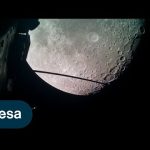
On 19–20 August 2024, Juice successfully completed a world-first lunar-Earth flyby, with flight controllers guiding the spacecraft first past the Moon, then past Earth. The gravity of the two changed Juice’s speed and direction, sending it on a shortcut to Jupiter via Venus.
The closest approach to the Moon was at 23:15 CEST on 19 August, deflecting Juice towards a closest approach to Earth just over 24 hours later at 23:56 CEST on 20 August. In the hours before and after both close approaches, Juice’s two monitoring cameras captured photos, giving us a unique ‘Juice eye view’ of our home planet.
Juice’s two monitoring cameras provide 1024 x 1024 pixel snapshots that can be processed in colour. Their main purpose is to monitor the spacecraft’s various booms and antennas, especially during the challenging period after launch. The photos they captured of the Moon and Earth during the lunar-Earth flyby are a bonus.
The piece of music that accompanies the images is called 11,2 km/s. It was composed by Gautier Acher back in 2015, and selected as the official theme music for ESA’s Estrack ground station network to mark its 40th anniversary (more information). The music is available under a CC BY-NC-SA licence.
Processing notes: The Juice monitoring cameras provide 1024 x 1024 pixel images. Upscaling software was used to convert the images into 2160 x 2160 pixel images, which match the 3480 x2160 pixel resolution of the 4K movie format.
Credits: ESA – European Space Agency Acknowledgements: Simeon Schmauß & Mark McCaughrean
★ Subscribe: http://bit.ly/ESAsubscribe and click twice on the bell button to receive our notifications.
We are Europe’s gateway to space. Our mission is to shape the development of Europe’s space capability and ensure that investment in space continues to deliver benefits to the citizens of Europe and the world. Check out https://www.esa.int/ to get up to speed on everything space related.
Timelapse video made during ESA astronaut Samantha Cristoforetti’s second mission to the International Space Station, “Minerva”. This timelapse was recorded looking aft (out from the rear) of the Space Station, showing the aurora shimmering away beyond the horizon.
★ Subscribe: http://bit.ly/ESAsubscribe and click twice on the bell button to receive our notifications.
We are Europe’s gateway to space. Our mission is to shape the development of Europe’s space capability and ensure that investment in space continues to deliver benefits to the citizens of Europe and the world. Check out https://www.esa.int/ to get up to speed on everything space related.
At Europe’s Spaceport in French Guiana, a test model of the Ariane 6’s central core has been assembled for the first time. Ariane 6 is the first Ariane rocket to be assembled horizontally, which is simpler and less costly than more traditional vertical assembly. One of the P120C boosters can be seen from different angles during installation, before the rocket’s central core is moved to its launchpad and placed upright in its mobile gantry. With the central core and boosters in place, combined tests validate compatibility between all components of the complete launch system.
★ Subscribe: http://bit.ly/ESAsubscribe and click twice on the bell button to receive our notifications.
We are Europe’s gateway to space. Our mission is to shape the development of Europe’s space capability and ensure that investment in space continues to deliver benefits to the citizens of Europe and the world. Check out https://www.esa.int/ to get up to speed on everything space related.
ESA’s new Vega-C rocket lifted off for its inaugural flight VV21 at 15:13 CEST/13:13 UTC/10:13 local time from Europe’s Spaceport in French Guiana. With new first and second stages and an uprated fourth stage, Vega-C increases performance to about 2.3 t in a reference 700 km polar orbit, from the 1.5 t capability of its predecessor, Vega. For flight VV21, Vega-C’s payload is LARES-2, a scientific mission of @AsiTVit and six research CubeSats from France, Italy and Slovenia.
We are Europe’s gateway to space. Our mission is to shape the development of Europe’s space capability and ensure that investment in space continues to deliver benefits to the citizens of Europe and the world. Check out https://www.esa.int/ to get up to speed on everything space related.
The James Webb Space Telescope lifted off on an Ariane 5 rocket from Europe’s Spaceport in French Guiana, at 13:20 CET on 25 December 2021 on its exciting mission to unlock the secrets of the Universe.
This timelapse shows highlights of the launch campaign from the arrival of Webb in French Guiana through to liftoff.
Every launch requires meticulous planning and preparation. For Webb, this process began about 15 years ago. Webb arrived from California on board the MN Colibri which sailed the Panama Canal to Pariacabo harbour in French Guiana. The shallow Kourou river was specially dredged to ensure a clear passage and the vessel followed high tide to safely reach port on 12 October 2021.
Though the telescope weighs only six tonnes, it was more than 10.5 m high and almost 4.5 m wide when folded. At Europe’s Spaceport it was unpacked inside a dedicated spacecraft preparation facility fitted with walls of air filters to protect the telescope from contamination during preparations for launch.
After its arrival in the final assembly building, Webb was lifted slowly about 40 m high and then carefully manoeuvred on top of Ariane 5 – one of the most delicate operations during the entire launch campaign. A ‘shower curtain’ about 12 m high and 8 m in diameter was installed in between two platforms, to create a closed-off space around Webb to avoid any contamination.
On the day of encapsulation, the fairing was lowered over the observatory and locked in place for liftoff. A laser guiding system assisted this particularly delicate operation for a perfect fit inside Ariane 5’s fairing.
Ariane 5 with Webb was rolled out from the final assembly building to the launch pad on 22 December. On 25 December, Ariane 5 performed the flawless launch of this once in a generation mission. Ariane 5’s highly precise launch meant that Webb saved its own fuel which can be used to significantly extend its expected lifetime of 10 years.
Webb is the largest, most powerful telescope ever launched into space. As part of an international collaboration agreement, ESA has provided the telescope’s launch service using the Ariane 5 launch vehicle. Working with partners, ESA was responsible for the development and qualification of Ariane 5 adaptations for the Webb mission and for the procurement of the launch service by @arianespace. ESA has also provided the workhorse spectrograph NIRSpec and 50% of the mid-infrared instrument MIRI, in collaboration with the University of Arizona. Webb is an international partnership between @NASA, ESA and the @Canadian Space Agency.
We are Europe’s gateway to space. Our mission is to shape the development of Europe’s space capability and ensure that investment in space continues to deliver benefits to the citizens of Europe and the world. Check out https://www.esa.int/ to get up to speed on everything space related.
A collection of the best timelapse videos made during ESA astronaut Thomas Pesquet’s second mission to the International Space Station, “Alpha” in 2021. The camera is setup to take pictures at intervals of two a second, and the pictures are then edited into this video that plays at 25 pictures a second. Most videos around 12 times faster than real speed.
Thomas shared this video on social media with the caption:
“Probably the last the timelapse from space, and fittingly here is a special edition “best of” montage: aurora, lightning, spacewalks, day views and spacecraft reentry in less than five minutes. Get comfy, cast it to your largest screen in the house and enjoy!”
Over 200 experiments are planned during Thomas’ time in space, with 40 European ones and 12 new experiments led by the French space agency @CNES.
We are Europe’s gateway to space. Our mission is to shape the development of Europe’s space capability and ensure that investment in space continues to deliver benefits to the citizens of Europe and the world. Check out https://www.esa.int/ to get up to speed on everything space related.
Timelapse video made during ESA astronaut Thomas Pesquet’s second mission to the International Space Station, “Alpha”. On 17 October 2021 at 01:14 GMT the Soyuz MS-18 undocked from the Space Station to return to Earth, inside were @Roscosmos Media cosmonaut Oleg Novitskiy (who had spent 191 days in space) and actress Yulia Peresild and Russian producer-director Klim Shipenko (who both spent 11 days in space). The trio landed on Earth just over three hours later. The camera for this timelapse was setup to take pictures at intervals of two a second, and the pictures are then edited into this video that plays at 25 pictures a second. The video is around 12 times faster than real speed.
Thomas shared this video on social media with the caption:
“Soyuz MS-18 departing two weekends ago already. Oleg left with Yulia and Klim and I see pictures of them back looking happy and healthy back on Earth. they were only in space for a few days though, a business trip, more than an expedition, for us and Oleg it will be a bit different: the physical and social readapting to Earth will require some work. This is a timelapse so it moves 12 times faster than in reality. I wasn’t the only one to film in the Cupola, and where the image shakes a bit is when one of my crewmates bumped the tripod! ”
Over 200 experiments are planned during Thomas’ time in space, with 40 European ones and 12 new experiments led by the French space agency @CNES.
We are Europe’s gateway to space. Our mission is to shape the development of Europe’s space capability and ensure that investment in space continues to deliver benefits to the citizens of Europe and the world. Check out https://www.esa.int/ to get up to speed on everything space related.
Time lapse of the stacking of the Orion spacecraft on top of the fully assembled Space Launch System (SLS) rocket at NASA’s Kennedy Space Center in Florida, on 21 October 2021, in preparation for the uncrewed Artemis I launch.
For Artemis I, the European Service Module will take the spacecraft more than 64 000 km beyond the Moon in a test flight to demonstrate its capabilities.
The European Service Module is ESA’s contribution to NASA’s Orion spacecraft that will send astronauts to the Moon and beyond. It provides electricity, water, oxygen and nitrogen as well as keeping the spacecraft at the right temperature and on course.
We are Europe’s gateway to space. Our mission is to shape the development of Europe’s space capability and ensure that investment in space continues to deliver benefits to the citizens of Europe and the world. Check out https://www.esa.int/ to get up to speed on everything space related.
Timelapse video made during ESA astronaut Thomas Pesquet’s second mission to the International Space Station, “Alpha”. The camera is setup to take pictures at intervals of two a second, and the pictures are then edited into this video that plays at 25 pictures a second. The video is around 12 times faster than real speed.
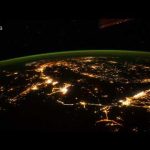
Thomas shared this video on social media with the caption: “A night #timelapse over South-East Asia. Green lights of squid fishing, bright city lights of Hong Kong and Shanghai followed by Seoul until the border of the Korean peninsula closes on a pitch black DPRK.”
Over 200 experiments are planned during Thomas’ time in space, with 40 European ones and 12 new experiments led by the French space agency #CNES.
Latest updates on the Alpha mission can be found via @esaspaceflight on Twitter, with more details on ESA’s exploration blog via thomaspesquet.esa.int.
Background information on the Alpha mission is available at www.esa.int/MissionAlpha with a brochure at www.esa.int/AlphaBrochure.
★ Subscribe: http://bit.ly/ESAsubscribe and click twice on the bell button to receive our notifications.
We are Europe’s gateway to space. Our mission is to shape the development of Europe’s space capability and ensure that investment in space continues to deliver benefits to the citizens of Europe and the world. Check out https://www.esa.int/ to get up to speed on everything space related.
Watch over one hour of our planet, seen from the International Space Station, in 4K resolution. This compilation was made from video taken by ESA astronauts, mostly by Thomas Pesquet during his first mission, Proxima, and ESA astronaut Alexander Gerst on his second mission, Horizons, as well as footage from Samantha Cristoforetti’s Futura mission and Paolo Nespoli’s Vita mission.
Flying 400 km above our amazing planet Earth, the Space Station travels at 28 800 km/h to stay in orbit. The videos are in real time and not sped up or edited. Most of the scenes were filmed in the European-built Cupola module, the Space Station’s observatory.
On 21 April 2001, the first ESA astronaut Umberto Guidoni arrived at the Space Station. Since then, the Space Station has grown immensely, as have the number of Europeans to have worked in it, together with the science experiments performed in orbit.
Europe contributes around 8% of the running costs of the International Space Station, but has built a large part of the structure, including ESA’s Columbus laboratory, the Cupola observatory, the Tranquillity and Harmony modules, as well as the computers that collect data and provide navigation, communications and operations for the Russian segment.
ESA also provided the Space Station with supplies and boosted its orbit through five Automated Transfer Vehicles, the heaviest and most versatile Space Station supply ferry. This programme evolved into the European Service Modules that ESA is supplying for @NASA’s Artemis programme, taking humans forward to the Moon and thus continuing the exemplary international collaboration beyond Earth’s orbit.
Since Umberto’s mission, there have been 26 further ESA astronaut missions to the International Space Station, with astronauts flying to Station on either the Russian Soyuz or US Space Shuttle spacecraft.
Thomas Pesquet’s second mission, Alpha, is the 28th mission for ESA, with ESA astronaut Matthias Maurer already lined up for his first flight later this year, and ESA astronaut Samantha Cristoforetti scheduled for the 30th ESA International Space Station mission in 2022.
★ Subscribe: http://bit.ly/ESAsubscribe and click twice on the bell button to receive our notifications.
We are Europe’s gateway to space. Our mission is to shape the development of Europe’s space capability and ensure that investment in space continues to deliver benefits to the citizens of Europe and the world. Check out https://www.esa.int/ to get up to speed on everything space related.
Capturing a spacecraft requires a complex choreography between human and machine, but these two make it look easy. In this video ESA astronaut Thomas Pesquet and @NASA astronaut Megan McArthur work together to grapple and berth the @Northrop Grumman Cygnus 16 spacecraft on the Earth-facing port of the Unity module on the International Space Station.
At 12:07 CEST (11:07 BST) Thursday 12 August, Megan used the International Space Station’s robotic Canadarm2 to grapple the spacecraft packed with over 3700 kg of science and supplies as Thomas monitored Cygnus systems during its approach.
The Cygnus will remain docked to the Station for about three months before it departs in November 2021.
We are Europe’s gateway to space. Our mission is to shape the development of Europe’s space capability and ensure that investment in space continues to deliver benefits to the citizens of Europe and the world. Check out https://www.esa.int/ to get up to speed on everything space related.
The Pirs docking compartment (also called DC-1) left the International Space Station together with the Progress MS-16 cargo spacecraft after 20 years of service and burned up safely in the atmosphere above the Pacific Ocean on 26 July 2021. Its departure made room for the Nauka science module.
European Space Agency astronaut, Thomas Pesquet, filmed this video and shared on social media with the caption: “Here’s a timelapse of DC1’s re-entry last week, together with its tow truck, Progress 77P, seen from above. Atmospheric re-entry without a heat shield results in a nice fireball (you clearly see smaller pieces of melting metal floating away and adding to the fireworks). This timelapse is sped up, we could observe the fireball for around six minutes. Next time you see a shooting star, it might be our ISS trash getting burnt up… Not sure it will be granted in that case, but you never know, I’d still advise to go ahead and make a wish.”
We are Europe’s gateway to space. Our mission is to shape the development of Europe’s space capability and ensure that investment in space continues to deliver benefits to the citizens of Europe and the world. Check out https://www.esa.int/ to get up to speed on everything space related.
ESA’s Jupiter Icy moons Explorer, Juice, has successfully completed rigorous thermal tests simulating the extreme coldness of space and the warmth of the Sun at ESA’s test centre ESTEC, in The Netherlands.
The spacecraft underwent a month of round-the-clock testing and monitoring in the Large Space Simulator, which recreates the vacuum of space and is able to simulate both hot and cold space environments. The spacecraft was subjected to temperatures ranging from 250 degrees to minus 180 degrees Celsius, showing that it can survive its journey in space.
Juice will launch in 2022 to our Solar System’s largest planet. It will spend over four years studying Jupiter’s atmosphere, magnetosphere and its icy moons Europa, Callisto and Ganymede, investigating whether the moons’ subsurface oceans are habitable for life.
We are Europe’s gateway to space. Our mission is to shape the development of Europe’s space capability and ensure that investment in space continues to deliver benefits to the citizens of Europe and the world. Check out https://www.esa.int/ to get up to speed on everything space related.
Timelapse video made during ESA astronaut Thomas Pesquet’s second mission to the International Space Station, “Alpha”.
ESA astronaut Thomas Pesquet and @NASA astronaut Shane Kimbrough performed three spacewalks in the span of 10 days to install two new solar arrays that will generate more electricity on the International Space Station.
The third and final spacewalk for the duo happened on June 25 to finish installing the second pair of new solar arrays. This spacewalk proceeded without problems, and the two new solar arrays are already working and supplying power to the Space Station.
The design of the new solar arrays will be used to power the lunar Gateway that will be built in an orbit around the Moon – the next outpost in space for the agencies that run the International Space Station.
Thomas has now spent exactly 33 hours on spacewalks, all with Shane over the course of two spaceflights.
Thomas posted this video on his social media channels with the caption: “Aki took another great timelapse of our last spacewalk to install the new solar panels… for now. Four more are set to be installed, but they are not on the Station yet. This timelapse is great because it shows how small we are compared to the huge layout of the Space Station (it is about the same size as a football field – both types: American football or actually-using-your-feet-football fields). Note how the solar arrays we are working on don’t move, this is because they were turned off and not following the Sun so were not generating power. As an extra precaution we didn’t connect the power cables until darkness!”
Over 200 experiments are planned during Thomas’ time in space, with 40 European ones and 12 new experiments led by the French space agency @CnesFrance.
We are Europe’s gateway to space. Our mission is to shape the development of Europe’s space capability and ensure that investment in space continues to deliver benefits to the citizens of Europe and the world. Check out https://www.esa.int/ to get up to speed on everything space related.
The ESA Jupiter Icy Moons Explorer (Juice) team has been working very hard to prepare the spacecraft for the first test in the one-year long environmental test campaign. This is the so-called Thermal Balance Thermal Vacuum (TBTV) test.
Juice is in the Large Space Simulator (LSS), a unique facility in Europe (run by the European Test Center, at ESA/ESTEC in the Netherlands) that can simulate the vacuum and cold and hot temperature conditions in space, and also the Sun itself!
The TBTV started on 17 June with the closure of the LSS and the “pumping-down”, meaning the removal of air within the chamber to a pressure level of 10nbar (1/100 000 000th of the outside air pressure). This is the closest Juice will come to space conditions while on Earth. It will undergo 24/7 testing, ending on 16 July 2021.
In this episode this process is followed and several team members comment on the different moments.
Produced for ESA by Lightcurve Films. GoPro footage by ESA. Original music by William Zeitler.
★ Subscribe: http://bit.ly/ESAsubscribe and click twice on the bell button to receive our notifications.
We are Europe’s gateway to space. Our mission is to shape the development of Europe’s space capability and ensure that investment in space continues to deliver benefits to the citizens of Europe and the world. Check out https://www.esa.int/ to get up to speed on everything space related.
Timelapse video made during ESA astronaut Thomas Pesquet’s second mission to the International Space Station, “Alpha”.
On Sunday 20 June 2021 Thomas and @NASA astronaut Shane Kimbrough were helped into their spacesuits again for their fourth spacewalk together. This time it was to complete installation of the first new solar array and get ahead on the second.
During this spacewalk the duo unfolded the solar arrays that are rolled into tubes for transport, aligned them, connected data cables and secured them to the mounting bracket. Connecting the power lines must be done during the orbital night-time as a precaution to avoid any chance of electric shock.
As Thomas and Shane waited for the night to arrive, Shane’s helmet lights and camera partially detached from his helmet but Thomas used some wire to successfully reattach them as a temporary fix.
From there the spacewalk went smoothly. Shane and Thomas connected the new solar array, watched it unfurl and prepared for the installation of the second new solar array. The second spacewalk lasted 6 hours and 28 minutes, with the duo arriving back at the airlock at 20:10 CEST (19:10 BST).
This video shows scenes from this spacewalk. The images for this timelapse were taken by @JAXA | 宇宙航空研究開発機構 astronaut and Space Station commander Aki Hoshide.
Thomas posted this video on his social media with the caption: “We have to do EVAs, but someone has to keep running the Space Station while we are preparing, spacewalking, reconfiguring, preparing again… Aki has been rock solid taking care of the spaceship pretty much by himself, performing all the maintenance and the science experiments, AND ON TOP OF THAT he found the time to take timelapses of our little walks outside. The man is a machine!”
Over 200 experiments are planned during Thomas’ time in space, with 40 European ones and 12 new experiments led by the French space agency @CNES.
We are Europe’s gateway to space. Our mission is to shape the development of Europe’s space capability and ensure that investment in space continues to deliver benefits to the citizens of Europe and the world. Check out https://www.esa.int/ to get up to speed on everything space related.
Timelapse video made during ESA astronaut Thomas Pesquet’s second mission to the International Space Station, “Alpha”.
On 16 June 2021 Thomas and @NASA astronaut Shane Kimbrough went on a spacewalk to install a new solar array for the International Space Station. These arrays, called IROSA for ISS Roll-Out Solar Array, had to be taken from their storage area outside the Space Station and passed from spacewalker to spacewalker to the worksite. There the rolled arrays were to be secured, unfolded, connected and then unfurled.
During the spacewalk a small technical problem in Shane’s spacesuit required him to return to the airlock and restart his Display and Control Module. This module provides astronauts with continuous information on pressure, temperature and other vital data during a spacewalk. Though the restart was successful and Shane was in no danger, it delayed the duo’s work, preventing them from completing installation of the first new solar array as planned. A second spacewalk was done on 20 June to finish installing the first solar array.
This video shows scenes from the first spacewalk with Thomas being moved on the robotic arm, at the controls was NASA astronaut Megan McArthur. The images for this timelapse were taken by @JAXA | 宇宙航空研究開発機構 astronaut and Space Station commander Aki Hoshide.
Thomas posted this video on his social media with the caption: “We have to do EVAs, but someone has to keep running the Space Station while we are preparing, spacewalking, reconfiguring, preparing again… Aki has been rock solid taking care of the spaceship pretty much by himself, performing all the maintenance and the science experiments, AND ON TOP OF THAT he found the time to take timelapses of our little walks outside. The man is a machine!”
Over 200 experiments are planned during Thomas’ time in space, with 40 European ones and 12 new experiments led by the French space agency @CNES
We are Europe’s gateway to space. Our mission is to shape the development of Europe’s space capability and ensure that investment in space continues to deliver benefits to the citizens of Europe and the world. Check out https://www.esa.int/ to get up to speed on everything space related.
An instrument destined for Jupiter orbit undergoes eight days of cryogenic radio-frequency testing using a new test facility at ESA’s ESTEC technical centre in the Netherlands. The Submillimetre Wave Instrument of ESA’s Juice mission will survey the churning atmosphere of Jupiter and the scanty atmospheres of its Galilean moons.
Testing took place in ESA’s custom-built Low-temperature Near-field Terahertz chamber, or Lorentz. The first chamber of its kind, the 2.8-m diameter Lorentz chamber can perform high-frequency radio-frequency testing in realistic space conditions, combining space-quality vacuum with ultra-low temperatures.
★ Subscribe: http://bit.ly/ESAsubscribe and click twice on the bell button to receive our notifications.
We are Europe’s gateway to space. Our mission is to shape the development of Europe’s space capability and ensure that investment in space continues to deliver benefits to the citizens of Europe and the world. Check out https://www.esa.int/ to get up to speed on everything space related.
This timelapse was filmed under the stars on the Ariane 6 launch base at Europe’s Spaceport in French Guiana.
Preparations are under way for the arrival of Ariane 6, Europe’s next-generation launch vehicle. Imagine yourself stepping out of the launcher assembly building or standing on the launch pad in front of the 90-metre high mobile gantry, to look at the stars.
Ariane 6, developed by ESA, has two versions depending on the required performance. This rocket will be capable of a wide range of missions to guarantee independent access to space for Europe and continue four decades of the Ariane adventure.
Credits: ESA – @CNES – @arianespace
★ Subscribe: http://bit.ly/ESAsubscribe and click twice on the bell button to receive our notifications.
We are Europe’s gateway to space. Our mission is to shape the development of Europe’s space capability and ensure that investment in space continues to deliver benefits to the citizens of Europe and the world. Check out https://www.esa.int/ to get up to speed on everything space related.
A timelapse from various angles of the launch of @SpaceX Falcon 9 with Crew Dragon Endeavour leaving Earth from Kennedy Space Center in Florida, USA.
The rocket lifted off at 10:49 BST (11:49 CEST, 05:49 local time) on 23 April 2021 from Launchpad 39A in Cape Canaveral with ESA astronaut Thomas Pesquet, @NASA astronauts Megan McArthur and Shane Kimbrough, and @JAXA | 宇宙航空研究開発機構 astronaut Akihiko Hoshide. On 24 April at 11:08 CEST the Crew-2 caught up with the International Space Station and docked with its Harmony module, marking the start of Thomas’ Alpha mission.
Thomas is the first ESA astronaut to fly in space in a vehicle other than the Russian Soyuz or the US Space Shuttle, and the first ESA astronaut to leave Earth from Florida, USA, in over a decade. This is his second flight, his first mission called Proxima saw Thomas fly to the Space Station on a Soyuz from Baikonur in Kazakhstan and his expedition broke records for amount of hours spent on research at the time.
We are Europe’s gateway to space. Our mission is to shape the development of Europe’s space capability and ensure that investment in space continues to deliver benefits to the citizens of Europe and the world. Check out https://www.esa.int/ to get up to speed on everything space related.
This timelapse video shows the hot firing model of the Ariane 6 upper stage being installed on the P5.2 test stand at the @DLR German Aerospace Center in Lampoldshausen, Germany on 16 February 2021.
After arrival from the @ArianeGroup facilities in Bremen, this 5.4 m-diameter upper stage was hoisted out of its container, tilted vertical and installed on the test stand.
Tests will simulate all aspects of flight including stage preparation such as fuelling with liquid oxygen and liquid hydrogen, and draining its tanks.
Data will be gathered on non-propulsive ballistic phases, tank pressurisation to increase performance, Vinci engine reignitions, exhaust nozzle manoeuvres, ending with passivation where all remaining internal energy is removed. Tests will typically last about 18 hours each.
★ Subscribe: http://bit.ly/ESAsubscribe and click twice on the bell button to receive our notifications.
We are Europe’s gateway to space. Our mission is to shape the development of Europe’s space capability and ensure that investment in space continues to deliver benefits to the citizens of Europe and the world. Check out https://www.esa.int/ to get up to speed on everything space related.
Enjoy this sped-up Earth view, captured by the Expedition 59 astronauts currently onboard the International Space Station. The station orbits the Earth every 90 minutes — meaning this sunset you see is actually one of 16 the station residents see each day!
This time-lapse video taken by NASA astronaut Nick Hague squeezes a 30-minute International Space Station trip over a cloudy Earth into 60 seconds, covering the Pacific to the Atlantic.
Following the launch of Aeolus on 22 August 2018, scientists have been busy fine-tuning and calibrating this latest Earth Explorer satellite. Aeolus carries a revolutionary instrument, which comprises a powerful laser, a large telescope and a very sensitive receiver. It works by emitting short, powerful pulses – 50 pulses per second – of ultraviolet light from a laser down into the atmosphere. The instrument then measures the backscattered signals from air molecules, dust particles and water droplets to provide vertical profiles that show the speed of the world’s winds in the lowermost 30 km of the atmosphere. These measurements are needed to improve weather forecasts. As part of the working being done to calibrate this novel mission, scientists have been taking similar measurements from an aircraft carrying an airborne version of Aeolus’ instrument. The pilot flies the plane under the satellite as it orbits above so that measurements of wind can be compared.
ESA is Europe’s gateway to space. Our mission is to shape the development of Europe’s space capability and ensure that investment in space continues to deliver benefits to the citizens of Europe and the world. Check out http://www.esa.int/ESA to get up to speed on everything space related.
This year saw ESA’s science exploration mission BepiColombo begin its seven year cruise to the innermost planet of our Solar System: Mercury. This timelapse recalls some of the preparations that went into readying the mission at Europe’s Spaceport in Kourou, French Guiana.
The mission, a joint endeavour between ESA and JAXA, comprises three spacecraft modules: ESA’s Mercury Planetary Orbiter and JAXA’s Mercury Magnetospheric Orbiter that will study all aspects of Mercury from their complementary orbits around the planet, and ESA’s Mercury Transfer Module that will bring them to the planet using a combination of solar electric propulsion and nine planetary flybys.
The video includes testing of the individual spacecraft units, stacking of the three modules and a protective sunshield into their launch configuration, integration of the spacecraft inside the launcher fairing, roll out to the launch pad, and finally launch itself. The mission lifted off at 01:45:28 GMT on 20 October 2018.
ESA is Europe’s gateway to space. Our mission is to shape the development of Europe’s space capability and ensure that investment in space continues to deliver benefits to the citizens of Europe and the world. Check out http://www.esa.int/ESA to get up to speed on everything space related.
Experience magical moments from ESA astronaut Alexander Gerst’s Horizons mission in this time-lapse of highlights from space.
Combining thousands of images taken by Alexander over more than six months, this Ultra High Definition video provides a glimpse into spacecraft operations and the beauty of Earth as seen from the International Space Station.
Marvel at orbital sunrises, dancing auroras, city lights, oceans, clouds, the Milky Way, the release of cargo vehicles, a Soyuz launch and more against the thin band of atmosphere that surrounds our planet.
ESA is Europe’s gateway to space. Our mission is to shape the development of Europe’s space capability and ensure that investment in space continues to deliver benefits to the citizens of Europe and the world. Check out http://www.esa.int/ESA to get up to speed on everything space related.
This is what three astronauts being launched into space looks like – seen from space. ESA astronaut Alexander Gerst took this time-lapse sequence from the International Space Station’s Cupola observatory on 3 December 2018.
Inside the Soyuz MS-11 spacecraft were NASA astronaut Anne McClain, Canadian Space Agency astronaut David Saint-Jacques and Roscosmos astronaut and Soyuz commander Oleg Konenenko. The trio blasted into orbit at 11:31 GMT from the Baikonur cosmodrome in Kazakhstan and docked with the International Space Station just six hours later.
Spacecraft are launched after the Space Station flies overhead. This allowed Alexander to set up a camera to take regular pictures at intervals that are played back to create this video.
The rocket leaves behind a trail of exhaust as it gains altitude and passes through the layers of Earth’s atmosphere.
ESA is Europe’s gateway to space. Our mission is to shape the development of Europe’s space capability and ensure that investment in space continues to deliver benefits to the citizens of Europe and the world. Check out http://www.esa.int/ESA to get up to speed on everything space related.
Timelapse of the Russian Progress MS-10 cargo spacecraft launched on 16 November 2018 at 18:14 GMT from Baikonur cosmodrome, Kazakhstan, taken by ESA astronaut Alexander Gerst from the International Space Station.
The spacecraft was launched atop a Soyuz rocket with 2564 kg of cargo and supplies. Flying at 28 800 km/h, 400 km high, the International Space Station requires regular supplies from Earth such as this Progress launch. Spacecraft are launched after the Space Station flies overhead so they catch up with the orbital outpost to dock, in this case two days later on 18 November 2018.
The images were taken from the European-built Cupola module with a camera set to take pictures at regular intervals. The pictures are then played quickly after each other at 8 to 16 times normal speed. The video shows around 15 minutes of the launch at normal speed.
The Progress spacecraft delivered food, fuel and supplies, including about 750 kg of propellant, 75 kg of oxygen and air and 440 l of water.
Some notable moments in this video are:
00:07 Soyuz-FG rocket booster separation.
00:19 Core stage separation.
00:34:05 Core stage starts burning in the atmosphere as it returns to Earth after having spent all its fuel.
00:34:19 Progress spacecraft separates from rocket and enters orbit to catch up with the International Space Station.
ESA is Europe’s gateway to space. Our mission is to shape the development of Europe’s space capability and ensure that investment in space continues to deliver benefits to the citizens of Europe and the world. Check out http://www.esa.int/ESA to get up to speed on everything space related.
Since the very first module Zarya launched from Baikonur Cosmodrome on 20 November 1998, the International Space Station has delivered a whole new perspective on this planet we call home. Join us as we celebrate 20 years of international collaboration and research for the benefit of Earth with ESA astronaut Alexander Gerst’s longest timelapse yet.
In just under 15 minutes, this clip takes you from Tunisia across Beijing and through Australia in two trips around the world. You can follow the Station’s location using the map at the top right-hand-side of the screen alongside annotations on the photos themselves.
This timelapse comprises approximately 21 375 images of Earth all captured by Alexander from the International Space Station and shown 12.5 times faster than actual speed.
Music is Orbital Horizons, an original composition by Los Angeles-based musician Matt Piper.
Participate in further Space Station celebrations via social media using hashtag #SpaceStation20th.
ESA is Europe’s gateway to space. Our mission is to shape the development of Europe’s space capability and ensure that investment in space continues to deliver benefits to the citizens of Europe and the world. Check out http://www.esa.int/ESA to get up to speed on everything space related.
This timelapse video shows still pictures taken from the International Space Station of the departing #Dragon supply spacecraft. Played in quick succession the video displays faster than real life but in 4K resolution.
The Dragon spacecraft was released from the Station’s robotic arm at 18:38 GMT on 3 August 2018. Thrusters fired to increase its distance from the Space Station and the spacecraft started its deorbit and return to Earth, splashing down in the Pacific Ocean less than seven hours after release.
The International Space Station flies at 28 800 km/h above our planet doing a complete orbit in around 90 minutes – during release operations the sun set and rose above the horizon many times.
As Dragon faded into the distance it flew over a stormy part of Earth – lightning flashes can be seen many kilometres below.
Dragon is the only spacecraft that can return to Earth with scientific cargo aside from the Soyuz spacecraft that ferries astronauts to space and back – this flight carried over 1700 kg of cargo.
ESA is Europe’s gateway to space. Our mission is to shape the development of Europe’s space capability and ensure that investment in space continues to deliver benefits to the citizens of Europe and the world. Check out http://www.esa.int/ESA to get up to speed on everything space related.
Ever wondered what it feels like to fly from Alaska to the Andes in 260 seconds? ESA astronaut Alexander Gerst captured this timelapse footage of Alaska, the USA and South America while orbiting Earth on board the International Space Station.
This timelapse is made up of 6,375 images shown 12.5 times faster than actual speed. Music is Our Oasis by Miriam Speyer, sourced from Audio Network Limited.
Māori, as native New Zealanders, refer to their islands as “Aotearoa” or “the land of the long white cloud”. This timelapse from ESA astronaut Alexander Gerst shows Australia and New Zealand shrouded in cloud from the unique viewpoint of the International Space Station.
Comprised of 5,175 photos, this timelapse is 12.5 times faster than actual speed and is set to the soundtrack “Try or Die” sourced from Audio Network Limited.
Orbiting Earth once every 90 minutes, the International Space Station soars into 16 sunrises and sunsets every single day. Many of these sunrises occur while the crew is working or sleeping, but ESA astronaut Alexander Gerst captured this stunning timelapse of a sunrise to share with us here on Earth.
These photos were taken by Alexander at an interval of two per second and the video has been edited at 25 frames per second.
Music: First Survivors 4 by Los Angeles-based British composer, Luke Richards. Sourced from Audio Network Limited.
See in this time-lapse how the Sentinel-3B satellite was prepared for its liftoff on 25 April 2018 from Plesetsk in Russia.
Sentinel-3B joined its twin, Sentinel-3A, in orbit. The pairing of identical satellites provides the best coverage and data delivery for Europe’s Copernicus programme – the largest environmental monitoring programme in the world. The satellites carry the same suite of cutting-edge instruments to measure oceans, land, ice and atmosphere.
Credits: Directed by Stephane Corvaja, ESA; Edited by Manuel Pedoussaut, Zetapress; Music by Hubrid-Rockot
A series of daytime photos were taken by ESA astronaut Paolo Nespoli from on board the International Space Station flying from Africa, to Italy and Russia to create this time-lapse of Earth.
ESA astronaut Paolo Nespoli in currently working and living on board the International Space Station as part of the Italian Space Agency’s long-duration VITA mission.
A series of nighttime photos were taken by ESA astronaut Paolo Nespoli to create this time-lapse of the Earth from the Black Sea to Oman as seen from the International Space Station.
ESA astronaut Paolo Nespoli in currently working and living on board the International Space Station as part of the Italian Space Agency’s long-duration VITA mission.