At approximately 7:49 a.m. on July 14, NASA’s New Horizons spacecraft is scheduled to be as close as it will get to Pluto, approximately 7,800 miles (12,500 kilometers) above the surface. This historic moment is part of NASA’s coverage of New Horizons’ nine year, three billion mile journey to the Pluto system to gather data about Pluto and its moons.
Author: kidibot
-

Top 5 Weirdest Facts About Quantum Physics
Top 5 Weirdest Facts About Quantum Physics
Hope you enjoy! 😀
Subscribe: http://www.youtube.com/subscription_center?add_user=Top5Quantum
Facebook: https://www.facebook.com/top5quantum
Twitter: https://twitter.com/Top5Quantum
Google+: https://plus.google.com/+Top5Quantum
Music: “Frozen Star” Kevin MacLeod (incompetech.com)
Licensed under Creative Commons: By Attribution 3.0
http://creativecommons.org/licenses/by/3.0/Instragram:
http://bit.ly/29ykZDo -
Earth from Space: Central Algeria
Earth from Space is presented by Kelsea Brennan-Wessels from the ESA Web-TV virtual studios. The sandy and rocky terrain of the Sahara desert in central Algeria, captured by the Sentinel-2A satellite, is featured in the one hundred fiftieth edition.
See also http://www.esa.int/spaceinimages/Images/2015/07/Central_Algeria to download the image.
-
ESA’s Space Operations Centre – the ESOC music video
ESA’s European Space Operations Centre links people with spacecraft travelling to the frontiers of human knowledge. Our world is about systems, communication and exploration; our passion is for humanity’s voyages into the Universe. And even the grandest journey begins with just a few steps.
-
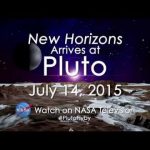
NASA’s New Horizons spacecraft arrives at Pluto on July 14th
NASA’s New Horizons spacecraft arrives at Pluto on July 14th; a journey lasting nearly 10 years and traveling over 3 billion miles. Watch coverage of the historic flyby of Pluto on NASA Television as NASA counts down to the Pluto encounter of a lifetime.
-
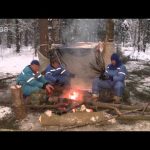
ESA astronaut Tim Peake winter survival training
ESA astronaut Tim Peake during winter survival training in Russia.
All astronauts go through winter survival training. There is always the possibility that a Soyuz spacecraft could land in a remote, cold area. Tim has to learn to survive in harsh climates while waiting for rescue.Tim is training for his mission to the International Space Station set to be launched on a Soyuz spacecraft from Baikonur Cosmodrome in Kazakhstan in December 2015.
-
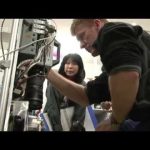
ESA astronaut Tim Peake training in Japan
ESA astronauts train with all International Space Station partners including onsite training in USA, Europe, Canada and Japan.
ESA astronaut Tim trained in Tsukuba at the Japanese Aerospace Exploration Centre on Japanes experiments and the Japanese space laboratory Kibo.
Tim is preparing for his mission to the International Space Station set to be launched on a Soyuz spacecraft from Baikonur Cosmodrome in Kazakhstan in December 2015.
-
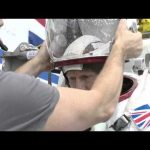
ESA astronaut Tim Peake spacewalk training
ESA astronaut Tim Peake during spacewalk training in Houston, USA.
Training underwater on life-size mockups of the Space Station is one way astronauts prepare for their missions as working in water resembles working in space.Tim is training for his mission to the International Space Station set to be launched on a Soyuz spacecraft from Baikonur Cosmodrome in Kazakhstan in December 2015.
-
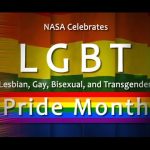
NASA LGBT Pride Month Profile Larry C Liou, Glenn Research Center
Larry C. Liou is a project manager in the Space Science Project Office at NASA John H. Glenn Research Center in Cleveland, Ohio. Born in Taiwan, ethnic heritage Chinese, Liou immigrated to the United States in 1977 where he raised a family, graduated from the University of Toledo, Suma cum Laude, and started his NASA career in science and engineering. Early in his career, Liou researched rocket propulsion, transitioned to management and eventually to earth science. “I am passionate about Earth Science that studies Earth as a planet which carries our affection, gratitude, respect and curiosity,” said Liou.
Currently keeping Liou busy is a project that uses a sensor on an aircraft to observe the harmful algal blooms on Lake Erie. Personally, Liou loves, respects and takes care of animals. “They have contributed to human’s wellness and prosperity in most major ways,” Liou said. Liou is also a musician, constantly thankful for the gift of music and music playing, which brings Liou joy and beautiful imagination. Plus, Liou sails “sailing takes me to nature and learning to utilize everything I have learned on journeys.”
-

ESAhangout with Tim Peake #SpeaktoPeake
ESA astronaut Tim Peake answers questions from school children in Wiltshire, UK. Tim joined the hangout from NASA’s Johnson Space Center in Houston where he is currently training for his six month Principia mission to the International Space Station, set for liftoff in December 2015.
The hangout was jointly hosted by ESA with +spacegovuk and +BBC Wiltshire. NASA’s Johnson Space Center provided support by hosting Tim in their Houston studio.
-

Asteroid Day – ESA experts explain the nature and threat of asteroids
If an asteroid were spotted headed towards Earth, what could humanity do about it? On 30 June, world renowned scientists, Nobel laureates, astronauts, technologists and artists join forces for Asteroid Day (http://www.asteroidday.org/), a global awareness movement to spread knowledge about asteroids and ways to protect Earth from such threats. The Day is held on the anniversary of the 1908 Siberian Tunguska event, the largest asteroid to impact our planet in recent history.
To mark Asteroid Day, ESA experts on Near-Earth Objects (NEO) and asteroids have answered the public’s most insightful questions. Respondents include Ian Carnelli, AIM Project Manager, Detlef Koshny, SSA-NEO Segment Manager and Michael Kueppers, AIM Project Scientist.
If approved next year by Europe’s space ministers, 2020 will see the launch of ESA’s deep space Asteroid Impact Mission or AIM, as part of AIDA (Asteroid Impact & Deflection Assessment), a larger international effort to investigate planetary defence techniques. AIM will travel to a binary asteroid system – the paired Didymos asteroids, which will come a comparatively close 11 million km to Earth in 2022. After encounter and study, the mission will then witness the asteroid being struck by another spacecraft, returning data to help guide planetary defence strategies.
Visit AIM (http://www.esa.int/aim) for more information.
Copyright: ESA
-

ExoMars
The ExoMars spacecraft is almost complete. A joint mission between ESA and Roscosmos, it begins with the launch of the ExoMars orbiter in 2016 and carries an aerodynamically designed capsule containing a robotic lander.
Getting to Mars, landing there safely and searching for life is a huge scientific and technical challenge. ExoMars 2016 will send back information about the Martian atmosphere and the lander’s findings. These will inform the second part of the mission, in 2018, when a European rover will drill into the Martian surface, up to two metres down. The rover will be trying to detect traces of organic molecules that indicate the presence of past or present life on Mars.
This video includes interviews with Jorge Vago, ExoMars Project Scientist, ESA and Pietro Baglioni, ExoMars Rover Manager, ESA. It shows ExoMars 2016 nearing construction in its clean room at Thales Alenia Space in France and a prototype ExoMars rover in the ExoMars test yard at ESA’s ESTEC facility in the Netherlands.
-
SpaceX, NASA Managers Discuss Vehicle Mishap Following CRS-7 Launch
During a post-launch press conference on June 28, mangers from SpaceX and NASA discuss the mishap following the liftoff of the SpaceX CRS-7 mission from Space Launch Complex 40 at Cape Canaveral Air Force Station. The mission was to deliver supplies, hardware and other important cargo to the International Space Station. SpaceX is leading the investigation of the cause of the issue.
Anyone who spots debris in the water or sees it washed up anywhere along the shore should report it by calling 866-392-0035 or emailing recovery@spaceX.com or contacting your nearest local law enforcement official.
-
SpaceX Pre-Launch Briefing from NASA’s Kennedy Space Center
NASA and commercial partner SpaceX discussed its plans for a launch of its seventh cargo delivery to the International Space Station under the agency’s Commercial Resupply Services contract. The company’s Falcon 9 will carry its Dragon cargo spacecraft to the station from Space Launch Complex 40 at Cape Canaveral Air Force Station in Florida and be filled with more than 4,000 pounds of supplies and payloads, including critical materials for the science and research investigations that will occur during Expeditions 44 and 45.
The science payloads aboard will offer new insight to combustion in microgravity, perform the first space-based observations of meteors entering Earth’s atmosphere, continue solving potential crew health risks and make new strides toward being able to grow food in space. Research continues to support the twins study and one-year mission investigations with NASA Astronaut Scott Kelly. This mission also is launching more than 30 student experiments, all of which are flying under the U.S. National Laboratory managed by the Center for the Advancement of Science in Space (CASIS).
The first of two International Docking Adapters for the station will be delivered in Dragon’s unpressurized trunk. The adapters will enable space station docking of commercial crew spacecraft, including the Boeing CST-100 and SpaceX Crew Dragon. Expedition 44 Flight Engineer Scott Kelly of NASA will use the station’s Canadarm2 robotic arm to reach out and capture Dragon with Station commander Gennady Padalka of the Russian Federal Space Agency (Roscosmos) supporting Kelly as they operate from the station’s cupola. After more than five weeks at the space station, the spacecraft will return with more than 1,400 pounds of cargo, including science experiments, crew supplies, hardware and computer resources, space station hardware, and trash.
-

Expedition 41 flight Engineer Astronaut Reid Wiseman Gives Presentation at NASA HQ
NASA Headquarters employees joined Astronaut Reid Wiseman, Expedition 41 flight engineer, for a post-flight presentation on Tuesday, June 23, to learn about his time onboard the space station as part of Expedition 40 and 41. As a member of the ISS Expedition 41 crew, Wiseman began his stay aboard the orbiting laboratory in May 2014 and returned to Earth in November 2014. This mission was his first spaceflight and included almost 13 hours of spacewalking to perform work outside the orbital complex. He and his crewmates also spent hundreds of hours conducting valuable scientific research in areas such as human physiology, medicine, physical science, Earth science and astrophysics.
-
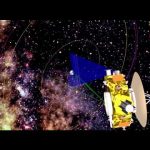
NASA’s New Horizons Mission Update from the Johns Hopkins University Applied Physics Lab (APL)
Weekly pre-flyby updates aired June 23 on NASA TV provides an overview of the New Horizons mission, the spacecraft and its suite of instruments being prepared for a July 14 flyby, and a summary of Pluto science to date.
-
Mission to Europa Gets Green Light on This Week @NASA – June 19, 2015
A new NASA mission to investigate the habitability of Jupiter’s ocean moon Europa has moved from the concept phase to the development phase known as formulation, after successfully completing its first major review by the agency. Europa is considered to be one of the best places in the solar system to search for signs of present-day life beyond Earth. Plans for the mission call for a spacecraft to be launched to the Jupiter system sometime in the 2020s. Also, Seeking other worlds suitable for life, Agreements advance Mars exploration, Asteroid exploration update, Newman visits Langley, Rainfall spacecraft re-enters over tropics and Sample Robot Return Challenge!
-
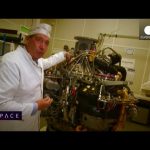
ESA Euronews: It’s rocket science!
Years in the building, seconds in the launching; rocket engines are truly awesome in their sheer power, but are also amazing feats of engineering and design.
The scientific principle remains quite simple: accelerated gas creating thrust through a nozzle. However, extrapolating that concept to the point where the rocket has sufficient power to lift people and satellites beyond Earth’s gravity and into orbit is far more complex. Don’t let anybody tell you otherwise, the manufacturing and testing process IS rocket science.
In Europe one of the key centres of work on rocket engines is done at the Snecma factory complex in a remote location in forests near the town of Vernon in Normandy. Many of the components are built elsewhere in Europe, but the assembly and testing are carried at the site in northern France.
The pieces are carefully milled from titanium or lightweight alloys over a period of weeks. When construction is finally completed then comes the critical test phase, where the rockets are fired into life inside a vast tower.
Space reporter Jeremy Wilks visited the Snecma site to find out more about this unique and constantly evolving industrial sector.
This video is also available in the following languages:
French: https://www.youtube.com/watch?v=OZBJLWDpcsw -
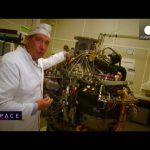
ESA Euronews: Rakétahajtóművek: több, mint gépészet
Iszonyú erő kell ahhoz, hogy valamit kijuttassunk az űrbe. A rakétahajtóművekre ma már komoly kereskedelmi iparág épül rájuk, amely a teljesítményt abban méri, mekkora tömeget hány dollárért lehet föld körüli pályára állítani.
Európa kifejezetten sikeres ebben az üzletben: az Ariane 5-ös rakéták az iparág kipróbált igáslovai, és már készül az új Ariane 6-os. A Space júniusi epizódjában Jeremy Wilks ellátogat a hajtóműveket gyártó francia SNECMA üzemeibe, hogy megtudja, hogyan lehet valamin akkorát lökni, hogy a geostacionárius pályáig meg se álljon.
A szakemberek a Space-ben megszokott nyíltsággal és érzelmességgel beszélnek a munkájukról, arról, hogy milyen dolog évekig építeni valamit, aminek a sikere azután pár perc alatt eldől, és egyetlen kis hiba is végzetes lehet.
-
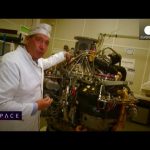
ESA Euronews: Missili, la potenza è nel motore
Per costruire un razzo possono volerci anni. Mentre per lanciarlo in orbita bastano pochi secondi. Secondi importanti dove lavorano contemporaneamente forze diverse.
“Per andare nello spazio serve tantissima potenza” spiega Gaele Winters
(ESA) “Potenza necessaria a superare la forza di gravità”La forza in grado di portare uomini e apparecchiature in orbita è generata da sofisticati motori nei quali brucia combustibile liquido o solido, o entrambi. Come nel caso del missile Ariane 5.
“Cinque, quattro, tre, due, uno, zero.E’ in quel momento che accendiamo le turbopompe, che inviano idrogeno e ossigeno nella camera di combustione del cosiddetto motore *Vulcain*” spiega Thierry Delaporte (Snecma) “Il primo ad accendersi. Una volta verificato che funziona, nel giro di 5 secondi, accendiamo anche i due booster laterali a propulsione e…..Hop, il razzo decolla”.
L’azienda dove si producono i motori usati per il programma europeo di lanciatori Ariane è a Vernon, in Francia. E’ qui che si procede ai test sui missili che saranno lanciati in orbita. La torre usata per i test si trova in una valle. E’ lì che i motori vengono accesi per la prima volta.
-
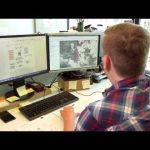
Copernicus: Sentinel services
On 23 June 2015 at 01:52 GMT (03:52 CEST 23 June; 22:52 local time 22 June) Sentinel-2A will launch from Europe’s Spaceport in French Guiana on top of a Vega.
This satellite will be the second Sentinel for the Copernicus Programme. Copernicus is the most ambitious Earth observation programme to date. It will provide accurate, timely and easily accessible information to improve the management of the environment, understand and mitigate the effects of climate change and ensure civil security.
This initiative is headed by the European Commission (EC) in partnership with the European Space Agency (ESA). ESA coordinates the delivery of data and is developing a new family of satellites, the Sentinels, specifically for the operational needs of Copernicus. The EC, acting on behalf of the European Union, is responsible for the overall initiative, setting requirements and managing the services. These services fall into six main categories: land management, the marine environment, atmosphere, emergency response, security and climate change.
This video shows a good example of these services with GeoVille, based in Austria, which is playing a key role in Copernicus services for land applications, related to both land cover production as well as downstream services in the spatial planning domain.
-

Could We Upload Our Consciousness To A Computer?
Would it ever be possible to one day upload our consciousness to a computer? How would we go about this?
Read More:
The Brain vs. The Computer
https://faculty.washington.edu/chudler/bvc.html
“Throughout history, people have compared the brain to different inventions.”Scientists Are Convinced Mind Transfer Is the Key to Immortality
http://motherboard.vice.com/blog/scientists-are-convinced-mind-transfer-is-the-key-to-immortality
“Call it mind transfer, uploading, brain backup, whatever—the idea of copying the human brain to a computer so it can live on without the body has a strong hold on futurists, neuroscientists, and folks that just want to live forever.”Mind-reading Technology Speeds Ahead
http://www.scientificamerican.com/article/mind-reading-technology-speeds-ahead/
“Jack Gallant perches on the edge of a swivel chair in his lab at the University of California, Berkeley, fixated on the screen of a computer that is trying to decode someone’s thoughts.”Engineering a memory with LTD and LTP
http://www.nature.com/nature/journal/v511/n7509/full/nature13294.html
“It has been proposed that memories are encoded by modification of synaptic strengths through cellular mechanisms such as long-term potentiation (LTP) and long-term depression (LTD).”MIT scientists implant a false memory into a mouse’s brain
http://www.washingtonpost.com/national/health-science/inception-mit-scientists-implant-a-false-memory-into-a-mouses-brain/2013/07/25/47bdee7a-f49a-11e2-a2f1-a7acf9bd5d3a_story.html
“Sometime soon, a lab mouse could wake up thinking he had snuggled up to a girl mouse the night before. But he hadn’t. The memory would be fake.”If your brain were a computer, how much storage space would it have?
http://io9.com/if-your-brain-were-a-computer-how-much-storage-space-w-509687776
“The comparison between the human brain and a computer is not a perfect one, but it does lend itself to some interesting lines of inquiry. For instance: what is the storage capacity of your brain?”
____________________DNews is dedicated to satisfying your curiosity and to bringing you mind-bending stories & perspectives you won’t find anywhere else! New videos twice daily.
Watch More DNews on TestTube http://testtube.com/dnews
Subscribe now! http://www.youtube.com/subscription_center?add_user=dnewschannel
DNews on Twitter http://twitter.com/dnews
Trace Dominguez on Twitter https://twitter.com/tracedominguez
Julia Wilde on Twitter https://twitter.com/julia_sci
DNews on Facebook https://facebook.com/DiscoveryNews
DNews on Google+ http://gplus.to/dnews
Discovery News http://discoverynews.com
Download the TestTube App: http://testu.be/1ndmmMq
-
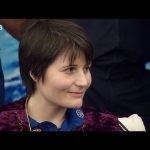
Soyuz TMA-15M landing – welcoming ceremony
ESA astronaut Samantha Cristoforetti, NASA astronaut Terry Virts and Russian commander Anton Shkaplerov landed in the Kazakh steppe after a three-hour ride in their Soyuz spacecraft 11 June 2015.
Shortly after landing the crew were welcomed back to Earth in a traditional Kazakh ceremony held for all astronauts who return from space on a Soyuz spacecraft.
-
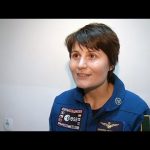
Intervista con Samantha dopo l’atterraggio
Intervista con l’astronauta dell’ESA Samantha Cristoforetti, nelle prime
ore dell’11 giugno, poco dopo l’atterraggio nelle steppe del Kazakistan.Samantha, insieme al comandante russo Anton Shkaplerov ed all’astronauta della NASA Terry Virts, è atterrata alle 13:44 GMT (15:44 CEST), con la stessa navicella Soyuz TMA-15M che il 23 novembre li aveva portati sulla Stazione Spaziale Internazionale.
-
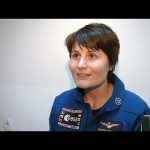
Interview with Samantha after landing
Interview with ESA astronaut Samantha Cristoforetti shortly after returning from a six and a half month stay on the International Space Station.
Samantha, together with Russian commander Anton Shkaplerov and NASA astronaut Terry Virts, landed with their the Soyuz TMA-15M spacecraft in the Kazakh steppe at 15:44 CEST (13:44 GMT) on 11 June 2015.
-
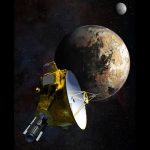
The Year of Pluto – New Horizons Documentary Brings Humanity Closer to the Edge of the Solar System
New Horizons is the first mission to the Kuiper Belt, a gigantic zone of icy bodies and mysterious small objects orbiting beyond Neptune. This region also is known as the “third” zone of our solar system, beyond the inner rocky planets and outer gas giants. Johns Hopkins University Applied Physics Laboratory (APL) in Maryland, designed, built and operates the New Horizons spacecraft, and manages the mission for NASA’s Science Mission Directorate in Washington. The Year of Pluto – NASA New Horizons is a one hour documentary which takes on the hard science and gives us answers to how the mission came about and why it matters. Interviews with Dr. James Green, John Spencer, Fran Bagenal, Mark Showalter and others share how New Horizons will answer many questions. New Horizons is part of the New Frontiers Program, managed by NASA’s Marshall Space Flight Center in Huntsville, Alabama.
-
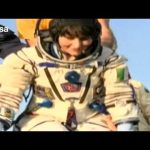
Soyuz TMA-15M landing – highlights
ESA astronaut Samantha Cristoforetti, NASA astronaut Terry Virts and Russian commander Anton Shkaplerov landed in the Kazakh steppe after a three-hour ride in their Soyuz spacecraft 11 June 2015. They left the International Space Station at 10:20 GMT at the end of their six-month stay on the research complex.
Soyuz TMA-15M braked from the Station’s cruising speed of almost 28 800 km/h and entered the atmosphere six hours later. The small descent module separated as planned and parachutes deployed to slow the vehicle down even more.
The module fired retrorockets moments before landing and springs in the moulded seats reduced the impact of hitting the steppe at 13:44 GMT. Teams were on hand within minutes to help them out.
-
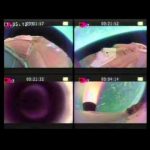
NASA’s Flying Saucer Makes Second Voyage to the Edge of Space
NASA’s Low Density Supersonic Decelerator (LDSD) launched on Monday, June 8th from the U.S. Navy’s Pacific Missile Range Facility on Kauai, Hawaii. The saucer-shaped vehicle was used to test new technologies that will help NASA land heavier payloads than current technology will allow on the surface of planets including Mars. The test vehicle was carried by balloon to about 120,000 feet. After release, an engine took the vehicle to 180,000 feet, where the tests occurred in the thin atmosphere to simulate Mars’ atmosphere. This flight test was the second of three planned for the project. The LDSD mission is designed to test entry and descent technology in the form of a donut-shaped airbag and a supersonic parachute that can be deployed while the vehicle is traveling several times the speed of sound.
-

Where do astronauts sleep?
Join ESA astronaut Samantha Cristoforetti for a guided tour of the International Space Station’s crew quarters – the bedroom.
After a day’s work running experiments and maintaining the weightless research centre astronauts can retreat to their private quarters that is no larger than a changing room. In this small space they can store personal items, use a laptop for internet and float to sleep in their sleeping bag.
Find out more about Samantha’s Futura mission here: http://www.esa.int/futura
Follow Samantha via http://samanthacristoforetti.esa.int
-
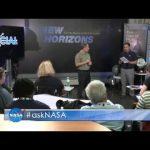
NASA Social Media Conducts Web Chat on New Horizons Pluto Mission at the Applied Physics Laboratory
On Saturday, at the Applied Physics Laboratory in Laurel, MD, NASA connected with social media followers in-person and online for a Web Social on the New Horizons mission exploring Pluto using #NASASocial and #PlutoFlyby and @NASANewHorizons.
NASA Social is a program to provide opportunities for NASA’s social media followers to learn and share information about NASA’s missions, people, and programs. NASA Social is the next evolution in the agency’s social media efforts. Formerly called NASA Tweetup, NASA Social program includes both special in-person events and social media credentials for individuals who share the news in a significant way. This program has brought thousands of people together for unique social media experiences of exploration and discovery.
-
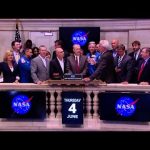
NASA, Partners Ring Closing Bell at New York Stock Exchange
NASA officials and representatives from U.S. commercial space partners rang the closing bell of the New York Stock Exchange Thursday, June 4. NASA’s work with U.S. industry is making commercial research on the space station more accessible and affordable, leading to discoveries not possible on Earth. Commercial companies are already providing cargo transportation services to the orbiting laboratory and will soon launch astronauts once again from the United States. This is stimulating the growth of a robust U.S. commercial space industry with access to low-Earth orbit, creating new jobs and markets.
-
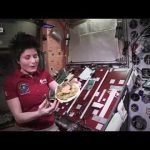
Cucinare nello spazio: riso integrale con pollo alla curcuma
L’astronauta dell’ESA Samantha Cristoforetti sta attualmente vivendo e lavorando a bordo della Stazione Spaziale Internazionale per la missione di lunga durata dell’ASI “Futura”. Vivendo nello spazio a centinaia di km dalla Terra e da casa il cibo è uno degli aspetti fondamentali per un astronauta, anche dal punto di vista psicologico; per questo motivo gli è concesso portare con loro una certa quantità del cosiddetto “bonus food”: piatti e ingredienti di loro scelta che ricordino i loro gusti e i sapori di casa. Abbiamo chiesto a Samantha di mostrarci come riesce a cucinare in microgravità uno di questi piatti: del pollo alla curcuma con riso integrale e piselli.
-

Cooking in space: whole red rice and turmeric chicken
ESA astronaut Samantha Cristoforetti is currently living on board the International Space Station for her long duration mission Futura. Food is an important item in space, also on the psychological side; that’s why astronauts are allowed a certain quantity of the so-called “bonus food” of their choice that reminds them of their home cooking tastes. We asked Samantha to show us how she manages to cook one of her bonus food recipes in microgravity: whole red rice with peas and chicken turmeric.
Make this recipe: http://bit.ly/CookingInSpaceWithSamantha
-
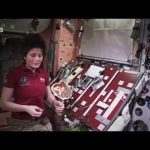
Cooking in space: mackerel, quinoa and leek cream tortilla
ESA astronaut Samantha Cristoforetti is currently living on board the International Space Station for her long duration mission Futura. Food is an important item in space, also on the psychological side; that’s why astronauts are allowed a certain quantity of the so-called “bonus food” of their choice that reminds them of their home cooking tastes. We asked Samantha to show us how she manages to cook one of her bonus food recipes in microgravity: a quinoa salad with dried tomatoes, mackerel and leek cream, all wrapped in a warm tortilla.
Make this recipe: http://bit.ly/CookingInSpaceWithSamantha
-
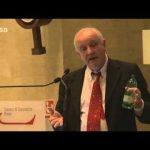
ESA’s Mark Doherty at the International Symposium on Climate Change
Held at the Temple of Hadrian in Rome, Italy, on 27–29 May 2015, the International Symposium on Climate Change reviewed the links between climate change and world development. Experts on a variety of climate- and development-related topics presented over the three-day period, including a talk by ESA’s Mark Doherty on observing climate from space.
Replays of all the symposium sessions are available on our website at: http://www.esa.int/spaceinvideos/Sets/International_Symposium_on_Climate_Change_-_Rome_2015
-

Suit Up – 50 Years of Spacewalks
This NASA documentary celebrates 50 years of extravehicular activity (EVA) or spacewalks that began with the first two EVAs conducted by Russian Alexey Leonov in March 1965 and American astronaut Edward White in June 1965 . The documentary features interviews with NASA Administrator and astronaut, Charles Bolden, NASA Deputy Administrator and spacesuit designer, Dava Newman, as well as other astronauts, engineers, technicians, managers and luminaries of spacewalk history. They share their personal stories and thoughts that cover the full EVA experience– from the early spacewalking experiences, to spacesuit manufacturing, to modern day spacewalks aboard the International Space Station as well as what the future holds for humans working on a tether in space. “Suit Up,” is narrated by actor and fan of space exploration Jon Cryer. Cryer recently traveled to Star City, NASA Headquarters and the Johnson Space Center to film an upcoming Travel Channel documentary series.
-
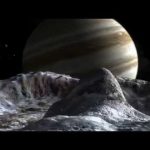
Science Instruments Selected for Europa Mission on This Week @NASA – May 29, 2015
NASA announced May 26, it has selected nine science instruments for a mission to Jupiter’s moon Europa to investigate whether the icy moon has conditions suitable for life. The instruments, targeted for launch aboard a robotic probe in the 2020s, include cameras and spectrometers to collect high-resolution imagery; an ice penetrating radar to measure surface thickness and look for subsurface lakes; and a magnetometer to measure the strength and direction of the moon’s magnetic field, and allow scientists to determine the depth and salinity of the moon’s ocean. The mission will collect data during a series of close flybys of Europa during a three-year period. Also, Commercial Crew update, Space station module relocated, Bolden visits space companies, SLS engine test, Supersonic vehicle test and more!
-

What Happens When Two Black Holes Collide?
This video was an answer to louis’ question: http://thoughty2.com/q/90/what-happens-if-2-black-holes-collide/
Ask Thoughty2 a question at: http://thoughty2.com/ask
Subscribe, New Videos Every Mon & Thurs: http://www.youtube.com/subscription_center?add_user=thoughty2
Read More At: http://thoughty2.com/p/91/what-happens-when-two-black-holes-collide/
Support me on Patreon: http://thoughty2.com/patreon
Facebook: http://thoughty2.com/facebook
Twitter: http://thoughty2.com/twitter
Thoughty2 Merchandise: http://thoughty2.spreadshirt.com
With Special Thanks To:
Morgan, Misha A-Wilson, Katrina Brogan, Michelle & Aaron Finn, Mhmd Haj Ali, Jeff Lee, Lindsay S, Kent Zacherl -
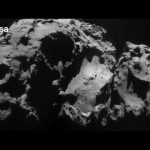
Rosetta update
The Rosetta spacecraft is still orbiting comet 67P/Churyumov-Gerasimenko while it now approaches the Sun. Six months ago Rosetta made history by delivering its Philae lander onto a comet’s surface – something no other space mission has done before.
This video covers the mission’s highlights so far: from its launch in 2004; its journey across the solar system and waking up after deep space hibernation ten years later, its arrival at the selection of a landing site and Philae’s unexpected multiple landings on the comet. It also reviews what we have learnt about the comet to this point.
Credit: ESA, with footage by DLR, licenced under CC-BY 3.0 DE
-

Towel day on the International Space Station
Don’t panic! This is the story of a book, a book called The Hitchiker’s Guide to the Galaxy, a wholly remarkable book.
ESA astronaut Samantha Cristoforetti reads from Douglas Adam’s “The Hitchhiker’s Guide to the Galaxy” for towel day from the European laboratory Columbus on the International Space Station.
The Guide has a few things to say on the subject of towels. A towel, it says, is about the most massively useful thing an interstellar hitchhiker can have.
To all you froods on the mostly harmless planet Earth, happy towel day!
Towel Day is an annual celebration on 25 May, as a tribute to the late author Douglas Adams when fans around the universe proudly carry a towel in his honour.