Food always tastes better when it’s homemade, and the same is true for ice cream. We went out and got some brown sugar from Imperial Sugar and Dixie Crystals to concoct a tasty ice cream creation. You can make your own ice cream, too! With the easy-to-follow steps below, you’ll have Brown Sugar Homemade Ice Cream in less than 30 minutes!
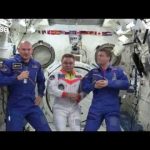
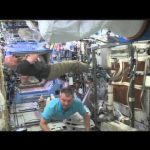
ESA astronaut Alexander Gerst spent 166 days in space with NASA astronaut Reid Wiseman and Roscosmos commander Max Suraev in 2014.
This ten-minute video shows highlights of his Blue Dot mission, from docking spacecraft to science and spacewalks Alexander worked to improve the International Space Station and life on Earth.
From launch to landing, look at the experiments and beautiful images Alexander shared with us.
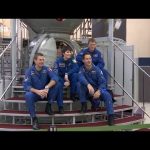
Samantha Cristoforetti from Italy will shortly fly to the International Space Station. The final stage of her preparations happens in Star City, near Moscow, training alongside three other members of ESA’s Astronaut Corps. The third of ESA’s new generation of astronauts to fly, she’ll be undergoing a long-duration stay in orbit – replacing Alexander Gerst from Germany as part of the Station’s permanent onboard crew.
Celebrating the landing of Rosetta’s Philae lander on 67P/Churyumov–Gerasimenko at ESA’s technical heart. Along with the main Rosetta landing event taking place at ESA’s ESOC control centre, many other events took place all across Europe. More than a quarter of a century in the making, the Rosetta comet-chaser had been designed, planned and finally tested at ESTEC – ESA’s largest establishment, based in Noordwijk, the Netherlands – in advance of its 2004 launch.
More than 450 external guests, media representatives and Agency personnel gathered together at SpaceExpo, ESTEC’s visitor centre, to follow the nail-biting Philae landing during the afternoon and evening of Wednesday 12 November 2014. ESTEC Director Franco Ongaro presided over the gathering, which was also attended by ESA astronaut André Kuipers, Rob van Hassel of Airbus Defence and Space Netherlands – who detailed the Dutch contributions to Rosetta – as well as comet expert Inge Loes ten Kate from Utrecht University.
Update on the Rosetta mission, including status of the Philae lander.
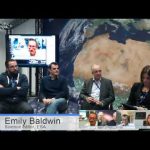
Hosted by Emily Baldwin – ESA Science Editor, with:
Andrea Accomazzo – ESA Rosetta Flight Director, ESOC
Stephan Ulamec – Philae Lander Manager, DLR
Matt Taylor – Rosetta Project Scientist, ESA
Philippe Gaudon – CNES Rosetta Project Manager, SONC
Holger Sierks – PI for OSIRIS, Max-Planck-Institute for Solar System Research
Valentina Lommatsch – DLR-Lander Control Center, mission team
Jeff Grossman – OSIRIS-REx Program Scientist, NASA
Gordon Johnston – OSIRIS-REx Program Scientist, NASA
Highlights from coverage of ESA’s Rosetta mission soft-landing its Philae probe on a comet, the first time in history that such an extraordinary feat has been achieved. Including the presentation of the first ROLIS image sent back by Philae as the lander descended to the surface of the comet.
After a tense wait during the seven-hour descent to the surface of Comet 67P/Churyumov–Gerasimenko, the signal confirming the successful touchdown arrived on Earth at 16:03 GMT (17:03 CET).
Highlights from coverage of ESA’s Rosetta mission soft-landing its Philae probe on a comet, the first time in history that such an extraordinary feat has been achieved.
After a tense wait during the seven-hour descent to the surface of Comet 67P/Churyumov–Gerasimenko, the signal confirming the successful touchdown arrived on Earth at 16:03 GMT (17:03 CET).
Scene inside Mission Control as the team regained contact with Rosetta as expected after separation, and with Philae that is descending onto the surface of Comet 67P/C-G.
The third of a trio of music videos released by ESA to celebrate the first ever attempted soft landing on a comet by ESA’s Rosetta mission.
Vangelis, the world-renowned musician, has composed this piece of music specially for ESA and inspired by the Rosetta mission. Vangelis’s music is often linked to themes of science, history and exploration, and he is best known for his Academy Award–winning score for the film Chariots of Fire, composing scores for the films Antarctica, Blade Runner, 1492: Conquest of Paradise and Alexander, and the use of his music in the documentary series Cosmos, by Carl Sagan.
Vangelis said: “Mythology, science and space exploration are subjects that have fascinated me since my early childhood. And they were always connected somehow with the music I write.”
Video copyright: ESA/Vangelis
Original music: Vangelis
The second of a trio of music videos released by ESA to celebrate the first ever attempted soft landing on a comet by ESA’s Rosetta mission.
Vangelis, the world-renowned musician, has composed this piece of music specially for ESA and inspired by the Rosetta mission. Vangelis’s music is often linked to themes of science, history and exploration, and he is best known for his Academy Award–winning score for the film Chariots of Fire, composing scores for the films Antarctica, Blade Runner, 1492: Conquest of Paradise and Alexander, and the use of his music in the documentary series Cosmos, by Carl Sagan.
Vangelis said: “Mythology, science and space exploration are subjects that have fascinated me since my early childhood. And they were always connected somehow with the music I write.”
Video copyright: ESA/Vangelis
Original music: Vangelis
The first of a trio of music videos released by ESA to celebrate the first ever attempted soft landing on a comet by ESA’s Rosetta mission.
Vangelis, the world-renowned musician, has composed this piece of music specially for ESA and inspired by the Rosetta mission. Vangelis’s music is often linked to themes of science, history and exploration, and he is best known for his Academy Award–winning score for the film Chariots of Fire, composing scores for the films Antarctica, Blade Runner, 1492: Conquest of Paradise and Alexander, and the use of his music in the documentary series Cosmos, by Carl Sagan.
Vangelis said: “Mythology, science and space exploration are subjects that have fascinated me since my early childhood. And they were always connected somehow with the music I write.”
Video copyright: ESA/Vangelis Original music: Vangelis
Follow Paxi to the edge of the Solar System to discover the world of comets, and learn about the amazing Rosetta mission to comet 67P/Churyumov-Gerasimenko.
In this video, targeted at children aged between 6 and 12, Paxi takes kids with him to discovery comets and Rosetta, the amazing ESA spacecraft flying alongside comet 67P/Churyumov-Gerasimenko that will attempt, on 12 November 2014, to release a lander onto it.
This video is the third of a series of animations in which Paxi, ESA’s Education mascot, touches on different aspects of the Solar System, the Universe, the secrets of planet Earth, and much more.
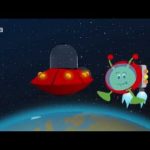
Meet Paxi, ESA’s Education mascot: where he comes from, what he likes about space travel, who his friends are…
This video, targeted at children aged between 6 and 12, introduces Paxi, a little alien that comes from planet Ally-O, who has come to Earth to meet new friends and take kids on an adventurous trip of space exploration. It is the first of a series of animations in which Paxi, ESA’s Education mascot, touches on different aspects of the Solar System, the Universe, the secrets of planet Earth, and much more.
You’ve let your friend in on a secret: you bought some magical Imperial Sugar or Dixie Crystals sugar cubes. Seriously! This Sugar Cube Magic will blow the socks off of your friends. Have your friend pick a number between 1 and 10, then write it on the sugar cube. From there, it’s a fun experience in misdirection and magic as you dissolve the sugar cube in water!
William Shatner, known to millions around the world as Capt. James T. Kirk from the original Star Trek series, sent this message to ESA’s Rosetta team today to wish them good luck for tomorrow’s Philae landing.
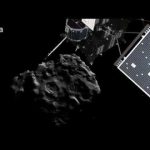
Rosetta’s deployment of Philae to land on Comet 67P/Churyumov–Gerasimenko.
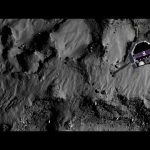
The animation begins with Philae still on Rosetta, which will come to within about 22.5 km of the centre of the nucleus to release the lander on 12 November 2014.
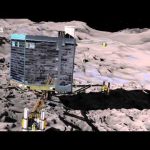
The animation then shows Philae being ejected by Rosetta and deploying its own three legs, and follows the lander’s descent until it reaches the target site on the comet about seven hours later.
The animation is speeded up, but the comet rotation is true: in the time it takes for Philae to descend, the nucleus has rotated by more than 180º (the comet’s rotation period is 12.4 hours).
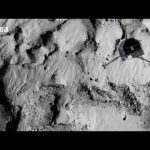
The final steps of Philae’s descent towards the comet are shown as seen by a hypothetical observer close to the landing site on the comet.
Acknowledgement: The background image of the sequence showing Philae closing in on the landing site was taken by Rosetta’s OSIRIS narrow-angle camera (ESA/Rosetta/MPS for OSIRIS Team MPS/UPD/LAM/IAA/SSO/INTA/UPM/DASP/IDA) on 14 September 2014 from a distance of about 30 km.
Philae was provided by a consortium led by DLR, MPS, CNES and ASI.
Rosetta’s deployment of Philae to land on Comet 67P/Churyumov–Gerasimenko.
The animation begins with Philae still on Rosetta, which will come to within about 22.5 km of the centre of the nucleus to release the lander on 12 November 2014.
The animation then shows Philae being ejected by Rosetta and deploying its own three legs, and follows the lander’s descent until it reaches the target site on the comet about seven hours later.
The animation is speeded up, but the comet rotation is true: in the time it takes for Philae to descend, the nucleus has rotated by more than 180º (the comet’s rotation period is 12.4 hours).
The final steps of Philae’s descent towards the comet are shown as seen by a hypothetical observer close to the landing site on the comet.
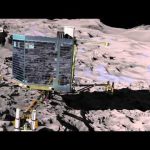
Finally, the animation shows Philae landing on the comet.
Because of the comet’s extremely low gravity, landing gear will absorb the small forces of landing while ice screws in the probe’s feet and a harpoon system will lock the probe to the surface. At the same time a thruster on top of the lander will push it down to counteract the impulse of the harpoon imparted in the opposite direction. Once it is anchored to the comet, the lander will begin its primary science mission, based on its 64-hour initial battery lifetime. The animation shows a number of the science instruments in action on the surface.
Acknowledgement: The background image of the sequence showing Philae closing in on the landing site was taken by Rosetta’s OSIRIS narrow-angle camera (ESA/Rosetta/MPS for OSIRIS Team MPS/UPD/LAM/IAA/SSO/INTA/UPM/DASP/IDA) on 14 September 2014 from a distance of about 30 km.
Philae was provided by a consortium led by DLR, MPS, CNES and ASI.
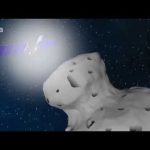
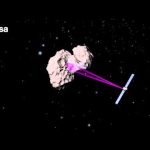
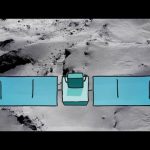
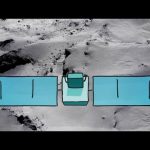
Rosetta orbiting Comet 67P/Churyumov–Gerasimenko and scanning its surface to make scientific measurements. The colours of the beams and their shape on the surface represent two different instruments imaging and analysing the comet.
The Rosetta orbiter has a total of 11 instruments to study the characteristics and environment of the comet. Rosetta is taking images of the comet at a variety of different wavelengths, measuring its gravity, mass, density, internal structure, shape and rotation, and assessing the properties of its gaseous, dust-laden atmosphere, or coma. It is also probing the surrounding plasma environment and analysing how it interacts with the solar wind.
Rosetta also carries a small lander, Philae, which will descend to the surface of the comet and make in situ measurements using its suite of 10 instruments.
The animation is not to scale; the comet is about 4.1 km wide and Rosetta is 32 m across including its solar wings, and it conducts scientific investigations at a range of altitudes. The comet shape is based on a true comet shape model.
Russian ISS commander, cosmonaut Maxim Suraev, NASA astronaut Reid Wiseman and ESA astronaut Alexander Gerst send a peace message from space. They remind us that the International Space Station serves as a shining example of how people can live and work together for the benefit of all humankind. It’s the hallmark of international cooperation – a milestone in human history.
Media and interested members of the public joined Rosetta mission experts online on Friday, 7 November for a briefing ahead of the historic comet landing on 12 November.
Programme:
Introduction: Emily Baldwin, ESA space science editor
Overview of media events: Jocelyne Landeau-Constantin, Head of ESOC communication office
Science from Rosetta so far: Matt Taylor, ESA Rosetta project scientist
Spacecraft status and operations timeline: Andrea Accomazzo, ESA Rosetta flight director
Key messages: Fred Jansen, ESA Rosetta mission manager
Q&A: all
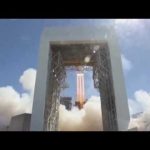
A NASA media briefing on Nov. 6 at Kennedy Space Center highlighted the fully assembled Orion spacecraft and details of its first test flight, scheduled for Dec. 4. The 4 and-a-half hour flight, called Exploration Flight Test-1, will send Orion 3,600 miles from Earth on a two-orbit flight to confirm its critical systems are ready for the challenges of eventually sending astronauts on deep space missions to an asteroid and Mars. Also, Delta IV Heavy wet dress test, Next ISS crew trains, Space agency leaders support ISS, Curiosity confirms orbital data and more!
A Theodore von Kármán Lecture Series talk, held November 6 and 7 at NASA’s Jet Propulsion Laboratory in Pasadena, California, addressed the key aspects of the agency’s Asteroid Redirect Robotic Mission (ARRM) concept, which seeks to rendezvous with, capture, and redirect to translunar space a near-Earth asteroid.
The final steps of Philae’s descent towards Comet 67P/Churyumov–Gerasimenko on 12 November 2014, as seen by a hypothetical observer close to the landing site on the comet.
The background image was taken by Rosetta’s OSIRIS narrow-angle camera on 14 September 2014 from a distance of about 30 km.
Philae was provided by a consortium led by DLR, MPS, CNES and ASI.
Credit: ESA/ATG medialab; background image: ESA/Rosetta/MPS for OSIRIS Team MPS/UPD/LAM/IAA/SSO/INTA/UPM/DASP/IDA
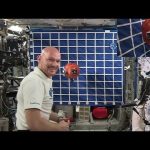
ESA astronaut Alexander Gerst performs a demonstration of how ESA’s Rosetta mission will attempt to put a lander, called ‘Philae’ on the surface of comet 67P/Churyumov–Gerasimenko.
Alexander narrates the story of the Rosetta mission and performs a demonstration that visualises the difficulties of landing on an object that has little gravitational pull. Using the weightless environment of the Space Station, Alexander attempts to land ‘Philae’ (an ear plug) onto the surface of the ‘comet’ (an inactive SPHERES robot) with increasing levels of difficulty: a rotating comet that is not moving to one that is both rotating and moving.
This video is one of the six experiments and demonstrations in the Flying Classroom, Alexander will use small items to demonstrate several principles of physics in microgravity to students aged 10–17 years.
The Rosetta mission’s lander, Philae, will be deployed on 12 November at 08:35 GMT/09:35 CET from a distance of 22.5 km from the centre of the comet. It will land about seven hours later, with confirmation expected to arrive at Earth at around 16:00 GMT/17:00 CET.
Rosetta will release its Philae lander when approximately 22 kilometres from the centre of the comet. A signal confirming the separation will arrive at ground stations on Earth 28 minutes and 20 seconds later while the lander’s descent to the surface will take seven hours. On the way down, Philae will take a series of images and onboard instruments will sample the dust, gas and plasma close to the comet’s surface and measure any magnetic field.
Philae’s three lander legs will absorb the momentum of impact and use it to drive an ice screw in each foot into the surface. At the same time two harpoons will fire to lock the probe onto the surface and a small thruster on top will counteract the impulse. Once anchored to the nucleus, Philae will begin its primary science mission, based on its initial battery lifetime of 64 hours.
The SESAME experiment – which contains three instruments – includes one called CASSE, located in the lander’s feet. Harald KRUEGER, Principal Investigator of Rosetta’s SESAME experiment, explains how CASSE will use acoustic waves to determine properties of the comet’s soil.
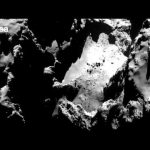
Within hours of landing, we also hope to see the first ever images of a comet from its surface.
Could astronauts one day be printing rather than building a base on the Moon? In 2013 ESA, working with industrial partners, proved that 3D printing using lunar material was feasible in principle. Since then, work continues to investigate the technique. The shielding against radiation provided by a 3D-printed block of simulated lunar regolith was measured, providing important inputs for next-stage designs… Soon the Agency is due to investigate another lunar 3D printing method, harnessing concentrated sunlight to melt regolith rather than using a binding liquid.
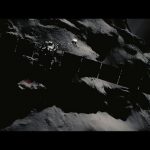
But how might lunar 3D printing one day be used in practice? Foster+Partners, contributing architectural concepts for the original study, put together this outline of a hypothetical mission to 3D-print an entire a lunar base, illustrating the design factors that steered them in their work. The rim of Shackleton Crater at the lunar south pole was chosen for the base location. The Moon’s rotation is such that the Sun only grazes its poles at low angles. The result is a near-constant ‘peak of eternal light’ along the rim of Shackleton Crater, beside regions of permanent shadow. Building in the vicinity of such a site would offer plentiful solar power, and relief from the extremes of heat and cold found across the rest of the Moon.
In reality any lunar base remains firmly on the drawing board, but each small step forward in research makes future lunar colonisation a little more feasible. In October 2014 more than 350 experts came together for a two-day Additive Manufacturing for Space Applications workshop at ESA’s ESTEC technical centre in Noordwijk, the Netherlands. They discussed the potential of 3D printing – also known as Additive Manufacturing – to transform the way the space industry operates and begin preparing common standards for its use.
A summary of Rosetta’s journey – from its launch on 2 March 2004 – to the planned landing on comet 67P/Churyumov-Gerasimenko on 12 November 2014. The journey has included four gravitational assists from Mars and the Earth, flybys with asteroids Steins and Lutetia, and the spacecraft’s temporary hibernation and successful wake up on 20 January 2014.
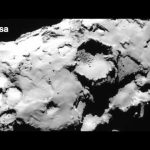
In May Rosetta put on the brakes and performed rendezvous manoeuvres for several months. During this period, images from the onboard cameras revealed the comet’s unusual ‘space duck’ shape.
Rosetta arrived at its destination on 6 August and became the first spacecraft to orbit a comet. The primary landing site was announced in September and Rosetta is now on schedule to release its Philae lander onto the comet’s surface in November.
After a ten-year journey, Rosetta and Philae had finally reached their destination, Comet 67P/Churyumov–Gerasimenko. Rosetta spent many weeks studying the comet, sending lots of information back to Earth. But where was Philae going to land? Eventually the scientists on Earth found the best place on the comet for Philae to land. Soon it was time to make the final preparations for Philae’s great adventure. Both spacecraft couldn’t wait any longer. The whole world would be watching as Rosetta and Philae prepared for their biggest challenge yet…
Nach einer 10-jährigen Reise haben Rosetta und Philae endlich ihr Ziel erreicht. Den Kometen 67P/Churyumov-Gerasimenko. Rosetta verbrachte mehrere Wochen damit, die Oberfläche des Kometen zu studieren und schickte viele Informationen zurück zur Erde. Aber wo würde Philae wohl landen können? Die Wissenschaftler überlegten lang und intensiv. Letztendlich fanden sie die beste Landestelle für Philae. Beide Raumsonden konnten es nicht mehr erwarten. Die ganze Welt würde zusehen, wenn sich Rosetta und Philae für ihre bisher größte Herausfordung bereit machen…
Discovering density has never been more colorful, or fun! The Sugar Rainbow is a creative and engaging method of teaching about how different densities will stack atop each other. There’s even an additional lesson about adhesion and cohesion! Combine gorgeous colors and awesome science with a little bit of sugar and water!
With ESA astronaut Alexander Gerst due to return on 10 November after six months onboard the ISS, Samantha Cristoforetti is set to fly to the station for a long-duration mission on 24 November. She will launch from Baikonur in Kazakhstan, and is currently joined at Star City by three other ESA astronauts – whose first missions are scheduled for 2015 and 2016.
NASA held a news conference Tuesday October 28 following the mishap that occurred at NASA’s Wallops Flight Facility in Virginia during the attempted launch of Orbital Sciences Corp’s Antares rocket and Cygnus cargo spacecraft to the International Space Station. Briefing participants were, Bill Gerstenmaier, associate administrator of NASA’s Human Exploration and Operations Mission Directorate, Frank Culbertson, Executive Vice President and General Manager of Advanced Programs Group at Orbital Sciences Corp, Bill Wrobel, director of NASA’s Wallops Flight Facility, and Mike Suffredini, NASA’s International Space Station Program Manager.
There might be more Trick than Treat at this house. Can you spot the ISS as it darts past this dark and for foreboding scene? Happy Halloween from NASA.
Stephen Hawking, one of the most prominent cosmologists of our time, has given voice to the great heights humanity can achieve. Recently, actor Eddie Redmayne, who plays Professor Hawking in the film “The Theory of Everything,” took time to explain the inspirational relationship between Professor Hawking and NASA’s mission and programs.
Several Mars-based NASA spacecraft had prime viewing positions for comet Siding Spring’s October 19 close flyby of the Red Planet. Early images included a composite photo from NASA’s Hubble Space Telescope that combined shots of Mars, the comet, and a star background to illustrate Siding Spring’s distance from Mars at closest approach. Also, images from the Mars Reconnaissance Orbiter’s HiRISE camera, which represent the highest-resolution views ever acquired of a comet that came from the Oort Cloud, at the outer fringe of the solar system. The comet flyby – only about 87,000 miles from Mars – was much closer than any other known comet flyby of a planet. Also, Partial solar eclipse, Space station spacewalk, Preparing to release Dragon, Cygnus launch update, Welding begins on SLS, Astronaut class visits Glenn and more!
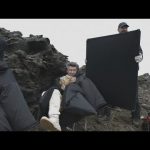
The making of the short film Ambition, a collaboration between Platige Image and ESA. Directed by Tomek Bagiński and starring Aidan Gillen and Aisling Franciosi, Ambition was filmed on location in Iceland, produced in Poland, and screened on 24 October 2014 during the British Film Institute’s celebration of Sci-Fi: Days of Fear and Wonder, at the Southbank, London.
Ambition is a collaboration between Platige Image and ESA. Directed by Tomek Bagiński and starring Aidan Gillen and Aisling Franciosi, Ambition was filmed on location in Iceland, and screened on 24 October 2014 during the British Film Institute’s celebration of Sci-Fi, at the Southbank, London.
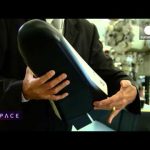
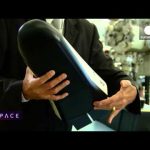
Re-entry is the make or break moment for spacecraft. It’s the time when satellites burn up and astronauts hold on for the ride of their lives. A new ESA spacecraft, called IXV Intermediate eXperimental Vehicle, will be launched into space in November 2014 in a bid to feed precious new data to engineers as they try to master the difficult transition between space and planet Earth. In this episode of Space, IXV programme manager Giorgio Tumino shows us around the spacecraft, while rarely-seen archive footage brings the heat, drama and danger of re-entry to life.
Subir até ao espaço é considerado normalmente o cerne da questão. Mas e o regresso à Terra? A reentrada na atmosfera é, na verdade, um dos maiores desafios da aventura espacial. Por isso, os europeus criaram uma nave chamada IXV que irá testar novas possibilidades precisamente no reencontro com o nosso planeta. É uma viagem única, até porque é impossível de recriar artificialmente a experiência. As aprendizagens têm sido feitas através de descidas efetivas. E é precisamente isso que a mais recente nave da Agência Espacial Europeia (ESA) vai fazer em novembro, como explica o coordenador de projeto, Giorgio Tumino: “O objetivo da missão do IXV é o de passar a controlar aquelas zonas cinzentas que desconhecemos acerca da reentrada atmosférica.”
Il rientro dallo spazio è pericoloso per le navicelle spaziali e i loro passeggeri. Una nuovo veicolo dell’ESA, la European Space Agency, chiamato “IXV”, sarà lanciato nello spazio a novembre per affrontare in modo diretto la sfida del rientro. Gli ingegneri vogliono dominare la difficile transizione tra lo spazio e il pianeta terra.