In 2013, NASA helped transform access to low Earth orbit … even as one of our venerable spacecraft reached the boundaries of the solar system … and we moved ahead on technologies — that will help us carry out an ambitious asteroid mission we announced … and, eventually, move on to Mars.
Here’s a quick trip back through 2013 for those and some of the other big things that happened This Year at NASA.
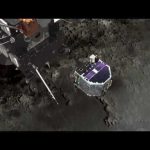
Visualisation of the deployment of the Philae lander from Rosetta at comet 67P/Churyumov-Gerasimenko in November 2014. Rosetta will come to within 2.5 km of the comet’s surface to deploy Philae, which will then take around 2 hours to reach the surface. Because of the comet’s extremely low gravity, a landing gear will absorb the small forces occurring during landing while ice screws in the probe’s feet and a harpoon system will lock the probe to the surface. At the same time a thruster on top of the lander will push it down to counteract the impulse of the harpoon imparted in the opposite direction. Once it is anchored to the comet, the lander will begin its primary science mission, based on its 64-hour initial battery lifetime. Then it will use solar cells to recharge and attempt to operate for several further weeks to months, depending on the activity of the comet and how quickly the solar cells are covered in dust.
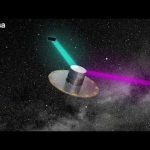
ESA’s Gaia mission blasted off on 19 December 2013 on a Soyuz rocket from Europe’s Spaceport in Kourou, French Guiana, on its exciting mission to study a billion suns.
Gaia is destined to create the most accurate map yet of the Milky Way. By making accurate measurements of the positions and motions of 1% of the total population of roughly 100 billion stars, it will answer questions about the origin and evolution of our home Galaxy.
The Soyuz launcher, operated by Arianespace, lifted off at 09:12 GMT (10:12 CET). About ten minutes later, after separation of the first three stages, the Fregat upper stage ignited, delivering Gaia into a temporary parking orbit at an altitude of 175 km.
Gaia is now en route towards an orbit around a gravitationally-stable virtual point in space called L2, some 1.5 million kilometres beyond Earth as seen from the Sun.
This video includes highlights of the launch webcast including lift-off from Kourou, the Soyuz mission, separation of Gaia and the successful entry into orbit.
Watch the full replay of the launch coverage of ESA’s billion-star surveyor Gaia. Liftoff occurred at 09:12UT/10:12CET on 19 December and the successful deployment of Gaia’s sunshield was confirmed approximately 90 minutes later. Gaia is now on its way to L2, where it will study the characteristics of 1 billion stars to create the most precise 3D map of our home galaxy, the Milky Way.
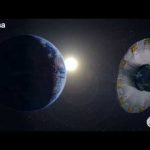
Animation showing Gaia launch and journey to its operating orbit. The animation begins by visualising the launch from Europe’s Spaceport in Kourou, French Guiana, on a Soyuz-STB/Fregat-MT vehicle. The rocket’s four boosters are jettisoned 118 seconds after launch, and the spacecraft fairing is jettisoned after 220 seconds. Following two burns, the Fregat upper stage separates from Gaia 42 minutes after launch. The separation activates an automatic sequence onboard Gaia, including switching on the spacecraft’s transmitters, pressurisation of the propulsion system, initial attitude acquisition and deployment of the sunshield. By then Gaia will be on its transfer orbit from Earth towards L2, a virtual point in space some 1.5 million kilometres ‘behind’ Earth as seen from the Sun. Gaia will take about a month to cruise and manoeuvre into a ‘Lissajous’ orbit around L2. The size of the orbit is typically 340 000 x 90 000 km and takes 180 days. There, Gaia will spin slowly in order to make systematic repeated observations of stars covering the whole sky with its two telescopes. Over its five-year mission, Gaia will monitor the positions, motions, temperatures, luminosities and compositions of a billion stars.
Carbon dioxide is a gas that we interact with every day. For instance, CO2 enables plants to perform photosynthesis, you exhale CO2 when you breathe, and CO2 can extinguish fire. You probably knew all those facts, but did you know that you can get really science-y and extremely creative when putting out flames with CO2? It’s as simple as pouring the gas onto fire. Pouring? You better believe it!
ESA’s Gaia mission will produce an unprecedented 3D map of our Galaxy by mapping, with exquisite precision, the position and motion of a billion stars. The key to this is the billion-pixel camera at the heart of its dual telescope. This animation illustrates how the camera works.
Gaia is ESA’s billion-star surveyor, designed to provide a precise 3D map of our Milky Way galaxy in order to understand its composition, formation and evolution.
With freezing cold temperatures crossing the nation, The Spangler Effect takes a look at the phenomenon of instant freezing water and the dangers of leaving unopened soda bottles out in the cold.
Milk goes great with a lot of things: cereal, cookies, cake, and pie. You know what’s even more incredible to mix with milk? A big ol’ bottle of soda! We know what you’re thinking, “Soda and milk would be disgusting, together!” You’re absolutely correct, but you aren’t supposed to drink the mixture! Instead, watch the magic happen when you mix the two.
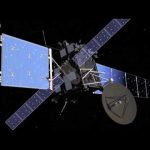
Visualisation of how the Rosetta spacecraft wakes up from deep space hibernation, 673 million kilometres from the Sun, on 20 January 2014.
Prior to entering hibernation on 8 June 2011, Rosetta was oriented so that its solar arrays faced the Sun, and it began rotating once per minute for stability. The only devices left running were its computer and several heaters.
Rosetta’s computer is programmed to carry out a sequence of events to re-establish contact with the Earth on 20 January, starting with an ‘alarm clock’ at 10:00 GMT. Immediately after, the star trackers begin to warm up. Around 6 hours later the thrusters are fired and the slow rotation stops. A slight adjustment is made to Rosetta’s orientation to ensure that the solar arrays now face the Sun. Then the star trackers switch on to determine its attitude. The spacecraft rotates towards Earth, and the transmitter is switched on. Then Rosetta’s high-gain antenna points to Earth and the signal is sent. The journey takes 45 minutes before the signal is received and mission controllers can begin to check Rosetta’s health, ready for the next phase of the mission.
The first opportunity for receiving a signal on Earth is between 17:30 GMT and 18:30 GMT.
#WakeUpRosetta – What do you do Mondays at 10 am? At 10:00 UTC on 20 January 2014, ESA’s comet-chasing Rosetta spacecraft will wake up from 31 months in deep-space hibernation. Save the date and join the adventure. More info at www.esa.int/rosetta.
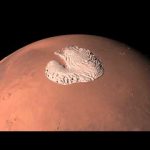
Enjoy views of the martian north pole from all angles in this new animation from ESA’s Mars Express.
The ice cap has a diameter of about 1000 km and consists of many thin layers of ice mixed with dust that extend to a depth of around 2 km below the cap. The prominent gap in the ice cap is a 318 km-long, 2 km-deep chasm called Chasma Boreale.
The layers result from variations in the orbit and rotation of Mars that affect the amount of sunlight received at the poles, and thus the amount of melting and deposition of materials over time. Meanwhile, strong prevailing winds are thought to be responsible for shaping the spiral troughs.
The polar ice cap in this movie was constructed using data provided by the Mars Advanced Radar for Subsurface and Ionospheric Sounding instrument, MARSIS.
Low-frequency radio waves beamed towards the surface are reflected back to Mars Express from the planet’s surface and from interfaces between layers of different materials underground.
The strength and timing of the radar echoes are a gauge of the depths of different types of interfaces, such as between rock, water or ice. This information can then be translated into 3D views, as seen in this movie.
With a more than ninety percent probability that Comet ISON broke apart from a major heating event on its approach to the sun Thanksgiving Day, the search is on for what’s left of it. NASA will use a variety of space and Earth based telescopes to monitor the comet over the next several weeks, before the fate of ISON can be confirmed. Also, Orion’s heat shield, Blue Origin milestone, Rover Challenge, Stone awarded medal and Celebrating Centaur.
Innovation through space, now in the UK – check out the ESA BIC Harwell. The ESA Business Incubation Centre – ESA BIC Harwell, is located in the UK, and is managed by the Science and Technology Facilities Council (STFC).
ESA BIC Harwell provides a unique opportunity to access world class scientific facilities and research including that of the Diamond Light Source and STFC’s Rutherford Appleton Laboratory (RAL) — home to its internationally renowned space science department RAL Space, the world’s most powerful pulsed neutron source ISIS and the Central Laser Facility.
The BIC is also the location of the UK ESA Centre and the International Space Innovation Centre (ISIC), which brings together the best of the British space sector, industry and academia in collaboration with international partners.
NASA hosted a Google+ Hangout to discuss extraordinary new images of Saturn taken by the Cassini spacecraft. Participants in the hangout learned what’s ahead in the next few years of the Cassini mission from panelists Kunio Sayanagi, Cassini imaging team associate, Hampton University, VA., Carolyn Porco, Cassini imaging team lead, Space Science Institute, Boulder, CO., Linda Spilker, Cassini project scientist, NASA’s Jet Propulsion Laboratory, Pasadena, CA., and Earl Maize, Cassini program manager, NASA’s Jet Propulsion Laboratory, Pasadena, CA.
Íme az űrkadétok: három fiatal mérnök, akiknek a munkája a szó szoros értelmében földönkívüli élményt jelent. A szakértők olyan új generációjáról van szó, akiknek az űrutazásról szóló álmaikat sikerült kézzelfogható karrierre váltaniuk.
Our Insta-Snow® powder has become pretty famous for being the most realistic faux snow on the market. What many people don’t know is that you can make instant snowballs from the fake snow! Insta-Snowballs might not work for snowball fights, but they’re remarkably easy to make, and ridiculously cool!
#WakeUpRosetta – Save the date. At 10:00 UTC on 20 January 2014, ESA’s comet-chasing Rosetta spacecraft will wake up from 31 months in deep-space hibernation. Save the date and join the adventure. More info at www.esa.int/rosetta.
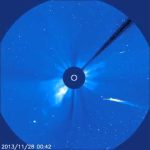
The ESA/NASA SOHO satellite watched as Comet ISON made its closest approach to the Sun on 28 November, at a distance of around 1.2 million kilometres from the Sun’s visible surface. Did it survive? Early reports suggested that only the comet’s tail continued to follow along ISON’s orbit. Further observations will reveal if a chunk of the comet’s nucleus survived. See the latest images: http://soho.esac.esa.int/hotshots/index.html/
Comet ISON on the approach to the Sun. It entered the SOHO LASCO C3 field of view at 01:41 UT on 27 November. This video covers over 24 hours of the journey so far. Will ISON survive its closest approach with the Sun? Stay tuned: http://soho.esac.esa.int/hotshots/index.html/
We’ve shown you how different sodas will either sink or swim in plain tap water, but what’s the deal with eggs? Drop as many eggs into plain tap water as you want, but they’ll all sink to the bottom. In the Floating Egg experiment, we’ll show you how the addition of something as simple as table salt, can drastically alter what happens to eggs in water.
The Mars Atmosphere and Volatile EvolutioN, or MAVEN spacecraft launched from Cape Canaveral Air Force Station in Florida on a 10-month journey to Mars. MAVEN will take critical measurements of the Martian upper atmosphere to investigate how loss of the atmosphere to space impacted the history of water on the planet’s surface. Also, Happy anniversary, ISS!, Asteroid Ideas, LADEE in science orbit, Orion progress, Rocket autopilot test, Commercial crew, and more!
Earth’s magnetic field is continuously changing. Magnetic north wanders, and every few hundred thousand years the polarity gradually flips, so that a compass would point south instead of north.
Meet the space cadets, three young engineers with enviable jobs that are quite literally out of this world. This edition of Space focuses on three professionals who’ve turned their dreams of working in space into real down-to- Earth careers.
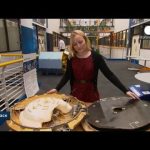
In the UK, 26-year-old Abbie Hutty, a spacecraft structures engineer at Astrium, is a proud member of the ExoMars team. She is developing the structure of the mission’s rover, ensuring that the actual body of the vehicle and other components are all structurally strong enough to withstand the launch from Earth, and landing on Mars.
Twenty-seven-year-old Marc Costa Sitjà, Science Operations Engineer at the European Space Agency, uses the huge antenna at Cebreros, west of Madrid, to ‘drive’ ESA’s Venus Express spacecraft around the planet. Every day he sends commands and receives data to and from the spacecraft from the agency’s ESAC facility near the Spanish capital.
Maria Komu, a 27-year-old researcher at the Finnish Meteorological Institute, works on Finnish mini satellite Aalto-1, and has a hands-on role developing a weather instrument for ESA’s ExoMars EDM mission.
Space is a childhood dream turned reality for all three. For Abbie the realisation that space wasn’t just science fiction came when she was still at school and she heard of the Beagle 2 mission to Mars, a lander that was developed in the UK by British engineers. Maria tells the story of a book about a school visit around the solar system that enchanted her as a young girl. Meanwhile Marc cites a vivid blue image of Venus as an inspiration to his career.
Abbie, Marc and Maria are all educated to masters level, while Maria continues studying towards a doctorate. They’re on the first steps of the career ladder, and that means plenty of learning ‘on-the-job’. Maria had to master soldering, programming, and testing, Marc developed his skills by creating software that helped a mission to better fulfill its purpose, while Abbie had to understand better the behaviour of particular materials in the cold vacuum of space.
The excitement of working in space is summed up by Abbie: “I think the space industry is quite a privileged industry to work in, because whilst you are still managing projects and meeting schedules and deadlines, and creating a product, at the end of the day that requires a certain amount of processes down on it, you can also come down to the clean rooms and look through the window and see your part of a spaceship, and think ‘that’s going to Mars, and I did that bit’, and you don’t get that anywhere else.”
Η Μαρία, ο Μαρκ και η Άμπι είναι τρεις νέοι μηχανικοί κι έχουν τρεις διαφορετικές ιστορίες, αλλά με ένα κοινό γνώρισμα. Η δουλειά τους είναι στη Γη, αλλά φεύγει από τα όριά της. Και οι τρεις πραγματοποίησαν το όνειρό τους: δουλεύουν στη διαστημική βιομηχανία. Και δηλώνουν ευτυχισμένοι γι’αυτό.
Λίγο μετά τα είκοσί τους χρόνια, ήδη έχουν σημαντικές ευθύνες.
Η Μαρία εργάζεται σε έναν φινλανδικό μίνι δορυφόρο και σε εργαλεία πρόγνωσης καιρού για την αποστολή ExoMars της ESA. Η Άμπι αναπτύσσει τη δομή του οχήματος της αποστολής. Ο Μαρκ σχεδιάζει τις επιχειρήσεις του δορυφόρου Venus Express της ESA.
Η Άμπι και ο Μαρκ έχουν μεταπτυχιακές σπουδές, ενώ η Μαρία είναι υποψήφια διδάκτωρ. Και οι τρεις λένε πως εμπνεύστηκαν από την ιδέα της εξερεύνησης του ηλιακού μας συστήματος.
Πλοήγηση δορυφόρων, κατασκευή διαστημικών οχημάτων και μετεωρολογικών σταθμών για τον Άρη. Όλα αυτά απαιτούν δεξιότητες, γνώση και αφοσίωση.
Δυσκολίες υπάρχουν σίγουρα. Όμως κανείς εκ των τριών δεν χάνει από το βλέμμα του τη μοναδική φύση μιας καριέρας στο διάστημα.
L’espace fascine bon nombre d’entre nous, mais bien peu ont la chance de travailler dans le domaine de la recherche spatiale. Nous avons rencontré trois jeunes ingénieurs qui ont entamé une carrière, la tête dans les étoiles et les pieds sur Terre.
A Helsinki, Maria Komu nous fait découvrir son lieu de travail : l’Institut météorologique finlandais qui dispose d’un laboratoire spatial. “Il y a à peine cinq ans, mon plus grand rêve, c’était simplement de pouvoir toucher quelque chose qui allait dans l’espace,” nous confie la jeune femme. “Aujourd’hui, je conçois des instruments qui vont dans l’espace, c’est incroyable !” s’enthousiasme-t-elle. Maria travaille sur un mini-satellite et des instruments météo pour le démonstrateur EDM de la mission ExoMars de l’Agence spatiale européenne (ESA).
Au nord de Londres, découvrons à présent, l’univers d’Abbie Hutty, ingénieur spatial structures chez Astrium. Son travail qui d’ailleurs, la passionne : s’assurer que “le corps du rover ExoMars est assez solide pour pouvoir supporter notamment le lancement, l’arrivée au sol et l’entrée dans l’atmosphère,” nous explique-t-elle.
En Espagne, à Cebreros, près de Madrid, Marc Costa Sitjà nous présente l’antenne à gain élevé qui permet à son équipe de communiquer avec le satellite Venus Express (ESA) pour gérer son pilotage. La parabole permet aux scientifiques d’envoyer des ordres de commande à l’engin et de recevoir des données en sa provenance comme une image de Vénus unique qu’ils ont réussi à constituer à partir de toute une série d’observations.
Nos trois jeunes ingénieurs ont choisi ces métiers pour explorer notre système solaire et peut-être éclaircir ses mystères. Une motivation qui les anime parfois depuis l’enfance. Chacun reconnaît avoir de la chance de mener une vie professionnelle dans un secteur qui les fascine. La Finlandaise Maria Komu aimerait poursuivre son rêve éveillé en visitant “d’immenses chambres à vide et peut-être des simulateurs solaires :c’est ce que je préfèrerais,” nous lance-t-elle avant de conclure : “et bien sûr, si je pouvais assister en vrai au lancement d’une fusée, ce serait vraiment cool !”
The Mars Atmosphere and Volatile EvolutioN, or MAVEN spacecraft launched from Cape Canaveral Air Force Station in Florida on a 10-month journey to Mars. MAVEN will take critical measurements of the Martian upper atmosphere to investigate how loss of the atmosphere to space impacted the history of water on the planet’s surface. Also, Happy anniversary, ISS!, Asteroid Ideas, LADEE in science orbit, Orion progress, Rocket autopilot test, Commercial crew, and more!
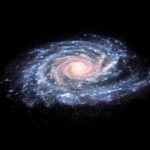
This virtual journey shows the different components that make up our home galaxy, the Milky Way, which contains about a hundred billion stars.
It starts at the black hole at the centre of the Milky Way and with the stars that orbit around it, before zooming out through the central Galactic Bulge, which hosts about ten billion stars.
The journey continues through a younger population of stars in the stellar disc, home to most of the Milky Way’s stars, and which is embedded in a slightly larger gaseous disc. Stars in the disc are arranged in a spiral arm pattern and orbit the centre of the Galaxy.
The discs and bulge are embedded in the stellar halo, a spherical structure that consists of a large number of globular clusters — the oldest population of stars in the Galaxy — as well as many isolated stars. An even larger halo of invisible dark matter is inferred by its gravitational effect on the motions of stars in the Galaxy.
Looking at a face-on view of the Galaxy we see the position of our Sun, located at a distance of about 26 000 light-years from the Galactic Centre.
Finally, the extent of the stellar survey conducted by ESA’s Hipparcos mission is shown, which surveyed more than 100 000 stars up to 300 light-years away from the Sun. In comparison, ESA’s Gaia survey will study one billion stars out to 30 000 light-years away.
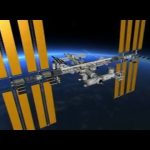
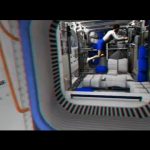
Get an idea of what it feels like to see the International Space Station from the outside, as an astronaut on a spacewalk. Put your 3D glasses on to appreciate the size of humankind’s orbital laboratory and watch a Soyuz spacecraft undock and a docking with ESA’s supply spacecraft Automated Transfer Vehicle.
Put your 3D glasses on for this virtual visit of the International Space Station’s modules. Float through the space laboratories and connecting modules from the perspective of an astronaut.
Courtesy of a little digital magic, the young man in this poster really does know when it’s a British Airways plane. And that really is the actual flight number and where it’s flying in from. #DiscoverBA
Did you know that the majority of burps are simply caused by swallowed air? It’s true! Burping is a natural human phenomenon, but it’s also possible for a bottle to burp. Say what?! Believe it… bottles can belch just like a human. All it takes is a bit of science know-how, especially when it comes to the properties of air and water.
Earth’s magnetic field is our life saver, protecting us from the energetic solar wind. The Swarm satellites will measure Earth’s magnetic field to allow us to understand it for a safer future.
The MAVEN spacecraft is the latest NASA probe designed to help piece together a complete picture of The Red Planet’s past. MAVEN’s piece of the puzzle — to understand what happened to Mars’ upper atmosphere. Following its launch from Cape Canaveral Air Force Station — MAVEN is scheduled to reach Mars in September 2014. Also, Getting to deep space, A stunning new view of Saturn, Commercial success, Earth science satellite, Antarctica campaign, Tail wing technology and more!