ESA astronaut Tim Peake answers questions from school children in Wiltshire, UK. Tim joined the hangout from NASA’s Johnson Space Center in Houston where he is currently training for his six month Principia mission to the International Space Station, set for liftoff in December 2015.
The hangout was jointly hosted by ESA with +spacegovuk and +BBC Wiltshire. NASA’s Johnson Space Center provided support by hosting Tim in their Houston studio.
If an asteroid were spotted headed towards Earth, what could humanity do about it? On 30 June, world renowned scientists, Nobel laureates, astronauts, technologists and artists join forces for Asteroid Day (http://www.asteroidday.org/), a global awareness movement to spread knowledge about asteroids and ways to protect Earth from such threats. The Day is held on the anniversary of the 1908 Siberian Tunguska event, the largest asteroid to impact our planet in recent history.
To mark Asteroid Day, ESA experts on Near-Earth Objects (NEO) and asteroids have answered the public’s most insightful questions. Respondents include Ian Carnelli, AIM Project Manager, Detlef Koshny, SSA-NEO Segment Manager and Michael Kueppers, AIM Project Scientist.
If approved next year by Europe’s space ministers, 2020 will see the launch of ESA’s deep space Asteroid Impact Mission or AIM, as part of AIDA (Asteroid Impact & Deflection Assessment), a larger international effort to investigate planetary defence techniques. AIM will travel to a binary asteroid system – the paired Didymos asteroids, which will come a comparatively close 11 million km to Earth in 2022. After encounter and study, the mission will then witness the asteroid being struck by another spacecraft, returning data to help guide planetary defence strategies.
The ExoMars spacecraft is almost complete. A joint mission between ESA and Roscosmos, it begins with the launch of the ExoMars orbiter in 2016 and carries an aerodynamically designed capsule containing a robotic lander.
Getting to Mars, landing there safely and searching for life is a huge scientific and technical challenge. ExoMars 2016 will send back information about the Martian atmosphere and the lander’s findings. These will inform the second part of the mission, in 2018, when a European rover will drill into the Martian surface, up to two metres down. The rover will be trying to detect traces of organic molecules that indicate the presence of past or present life on Mars.
This video includes interviews with Jorge Vago, ExoMars Project Scientist, ESA and Pietro Baglioni, ExoMars Rover Manager, ESA. It shows ExoMars 2016 nearing construction in its clean room at Thales Alenia Space in France and a prototype ExoMars rover in the ExoMars test yard at ESA’s ESTEC facility in the Netherlands.
Years in the building, seconds in the launching; rocket engines are truly awesome in their sheer power, but are also amazing feats of engineering and design.
The scientific principle remains quite simple: accelerated gas creating thrust through a nozzle. However, extrapolating that concept to the point where the rocket has sufficient power to lift people and satellites beyond Earth’s gravity and into orbit is far more complex. Don’t let anybody tell you otherwise, the manufacturing and testing process IS rocket science.
In Europe one of the key centres of work on rocket engines is done at the Snecma factory complex in a remote location in forests near the town of Vernon in Normandy. Many of the components are built elsewhere in Europe, but the assembly and testing are carried at the site in northern France.
The pieces are carefully milled from titanium or lightweight alloys over a period of weeks. When construction is finally completed then comes the critical test phase, where the rockets are fired into life inside a vast tower.
Space reporter Jeremy Wilks visited the Snecma site to find out more about this unique and constantly evolving industrial sector.
Iszonyú erő kell ahhoz, hogy valamit kijuttassunk az űrbe. A rakétahajtóművekre ma már komoly kereskedelmi iparág épül rájuk, amely a teljesítményt abban méri, mekkora tömeget hány dollárért lehet föld körüli pályára állítani.
Európa kifejezetten sikeres ebben az üzletben: az Ariane 5-ös rakéták az iparág kipróbált igáslovai, és már készül az új Ariane 6-os. A Space júniusi epizódjában Jeremy Wilks ellátogat a hajtóműveket gyártó francia SNECMA üzemeibe, hogy megtudja, hogyan lehet valamin akkorát lökni, hogy a geostacionárius pályáig meg se álljon.
A szakemberek a Space-ben megszokott nyíltsággal és érzelmességgel beszélnek a munkájukról, arról, hogy milyen dolog évekig építeni valamit, aminek a sikere azután pár perc alatt eldől, és egyetlen kis hiba is végzetes lehet.
Per costruire un razzo possono volerci anni. Mentre per lanciarlo in orbita bastano pochi secondi. Secondi importanti dove lavorano contemporaneamente forze diverse.
“Per andare nello spazio serve tantissima potenza” spiega Gaele Winters (ESA) “Potenza necessaria a superare la forza di gravità”
La forza in grado di portare uomini e apparecchiature in orbita è generata da sofisticati motori nei quali brucia combustibile liquido o solido, o entrambi. Come nel caso del missile Ariane 5.
“Cinque, quattro, tre, due, uno, zero.E’ in quel momento che accendiamo le turbopompe, che inviano idrogeno e ossigeno nella camera di combustione del cosiddetto motore *Vulcain*” spiega Thierry Delaporte (Snecma) “Il primo ad accendersi. Una volta verificato che funziona, nel giro di 5 secondi, accendiamo anche i due booster laterali a propulsione e…..Hop, il razzo decolla”.
L’azienda dove si producono i motori usati per il programma europeo di lanciatori Ariane è a Vernon, in Francia. E’ qui che si procede ai test sui missili che saranno lanciati in orbita. La torre usata per i test si trova in una valle. E’ lì che i motori vengono accesi per la prima volta.
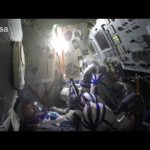
ESA astronaut Samantha Cristoforetti, NASA astronaut Terry Virts and Russian commander Anton Shkaplerov landed in the Kazakh steppe after a three-hour ride in their Soyuz spacecraft 11 June 2015.
Shortly after landing the crew were welcomed back to Earth in a traditional Kazakh ceremony held for all astronauts who return from space on a Soyuz spacecraft.
Intervista con l’astronauta dell’ESA Samantha Cristoforetti, nelle prime
ore dell’11 giugno, poco dopo l’atterraggio nelle steppe del Kazakistan.
Samantha, insieme al comandante russo Anton Shkaplerov ed all’astronauta della NASA Terry Virts, è atterrata alle 13:44 GMT (15:44 CEST), con la stessa navicella Soyuz TMA-15M che il 23 novembre li aveva portati sulla Stazione Spaziale Internazionale.
Interview with ESA astronaut Samantha Cristoforetti shortly after returning from a six and a half month stay on the International Space Station.
Samantha, together with Russian commander Anton Shkaplerov and NASA astronaut Terry Virts, landed with their the Soyuz TMA-15M spacecraft in the Kazakh steppe at 15:44 CEST (13:44 GMT) on 11 June 2015.
ESA astronaut Samantha Cristoforetti, NASA astronaut Terry Virts and Russian commander Anton Shkaplerov landed in the Kazakh steppe after a three-hour ride in their Soyuz spacecraft 11 June 2015. They left the International Space Station at 10:20 GMT at the end of their six-month stay on the research complex.
Soyuz TMA-15M braked from the Station’s cruising speed of almost 28 800 km/h and entered the atmosphere six hours later. The small descent module separated as planned and parachutes deployed to slow the vehicle down even more.
The module fired retrorockets moments before landing and springs in the moulded seats reduced the impact of hitting the steppe at 13:44 GMT. Teams were on hand within minutes to help them out.
Join ESA astronaut Samantha Cristoforetti for a guided tour of the International Space Station’s crew quarters – the bedroom.
After a day’s work running experiments and maintaining the weightless research centre astronauts can retreat to their private quarters that is no larger than a changing room. In this small space they can store personal items, use a laptop for internet and float to sleep in their sleeping bag.
The Rosetta spacecraft is still orbiting comet 67P/Churyumov-Gerasimenko while it now approaches the Sun. Six months ago Rosetta made history by delivering its Philae lander onto a comet’s surface – something no other space mission has done before.
This video covers the mission’s highlights so far: from its launch in 2004; its journey across the solar system and waking up after deep space hibernation ten years later, its arrival at the selection of a landing site and Philae’s unexpected multiple landings on the comet. It also reviews what we have learnt about the comet to this point.
Credit: ESA, with footage by DLR, licenced under CC-BY 3.0 DE
Don’t panic! This is the story of a book, a book called The Hitchiker’s Guide to the Galaxy, a wholly remarkable book.
ESA astronaut Samantha Cristoforetti reads from Douglas Adam’s “The Hitchhiker’s Guide to the Galaxy” for towel day from the European laboratory Columbus on the International Space Station.
The Guide has a few things to say on the subject of towels. A towel, it says, is about the most massively useful thing an interstellar hitchhiker can have.
To all you froods on the mostly harmless planet Earth, happy towel day!
Towel Day is an annual celebration on 25 May, as a tribute to the late author Douglas Adams when fans around the universe proudly carry a towel in his honour.
The ExoMars 2016 mission will try to answer one of the toughest and most intriguing questions in our Solar System: is there, or has there ever been, life on Mars?
Getting to Mars, landing there safely, and then beginning the search for life is a huge scientific and technical challenge for the large team behind ExoMars, a joint ESA and Roscosmos project to search for life on Mars. It is the world’s biggest ever mission to the red planet.The ExoMars mission could reveal if there is, or has ever been, life on Mars by the end of the decade.
Maurizio Capuano e Richard Bessudo fanno il conto alla rovescia per il lancio di una delle più grandi missioni al mondo sul Pianeta Rosso. Fanno parte del team di ExoMars, un progetto congiunto di ESA e di Roscosmos che intende cercare segni di vita su Marte. La prima astronave è quasi pronta.
Maurizio Capuano, manager del programma ExoMars 2016, ThalesAleniaSpace: “Questo è Exomars 2016 che l’anno prossimo arriverà sul pianeta rosso. La parte bassa si metterà in orbita marziana aprendo i suoi pannelli solari per prendere l’energia dal sole, la parte superiore è il cosiddetto lander che atterrerà direttamente sulla superficie marziana completamente autonomo”.
ExoMars è composto da due missioni, che saranno lanciate rispettivamente nel 2016 e nel 2018. Al ThalesAleniaSpace nel sud della Francia, la navicella spaziale è sottoposta a un rigoroso programma di test, visto che le finestre di lancio non sono frequenti, come spiega Richard Bessudo, manager del programma ExoMars Trace Gas Orbiter. “Per andare su Marte occorre ottenere le condizioni favorevoli di congiunzione tra Terra e Marte. Tenuto conto delle orbite dei due pianeti, le congiunzioni favorevoli si riproducono soltanto ogni 26 mesi”.
Una volta su Marte, l’astronave si separa in due parti. Il satellite resta in orbita e il lander si dirige sulla superficie. L’ESA spera che questa capsula porterà a termine il primo atterraggio controllato europeo su Marte.
Fra i libri che l’astronauta Samantha Cristoforetti ha portato a bordo della Stazione Spaziale Internazionale c’è anche “I Viaggi di Giovannino Perdigiorno” di Gianni Rodari.
Sono tante le filastrocche di questa raccolta e Samantha ha deciso di leggerne alcune iniziando questa serie di letture spaziali da “Il pianeta di cioccolato”. Buon ascolto… dallo spazio!
Among the books that ESA astronaut Samantha Cristoforetti has brought on board the International Space Station there is also the collection of rhymes “I viaggi di Giovannino Perdigiorno” from the famous Italian children’s author Gianni Rodari.
Rodari is also famous in Russia; in this video Samantha reads a Russian version of the story “Il pianeta di cioccolato” (The planet made of chocolate).
Still images taken by ESA astronaut Samantha Cristoforetti on the International Space Station were joined together to create this timelapse.
The astronauts on the Space Station spend as much time as possible on science. During her 40-hour working week Samantha runs many experiments from Italy’s ASI space agency and ESA, and takes part in even more from scientists all over the world.
Samantha is living and working on board the International Space Station as part of the six-strong Expedition 42 and 43 crew. Follow her Futura mission at http://samanthacristoforetti.esa.int.
(L-115 days) ESA astronaut Andreas Mogensen and Russian cosmonaut Sergei Volkov take us inside the Soyuz simulator at Star City where they are training for off-nominal situations they could face during their spaceflight. In practice, this includes anything their Soyuz instructor decides to throw at them – including scenarios such as fire or depressurisation.
Andreas is currently training for his 10-day Iriss mission to the International Space Station, set for launch in September 2015.
ESA astronaut Samantha Cristoforetti shows how to use the most unglamorous but often asked-about part of living on the International Space Station: the toilet.
A fan creates suction to avoid smells and floating waste. Solid waste is stored and put in cargo ferries to burn up when the spacecraft leaves the Space Station. The astronaut urine is recycled – into drinking water.
ESA astronaut Samantha Cristoforetti, from Italy, will shortly be ending her long-duration stay onboard the International Space Station. Launched in November 2014, the Futura mission is the result of a special agreement between NASA and the Italian Space Agency ASI.
During her time in orbit Samantha Cristoforetti has undergone an intensive programme of scientific research, educational and maintenance activities, as well as overseeing the undocking of ESA’s fifth – and last – Automated Transfer Vehicle.
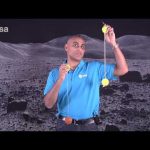
This video, part of a new series of ESA teaching resources called ‘Teach with space’, shows an experiment that can be performed by teachers in the classroom to demonstrate the concept of a barycentre, or centre of mass, and how objects in orbit around each other move.
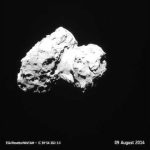
This animation of NAVCAM images follows the spacecraft’s approach to the comet from a distance of about 800 km on 1 August to a distance of about 62 km on 22 August 2014.
The movie is a showcase of over one thousand NAVCAM images released today in ESA’s Archive Image Browser: http://imagearchives.esac.esa.int/
Plymouth is one of England’s historic port cities, a place from which sailors, soldiers and scientists have set off to sea for centuries. Today there’s a new twist to the tale though, as oceanographers now have a huge fleet of satellites in space to add to their list of high quality data sources in order to study and understand our seas.
The field of satellite ocean observation is due to get a boost later this year as ESA’s Sentinel-3 will join the fleet of Earth observers already in orbit. It’s part of Europe’s Copernicus programme, and heralds a new era in ocean observation by offering an uninterrupted flow of data from its speedy polar orbit, now and well into the future.
Az Európai Űrügynökség hamarosan felbocsátja a Sentinel-3 műholdat, amelynek egyik fő feladata az lesz, hogy az óceánokról gyűjtsön adatokat.
Régóta tudjuk hogy az óceánok alapvető fontosságúak a földi élet szempontjából, és ezek szabályozzák az időkárást és a klímát. De most a műholdak segítségével ezt globális léptékben figyelhetjük meg. Egy műhold egy nap alatt annyi adatot szolgáltat az óceánokról, mint egy hajó egy év alatt. Ezeket az ismereteket azonban össze kell vetni a felszínen végzett mérésekkel.
Hogyan is történik mindez: például az űrből megfigyelhető az óceán színe, ami következtetni enged a fitoplankton, egy apró algaféle mennyiségére. Ezek az apró jószágok bocsátják ki a Föld oxigéntermelésének felét, ezek a tengeri ökoszisztéma alapvető építőkockái, ugyanakkor jelzőrendszerként is funkcionálnak, mert nagyon érzékenyen reagálnak a környezet változásaira. Ugyanakkor csak mintavétellel lehet megmondani, hogy mi is az, amit a műhold a a földkörüli pályáról lát.
Ezeknek a kutatásoknak köszönhetően tudjuk, hogyan változik a vízsszint, az óceánok hőmérséklete, az élővilág állapota: ha kellő mennyiségű adat gyűlik össze, abból sokkal inkább megérthetjük a Föld klimatikus viszonyait és folyamatait, mint bármi másból.
ESA astronaut Samantha Cristoforetti running experiments in weightlessness during her Futura mission for scientists from all over the world. The International Space Station offers three state-of-the-art laboratories where research can be done without gravity. The European Columbus laboratory, the Japanese Kibo and the American Destiny module offer facilities for physics, biology, geophysics and medicine.
Samantha’s 40-hour work week is devoted to science and maintaining the weightless research centre. This video gives a fast-track impression of some of the experiments she worked on. In quick succession we see Samantha working on: exercise machine ARED, measuring her body mass, the robotic droids SPHERES, ESA’s microgravity glovebox, muscle-measurement machine MARES, centrifuge-incubator Kubik, Biolab, Materials Science Laboratory and ejecting miniature satellites called Cubesats into space.
The astronauts on board the International Space Station get hungry from time to time during their long day of work in microgravity. We asked Samantha Cristoforetti, ESA astronaut on board the ISS for the Futura mission, to tell us about the kind of healthy snack she likes to eat during her breaks.
Anche a bordo della Stazione Spaziale Internazionale gli astronauti hanno ogni tanto bisogno di una pausa tra esperimenti, esercizio fisico e lavori di manutenzione. Samantha Cristoforetti, astronauta dell’Agenzia Spaziale Europea in missione per l’Agenzia Spaziale Italiana, ci mostra qualche esempio di uno snack sano in microgravitá.
In this special edition, Sentinel-2 Project Manager François Spoto and System Engineering and Operations Manager Omar Sy join the show to tell us more about the Sentinel-2A satellite and its mission at IABG in Munich, Germany.
Last summer, they were considered lost: two Galileo satellites ended in the wrong orbit after their launch by a Soyuz from Kourou, French Guiana. But now the two satellites have been recovered and they should be able to fulfil at least partially their mission – a situation made possible thanks to expertise and hard work in the extended Galileo team, from ESA, to agencies partners and industry.
Having completed a short and flawless return from space, the Intermediate eXperimental Vehicle (IXV), Europe’s atmospheric reentry demonstrator, is now on its way to Europe for detailed analysis of its flight experience. The successful mission opens a new door for Europe in future space transportation.
Dancing is probably the oldest human artform – and now ESA’s Proba-3 precision formation-flying mission intends to extend the art of dance to space.
Like dancers, a pair of minisatellites will move around each other, their relative positions maintained to millimetre-scale precision, as if they were both parts of one giant spacecraft.
Their mission is to cast a shadow from one minisatellite onto another, in order to form an artificial total solar eclipse in space – then study the fine details of the Sun’s wispy atmosphere, the solar corona.
Franco Ongaro, ESA Director of Technical and Quality Management; Frederic Teston, Head of System and Cost Engineering; Andrea Santovincenzo, ESA engineer and the project’s manager Agnes Mestreau-Garreau, explain how to go about teaching a space mission to dance.
As Europe enjoyed a partial solar eclipse on the morning of Friday 20 March 2015, ESA’s Sun-watching Proba-2 minisatellite had a ringside seat from orbit. Proba-2 used its SWAP imager to capture the Moon passing in front of the Sun. SWAP views the solar disc at extreme ultraviolet wavelengths to capture the turbulent surface of the Sun and its swirling corona.
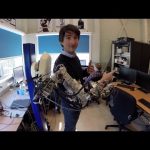
In preparation for his 10-day Iriss mission to the International Space Station in September this year, ESA astronaut Andreas Mogensen is at ESA’s technical centre, ESTEC, in Noordwijk, the Netherlands, visiting the Telerobotics and Haptics Laboratory. In this second part of his video diary, Andreas meets Bill Carey to talk about the Meteron project. Andreas will participate in Meteron during his ISS mission.
In preparation for his 10-day Iriss mission to the International Space
Station in September this year, ESA astronaut Andreas Mogensen is at
ESA’s technical centre, ESTEC, in Noordwijk, the Netherlands, visiting
the Telerobotics and Haptics Laboratory. Andreas catches up with Andre
Schiele, head of the laboratory, to learn more about the robotics
activities he will be participating in during his mission.
This month’s Space focuses on startups in Europe that are finding everyday Earthly applications for space innovations.
There’s a long tradition of transferring technology from one sector to another to improve life on our planet, and in the case of space that can lead to some unlikely links between science success stories such as the Philae lander, and the hunt for bedbugs in hotel rooms, or between the Smart-1 moon mission and the efficiency of geothermal energy. We visit two of the 11 ESA business incubation centres around Europe, one in Barcelona, the other near Oxford.
Este mes Space visita varias empresas europeas de reciente creación que buscan aplicar la tecnología espacial aquí en la Tierra.
Las misiones espaciales fuerzan los límites de la ingeniería y ese conocimiento se ha trasladado, desde hace años, a nuestra vida diaria a través de aparatos e inventos innovadores.
Hemos visitado dos de las once incubadoras de empresas que la ESA posee en Europa, una en Barcelona y otra cerca de Oxford. Allí hemos descubierto varios proyectos que ya están, literalmente, despegando.
Replay of our ‘Out of this world’ Google hangout between ESA astronaut Tim Peake and pupils from Rode Heath Primary from Cheshire, UK.
On Wednesday 25 February at 11:00 CET (10:00 GMT) Tim spoke to Rode Heath as part of their ‘Out of this world’ project. Hosted by Manchester Metropolitan University, representatives from all year groups at Rode Heath asked Tim their questions.
Tim is currently training for launch to the International Space Station on 20 November 2015. He will spend six months living and working on the ISS for his Principia mission.
L’astronauta ESA Samantha Cristoforetti, attualmente sulla Stazione Spaziale Internazionale per la missione Futura dell’Agenzia Spaziale Italiana, ci mostra come funziona la “palestra spaziale” iniziando da ARED, l’Advanced Resistive Exercise Device.
ESA astronaut Samantha Cristoforetti, currently living and working on the International Space Station, shows us the ‘space gym’. Starting with ARED, the Advanced Resistive Exercise Device.