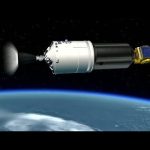
The third Copernicus Sentinel-1 satellite, Sentinel-1C, has launched aboard a Vega-C rocket, flight VV25, from Europe’s Spaceport in French Guiana. The rocket lifted off on 5 December 2024 at 22:20 CET (18:20 local time).
Sentinel-1C extends the legacy of its predecessors, delivering high-resolution radar imagery to monitor Earth’s changing environment, supporting a diverse range of applications and advance scientific research. Additionally, Sentinel-1C introduces new capabilities for detecting and monitoring maritime traffic.
The launch also marks Vega-C’s ‘return to flight’, a key step in restoring Europe’s independent access to space. Vega-C is the evolution of the Vega family of rockets and delivers increased performance, greater payload volume and improved competitiveness.
Credits: ESA/CNES/Arianespace
★ Subscribe: http://bit.ly/ESAsubscribe and click twice on the bell button to receive our notifications.
We are Europe’s gateway to space. Our mission is to shape the development of Europe’s space capability and ensure that investment in space continues to deliver benefits to the citizens of Europe and the world. Check out https://www.esa.int/ to get up to speed on everything space related.
The third Copernicus Sentinel-1 satellite, Sentinel-1C, has launched aboard a Vega-C rocket, flight VV25, from Europe’s Spaceport in French Guiana. The rocket lifted off on 5 December 2024 at 22:20 CET (18:20 local time).
Sentinel-1C extends the legacy of its predecessors, delivering high-resolution radar imagery to monitor Earth’s changing environment, supporting a diverse range of applications and advance scientific research. Additionally, Sentinel-1C introduces new capabilities for detecting and monitoring maritime traffic.
The launch also marks Vega-C’s ‘return to flight’, a key step in restoring Europe’s independent access to space. Vega-C is the evolution of the Vega family of rockets and delivers increased performance, greater payload volume and improved competitiveness.
Credits: Arianespace
★ Subscribe: http://bit.ly/ESAsubscribe and click twice on the bell button to receive our notifications.
We are Europe’s gateway to space. Our mission is to shape the development of Europe’s space capability and ensure that investment in space continues to deliver benefits to the citizens of Europe and the world. Check out https://www.esa.int/ to get up to speed on everything space related.
Animation of the first launch of the Ariane 6 rocket with two boosters.
Ariane 6 is an all-new design, created to succeed Ariane 5 as Europe’s heavy-lift launch system. With Ariane 6’s upper stage and its reignitable Vinci engine, Europe’s launch capability will be tailored to the needs of multiple payloads, for example to orbit satellite constellations. This autonomous capability to reach Earth orbit and deep space supports Europe’s navigation, Earth observation, scientific and security programmes. Ongoing development of Europe’s space transportation capabilities is made possible by the sustained dedication of thousands of talented people working in ESA’s 22 Member States.
At over 60 metres tall, Ariane 6 will weigh almost 900 tonnes when launched with a full payload – roughly equivalent to one and a half Airbus A380 passenger aircraft.
Vinci, the upper stage engine of Ariane 6 fed by liquid hydrogen and oxygen, can be stopped and restarted multiple times – to place satellites into different orbits and then de-orbit the upper stage, so it is not left behind as hazardous debris in space.
For the development of Ariane 6, ESA is working with an industrial network of several hundred companies in 13 European countries, led by prime contractor ArianeGroup.
France’s space agency, CNES, is preparing the Ariane 6 launch facilities at Europe’s Spaceport in French Guiana.
Credits: ESA – European Space Agency
★ Subscribe: http://bit.ly/ESAsubscribe and click twice on the bell button to receive our notifications.
We are Europe’s gateway to space. Our mission is to shape the development of Europe’s space capability and ensure that investment in space continues to deliver benefits to the citizens of Europe and the world. Check out https://www.esa.int/ to get up to speed on everything space related.
On 22 June 2023 at Europe’s Spaceport in French Guiana, engineers rolled back the mobile gantry protecting Ariane 6 on its launch pad. The exercise helped validate ground systems and prepare for a series of engine fire tests.
Credits: ESA ; S. Corvaja, ESA/M. Pédoussaut, Zetapress
★ Subscribe: http://bit.ly/ESAsubscribe and click twice on the bell button to receive our notifications.
We are Europe’s gateway to space. Our mission is to shape the development of Europe’s space capability and ensure that investment in space continues to deliver benefits to the citizens of Europe and the world. Check out https://www.esa.int/ to get up to speed on everything space related.
The first Meteosat Third Generation Imager (MTG-I1) satellite lifted off on an Ariane 5 rocket from Europe’s Spaceport in French Guiana on 13 December at 21:30 CET.
From geostationary orbit, 36,000 km above the equator, this all-new weather satellite will provide state-of-the art observations of Earth’s atmosphere and realtime monitoring of lightning events, taking weather forecasting to the next level. The satellite carries two completely new instruments: Europe’s first Lightning Imager and a Flexible Combined Imager.
MTG-I1 is the first of six satellites that form the full MTG system, which will provide critical data for weather forecasting over the next 20 years. In full operations, the mission will comprise two MTG-I satellites and one MTG Sounding (MTG-S) satellites working in tandem.
★ Subscribe: http://bit.ly/ESAsubscribe and click twice on the bell button to receive our notifications.
We are Europe’s gateway to space. Our mission is to shape the development of Europe’s space capability and ensure that investment in space continues to deliver benefits to the citizens of Europe and the world. Check out https://www.esa.int/ to get up to speed on everything space related.
This Ariane 6 combined tests model will be used to validate the entire launch system during its ground phase in readiness for the inaugural launch of the first Ariane 6 rocket.
We are Europe’s gateway to space. Our mission is to shape the development of Europe’s space capability and ensure that investment in space continues to deliver benefits to the citizens of Europe and the world. Check out https://www.esa.int/ to get up to speed on everything space related.
At Europe’s Spaceport in French Guiana, a test model of the Ariane 6’s central core has been assembled for the first time. Ariane 6 is the first Ariane rocket to be assembled horizontally, which is simpler and less costly than more traditional vertical assembly. One of the P120C boosters can be seen from different angles during installation, before the rocket’s central core is moved to its launchpad and placed upright in its mobile gantry. With the central core and boosters in place, combined tests validate compatibility between all components of the complete launch system.
★ Subscribe: http://bit.ly/ESAsubscribe and click twice on the bell button to receive our notifications.
We are Europe’s gateway to space. Our mission is to shape the development of Europe’s space capability and ensure that investment in space continues to deliver benefits to the citizens of Europe and the world. Check out https://www.esa.int/ to get up to speed on everything space related.
It has been an exciting and busy summer for the European Space Agency, with development and testing of its new Ariane 6 launcher. At Europe’s spaceport in, French Guiana, a test model of the launcher’s central core was assembled for the first time. Ariane 6 is the first Ariane rocket to be assembled horizontally, which is simpler and less costly than more traditional vertical assembly. Then, the rocket was moved to its launchpad and placed upright in the massive mobile gantry for combined tests, to validate the compatibility between all components of the complete launch system. Soon more testing will be done on Ariane 6’s upper stage at a purpose-built @DLRde facility in Lampoldshausen, Germany.
★ Subscribe: http://bit.ly/ESAsubscribe and click twice on the bell button to receive our notifications.
We are Europe’s gateway to space. Our mission is to shape the development of Europe’s space capability and ensure that investment in space continues to deliver benefits to the citizens of Europe and the world. Check out https://www.esa.int/ to get up to speed on everything space related.
ESA’s new Vega-C rocket lifted off for its inaugural flight VV21 at 15:13 CEST/13:13 UTC/10:13 local time from Europe’s Spaceport in French Guiana. With new first and second stages and an uprated fourth stage, Vega-C increases performance to about 2.3 t in a reference 700 km polar orbit, from the 1.5 t capability of its predecessor, Vega. For flight VV21, Vega-C’s payload is LARES-2, a scientific mission of @AsiTVit and six research CubeSats from France, Italy and Slovenia.
We are Europe’s gateway to space. Our mission is to shape the development of Europe’s space capability and ensure that investment in space continues to deliver benefits to the citizens of Europe and the world. Check out https://www.esa.int/ to get up to speed on everything space related.
ESA’s new Vega-C rocket lifted off for its inaugural flight VV21 on 13 July 2022 at 15:13 CEST/13:13 UTC/10:13 local time from Europe’s Spaceport in French Guiana. This video features shots of the launch from different angles.
With new first and second stages and an uprated fourth stage, Vega-C increases performance to about 2.3 t in a reference 700 km polar orbit, from the 1.5 t capability of its predecessor, Vega.
For flight VV21, Vega-C’s payload is LARES-2, a scientific mission of the Italian space agency ASI and six research CubeSats from France, Italy and Slovenia.
We are Europe’s gateway to space. Our mission is to shape the development of Europe’s space capability and ensure that investment in space continues to deliver benefits to the citizens of Europe and the world. Check out https://www.esa.int/ to get up to speed on everything space related.
Enjoy the inaugural flight of ESA’s new Vega-C rocket. The principal payload of this flight is LARES-2, a scientific mission of @AsiTV. Also onboard are six European research CubeSats.
We are Europe’s gateway to space. Our mission is to shape the development of Europe’s space capability and ensure that investment in space continues to deliver benefits to the citizens of Europe and the world. Check out https://www.esa.int/ to get up to speed on everything space related.
Enjoy the inaugural flight of ESA’s new Vega-C rocket. The principal payload of this flight is LARES-2, a scientific mission of @AsiTV. Also onboard are six European research CubeSats.
We are Europe’s gateway to space. Our mission is to shape the development of Europe’s space capability and ensure that investment in space continues to deliver benefits to the citizens of Europe and the world. Check out https://www.esa.int/ to get up to speed on everything space related.
Enjoy the inaugural flight of ESA’s new Vega-C rocket. The principal payload of this flight is LARES-2, a scientific mission of the @AsiTV. Also onboard are six European research CubeSats.
We are Europe’s gateway to space. Our mission is to shape the development of Europe’s space capability and ensure that investment in space continues to deliver benefits to the citizens of Europe and the world. Check out https://www.esa.int/ to get up to speed on everything space related.
ESA’s newest launcher stands nearly 35m tall when its four stages and payload are fully stacked. For its inaugural flight, VV21, the main payload is LARES-2, a scientific mission of @AsiTV.
We are Europe’s gateway to space. Our mission is to shape the development of Europe’s space capability and ensure that investment in space continues to deliver benefits to the citizens of Europe and the world. Check out https://www.esa.int/ to get up to speed on everything space related.
This animated preview of flight VV21 illustrates gantry rollout and liftoff from Europe’s Spaceport in French Guiana, stage and fairing separations, and deployment of the Italian Space Agency’s LARES-2 scientific payload and six research CubeSats. Vega-C represents a dramatic capability boost compared to its predecessor, Vega, which has flown since 2012. With new first and second stages and an uprated fourth stage, Vega-C increases performance from Vega’s 1.5 t to about 2.2 t in a reference 700 km polar orbit and handles larger payloads.
We are Europe’s gateway to space. Our mission is to shape the development of Europe’s space capability and ensure that investment in space continues to deliver benefits to the citizens of Europe and the world. Check out https://www.esa.int/ to get up to speed on everything space related.
How long would it take us to reach our closest neighbour? How do astronomers know so much about the universe? Why is astronomy important for society? In this Meet the Experts episode, ESA research fellow Tereza Jerabkova discusses our place in the universe and takes us on a journey through space.
We are Europe’s gateway to space. Our mission is to shape the development of Europe’s space capability and ensure that investment in space continues to deliver benefits to the citizens of Europe and the world. Check out https://www.esa.int/ to get up to speed on everything space related.
Are you curious to know how a telescope works? Join ESA astronomer Giovanna Giardino as she gives an insight into the inner workings of the world’s largest telescope in space, the extraordinary James Webb Space Telescope.
We are Europe’s gateway to space. Our mission is to shape the development of Europe’s space capability and ensure that investment in space continues to deliver benefits to the citizens of Europe and the world. Check out https://www.esa.int/ to get up to speed on everything space related.
How did the universe go from a dark and cold place after the Big Bang, to the mesmerizing cosmos we see today? In this episode of Meet the Experts, ESA research fellow Rachana Bhatawdekar takes us on a tour of the early universe, to discover how the very first stars and galaxies were born after the Big Bang.
We are Europe’s gateway to space. Our mission is to shape the development of Europe’s space capability and ensure that investment in space continues to deliver benefits to the citizens of Europe and the world. Check out https://www.esa.int/ to get up to speed on everything space related.
The James Webb Space Telescope lifted off on an Ariane 5 rocket from Europe’s Spaceport in French Guiana, at 13:20 CET on 25 December 2021 on its exciting mission to unlock the secrets of the Universe.
This timelapse shows highlights of the launch campaign from the arrival of Webb in French Guiana through to liftoff.
Every launch requires meticulous planning and preparation. For Webb, this process began about 15 years ago. Webb arrived from California on board the MN Colibri which sailed the Panama Canal to Pariacabo harbour in French Guiana. The shallow Kourou river was specially dredged to ensure a clear passage and the vessel followed high tide to safely reach port on 12 October 2021.
Though the telescope weighs only six tonnes, it was more than 10.5 m high and almost 4.5 m wide when folded. At Europe’s Spaceport it was unpacked inside a dedicated spacecraft preparation facility fitted with walls of air filters to protect the telescope from contamination during preparations for launch.
After its arrival in the final assembly building, Webb was lifted slowly about 40 m high and then carefully manoeuvred on top of Ariane 5 – one of the most delicate operations during the entire launch campaign. A ‘shower curtain’ about 12 m high and 8 m in diameter was installed in between two platforms, to create a closed-off space around Webb to avoid any contamination.
On the day of encapsulation, the fairing was lowered over the observatory and locked in place for liftoff. A laser guiding system assisted this particularly delicate operation for a perfect fit inside Ariane 5’s fairing.
Ariane 5 with Webb was rolled out from the final assembly building to the launch pad on 22 December. On 25 December, Ariane 5 performed the flawless launch of this once in a generation mission. Ariane 5’s highly precise launch meant that Webb saved its own fuel which can be used to significantly extend its expected lifetime of 10 years.
Webb is the largest, most powerful telescope ever launched into space. As part of an international collaboration agreement, ESA has provided the telescope’s launch service using the Ariane 5 launch vehicle. Working with partners, ESA was responsible for the development and qualification of Ariane 5 adaptations for the Webb mission and for the procurement of the launch service by @arianespace. ESA has also provided the workhorse spectrograph NIRSpec and 50% of the mid-infrared instrument MIRI, in collaboration with the University of Arizona. Webb is an international partnership between @NASA, ESA and the @Canadian Space Agency.
We are Europe’s gateway to space. Our mission is to shape the development of Europe’s space capability and ensure that investment in space continues to deliver benefits to the citizens of Europe and the world. Check out https://www.esa.int/ to get up to speed on everything space related.
This real-time video shows the separation of the James Webb Space Telescope from the Ariane 5 launch vehicle and the subsequent solar array deployment.
Webb’s launch on an ESA-provided Ariane 5 rocket was performed by @arianespace on behalf of ESA from Europe’s Spaceport in French Guiana, at 12:20:07 GMT (13:20:07 CET) on 25 December 2021.
Webb separation from the Ariane 5 occurred at 12:47:14 GMT (13:47:14 CET) with solar array deployment starting 69 seconds later.
Thanks to Ariane 5’s highly precise launch trajectory Webb’s solar array was able to deploy soon after separation from the Ariane 5, capturing sunlight to power the observatory.
This video shows the view from Ariane 5’s upper stage, taken by a camera manufactured by Irish company Réaltra Space Systems Engineering.
Webb is the next great space science observatory following Hubble, designed to answer outstanding questions about the Universe and to make breakthrough discoveries in all fields of astronomy. Webb will see farther into our origins: from the formation of stars and planets, to the birth of the first galaxies in the early Universe. Webb is an international partnership between @NASA, ESA and the @Canadian Space Agency.
We are Europe’s gateway to space. Our mission is to shape the development of Europe’s space capability and ensure that investment in space continues to deliver benefits to the citizens of Europe and the world. Check out https://www.esa.int/ to get up to speed on everything space related.
Highlights of the launch campaign for the James Webb Space Telescope, from its arrival at Europe’s Spaceport in Kourou, French Guiana, weeks of launch preparations, to launch on board an Ariane 5, and separation of the spacecraft and solar panel deployment.
Now in space and on its way to L2, Webb will undergo a complex unfolding sequence. In the months after, the instruments will be turned on and their capabilities tested. After half a year in space, Webb will start its routine science observations.
Webb will see farther into our origins: from the Universe’s first galaxies, to the birth of stars and planets, to exoplanets with the potential for life, and our own Solar System.
We are Europe’s gateway to space. Our mission is to shape the development of Europe’s space capability and ensure that investment in space continues to deliver benefits to the citizens of Europe and the world. Check out https://www.esa.int/ to get up to speed on everything space related.
The world’s next generation cosmic observatory, the James Webb Space Telescope, is due for launch on an Ariane 5 from Europe’s Spaceport in French Guiana in late December.
Developed and constructed over more than 30 years, Webb is a remarkable feat of engineering and technology – with the largest astronomical mirror ever flown in space, sophisticated new scientific instruments, and a sunshield the size of a tennis court.
Webb is an international partnership between @NASA, ESA and the @Canadian Space Agency and will reveal the Universe in a whole new light. Optimised for infrared wavelengths, its detectors will be able to look back to shortly after the very dawn of time, revealing the formation of the first galaxies, as well as study stars and planets in our own Milky Way.
We are Europe’s gateway to space. Our mission is to shape the development of Europe’s space capability and ensure that investment in space continues to deliver benefits to the citizens of Europe and the world. Check out https://www.esa.int/ to get up to speed on everything space related.
The James Webb Space Telescope, configured for flight, was moved from the cleanroom to the payload preparation facility for fuelling at Europe’s Spaceport in French Guiana on 11–12 November 2021.
Webb will be loaded with propellants before being mounted on top of the rocket and then encapsulated by the Ariane 5 fairing.
Webb will be the largest, most powerful telescope ever launched into space. As part of an international collaboration agreement, ESA is providing the telescope’s launch service using the Ariane 5 launch vehicle. Working with partners, ESA was responsible for the development and qualification of Ariane 5 adaptations for the Webb mission and for the procurement of the launch service by Arianespace.
Webb is an international partnership between @NASA , ESA and the @Canadian Space Agency.
We are Europe’s gateway to space. Our mission is to shape the development of Europe’s space capability and ensure that investment in space continues to deliver benefits to the citizens of Europe and the world. Check out https://www.esa.int/ to get up to speed on everything space related.
ESA’s Ariane 6 will offer more performance and flexibility than its predecessor Ariane 5 and will be available in two versions, with either two or four boosters.
This new rocket will launch from Europe’s Spaceport in French Guiana and its home, the recently inaugurated launch complex, is a marvel of engineering. Take a tour with Tony Dos Santos, ESA’s Technical Manager there.
The main elements of the Ariane 6 launch complex include the mobile gantry, launch pad and launch vehicle assembly building.
See tests being carried out to qualify vital systems involved in a launch campaign and hear how they work. This includes raising a mockup Ariane 6 core stage vertical in the 90 m-high mobile gantry. Watch the deluge system gush water to absorb the roar of launch and capture the moment the fluidic systems detach from the rocket as it lifts off.
The Ariane 6 programme is funded and developed by ESA. These tests by @CNESand @ArianeGroup teams were jointly performed under the responsibility of ESA.
Ariane 6 opens new opportunities and guarantees continued access to space for ESA Member States.
★ Subscribe: http://bit.ly/ESAsubscribe and click twice on the bell button to receive our notifications.
We are Europe’s gateway to space. Our mission is to shape the development of Europe’s space capability and ensure that investment in space continues to deliver benefits to the citizens of Europe and the world. Check out https://www.esa.int/ to get up to speed on everything space related.
These are exciting days at Europe’s Spaceport in French Guiana and throughout several sites in ESA Member States as the development of Ariane 6 enters its final phase. Ariane 6 parts are being shipped from Europe for combined tests on the new Ariane 6 launch base. These tests rehearse all activities and systems involving the rocket and launch base on an Ariane 6 launch campaign. On the final test, the Ariane 6 core stage will perform a static hot firing while standing on its recently inaugurated launch pad. It will be from this new launch base that ESA’s Ariane 6 rocket will soon be launched for the first time.
Meanwhile in Europe, Ariane 6’s upper stage will experience the conditions of space at a new test bench at @DLR in Lampoldshausen. After this, all is ready for the much anticipated first flight of ESA’s new heavy-lift rocket from Europe’s Spaceport.
★ Subscribe: http://bit.ly/ESAsubscribe and click twice on the bell button to receive our notifications.
We are Europe’s gateway to space. Our mission is to shape the development of Europe’s space capability and ensure that investment in space continues to deliver benefits to the citizens of Europe and the world. Check out https://www.esa.int/ to get up to speed on everything space related.
The James Webb Space Telescope, a once in a generation space mission, arrived safely at Pariacabo harbour in French Guiana on 12 October 2021, ahead of its launch on an Ariane 5 rocket from Europe’s Spaceport.
Webb was packed in a 30 m long container with additional equipment. It arrived from California on board the MN Colibri which sailed the Panama Canal to French Guiana on a 16-day voyage. The shallow Kourou river was specially dredged to ensure a clear passage and the vessel followed high tide to safely reach port.
The MN Colibri, like its sister vessel the MN Toucan, were built to ship Ariane 5 rocket parts from Europe to French Guiana. They were specifically designed to carry a complete set of Ariane 5 parts across the Atlantic, while having a low enough draft to enable them to follow a route along the shallow Kourou river to the Pariacabo harbour.
Webb will be the largest, most powerful telescope ever launched into space. As part of an international collaboration agreement, ESA is providing the telescope’s launch service using the Ariane 5 launch vehicle. Working with partners, ESA was responsible for the development and qualification of Ariane 5 adaptations for the Webb mission and for the procurement of the launch service by @arianespace.
Webb is an international partnership between @NASA, ESA and the @Canadian Space Agency.
We are Europe’s gateway to space. Our mission is to shape the development of Europe’s space capability and ensure that investment in space continues to deliver benefits to the citizens of Europe and the world. Check out https://www.esa.int/ to get up to speed on everything space related.
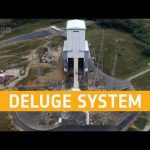
The water deluge system, which is activated at liftoff, was put to the test on the Ariane 6 launch pad at Europe’s Spaceport in April 2021. This is one of the qualification tests to prepare for the arrival of Ariane 6, Europe’s next generation heavy-lift launch vehicle.
Spraying huge volumes of water on the launch pad and beneath the launch table protects both the launch vehicle and its payloads by absorbing and deflecting the tremendous acoustic energy generated at liftoff. Shockwaves created as engine exhaust gases exceed the speed of sound and collide with ambient air cause noise levels to reach 180 decibels.
Three areas are deluged with water during launch, this is done in sequence.
At 20 seconds before liftoff, water sprays over the steel deflector 25 metres below the launch table. This deflector channels the engine exhaust into the two trenches.
At 6 seconds before liftoff, the exhaust tunnel under the launch table is deluged. This channels the engine exhaust below the launch table and into the underground trenches leading away from the launch pad.
Finally, as Ariane 6 lifts off the ground four arrays of pipes around the sides of the launch table will flood the launch pad.
This water also serves to cool and protect the ground installations, mainly the steel launch table.
About 700 cubic metres of water will be released during launch. This comes from the nearby tower which holds 1200 cubic metres of water. After launch it is refilled with water from a nearby lake.
After launch, any remaining water below the launch table is pumped away.
Credits: ESA- @CNES – @arianespace
★ Subscribe: http://bit.ly/ESAsubscribe and click twice on the bell button to receive our notifications.
We are Europe’s gateway to space. Our mission is to shape the development of Europe’s space capability and ensure that investment in space continues to deliver benefits to the citizens of Europe and the world. Check out https://www.esa.int/ to get up to speed on everything space related.
This timelapse was filmed under the stars on the Ariane 6 launch base at Europe’s Spaceport in French Guiana.
Preparations are under way for the arrival of Ariane 6, Europe’s next-generation launch vehicle. Imagine yourself stepping out of the launcher assembly building or standing on the launch pad in front of the 90-metre high mobile gantry, to look at the stars.
Ariane 6, developed by ESA, has two versions depending on the required performance. This rocket will be capable of a wide range of missions to guarantee independent access to space for Europe and continue four decades of the Ariane adventure.
Credits: ESA – @CNES – @arianespace
★ Subscribe: http://bit.ly/ESAsubscribe and click twice on the bell button to receive our notifications.
We are Europe’s gateway to space. Our mission is to shape the development of Europe’s space capability and ensure that investment in space continues to deliver benefits to the citizens of Europe and the world. Check out https://www.esa.int/ to get up to speed on everything space related.
Workers are returning to Europe’s Spaceport in Kourou, French Guiana to resume preparations for Vega and Ariane 5 launches. Construction of the new Ariane 6 launch pad has also restarted.
COVID-19 lockdown measures introduced in March meant that all but safety-critical operations were suspended at the Spaceport and the vast site had to be secured. Strict new safety and hygiene procedures have now been introduced. Launch teams returning from mainland Europe will spend two weeks in quarantine.
Vega is due to return to flight this summer on its first rideshare mission dedicated to small satellites and Vega’s new dispenser called the Small Spacecraft Mission Service.
★ Subscribe: http://bit.ly/ESAsubscribe and click twice on the bell button to receive our notifications.
We are Europe’s gateway to space. Our mission is to shape the development of Europe’s space capability and ensure that investment in space continues to deliver benefits to the citizens of Europe and the world. Check out http://www.esa.int/ESA to get up to speed on everything space related.
Europe’s Spaceport lies northeast of South America in French Guiana, an overseas department of France. This location near the equator enables the Ariane, Soyuz and Vega launch vehicles operated at the Spaceport to complete a wide range of missions to any orbit for clients from around the globe.
The Spaceport comes under the responsibility of the French space agency CNES while infrastructures are funded by the European Space Agency.
ESA owns the launcher and satellite preparation buildings, launch operation facilities and a plant for making solid propellant and integrating solid rocket motors.
ESA also finances new facilities, such as launch complexes and industrial production facilities for new launchers such as Vega-C and Ariane 6.
★ Subscribe: http://bit.ly/ESAsubscribe and click twice on the bell button to receive our notifications.
We are Europe’s gateway to space. Our mission is to shape the development of Europe’s space capability and ensure that investment in space continues to deliver benefits to the citizens of Europe and the world. Check out http://www.esa.int/ESA to get up to speed on everything space related.
Things are shaping up at Europe’s Spaceport in French Guiana in preparation for Ariane 6. Take a tour of the launch complex and its various facilities.
Recent tests have used mock-ups of the P120C boosters to trial how they will be transported. See them on the launch pad, and get a sense of scale for Ariane 6.
We are Europe’s gateway to space. Our mission is to shape the development of Europe’s space capability and ensure that investment in space continues to deliver benefits to the citizens of Europe and the world. Check out http://www.esa.int/ESA to get up to speed on everything space related.
BepiColombo is scheduled for launch at 01:45 GMT (03:45 CEST) on 20 October on an Ariane 5 from Europe’s Spaceport in Kourou.
Final assembly of the two orbiters and transfer module has taken place, ready for the spacecraft to be integrated into its Ariane 5 launcher.
BepiColombo is Europe’s first mission to Mercury, the smallest and least explored planet in the inner Solar System. It is a joint endeavour between ESA and the Japan Aerospace Exploration Agency, JAXA, and consists of two scientific orbiters: ESA’s Mercury Planetary Orbiter (MPO) and JAXA’s Mercury Magnetospheric Orbiter (MMO). The mission will study all aspects of Mercury, from the structure and dynamics of its magnetosphere and how it interacts with the solar wind, to its internal structure with its large iron core, and the origin of the planet’s magnetic field.
ESA is Europe’s gateway to space. Our mission is to shape the development of Europe’s space capability and ensure that investment in space continues to deliver benefits to the citizens of Europe and the world. Check out http://www.esa.int/ESA to get up to speed on everything space related.
Europe’s next four Galileo satellites lifted off at 11:25 GMT (13:25 CEST, 08:25 local time) on 25 July from Europe’s Spaceport in French Guiana atop an Ariane 5 launcher.
El Puerto Espacial Europeo en la Guyana francesa, está en plena efervescencia. Estamos en medio de una gigantesca obra. Aquí se sitúa la nueva plataforma de lanzamiento de Ariane 6, cuyo despegue está previsto en julio de 2020. Intentamos averigurar qué se necesita para mantenerse a la vanguardia en el negocio del espacio.
Amanece en Guyana y los ingenieros europeos se afanan en la construcción del terminal de lanzamiento de Ariane 6. Esta gigantesca obra tiene un único objetivo: lanzar cohetes al espacio por un coste, dos veces inferior al de Ariane 5. Para lograrlo se necesita un montón de hormigón, de acero y de mano de obra.
Dans cette édition de Space, nous entrons dans les coulisses d’un chantier colossal au Centre spatial européen de Kourou en Guyane française. Un pas de tir est en train de sortir de terre en vue du vol inaugural d’Ariane 6 programmé en juillet 2020. Grâce à ce projet, l’Europe se relance dans la compétition mondiale qui oppose les acteurs du secteur spatial.
Sur la côte nord-est de l’Amérique du Sud, à Kourou en Guyane, des ingénieurs européens s’affairent à la construction du nouveau pas de tir d’Ariane 6. Ce chantier colossal doit répondre à un objectif simple : diviser par deux, les coûts de lancement par rapport à son modèle précédent. Pour y parvenir, il faut d’abord une quantité astronomique de béton, d’acier et de main-d’oeuvre.
The race is on to build the new launch pad for the Ariane 6 rocket, due to make its maiden voyage in July 2020. Construction is in full swing in French Guiana as Europe builds not only a new rocket but also a new way of launching rockets, in a bid to face down competition from the likes of Space X.
When Euronews visited, around 500 people were active on the site from six in the morning until ten at night, with attention focused on two key elements of the pad – firstly the huge flame trench which will take the hot gases away from the rocket on launch, and the new building in which the Ariane 6 will be built.
At Europe’s Spaceport in French Guiana, Ariane 6 is now a reality with the launch zone taking shape.
Indeed there is no time to lose for the future European launcher since its first launch is planned for July 2020.
But the independent access to space for Europe is at stake along with its leading role on the launcher market.
This video shows the status of Ariane 6 launch zone in Kourou with latest drone images and an interview with Daniel Neuenschwander, ESA’s Director of Space Transportation.
At the European spaceport in Kourou, French Guiana, the new launch facilities for ESA’s Ariane 6 launcher are being built. With the Ariane 6 launcher and the upgrade of the Vega to Vega C, Europe expands its launching capacities by creating versatile launchers that meet market demands. At the same time ESA supports both institutional missions and European industry as both Ariane 6 and Vega C will be fully European. With Ariane 6 and Vega C, Europe secures its independent access to space for years to come.