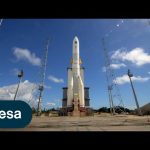
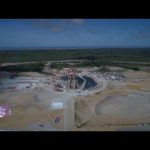
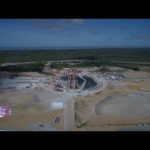
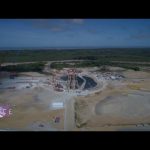
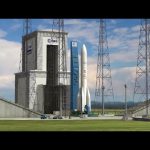
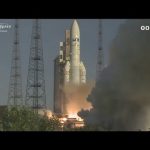
Europe’s new rocket Ariane 6 will take off from Europe’s Spaceport in French Guiana, near the equator, and far from populated areas.
Why did Europe choose a spaceport on the other side of the world? The main reason is the lack of space. There are hardly any places in Europe where rockets can be launched and fly over unpopulated areas during its initial launch phase. We also need a large area to build the launch pad and operations.
Europe’s Spaceport is also very close to the equator. As our Earth spins itself, you can get an extra boost if you launch where Earth is widest… at the equator.
📹 ESA – European Space Agency 📸 ESA – European Space Agency
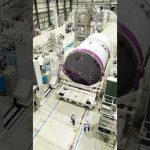
The two central stages for Ariane 6’s first flight are being assembled in the launcher assembly building (BAL) at Europe’s Spaceport. The core stage and the upper stage for Europe’s new rocket Ariane 6 are set to fly in the Summer of 2024. Once assembled, the stages will be transferred to the launch pad.
On the launch pad, the two stages will be raised into their vertical launch position inside the mobile assembly building. Here the two boosters for Ariane 6’s first flight will be added and then the payloads will be placed on top and be covered by the fairing – Ariane 6’s nose cone that splits vertically in two.
The stages arrived at Europe’s Spaceport on novel hybrid sail ship Canopée on 21 February after a two-week transatlantic crossing from mainland Europe.
Ariane 6 is an all-new design, created to succeed Ariane 5 as Europe’s heavy-lift launch system. With Ariane 6’s upper stage restart capability, Europe’s launch capability will be tailored to the needs of multiple payload missions, for example to orbit satellite constellations. This autonomous capability to reach Earth orbit and deep space supports Europe’s navigation, Earth observation, scientific and security programmes. Ongoing development of Europe’s space transportation capabilities is made possible by the sustained dedication of thousands of talented people working in ESA’s 22 Member States.
The largest components for the first flight model of Europe’s new rocket Ariane 6 arrived at the port of Pariacabo in Kourou, French Guiana on 21 February 2024 via the novel ship, Canopée (canopy in French).
The Ariane 6 stages and components are all manufactured across Europe. On this trip, Canopée brought the central core for Ariane 6’s first flight. The main engine and the main stage were integrated in Les Mureaux, France, while the upper stage and insulation for the rocket’s exterior were built up in Bremen, Germany.
The various Ariane 6 components are then offloaded and transported by road to the new Ariane 6 launch vehicle assembly building just a few kilometres away. Here, the launcher stages are unpacked and installed on the assembly line for integration, and finally, liftoff.
The Ariane 6 boosters are already in Europe’s Spaceport after their production in Italy, they are the same P120C solid propulsion boosters as used for Europe’s Vega-C rocket.
First the central core will be assembled horizontally after which it is transported to the launchpad. Here it will be lifted into the upright position after which Boosters and the upper stage will be added inside the mobile gantry.
This summer Flight Model-1 will be ready to let its engine rumble and fly.
Credits: ESA/CNES/Arianespace/Arianegroup
★ Subscribe: http://bit.ly/ESAsubscribe and click twice on the bell button to receive our notifications.
We are Europe’s gateway to space. Our mission is to shape the development of Europe’s space capability and ensure that investment in space continues to deliver benefits to the citizens of Europe and the world. Check out https://www.esa.int/ to get up to speed on everything space related.
Teams across Europe and at Europe’s Spaceport in French Guiana, have been tirelessly conducting a test campaign that will, in 2024, end with the first launch of Europe’s newest heavy-lift rocket, Ariane 6.
In the summer, the mobile gantry was rolled back at the launchpad, revealing the huge rocket to the elements. Then, the main stage’s Vulcain 2.1 engine roared into life in a series of ‘hot fire’ tests for the rocket and entire ground system, including tank filling rehearsals, countdowns, vibration-damping water systems and more.
Tests continued on the upper-stage reignitable Vinci engine and Auxiliary Power Unit at the German Aerospace Center (DLR) test site in Lampoldshausen.
Very soon, tests will be complete, and Europe’s heavy-lift rocket will take flight.
★ Subscribe: http://bit.ly/ESAsubscribe and click twice on the bell button to receive our notifications.
We are Europe’s gateway to space. Our mission is to shape the development of Europe’s space capability and ensure that investment in space continues to deliver benefits to the citizens of Europe and the world. Check out https://www.esa.int/ to get up to speed on everything space related.
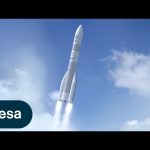
Animation of the first launch of the Ariane 6 rocket with two boosters.
Ariane 6 is an all-new design, created to succeed Ariane 5 as Europe’s heavy-lift launch system. With Ariane 6’s upper stage and its reignitable Vinci engine, Europe’s launch capability will be tailored to the needs of multiple payloads, for example to orbit satellite constellations. This autonomous capability to reach Earth orbit and deep space supports Europe’s navigation, Earth observation, scientific and security programmes. Ongoing development of Europe’s space transportation capabilities is made possible by the sustained dedication of thousands of talented people working in ESA’s 22 Member States.
At over 60 metres tall, Ariane 6 will weigh almost 900 tonnes when launched with a full payload – roughly equivalent to one and a half Airbus A380 passenger aircraft.
Vinci, the upper stage engine of Ariane 6 fed by liquid hydrogen and oxygen, can be stopped and restarted multiple times – to place satellites into different orbits and then de-orbit the upper stage, so it is not left behind as hazardous debris in space.
For the development of Ariane 6, ESA is working with an industrial network of several hundred companies in 13 European countries, led by prime contractor ArianeGroup.
France’s space agency, CNES, is preparing the Ariane 6 launch facilities at Europe’s Spaceport in French Guiana.
Credits: ESA – European Space Agency
★ Subscribe: http://bit.ly/ESAsubscribe and click twice on the bell button to receive our notifications.
We are Europe’s gateway to space. Our mission is to shape the development of Europe’s space capability and ensure that investment in space continues to deliver benefits to the citizens of Europe and the world. Check out https://www.esa.int/ to get up to speed on everything space related.
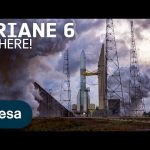
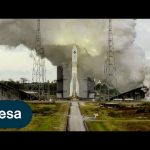
Cinq, quatre, trois, deux, un. Allumage Vulcain! This is the moment Ariane 6’s main engine was sparked into life, and the entire main stage of the new rocket and the many parts of the launch pad in Kourou, French Guiana, practised for the full duration of a launch. Of course, as planned, the test model did not leave the ground.
Without its boosters, instead of piercing the clouds Ariane 6’ created its own on Earth: a clean byproduct of the Vulcain 2.1 engine’s oxygen and hydrogen propellants, which came together to send out impressive swirls of H2O.
After the almost 150 tonnes of propellant was burnt through and the clouds dispersed, the curtains closed on the successful rehearsal. The data from thousands of monitors around the rocket will be crunched in the coming weeks to learn all that’s needed for Ariane’s next, real, flight.
Credits: ESA – European Space Agency
★ Subscribe: http://bit.ly/ESAsubscribe and click twice on the bell button to receive our notifications.
We are Europe’s gateway to space. Our mission is to shape the development of Europe’s space capability and ensure that investment in space continues to deliver benefits to the citizens of Europe and the world. Check out https://www.esa.int/ to get up to speed on everything space related.
Watch as Europe’s new Ariane 6 rocket goes through a full-scale rehearsal in preparation for its first flight, when teams from @ArianeGroup, @CnesFrance and ESA on the ground will complete a launch countdown rehearsal. The test includes the ignition of the core stage Vulcain 2.1 engine, followed by 470 seconds of stabilised operation covering the entire core stage flight phase, as it would function on a launch into space.
Coverage started 19:40 UTC (20:40 CET) on 23 November 2023, 20 minutes before engine ignition and continue five minutes after core stage operation, once the engine burns through all its propellant.
Timestaps of the video: 00:00 – 16:18 – Stay tuned 16:19 – 47:49 – Countdown and stop of countdown 47:50 – 01:14:19 – Stay tuned 01:14:20 – 01:30:43 – Restart of countdown and hot-fire test
For this rehearsal, the boosters were not ignited, so Ariane 6 stayed firmly on the launch pad at Europe’s Spaceport in French Guiana.
The eight-minute engine-fire trial reenacts how the Ariane 6 core stage will fire during a normal flight into space. The trial, conducted with a test model on the launch pad at Europe’s Spaceport will be the longest ‘full-stack’ run yet for Ariane 6’s lower liquid propulsion module equipped with a Vulcain 2.1 engine.
The Vulcain 2.1 engine will burn through almost 150 tonnes of propellant supplied from the Ariane 6 core stage tanks – liquid oxygen and liquid hydrogen – supercooled to temperatures below -250°C.
The Vulcain 2.1 engine is an evolution of the Vulcain 2 engine that made Ariane 5 Europe’s most successful launch system ever. The upgrade has a simplified and cheaper design and features new technology in the engine nozzle, while the ignition system has been moved from the engine to the launch pad to make the core stage perform better and cost less.
Credits: ESA – European Space Agency
★ Subscribe: http://bit.ly/ESAsubscribe and click twice on the bell button to receive our notifications.
We are Europe’s gateway to space. Our mission is to shape the development of Europe’s space capability and ensure that investment in space continues to deliver benefits to the citizens of Europe and the world. Check out https://www.esa.int/ to get up to speed on everything space related.
On 5 September 2023, teams from France’s space agency CNES and Arianegroup under the lead of ESA carried out a complete Ariane 6 launch sequence on its launch pad at Europe’s spaceport in French Guiana. The test ended with a hot-fire of the launcher’s core stage and startup of the Vulcain 2.1 engine.
This is a key step in the test campaign. It follows from initial integration of the Ariane 6 launcher on its launch pad, electrical and fluid system tests and the first launch sequence test run on 18 July 2023.
This test involved a launch sequence and final countdown representative of a launch, including removal of the Ariane 6 mobile gantry and filling the launcher’s upper and core stage tanks with liquid hydrogen and liquid oxygen. The test ended with the ignition and the startup of the core stage’s Vulcain 2.1 engine, followed by four seconds of firing.
The next milestone is to complete a core stage long hot-fire test, where the Vulcain 2.1 engine will operate for about 8 minutes.
Ariane 6 is an all-new design, created to succeed Ariane 5 as Europe’s heavy-lift launch system. With Ariane 6’s upper stage and its reignitable Vinci engine, Europe’s launch capability will be tailored to the needs of multiple payloads, for example to orbit satellite constellations. This autonomous capability to reach Earth orbit and deep space supports Europe’s navigation, Earth observation, scientific and security programmes. Ongoing development of Europe’s space transportation capabilities is made possible by the sustained dedication of thousands of talented people working in ESA’s 22 Member States.
www.esa.int/ariane
Credits: ESA/ARIANEGROUP/CNES – Optique vidéo du CSG
★ Subscribe: http://bit.ly/ESAsubscribe and click twice on the bell button to receive our notifications.
We are Europe’s gateway to space. Our mission is to shape the development of Europe’s space capability and ensure that investment in space continues to deliver benefits to the citizens of Europe and the world. Check out https://www.esa.int/ to get up to speed on everything space related.
ESA’s Ariane 6 will offer more performance and flexibility than its predecessor Ariane 5 and will be available in two versions, with either two or four boosters.
This new rocket will launch from Europe’s Spaceport in French Guiana and its home, the recently inaugurated launch complex, is a marvel of engineering. Take a tour with Tony Dos Santos, ESA’s Technical Manager there.
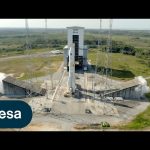
The main elements of the Ariane 6 launch complex include the mobile gantry, launch pad and launch vehicle assembly building.
See tests being carried out to qualify vital systems involved in a launch campaign and hear how they work. This includes raising a mockup Ariane 6 core stage vertical in the 90 m-high mobile gantry. Watch the deluge system gush water to absorb the roar of launch and capture the moment the fluidic systems detach from the rocket as it lifts off.
The Ariane 6 programme is funded and developed by ESA. These tests by @CNESand @ArianeGroup teams were jointly performed under the responsibility of ESA.
Ariane 6 opens new opportunities and guarantees continued access to space for ESA Member States.
★ Subscribe: http://bit.ly/ESAsubscribe and click twice on the bell button to receive our notifications.
We are Europe’s gateway to space. Our mission is to shape the development of Europe’s space capability and ensure that investment in space continues to deliver benefits to the citizens of Europe and the world. Check out https://www.esa.int/ to get up to speed on everything space related.
These are exciting days at Europe’s Spaceport in French Guiana and throughout several sites in ESA Member States as the development of Ariane 6 enters its final phase. Ariane 6 parts are being shipped from Europe for combined tests on the new Ariane 6 launch base. These tests rehearse all activities and systems involving the rocket and launch base on an Ariane 6 launch campaign. On the final test, the Ariane 6 core stage will perform a static hot firing while standing on its recently inaugurated launch pad. It will be from this new launch base that ESA’s Ariane 6 rocket will soon be launched for the first time.
Meanwhile in Europe, Ariane 6’s upper stage will experience the conditions of space at a new test bench at @DLR in Lampoldshausen. After this, all is ready for the much anticipated first flight of ESA’s new heavy-lift rocket from Europe’s Spaceport.
★ Subscribe: http://bit.ly/ESAsubscribe and click twice on the bell button to receive our notifications.
We are Europe’s gateway to space. Our mission is to shape the development of Europe’s space capability and ensure that investment in space continues to deliver benefits to the citizens of Europe and the world. Check out https://www.esa.int/ to get up to speed on everything space related.
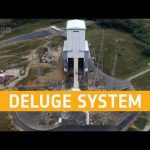
The water deluge system, which is activated at liftoff, was put to the test on the Ariane 6 launch pad at Europe’s Spaceport in April 2021. This is one of the qualification tests to prepare for the arrival of Ariane 6, Europe’s next generation heavy-lift launch vehicle.
Spraying huge volumes of water on the launch pad and beneath the launch table protects both the launch vehicle and its payloads by absorbing and deflecting the tremendous acoustic energy generated at liftoff. Shockwaves created as engine exhaust gases exceed the speed of sound and collide with ambient air cause noise levels to reach 180 decibels.
Three areas are deluged with water during launch, this is done in sequence.
At 20 seconds before liftoff, water sprays over the steel deflector 25 metres below the launch table. This deflector channels the engine exhaust into the two trenches.
At 6 seconds before liftoff, the exhaust tunnel under the launch table is deluged. This channels the engine exhaust below the launch table and into the underground trenches leading away from the launch pad.
Finally, as Ariane 6 lifts off the ground four arrays of pipes around the sides of the launch table will flood the launch pad.
This water also serves to cool and protect the ground installations, mainly the steel launch table.
About 700 cubic metres of water will be released during launch. This comes from the nearby tower which holds 1200 cubic metres of water. After launch it is refilled with water from a nearby lake.
After launch, any remaining water below the launch table is pumped away.
Credits: ESA- @CNES – @arianespace
★ Subscribe: http://bit.ly/ESAsubscribe and click twice on the bell button to receive our notifications.
We are Europe’s gateway to space. Our mission is to shape the development of Europe’s space capability and ensure that investment in space continues to deliver benefits to the citizens of Europe and the world. Check out https://www.esa.int/ to get up to speed on everything space related.
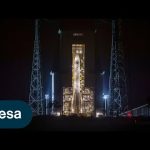
This timelapse was filmed under the stars on the Ariane 6 launch base at Europe’s Spaceport in French Guiana.
Preparations are under way for the arrival of Ariane 6, Europe’s next-generation launch vehicle. Imagine yourself stepping out of the launcher assembly building or standing on the launch pad in front of the 90-metre high mobile gantry, to look at the stars.
Ariane 6, developed by ESA, has two versions depending on the required performance. This rocket will be capable of a wide range of missions to guarantee independent access to space for Europe and continue four decades of the Ariane adventure.
Credits: ESA – @CNES – @arianespace
★ Subscribe: http://bit.ly/ESAsubscribe and click twice on the bell button to receive our notifications.
We are Europe’s gateway to space. Our mission is to shape the development of Europe’s space capability and ensure that investment in space continues to deliver benefits to the citizens of Europe and the world. Check out https://www.esa.int/ to get up to speed on everything space related.
Workers are returning to Europe’s Spaceport in Kourou, French Guiana to resume preparations for Vega and Ariane 5 launches. Construction of the new Ariane 6 launch pad has also restarted.
COVID-19 lockdown measures introduced in March meant that all but safety-critical operations were suspended at the Spaceport and the vast site had to be secured. Strict new safety and hygiene procedures have now been introduced. Launch teams returning from mainland Europe will spend two weeks in quarantine.
Vega is due to return to flight this summer on its first rideshare mission dedicated to small satellites and Vega’s new dispenser called the Small Spacecraft Mission Service.
★ Subscribe: http://bit.ly/ESAsubscribe and click twice on the bell button to receive our notifications.
We are Europe’s gateway to space. Our mission is to shape the development of Europe’s space capability and ensure that investment in space continues to deliver benefits to the citizens of Europe and the world. Check out http://www.esa.int/ESA to get up to speed on everything space related.
Things are shaping up at Europe’s Spaceport in French Guiana in preparation for Ariane 6. Take a tour of the launch complex and its various facilities.
Recent tests have used mock-ups of the P120C boosters to trial how they will be transported. See them on the launch pad, and get a sense of scale for Ariane 6.
We are Europe’s gateway to space. Our mission is to shape the development of Europe’s space capability and ensure that investment in space continues to deliver benefits to the citizens of Europe and the world. Check out http://www.esa.int/ESA to get up to speed on everything space related.
El Puerto Espacial Europeo en la Guyana francesa, está en plena efervescencia. Estamos en medio de una gigantesca obra. Aquí se sitúa la nueva plataforma de lanzamiento de Ariane 6, cuyo despegue está previsto en julio de 2020. Intentamos averigurar qué se necesita para mantenerse a la vanguardia en el negocio del espacio.
Amanece en Guyana y los ingenieros europeos se afanan en la construcción del terminal de lanzamiento de Ariane 6. Esta gigantesca obra tiene un único objetivo: lanzar cohetes al espacio por un coste, dos veces inferior al de Ariane 5. Para lograrlo se necesita un montón de hormigón, de acero y de mano de obra.
Dans cette édition de Space, nous entrons dans les coulisses d’un chantier colossal au Centre spatial européen de Kourou en Guyane française. Un pas de tir est en train de sortir de terre en vue du vol inaugural d’Ariane 6 programmé en juillet 2020. Grâce à ce projet, l’Europe se relance dans la compétition mondiale qui oppose les acteurs du secteur spatial.
Sur la côte nord-est de l’Amérique du Sud, à Kourou en Guyane, des ingénieurs européens s’affairent à la construction du nouveau pas de tir d’Ariane 6. Ce chantier colossal doit répondre à un objectif simple : diviser par deux, les coûts de lancement par rapport à son modèle précédent. Pour y parvenir, il faut d’abord une quantité astronomique de béton, d’acier et de main-d’oeuvre.
The race is on to build the new launch pad for the Ariane 6 rocket, due to make its maiden voyage in July 2020. Construction is in full swing in French Guiana as Europe builds not only a new rocket but also a new way of launching rockets, in a bid to face down competition from the likes of Space X.
When Euronews visited, around 500 people were active on the site from six in the morning until ten at night, with attention focused on two key elements of the pad – firstly the huge flame trench which will take the hot gases away from the rocket on launch, and the new building in which the Ariane 6 will be built.
At the European spaceport in Kourou, French Guiana, the new launch facilities for ESA’s Ariane 6 launcher are being built. With the Ariane 6 launcher and the upgrade of the Vega to Vega C, Europe expands its launching capacities by creating versatile launchers that meet market demands. At the same time ESA supports both institutional missions and European industry as both Ariane 6 and Vega C will be fully European. With Ariane 6 and Vega C, Europe secures its independent access to space for years to come.
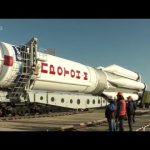
Timelapse movie following the preparations of the ExoMars 2016 spacecraft in the lead up to launch on 14 March 2016. The movie includes the integration of the entry, descent and landing demonstrator module, Schiaparelli, with the Trace Gas Orbiter, and the journey of the spacecraft inside the Proton rocket as it is moved to the launch pad and raised to a vertical position.
ExoMars launched from Baikonur, Kazakhstan at 09:31 GMT on 14 March. It will arrive at the Red Planet on 19 October. Its mission is to address unsolved mysteries of the planet’s atmosphere that could indicate present-day geological – or even biological – activity, and to demonstrate the landing technologies needed for future missions to Mars.
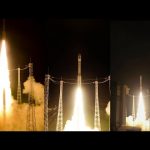
This timelapse video shows Sentinel-3A, from final preparations to liftoff on a Rockot launcher from the Plesetsk Cosmodrome in northern Russia, at 17:57 GMT (18:57 CET) on 16 February 2016.
Sentinel-3A is the third satellite to be launched for Europe’s Copernicus environment monitoring programme.
Designed as a two-satellite constellation – Sentinel-3A and -3B – the Sentinel-3 mission carries a series of cutting-edge instruments for systematic measurements of Earth’s oceans, land, ice and atmosphere. Over oceans, Sentinel-3 measures the temperature, colour and height of the sea surface as well as the thickness of sea ice. These measurements will be used, for example, to monitor changes in sea level, marine pollution and biological productivity. Over land, this innovative mission will monitor wildfires, map the way land is used, provide indices of vegetation state and measure the height of rivers and lakes.
This timelapse video shows the preparations for LISA Pathfinder’s launch at Europe’s Spaceport in Kourou, French Guiana. The video spans three weeks, starting on 12 November 2015 with the completed and fuelled spacecraft and ending on the 3 December launch day.
Over this period, the spacecraft was attached to the payload adaptor of the Vega launcher, encapsulated within the half-shells of the rocket fairing, transferred to the launcher assembly area, and installed on top of Vega inside the mobile gantry, which was rolled back shortly before liftoff.
LISA Pathfinder will test key technologies for space-based observation of gravitational waves – ripples in the fabric of spacetime that are predicted by Albert Einstein’s general theory of relativity.
Credit/Copyrights: Directed by Stephane Corvaja, ESA; Edited by Manuel Pedoussaut, Zetapress; Music: Hubrid-Gravity
Thursday 2 August 2012 marked the 50th successful Ariane flight in a row: an Ariane 5 was launched from Europe’s Spaceport in French Guiana to perform a dual deployment of two telecommunications satellites, Intelsat 20 and Hylas-2, into their planned transfer orbits.
Lift off of flight VA208 took place at 22:54 CEST; 17:54 French Guiana time. This was Ariane 5’s fourth launch of 2012, continuing a line of launch successes unbroken since 2003.
Vega, le nouveau lanceur de l’ESA, est désormais prêt pour son entrée en exploitation aux côtés d’Ariane-5 et de Soyouz, après le succès de son vol de qualification, effectué ce matin depuis le port spatial de l’Europe à Kourou (Guyane française).
Avec Vega, qui vient compléter la famille des lanceurs disponibles à Kourou, l’Europe est désormais à même de répondre à toute la gamme des besoins de lancement, que ce soit pour mettre sur orbite des petits satellites scientifiques et d’observation de la Terre ou pour entreprendre des missions de vaste envergure comme l’envoi de véhicules ESA de ravitaillement à destination de la Station spatiale internationale (ISS).
Vega a décollé pour la première fois à 10h00 GMT (11h00 heure de Paris, 7h00 heure locale) de son nouveau pas de tir, et son vol de qualification s’est parfaitement déroulé.
The family of European rockets is growing. The next one is the youngest, called Vega, soon to be launched from Europe’s Spaceport in French Guiana.
This new rocket complements the range that Europe already has to offer in the commercial market.
La famiglia dei vettori spaziali europei si allarga con il prossimo lancio di Vega dalla base europea della Guyana francese. Questo nuovo lanciatore va a completare l’offerta della gamma europea nell’ambito dei razzi commerciali. Ne parliamo nella rubrica Space.
Lançou o Sputnik e Gagarin para o espaço. O mítico foguetão russo Soyuz conta já com mais de 1700 voos. O lançamento do Porto Espacial Europeu, na Guiana Francesa, abre um novo capítulo na sua longa carreira.
On 24 December 1979, Ariane made its first flight from French Guiana, marking the beginning of 30 years of success and giving Europe a guaranteed independent access to space. With Ariane, ESA could develop its own programmes in many different domains: telecommunications, Earth observation, science and exploration. Europe was the pioneer in the civil launch space market, with the creation of Arianespace, the world-leading space transportation company.