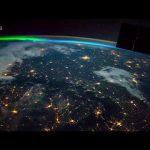
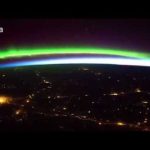
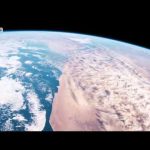
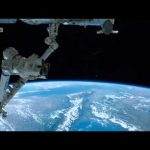
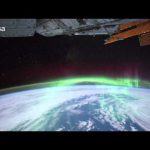
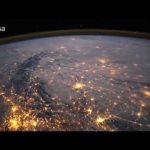
On 12 September 2017, 710 photos were taken by ESA astronaut Paolo Nespoli to create this time-lapse of the Earth (from Africa to Russia) as seen from the International Space Station.
ESA astronaut Paolo Nespoli in currently working and living aboard the Station as part of his long duration Vita mission.
More info: Aperture Value: 2,971 Color Space: sRGB Contrast: Normal Custom Rendered: Normal process Date Time Digitized: 20 Aug 2017 19:55:00 Digital Zoom Ratio: 1 Exif Version: 2.2.1 Exposure Bias Value: 0 Exposure Mode: Manual exposure Exposure Program: Manual Exposure Time: 1/0 File Source: DSC Flash: No Flash FNumber: 2,8 Focal Length: 16 Focal Length In 35mm Film: 16 Focal Plane Resolution Unit: centimeters Focal Plane X Resolution: 1.368,889 Focal Plane Y Resolution: 1.368,889 Gain Control: High gain up ISO Speed Ratings: 5.000 Lens Model: 16.0 mm f/2.8 Lens Specification: 16, 16, 2,8, 2,8 Light Source: unknown Max Aperture Value: 3 Metering Mode: Pattern Pixel X Dimension: 4.928 Pixel Y Dimension: 3.280 Saturation: Normal Scene Capture Type: Standard Scene Type: A directly photographed image Sensing Method: One-chip color area sensor SensitivityType: Recommended exposure index (REI) Sharpness: Normal Shutter Speed Value: 1/0 Subject Distance Range: unknown Sub-second Time: 00 Sub-second Time Digitized: 00 Sub-second Time Original: 00 User Comment: NASA 2071135 77.8F White Balance: Auto white balance Image Number: 96.021 Lens ID: 52 Lens Info: 16, 16, 2,8, 2,8 Lens Model: 16.0 mm f/2.8
“If I have seen further, it is by standing on the shoulders of giants” is the famous quote by renowned scientist Sir Isaac Newton. This is particularly apt as a title for this video summary of ESA astronaut Tim Peake’s Principia mission – named after Newton’s monumental work Philosophiae Naturalis Principia and now building on the work of previous European astronaut missions, while being supported by a huge team of scientists and engineers on the ground.
The music accompanying this video was chosen by Tim, coming from the soundtrack of one of his favourite films, the 2004 movie Layer Cake. This piece is called ‘Drive to the Boatyard’, by internationally known British film composer Ilan Eshkeri. Ilan provided a slightly extended piece specially for ESA.
Tim comments: “I’m delighted with this video, which captures the essence of human spaceflight and natural beauty of our planet from space – all put to Ilan’s inspiring soundtrack!”
This timelapse video shows the Soyuz TMA-18M spacecraft moving from its integration facility to it launch pad in Baikonur Cosmodrome and the launch on 2 September 2015 with commander Sergei Volkov, ESA astronaut Andreas Mogensen and Aidyn Aimbetov to the International Space Station.
Andreas became Denmark’s first astronaut when he left our planet on his 10-day ‘iriss’ mission. ESA used the mission to test new technologies and conduct a series of scientific experiments.
Andreas returned to Earth with Soyuz spacecraft commander Gennady Padalka and Kazakh cosmonaut Aidyn Aimbetov on 12 September.
Still images taken by ESA astronaut Samantha Cristoforetti on the International Space Station were joined together to create this timelapse.
The astronauts on the Space Station spend as much time as possible on science. During her 40-hour working week Samantha runs many experiments from Italy’s ASI space agency and ESA, and takes part in even more from scientists all over the world.
Samantha is living and working on board the International Space Station as part of the six-strong Expedition 42 and 43 crew. Follow her Futura mission at http://samanthacristoforetti.esa.int.
Similar to ESA astronaut Samantha Cristoforetti’s night timelapse over Italy and Egypt (https://www.youtube.com/watch?v=Lgw36RCQPvM) but taken during the day, this video takes you on a 30-second journey over Italy, passing Greece while flying over the Mediterranean Sea to follow the Nile and finish at the Indian Ocean.
Looking out from the International Space Station’s Cupola observatory while circling Earth at speeds of 28 800 km/h, the 5500 km flight took Samantha around 12 minutes. Images from a Space Station camera were joined together to create this video and make the flight seem even faster.
The astronauts on the Space Station spend as much time as possible on science. During her 40-hour working week Samantha runs many experiments from Italy’s ASI space agency and ESA, and takes part in even more from scientists all over the world.
Samantha is living and working on board the International Space Station as part of the six-strong Expedition 42 and 43 crew. Follow her Futura mission at http://samanthacristoforetti.esa.int.
This timelapse video shows the Soyuz TMA-15M spacecraft during transfer from the MIK 40 integration facility to Baikonur Cosmodrome launch pad 31, as well as the launch on 23 November 2014 with ESA astronaut Samantha Cristoforetti and her crewmates to the International Space Station where they will live and work for five months.
With Samantha are Russian Soyuz commander Anton Shkaplerov and NASA astronaut Terry Virts. All three are part of the Station’s Expedition 42/43 crew.
On this mission, Samantha is flying as an ESA astronaut for Italy’s ASI space agency under a special agreement between ASI and NASA.
Directed by Stephane Corvaja, ESA Edited by Manuel Pedoussaut, Zetapress Music: MZB
This timelapse video shows two passes over Europe taken by ESA astronaut Alexander Gerst as he flew overhead on the International Space Station at around 400 km altitude.
The International Space Station travels at 28 800 km/h meaning that it only takes 90 minutes to circle Earth completely. Each orbit the Station moves around 2200 km to the West in relation to 90 minutes before.
Astronauts often use normal consumer digital cameras to take pictures of Earth through Europe’s observatory module Cupola in their spare time. Setting the camera to take an image every few seconds and then playing the images back quickly create this timelapse effect.
Alexander worked as a geophysicist and volcanologist before he was chosen as an ESA astronaut in 2009. His Blue Dot mission includes an extensive scientific programme of experiments in physical science, biology, and human physiology as well as radiation research and technology demonstrations. All experiments chosen make use of the out-of-this-world laboratory to improve life on Earth or prepare for further human exploration of our Solar System.
This timelapse video from space was taken by ESA astronaut Alexander Gerst from the Cupola observatory module on the International Space Station as it orbited Earth at around 400 km altitude. As the Space Station passes over Earth at night we can see city lights and lightning.
The International Space Station travels at 28 800 km/h meaning that it only takes 90 minutes to circle Earth completely. Each orbit the Station moves around 2200 km to the West in relation to 90 minutes before.
Astronauts often use normal consumer digital cameras to take pictures of Earth through Europe’s observatory module Cupola in their spare time. Setting the camera to take an image every few seconds and then playing the images back quickly create this timelapse effect.
Alexander worked as a geophysicist and volcanologist before he was chosen as an ESA astronaut in 2009. His Blue Dot mission includes an extensive scientific programme of experiments in physical science, biology, and human physiology as well as radiation research and technology demonstrations. All experiments chosen make use of the out-of-this-world laboratory to improve life on Earth or prepare for further human exploration of our Solar System.
It takes 90 minutes for an astronaut on the International Space Station to circle Earth completely, passing from daytime to nighttime and back again. This video taken by ESA astronaut Alexander Gerst shows the view from space in under one minute. Each orbit the Station moves around 2200 km to the West in relation to 90 minutes before.
Astronauts often use normal consumer digital cameras to take pictures of Earth through Europe’s observatory module Cupola in their spare time. Setting the camera to take an image every few seconds and then playing the images back quickly create this timelapse effect.
Alexander worked as a geophysicist and volcanologist before he was chosen as an ESA astronaut in 2009. His Blue Dot mission includes an extensive scientific programme of experiments in physical science, biology, and human physiology as well as radiation research and technology demonstrations. All experiments chosen make use of the out-of-this-world laboratory to improve life on Earth or prepare for further human exploration of our Solar System.
This timelapse video was made from images taken by ESA astronaut Alexander Gerst orbiting Earth on the International Space Station.
The video is offered in Ultra High Definition, the highest available to consumers. Be sure to change the settings in YouTube if your computer or television can handle it for the full effect.
The montage is made from a long sequence of still photographs taken at a resolution of 4256 x 2832 pixels at a rate of one every second. The high resolution allowed the ESA production team to create a 3840 x 2160 pixel movie, also known as Ultra HD or 4K.
Playing these sequences at 25 frames per second, the film runs 25 times faster than it looks for the astronauts in space.
The artistic effects of the light trails from stars and cities at night are created by superimposing the individual images and fading them out slowly.
Alexander Gerst is a member of the International Space Station Expedition 40 crew. He is spending five and a half months living and working on the ISS for his Blue Dot mission.
ESA astronaut Alexander Gerst recorded this timelapse from the International Space Station as it flew over Brazil and the Atlantic Ocean at speeds of 28 800 km/h, 400 km above our planet.
Animation using a sequence of raw NAVCAM frames from 8 May to 22 June. The NAVCAM has a 5-degree field of view and takes 1024 x 1024 12-bit per pixel images.
Soyuz flight VS06, with the Gaia space observatory, lifted off from Europe’s Spaceport, French Guiana, on 19 December 2013. This timelapse movie shows Gaia sunshield deployment test, the transfer of the Soyuz from the assembly building to the launch pad and the lift off.
Time lapse movie of the transit of Venus, as seen from the land of the midnight sun in Svalbard. Interference from cloud gives an eerie feel to the scene.
André took this video of Aurora Australis from the European Cupola module in the Space Station. The beautiful phenomenon is caused by bursts of particles from the Sun pouring down Earth’s magnetic field into the atmosphere.
Western Europe in timelapse as seen from the International Space Station by ESA astronaut André Kuipers, during his long-duration mission to the ISS, PromISSe