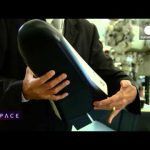
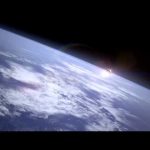
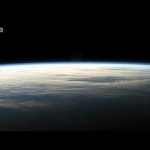
Pour les véhicules spatiaux, la rentrée dans l’atmosphère, c’est le moment où – pourrait-on dire – ça passe ou ça casse. C’est la phase où les satellites s’enflamment et où les astronautes retiennent leur souffle.
Un nouveau vaisseau de l’ESA baptisé IXV sera lancé dans l’espace en novembre 2014 dans l’objectif de fournir de nouvelles données aux ingénieurs alors qu’ils tentent de maîtriser cette délicate transition entre l’espace et la planète Terre.
Dans cette édition de Space sur euronews, le manager du programme IXV Giorgio Tumino nous présente le véhicule. Nous abordons aussi, images rares à l’appui, les conditions et les risques de cette rentrée atmosphérique.
Earth from Space is presented by Kelsea Brennan-Wessels from the ESA Web-TV virtual studios. Explore the city of Mumbai in the one hundred twenty-first edition.
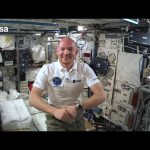
ESA astronaut Alexander Gerst sends his greetings to the Euro-Space-Day in Saarbrücken, Germany. The tri-national (FR-LU-DE) event will bring together students, scientific institutions and space industry.
Many people have wondered exactly how a Magic Pumpkin is created. Well, sorry to burst your bubble, but the secret it animation. It’s a cartoon. Want to create your own illustrated Magic Pumpkin? Check out the amazing Magic Pumpkin designed by our team of scientists. It’s an activity that will have you spinning… literally!
Steve Spangler is a celebrity teacher, science toy designer, speaker, author and an Emmy award-winning television personality. Spangler is probably best known for his Mentos and Diet Coke geyser experiment that went viral in. Spangler is the founder of www.SteveSpanglerScience.com, a Denver-based company specializing in the creation of science toys, classroom science demonstrations, teacher resources and home for Spangler’s popular science experiment archive and video collection. Spangler is a frequent guest on the Ellen DeGeneres Show and Denver 9 News where he takes classroom science experiments to the extreme. For teachers, parents or DIY Science ideas – check out other sources of learning:
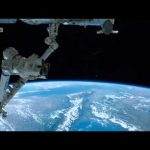
This timelapse video shows two passes over Europe taken by ESA astronaut Alexander Gerst as he flew overhead on the International Space Station at around 400 km altitude.
The International Space Station travels at 28 800 km/h meaning that it only takes 90 minutes to circle Earth completely. Each orbit the Station moves around 2200 km to the West in relation to 90 minutes before.
Astronauts often use normal consumer digital cameras to take pictures of Earth through Europe’s observatory module Cupola in their spare time. Setting the camera to take an image every few seconds and then playing the images back quickly create this timelapse effect.
Alexander worked as a geophysicist and volcanologist before he was chosen as an ESA astronaut in 2009. His Blue Dot mission includes an extensive scientific programme of experiments in physical science, biology, and human physiology as well as radiation research and technology demonstrations. All experiments chosen make use of the out-of-this-world laboratory to improve life on Earth or prepare for further human exploration of our Solar System.
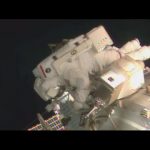
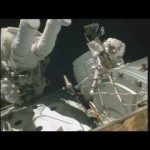
During an October 15 spacewalk outside the International Space Station – the second U.S. spacewalk in as many weeks – Expedition 41 Flight Engineers Reid Wiseman and Barry Wilmore of NASA, replaced a failed voltage regulation device to restore the station’s electrical power output to full capacity. The pair also relocated camera and TV equipment as part of a major reconfiguration to accommodate new docking adapters for use by U.S. commercial crew spacecraft in the next few years. Also, MAVEN’s “First Light”, Hubble finds extremely distant galaxy, Possible bonus destination for New Horizons, New information about volcanic activity on our moon and more!
ESA astronaut Alexander Gerst is responsible for unloading all the cargo from ESA’s Automated Transfer Vehicle (ATV) Georges Lemaître to the International Space Station. This includes the 100 kg of oxygen stored in ATV’s tanks. Here Alexander recorded the process of opening the valves and checking the pressure.
Georges Lemaître bought 6602 kg of freight, including 2680 kg of dry cargo and 3922 kg of water, propellants and gases to the Station.
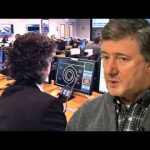
Massimo Bandecchi speaks about the work being done in ESA’s Concurrent Design Facility (CDF). The CDF is a state-of-the-art facility equipped with a network of computers, multimedia devices and software tools, which allows a team of experts from several disciplines to apply the concurrent engineering method to the design of future space missions.
Interested to work here as a trainee? Vacancy posts for Young Graduate Trainees (YGTs) go online once a year in mid-November, and stay open for one month. About 80 YGT job offers will open, aimed at engineers, physicists, biologists or medical graduates, but also business graduates and lawyers.
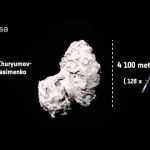
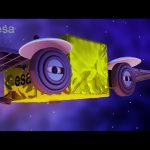
This short animation explains the relative sizes of the Rosetta spacecraft and comet 67P/Churyumov–Gerasimenko. Rosetta is 32 m from tip to tip of the solar wings. The comet measures 4.1 km along its longest length, 128 times the width of Rosetta.
Unlike typical artist’s impressions, this image is scaled to convey the vast difference in size between Rosetta and the comet, even when the spacecraft is in a close 10 km orbit, as depicted here.
Rosetta reached 10 km distance from the comet centre by October 2014.
Outside the International Space Station, Expedition 41 Flight Engineers Reid Wiseman and Barry Wilmore of NASA replaced a voltage regulation device and relocated camera and television equipment during a spacewalk Oct. 15, the second excursion outside the Quest airlock by station astronauts in U.S. spacesuits in as many weeks. The voltage regulator, called a Sequential Shunt Unit, failed in May, taking down one of eight power channels for station systems. Its replacement brought the station’s electrical output back to full capacity. The repositioning of the camera and television equipment was the first step in a major reconfiguration of station systems and modules to accommodate next year’s delivery of new docking adapters that will be used by commercial crew vehicles later this decade. The spacewalk was the 183rd in support of station assembly and maintenance, the second by Wiseman and the first for Wilmore.
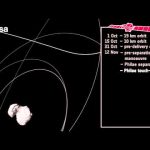
Animation showing Rosetta’s orbit in the lead up to, during and after lander separation.
The animation begins on 1 October 2014, when Rosetta is orbiting about 19 km from Comet 67P/Churyumov–Gerasimenko (all distances refer to the comet’s centre). The animation shows the transition to the close 10 km orbit by mid-October, and then the steps taken to move onto the pre-separation trajectory.
On the day of landing, 12 November, Rosetta makes a further manoeuvre 2–3 hours before separation to move to 22.5 km from the comet centre to deploy the lander, Philae. While Philae descends to the surface over a period of seven hours, Rosetta makes another manoeuvre to maintain visibility with the lander. A series of ‘relay phase’ manoeuvres then move Rosetta out to a distance of about 50 km, before moving first to a 30 km orbit and later to an orbit at about 20 km by early December.
The speed of the animation slows during the separation and lander phase to better highlight these events. The comet shape and rate of rotation is real – the comet rotates with a period of about 12.4 hours.
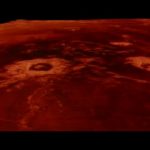
Launched in 2005, ESA’s Venus Express spacecraft has been observing Earth’s so called ‘sister’ planet from a unique point of view: in orbit around Venus itself. This mission is providing scientists with detailed information about the Venusian atmosphere and in the course of these studies many surprises have emerged.
There’s nothing better than having a bowl full of worms without the hassle of digging them out of the ground… and all by using fascinating polymer science. Now our worm-ologists have made an exciting new kind of Insta-Worms that are heat sensitive! You won’t believe your eyes as temperature changes the appearance of this special kind of Insta-Worms.
This timelapse video from space was taken by ESA astronaut Alexander Gerst from the Cupola observatory module on the International Space Station as it orbited Earth at around 400 km altitude. As the Space Station passes over Earth at night we can see city lights and lightning.
The International Space Station travels at 28 800 km/h meaning that it only takes 90 minutes to circle Earth completely. Each orbit the Station moves around 2200 km to the West in relation to 90 minutes before.
Astronauts often use normal consumer digital cameras to take pictures of Earth through Europe’s observatory module Cupola in their spare time. Setting the camera to take an image every few seconds and then playing the images back quickly create this timelapse effect.
Alexander worked as a geophysicist and volcanologist before he was chosen as an ESA astronaut in 2009. His Blue Dot mission includes an extensive scientific programme of experiments in physical science, biology, and human physiology as well as radiation research and technology demonstrations. All experiments chosen make use of the out-of-this-world laboratory to improve life on Earth or prepare for further human exploration of our Solar System.
Sunday 5 October saw thousands of visitors converge on the European Space Agency’s technical heart for its annual Open Day. Touring across the site, they met astronauts, viewed spacecraft and inspected test facilities – and came face to face with a spectacular new world.
Clean Space is the European Space Agency’s initiative to safeguard the terrestrial and orbital environments, while boosting the innovation and competitiveness of Europe’s space sector. This animated guide follows a newly-launched satellite as it first enters orbit, in the process explaining the various branches of the Clean Space effort and the different future Clean Space aims to build.
Now with English, French, German, Dutch, Italian, Greek, Romanian and Swedish subtitles. More languages will be added as they become available.
During an October 9 press briefing at NASA headquarters, panelists discussed the Earth and space-based assets that will be in position to observe the October 19 flyby of Mars by comet C/2013 A1, also known as comet Siding Spring. These assets include NASA’s iconic Hubble Space Telescope and spacecraft orbiting and roving Mars.
During the once-in-a-lifetime flyby, Siding Spring will pass within about 88,000 miles (139,500 kilometers) of the Red Planet — less than half the distance between Earth and our moon and less than one-tenth the distance of any known comet flyby of Earth. This proximity will provide an unprecedented opportunity for researchers to gather data on both the comet and its effect on the Martian atmosphere.
As the flight test of NASA’s Orion spacecraft nears, the agency released Oct. 8 a video detailing the spacecraft’s test and the critical systems engineers will evaluate during the Dec. 4 flight. Orion is in the final stages of preparation for the uncrewed flight test that will take it 3,600 miles above Earth on a 4.5-hour mission to test many of the systems necessary for future human missions into deep space. After two orbits, Orion will reenter Earth’s atmosphere at almost 20,000 miles per hour, and reach temperatures near 4,000 degrees Fahrenheit, before its parachute system deploys to slow the spacecraft for a splashdown in the Pacific Ocean.
On future missions, the Orion spacecraft will carry astronauts farther into the solar system than ever before, including to an asteroid and Mars.
Clad in U.S. spacesuits, Expedition 41 Flight Engineers Reid Wiseman of NASA and Alexander Gerst of the European Space Agency conducted a spacewalk outside the International Space Station Oct. 7 to relocate a failed cooling pump and to install a power cable device designed to provide backup electrical capability to the station’s rail car system. The spacewalk was the 182nd in support of station assembly and maintenance and the first for both Wiseman and Gerst.
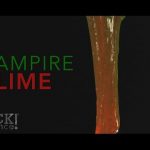
Where does slime come from, you ask? Monsters, of course. But thanks to some cool genetic mutations, vampires now have their own slime. Telling the difference between monster slime and vampire slime can be tricky at first glance, unless you know the vampire secret… hold the slime up to the light. Ordinary monster slime just looks green (because monster blood is green, dah). Vampire slime, on the other hand, shows its true color when you hold it up to the light because the green turns dark red to reveal what vampires drink… well… you know… that stuff. Leave it to the vampires to find another way to hide their true identity.
This activity will prove that Mom was right… “Wash your hands with soap and warm water!” A Petri dish prepared with nutrient agar (a seaweed derivative with beef nutrients) is an ideal food source for the bacteria you’ll be growing. In this experiment, Steve Spangler collected samples from items around the office – you will not believe what he found.
This timelapse video from space has it all: an orbit of Earth with lightning and aurora, followed by a space sunrise and daytime views of our cloudy planet. The images were taken by ESA astronaut Alexander Gerst as he orbited Earth on the International Space Station at around 400 km altitude. The nighttime video shows a Soyuz spacecraft that ferries the astronauts to the outpost. At the end of the video green aurora can be seen as Earth’s interacts with solar radiation.
The International Space Station travels at 28 800 km/h meaning that it only takes 90 minutes to circle Earth completely. Each orbit the Station moves around 2200 km to the West in relation to 90 minutes before.
Astronauts often use normal consumer digital cameras to take pictures of Earth through Europe’s observatory module Cupola in their spare time. Setting the camera to take an image every few seconds and then playing the images back quickly create this timelapse effect.
Alexander worked as a geophysicist and volcanologist before he was chosen as an ESA astronaut in 2009. His Blue Dot mission includes an extensive scientific programme of experiments in physical science, biology, and human physiology as well as radiation research and technology demonstrations. All experiments chosen make use of the out-of-this-world laboratory to improve life on Earth or prepare for further human exploration of our Solar System.
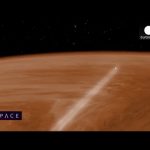
Venus is our mysterious neighbour, a strange world where the Sun rises in the west and sets in the east, and a day lasts longer than a year. ESA’s Venus Express mission has spent the last eight years gathering data to offer science a fresh insight into the atmosphere and climate of the planet, including a daring aerobraking manœuvre this summer that revealed previously unknown waves in the upper atmosphere.
A Vénusz a Föld legközelebbi szomszédja, amelyről ehhez képest elég keveset tudunk. Különleges világ, ahol a Nap Nyugaton kel és Keleten megy le, egy nap pedig tovább tart, mint egy év. Az Európai Űrügynökség – az ESA Vénusz Expressz missziója az elmúlt évben nagy mennyiségű adatot gyűjtött össze, a bolygó légköréről és klímájáról. Egy kockázatos légfékezési manőverrel pedig korábban ismeretlen hullámzást fedeztek fel a bolygó sűrű atmoszférájának felső rétegeiben.
Η Αφροδίτη είναι ο μυστηριώδης γείτονάς μας. Ένας παράξενος κόσμος, όπου ο ήλιος ανατέλλει στη Δύση, δύει στην Ανατολή και μία ημέρα διαρκεί περισσότερο από ένα έτος. Η αποστολή “Venus Express” του Ευρωπαϊκού Οργανισμού Διαστήματος συγκεντρώνει τα τελευταία οκτώ χρόνια στοιχεία, που προσφέρουν μία ανανεωμένη εικόνα για την ατμόσφαιρα και το κλίμα στον πλανήτη Αφροδίτη. Η τολμηρή αεροπέδηση αποκαλύπτει άγνωστα κύματα στα ανώτερα στρώματα της ατμόσφαιρας.
Venus, un misterioso vecino. Un extraño mundo donde el Sol sale por el oeste y se oculta por el este y el día dura más de un año terrestre. La misión de la ESA Venus Express ha pasado 8 años recogiendo datos sobre la atmósfera y el clima de este planeta tan singular. Gracias a la técnica del “aerobraking”, la nave pudo acercarse a la atmósfera de Venus revelando la existencia de olas desconocidas hasta ahora.
It takes 90 minutes for an astronaut on the International Space Station to circle Earth completely, passing from daytime to nighttime and back again. This video taken by ESA astronaut Alexander Gerst shows the view from space in under one minute. Each orbit the Station moves around 2200 km to the West in relation to 90 minutes before.
Astronauts often use normal consumer digital cameras to take pictures of Earth through Europe’s observatory module Cupola in their spare time. Setting the camera to take an image every few seconds and then playing the images back quickly create this timelapse effect.
Alexander worked as a geophysicist and volcanologist before he was chosen as an ESA astronaut in 2009. His Blue Dot mission includes an extensive scientific programme of experiments in physical science, biology, and human physiology as well as radiation research and technology demonstrations. All experiments chosen make use of the out-of-this-world laboratory to improve life on Earth or prepare for further human exploration of our Solar System.
Science staples involve things that go boom and things that blast off. With the Ping Pong Popper kids’ science experiment, you’ll take both the booming and blasting to new, hands-on levels. You get to construct popper toy and learn about combustion!
Joe Hanson – Host and writer
Joe Nicolosi – Director
Amanda Fox – Producer, Spotzen IncKate Eads – Associate Producer
Katie Graham – Director of Photography
Editing/Motion Graphics – Andrew Matthews/Kirby Conn
Gaffers – John Knudsen/Philip Sheldon
Post-production intern – Dalton Allen
The Asteroid Impact and Deflection Assessment (AIDA) study examines ways to potentially deflect asteroids from trajectories that could lead to them impacting Earth. The Johns Hopkins University Applied Physics Laboratory would work with NASA and ESA on the mission, which includes two independent spacecraft: an impactor (to be built by APL for NASA) and an impact monitor (to be built by ESA).
The target of this mission is the binary asteroid system Didymos. The impactor would strike the smaller secondary of Didymos, while the monitor would observe and measure any change in the relative orbit.
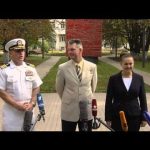
NASA officials at the agency’s Kennedy Space Center in Florida announced Sept. 16 the selection of Boeing and SpaceX to develop and certify crew transportation systems that will transport U.S. astronaut crews from American soil to and from the International Space Station. Participants in the announcement included NASA Administrator Charles Bolden, Kennedy Director Bob Cabana, Commercial Crew Program Manager Kathy Lueders, and Astronaut Mike Fincke.
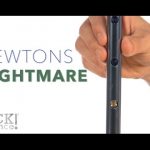
Drop one weight into the tube and, no surprise here, the weight drops to the ground with a thud. Go figure… it’s gravity at work! The second weight might bend your mind a little, though. Drop this weight into the aluminum tube and… wait… why didn’t it come out the bottom? Give it a second, that weight just takes a while longer, but figuring it out may be a bit tricky. That’s why we call it Newton’s Nightmare!
NASA Administrator Charlie Bolden, other NASA officials and representatives from The Boeing Company participated in a September 12 ribbon cutting for the new 170-foot-high Vertical Assembly Center at NASA’s Michoud Assembly Facility in New Orleans. The Vertical Assembly Center is a new tool that will be used to assemble parts of NASA’s Space Launch System rocket that will send humans to an asteroid and Mars. The administrator also visited Stennis Space Center in nearby Bay St. Louis, Mississippi, where engineers plan to test the RS-25 engines that will power the core stage of SLS. Also, Orion moved for fueling, Curiosity to climb Martian mountain, Possible geological activity on Europa, Expedition 40 returns, Earth Science on ISS and Hurricane-hunting aircraft!
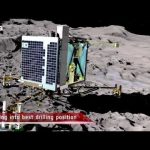
Annotated version of the Philae’s mission at comet 67P animation.
The animation begins with the deployment of Philae from Rosetta at comet 67P/Churyumov–Gerasimenko in November 2014. It will take several hours for it to reach the surface. Because of the comet’s extremely low gravity, landing gear will absorb the small forces of landing while ice screws in the probe’s feet and a harpoon system will lock the probe to the surface. At the same time a thruster on top of the lander will push it down to counteract the impulse of the harpoon imparted in the opposite direction.
Once it is anchored to the comet, the lander will begin its primary science mission, based on its 64-hour initial battery lifetime. The animation shows a number of the science instruments in action on the surface.
Rosetta’s Philae lander is provided by a consortium led by DLR, MPS, CNES and ASI.
This timelapse video was made from images taken by ESA astronaut Alexander Gerst orbiting Earth on the International Space Station.
The video is offered in Ultra High Definition, the highest available to consumers. Be sure to change the settings in YouTube if your computer or television can handle it for the full effect.
The montage is made from a long sequence of still photographs taken at a resolution of 4256 x 2832 pixels at a rate of one every second. The high resolution allowed the ESA production team to create a 3840 x 2160 pixel movie, also known as Ultra HD or 4K.
Playing these sequences at 25 frames per second, the film runs 25 times faster than it looks for the astronauts in space.
The artistic effects of the light trails from stars and cities at night are created by superimposing the individual images and fading them out slowly.
Alexander Gerst is a member of the International Space Station Expedition 40 crew. He is spending five and a half months living and working on the ISS for his Blue Dot mission.
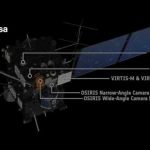
Animation highlighting the imaging and spectroscopy instruments on ESA’s Rosetta spacecraft. The animation focuses on the wavelengths and the fields of view of the Alice, MIRO, OSIRIS and VIRTIS instruments.
Earth from Space is presented by Kelsea Brennan-Wessels from the ESA Web-TV virtual studios. In the one-hundred-fifteenth edition, discover this important water source for over 60 million people in Chad, Cameroon, Niger and Nigeria.
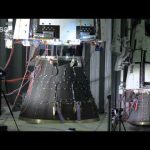
ESA’s Intermediate eXperimental Vehicle, IXV, is put to the test at ESA’s technical centre, ESTEC, in the Netherlands. During the actual flight, at an altitude of 320 km, a pyrotechnic device will fire to open a clamp band for springs to push IXV away from the upper stage. This test shows mission planners that it can withstand the mechanical shock of the pyrotechnic detonation, mimicking the moment the craft separates from the Vega rocket.
To be launched on Vega in early November 2014, IXV will test in flight the technologies and critical systems for Europe’s future automated re-entry vehicles returning from low orbit.
The Navigation Support Office is based at ESOC’s Navigation Facility, which provides products and services related to global navigation satellite systems in support of ESA missions and to European customers such as Eumetsat and to worldwide customers through its participation in the International Global Navigation Satellite Systems (IGNSS) Services group.
The core service consists of calculating and predicting highly accurate GPS, Galileo and GLONAS satellite orbits, in near-real time, every six hours, around the clock. These data are then used to improve GPS position accuracy, paving the way to even more sophisticated applications such as scientific studies, large-scale climate monitoring and tracking of long-term changes in Earth’s geology.