Ten years ago, on 19 December 2013, our billion star-mapping satellite Gaia launched.
Since then, Gaia has been scanning the sky and gathering an enormous amount of data on the positions and motions of 1.8 billion stars, enabling discoveries about the history of our galaxy.
Gaia is creating an extraordinarily precise three-dimensional map of more than a billion stars throughout our Milky Way galaxy and beyond, mapping their motions, luminosity, temperature and composition.
This huge stellar census will provide the data needed to tackle an enormous range of important questions related to the origin, structure and evolutionary history of our galaxy.
Gaia’s catalogue is ever-growing containing data on stars and other cosmic objects such as galaxies, exoplanets, and binary stars. Here’s to more discoveries!
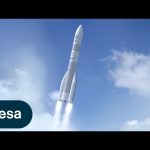
Animation of the first launch of the Ariane 6 rocket with two boosters.
Ariane 6 is an all-new design, created to succeed Ariane 5 as Europe’s heavy-lift launch system. With Ariane 6’s upper stage and its reignitable Vinci engine, Europe’s launch capability will be tailored to the needs of multiple payloads, for example to orbit satellite constellations. This autonomous capability to reach Earth orbit and deep space supports Europe’s navigation, Earth observation, scientific and security programmes. Ongoing development of Europe’s space transportation capabilities is made possible by the sustained dedication of thousands of talented people working in ESA’s 22 Member States.
At over 60 metres tall, Ariane 6 will weigh almost 900 tonnes when launched with a full payload – roughly equivalent to one and a half Airbus A380 passenger aircraft.
Vinci, the upper stage engine of Ariane 6 fed by liquid hydrogen and oxygen, can be stopped and restarted multiple times – to place satellites into different orbits and then de-orbit the upper stage, so it is not left behind as hazardous debris in space.
For the development of Ariane 6, ESA is working with an industrial network of several hundred companies in 13 European countries, led by prime contractor ArianeGroup.
France’s space agency, CNES, is preparing the Ariane 6 launch facilities at Europe’s Spaceport in French Guiana.
Credits: ESA – European Space Agency
★ Subscribe: http://bit.ly/ESAsubscribe and click twice on the bell button to receive our notifications.
We are Europe’s gateway to space. Our mission is to shape the development of Europe’s space capability and ensure that investment in space continues to deliver benefits to the citizens of Europe and the world. Check out https://www.esa.int/ to get up to speed on everything space related.
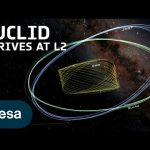
In the month after its launch on 1 July, Euclid has travelled 1.5 million kilometres from Earth towards the Sun-Earth Lagrange point L2, meaning it has ‘arrived’ at its destination orbit.
This animation showcases the orbits of Euclid (green), the James Webb Space Telescope (blue), and the Gaia mission (yellow) around this unique position in space. The positions of the spacecraft in this animation don’t correspond to their current positions in space.
Located about 1.5 million kilometres from Earth in the opposite direction from the Sun, L2 is about four times further away than our Moon. Several other space missions like Webb and Gaia also orbit L2 as it offers the perfect vantage point to study the Universe.
At L2, the spacecraft can keep the Sun, Earth and Moon behind them at all times, so they don’t interfere with observations, while at the same time getting a clear view of deep space and pointing an antenna back to Earth to remain in close communication.
Euclid and Webb’s halo orbit around L2 is big. In terms of distance, the ‘radius’ of Euclid’s orbit varies from about 400 000 kilometres at its closest to the centre, and up to 800 000 kilometres at its furthest. By the time Euclid has completed one full revolution around L2, the Moon will have circled the Earth six times. Gaia orbits L2 in a Lissajous orbit, with a maximum distance of around 350 000 km from its centre.
The region around L2 is big and even though the orbits of these spacecraft seem to cross in the animation, in reality there is plenty of space and a collision can be easily avoided. For example, Webb and Gaia are between 400 000 and 1 100 000 km apart, depending on where they are in their respective orbits.
Video credit: ESA/Gaia/DPAC; CC BY-SA 3.0 IGO
★ Subscribe: http://bit.ly/ESAsubscribe and click twice on the bell button to receive our notifications.
We are Europe’s gateway to space. Our mission is to shape the development of Europe’s space capability and ensure that investment in space continues to deliver benefits to the citizens of Europe and the world. Check out https://www.esa.int/ to get up to speed on everything space related.
If you think its only possible be held in orbit around a central body of mass – say a planet or a star – you’d be wrong. It is in fact possible to orbit around an invisible point, an oasis of forces, infinitesimal in size. ESA’s Euclid mission was launched on 1 July 2023 to uncover the secrets of the dark universe. Its destination? Like many astronomy missions before it, Lagrange point 2.
‘L2’ is an ideal location for astronomy missions because they can keep the Sun, Earth and Moon behind them at all times, so they don’t interfere with observations, while at the same time getting a clear view of deep space and pointing an antenna back to Earth to remain in close communication. The permanent sunlight on Euclid at L2 also keeps the telescope thermally stable, allowing for the extremely high stability required for the instrument’s long exposure observations. Euclid’s orbit around Lagrange point 2 is big. In terms of distance, the ‘radius’ of Euclid’s orbit varies from about 400 000 kilometres at its closest to the centre, and up to 800 000 kilometres at its furthest. By the time Euclid has completed one full revolution around L2, the Moon will have circled the Earth six times.
The reason for this large orbit is that it is almost free, in terms of fuel, to get there. The better the accuracy of the rocket that launches a mission into such a large halo orbit around L2, the less fuel that’s needed to perform correction manoeuvres – and Euclid only required a tiny correction manoeuvre after its near-perfect launch on a Space X Falcon 9.
This animation, created using “Gaia Sky”, shows Euclid’s path from Earth to this unique and useful position in space. Located about 1.5 million kilometres from Earth in the opposite direction from the Sun, the second Lagrange point (or Libration point) is about four times further away than our Moon.
Euclid will spend about a month getting to ‘L2’ followed by a planned six years in orbit, from where it will study the mysterious nature of dark matter and dark energy, that make up 95% of our Universe, but about which very little is known.
Credits: ESA/Gaia/DPAC, CC BY-SA 3.0 IGO
★ Subscribe: http://bit.ly/ESAsubscribe and click twice on the bell button to receive our notifications.
We are Europe’s gateway to space. Our mission is to shape the development of Europe’s space capability and ensure that investment in space continues to deliver benefits to the citizens of Europe and the world. Check out https://www.esa.int/ to get up to speed on everything space related.
When a spacecraft launches on a mission to another planet it must first break free of the Earth’s gravitational field. Once it has done that, it enters interplanetary space, where the dominant force is the gravitational field of the Sun.
The spacecraft begins to follow a curving orbit, around the Sun, which is similar to the orbit of a comet. When this orbit brings it close to its target destination the spacecraft must fire a retrorocket to slow down and allow itself to be captured by the gravitational field of its target. The smaller the target, the more the spacecraft must slow down.
Sometimes passing a planet can result in the spacecraft being accelerated, even without the spacecraft firing any of its thrusters. This is known as the ‘slingshot’ effect. Such ‘gravity assist’ manoeuvres are now a standard part of spaceflight and are used by almost all our interplanetary missions. They take advantage of the fact that the gravitational attraction of the planets can be used to change the trajectory and speed of a spacecraft.
The amount by which the spacecraft speeds up or slows down is determined by whether it is passing behind or in front of the planet as the planet follows its orbit. When the spacecraft leaves the influence of the planet, it follows an orbit on a different course than before.
📹 @EuropeanSpaceAgency
★ Subscribe: http://bit.ly/ESAsubscribe and click twice on the bell button to receive our notifications.
We are Europe’s gateway to space. Our mission is to shape the development of Europe’s space capability and ensure that investment in space continues to deliver benefits to the citizens of Europe and the world. Check out https://www.esa.int/ to get up to speed on everything space related.
After the uncrewed Artemis I test flight, the Artemis II mission will have astronauts demonstrate what the Orion spacecraft – powered by a European Service Module – can do on its voyage around the Moon.
Two astronauts will fly on the second Artemis mission and take over controls to show how Orion handles at close-quarter flying. While in Earth orbit the spacecraft will detach from its second stage, fly away, turn around, approach the second stage and then fly away again – all using the European Service Module’s 33 thrusters.
Whereas in the first Artemis mission the second stage fired Orion into its lunar orbit, for the second mission it will be the European Service Module that will give the spacecraft its final push to its voyage around the Moon.
The crew will fly Orion to 8889 km beyond the Moon before completing a lunar flyby and returning to Earth. The mission will take a minimum of eight days and will collect valuable flight test data.
The European Service Module is one of ESA’s many contributions to NASA’s Orion spacecraft and the Artemis programme that will send astronauts to the Moon and beyond. It provides electricity, water, oxygen and nitrogen as well as keeping the spacecraft at the right temperature and on course.
The European Service Module has 33 thrusters, 11 km of electrical wiring, four propellant and two pressure tanks that all work together to supply propulsion and everything needed to keep astronauts alive far from Earth – there is no room for error.
★ Subscribe: http://bit.ly/ESAsubscribe and click twice on the bell button to receive our notifications.
We are Europe’s gateway to space. Our mission is to shape the development of Europe’s space capability and ensure that investment in space continues to deliver benefits to the citizens of Europe and the world. Check out https://www.esa.int/ to get up to speed on everything space related.
Meet Hera, our very own asteroid detective. Together with two CubeSats – Milani the rock decoder and Juventas the radar visionary – Hera is off on an adventure to explore Didymos, a double asteroid system that is typical of the thousands that pose an impact risk to planet Earth.
Suitable for kids and adults alike, this episode of ‘The Incredible Adventures of Hera’ details the miniaturised James-Bond-style technology that Hera and its CubeSats will carry aboard with them to explore their asteroid target.
We are Europe’s gateway to space. Our mission is to shape the development of Europe’s space capability and ensure that investment in space continues to deliver benefits to the citizens of Europe and the world. Check out https://www.esa.int/ to get up to speed on everything space related.
Meet Hera, our very own asteroid detective. Together with two small CubeSats – Milani the rock decoder and Juventas the radar visionary – Hera is off on an adventure to explore Didymos, a double asteroid system that is typical of the thousands that pose an impact risk to planet Earth.
Suitable for space enthusiasts young and old, this episode of ‘The incredible adventures of the Hera mission’ is all about craters. What are they? Why are they important? Why is NASA’s DART spacecraft about to collide with an asteroid to create the Solar System’s newest – and perhaps most important – crater? And why do we need Hera to unveil the secrets of this crater?
We are Europe’s gateway to space. Our mission is to shape the development of Europe’s space capability and ensure that investment in space continues to deliver benefits to the citizens of Europe and the world. Check out https://www.esa.int/ to get up to speed on everything space related.
The Orion spacecraft with European Service Module will fly farther from Earth than any human-rated vehicle has ever flown before. This video gives an overview of the first mission – without astronauts – for Artemis, focussing on ESA’s European Service Module that powers the spacecraft.
The spacecraft will perform a flyby of the Moon, using lunar gravity to gain speed and propel itself 70 000 km beyond the Moon, almost half a million km from Earth – further than any human has ever travelled, where it will inject itself in a Distant Retrograde Orbit around the Moon.
On its return journey, Orion will do another flyby of the Moon before heading back to Earth.
The total trip will take around 20 days, ending with a splashdown in the Pacific Ocean without the European Service Module – it separates and burns up harmlessly in the atmosphere.
The second Artemis mission will have a simplified flight plan with only a flyby of the Moon but with four astronauts. The third Artemis mission will see astronauts taken to the lunar surface.
The European Service Module is ESA’s contribution to @NASA’s Orion spacecraft that will send astronauts to the Moon and beyond. It provides electricity, water, oxygen and nitrogen as well as keeping the spacecraft at the right temperature and on course.
The European Service Module has 33 thrusters, 11 km of electrical wiring, four propellant and two pressure tanks that all work together to supply propulsion and everything needed to keep astronauts alive far from Earth – there is no room for error.
★ Subscribe: http://bit.ly/ESAsubscribe and click twice on the bell button to receive our notifications.
We are Europe’s gateway to space. Our mission is to shape the development of Europe’s space capability and ensure that investment in space continues to deliver benefits to the citizens of Europe and the world. Check out https://www.esa.int/ to get up to speed on everything space related.
ESA and NASA are working hand in hand before the first Artemis mission to the Moon through a series of joint mission simulations. Teams based at the Erasmus Support Facility (ESF) at ESA’s ESTEC facility in The Netherlands, the German Space Operations Centre at ESA’s Columbus Control Centre in Oberphfaffenhofen and NASA’s Johnson Space Center in Houston are combining their expertise in a series of exercises to ensure a successful launch.
When it comes to simulations, it’s important that not everything goes perfectly right as it recreates – in real time – different stages of the mission to monitor the spacecraft’s position, propulsion, power, avionics and thermal properties. The European team, consisting of 40 people from ESA and industry, apply their considerable expertise from working on the European Service Module (ESM) to any unexpected problems. The ESM will provide power for the Orion spacecraft and propel it along its orbit to the Moon.
We are Europe’s gateway to space. Our mission is to shape the development of Europe’s space capability and ensure that investment in space continues to deliver benefits to the citizens of Europe and the world. Check out https://www.esa.int/ to get up to speed on everything space related.
One of the surprising discoveries coming out of Gaia data release 3, is that Gaia is able to detect starquakes – tiny motions on the surface of a star – that change the shapes of stars, something the observatory was not originally built for.
Previously, Gaia already found radial oscillations that cause stars to swell and shrink periodically, while keeping their spherical shape. But Gaia has now also spotted other vibrations that are more like large-scale tsunamis. These nonradial oscillations change the global shape of a star and are therefore harder to detect.
Nonradial oscillation modes cause a star’s surface to move while it rotates, as shown in the animation. Dark patches are slightly cooler than bright patches, giving rise to periodic changes in the brightness of the star. The frequency of the rotating and pulsating stars was increased 8.6 million times to shift them into the audible range of humans.
Credit: ESA/Gaia/DPAC, CC BY-SA 3.0 IGO. Acknowledgement: Animation and sonification were created by: Dr. Joey Mombarg, KU Leuven, Belgium. Based on information from Gaia Data Release 3: Pulsations in main-sequence OBAF stars as observed by Gaia by the Gaia Collaboration, De Ridder et al., 2022, submitted to A&A. Van Reeth et al. 2015, ApJS 218, id.2, 32 pp. Mombarg et al. 2021, A&A 650, id.A58, 23 pp.
★ Subscribe: http://bit.ly/ESAsubscribe and click twice on the bell button to receive our notifications.
We are Europe’s gateway to space. Our mission is to shape the development of Europe’s space capability and ensure that investment in space continues to deliver benefits to the citizens of Europe and the world. Check out https://www.esa.int/ to get up to speed on everything space related.
Since its launch in 2013 ESA’s Gaia observatory has been mapping our galaxy from Lagrange point 2, creating the most accurate and complete multi-dimensional map of the Milky Way. By now two full sets of data have been released, the first set in 2016 and a second one in 2018. These data releases contained stellar positions, distances, motions across the sky, and colour information, among others. Now on 13 June 2022 a third and new full data set will be released. This data release will contain even more and improved information about almost 2 billion stars, Solar System objects and extragalactic sources. It also includes radial velocities for 33 million stars, a five-time increase compared to data release 2. Another novelty in this data set is the largest catalogue yet of binary stars in the Milky Way, which is crucial to understand stellar evolution.
We are Europe’s gateway to space. Our mission is to shape the development of Europe’s space capability and ensure that investment in space continues to deliver benefits to the citizens of Europe and the world. Check out https://www.esa.int/ to get up to speed on everything space related.
Satellite images of our planet have become essential to our survival, offering a new outlook of our world. With rising seas being one of the biggest threats to society, satellite altimeter missions such as Copernicus Sentinel-6 are essential in monitoring global and regional changes in sea level.
Unbeknown to many, the island of Crete, Greece, plays an important role in the Copernicus satellite altimetry constellation and on an international stage. Satellite altimetry data have to be continuously monitored at the ESA’s Permanent Facility for Altimetry Calibration where different techniques have pioneered the use of transponders to provide the best measurements to validate satellite altimeters in space soon after launch.
This documentary explains how measurements are taken from the top of the White Mountains to make sure users get the best data on sea height from satellite altimetry.
It features interviews with Craig Donlon, Head of ESA’s Earth Surfaces and Interior Earth and Mission Science Division and Stelios Mertikas, Director of Laboratory of Geodesy & Geomatics Engineering at the @Technical University of Crete.
We are Europe’s gateway to space. Our mission is to shape the development of Europe’s space capability and ensure that investment in space continues to deliver benefits to the citizens of Europe and the world. Check out https://www.esa.int/ to get up to speed on everything space related.
ESA’s Juice mission has entered its final phase of development, with the spacecraft moving to an @Airbus Defence and Space facility in Toulouse, France, for the next round of testing. The spacecraft has been fully integrated, and these tests will be done in full flight configuration, as Juice is scheduled for launch from Europe’s Spaceport in Kourou, French Guiana, in April 2023.
The Juice mission is a perfect example of collaboration between several national space agencies and European industry. Its objective is to explore the gas giant Jupiter, its environment, and three of its moons: Europa, Callisto and Ganymede. By studying this planetary system, ESA hopes to learn more about the icy worlds around Jupiter and the origins and possibility of life in our Universe
We are Europe’s gateway to space. Our mission is to shape the development of Europe’s space capability and ensure that investment in space continues to deliver benefits to the citizens of Europe and the world. Check out https://www.esa.int/ to get up to speed on everything space related.
ESA’s Jupiter Icy Moons Explorer, Juice, is set to embark on an eight-year cruise to Jupiter starting April 2023. The mission will investigate the emergence of habitable worlds around gas giants and the Jupiter system as an archetype for the numerous giant planets now known to orbit other stars.
This animation depicts Juice’s journey to Jupiter and highlights from its foreseen tour of the giant planet and its large ocean-bearing moons. It depicts Juice’s journey from leaving Earth’s surface in a launch window 5–25 April 2023 and performing multiple gravity assist flybys in the inner Solar System, to arrival at Jupiter (July 2031), flybys of the Jovian moons Europa, Callisto and Ganymede, orbital insertion at Ganymede (December 2034), and eventual impact on this moon’s surface (late 2035).
An Ariane 5 will lift Juice into space from Europe’s Spaceport in Kourou. A series of gravity assist flybys of Earth, the Earth-Moon system and Venus will set the spacecraft on course for its July 2031 arrival at Jupiter. These flybys are shown here in order – Earth-Moon (August 2024), Venus (August 2025), Earth (September 2026, January 2029) – interspersed by Juice’s continuing orbits around the Sun. Juice’s flyby of the Earth-Moon system, known as a Lunar-Earth gravity assist (LEGA), is a world first: by performing this manoeuvre – a gravity assist flyby of the Moon followed just 1.5 days later by one of Earth – Juice will save a significant amount of propellant on its journey.
Juice will start its science mission about six months prior to entering orbit around Jupiter, making observations as it approaches its destination. Once in the Jovian system, a gravity assist flyby of Jupiter’s largest moon Ganymede – also the largest moon in the Solar System – will help Juice enter orbit around Jupiter, where the spacecraft will spend four years observing the gas giant and three of its moons: Ganymede, Callisto and Europa.
Juice will make two flybys of Europa (July 2032), which has strong evidence for an ocean of liquid water under its icy shell. Juice will look at the moon’s active zones, its surface composition and geology, search for pockets of liquid water under the surface, and study the plasma environment around Europa, also exploring the moon’s tiny atmosphere and hunting for plumes of water vapour (as have been previously detected erupting to space).
A sequence of Callisto flybys will be used to study this ancient, cratered world that may too harbour a subsurface ocean, also changing the angle of Juice’s orbit with respect to Jupiter’s equator, making it possible to explore Jupiter’s higher latitudes (2032–2034).
A sequence of Ganymede and Callisto flybys will adjust Juice’s orbit – properly orienting it while minimising the amount of propellant expended – so that it can enter orbit around Ganymede in December 2034, making it the first spacecraft to orbit another planet’s moon. Juice’s initial elliptical orbit will be followed by a 5000 km-altitude circular orbit, and later a 500 km-altitude circular orbit.
Ganymede is the only moon in the Solar System to have a magnetosphere. Juice will investigate this phenomenon and the moon’s internal magnetic field, and explore how its plasma environment interacts with that of Jupiter. Juice will also study Ganymede’s atmosphere, surface, subsurface, interior and internal ocean, investigating the moon as not only a planetary object but also a possible habitat.
Over time, Juice’s orbit around Ganymede will naturally decay due to lack of propellant, and it will make a grazing impact onto the surface (late 2035).
The Juice launch itself will be a historical milestone for more reasons than one. It will be the final launch for Ariane 5, ending the launcher’s nearly three-decade run as one of the world’s most successful heavy-lift rockets. Its duties are being taken over by Ariane 6.
We are Europe’s gateway to space. Our mission is to shape the development of Europe’s space capability and ensure that investment in space continues to deliver benefits to the citizens of Europe and the world. Check out https://www.esa.int/ to get up to speed on everything space related.
One of the many milestones in the leadup to the launch of Artemis is its rollout: this is when a crawler will carry the SLS rocket with Orion and ESM from the Vehicle Assembly Building to launchpad 39B. @NASA’s John Giles gives us a tour of the crawler and explains the adaptations made to this “wonderful piece of machinery” since it was first built for the Apollo programme in the 1960s. ESA is playing a key role in NASA’s Artemis programme, which will bring astronauts back to the Moon. The European Service Module – or ESM – will provide propulsion, power and thermal control for the Orion spacecraft.
We are Europe’s gateway to space. Our mission is to shape the development of Europe’s space capability and ensure that investment in space continues to deliver benefits to the citizens of Europe and the world. Check out https://www.esa.int/ to get up to speed on everything space related.
Meet Hera, our very own asteroid detective. Together with two CubeSats – Milani the rock decoder and Juventas the radar visionary – Hera is off on an adventure to explore Didymos, a double asteroid system that is typical of the thousands that pose an impact risk to planet Earth.
Suitable for kids and adults alike, this episode tells the story of the discovery of asteroids, in ‘The Curious Case of the Missing Planet’. Astronomers in the 18th century were sure there was a planet in the wide gap between Mars and Jupiter – and even formed a group called the Celestial Police to find it. But eventually it became clear there was no single world out there, just lots and lots of little ones. Fast forward to today and more than a million asteroids have been discovered, and Hera will perform close-up detection on two of them.
We are Europe’s gateway to space. Our mission is to shape the development of Europe’s space capability and ensure that investment in space continues to deliver benefits to the citizens of Europe and the world. Check out https://www.esa.int/ to get up to speed on everything space related.
Satellites observe the Earth using a range of wavelengths on the electromagnetic spectrum. Different wavelengths allow us to probe different aspects of Earth’s land, atmosphere and ocean. By sampling the electromagnetic spectrum at multiple wavelengths, we can build a more complete picture of Earth’s complex climate system.
We are Europe’s gateway to space. Our mission is to shape the development of Europe’s space capability and ensure that investment in space continues to deliver benefits to the citizens of Europe and the world. Check out https://www.esa.int/ to get up to speed on everything space related.
Satellites play a vital role in monitoring the rapid changes taking place in the Arctic. Tracking ice lost from the world’s glaciers, ice sheets and frozen land shows that Earth is losing ice at an accelerating rate. Currently more than a trillion tonnes of ice is lost each year. The sooner Earth’s temperature is stabilised, the more manageable the impacts of ice loss will be.
Credit: ESA/Planetary Visions
★ Subscribe: http://bit.ly/ESAsubscribe and click twice on the bell button to receive our notifications.
We are Europe’s gateway to space. Our mission is to shape the development of Europe’s space capability and ensure that investment in space continues to deliver benefits to the citizens of Europe and the world. Check out https://www.esa.int/ to get up to speed on everything space related.
The European Space Agency is playing a vital role in humankind’s return to the Moon. In a few months @NASA will launch Artemis I from the Kennedy Space Center. The uncrewed mission will carry NASA’s Orion spacecraft incorporating ESA’s European Service Module (ESM-1), built and tested by Airbus Bremen, in Germany, with the help of 10 European nations. ESM-1’s main engine and 32 thrusters will propel Orion into orbit around the Moon and return it to Earth.
As Artemis I prepares for launch, the second European Service Module (ESM-2) is about to ship to the US with ESM-3 also currently under construction. The second Artemis mission, however, has a crucial difference: it will carry four astronauts for a lunar flyby. ESM-2 will provide propulsion, power, oxygen, water and life support as well as controlling the temperature in the orbiting crew module. ESM-3 will go one step further and put the first person on the Moon for 50 years.
We are Europe’s gateway to space. Our mission is to shape the development of Europe’s space capability and ensure that investment in space continues to deliver benefits to the citizens of Europe and the world. Check out https://www.esa.int/ to get up to speed on everything space related.
Meet bag, bottle and straw, three bits of plastic left on the beach. They are only small, but they are heading into the ocean, where they could cause big damage. ESA is exploring how satellites can help detect and reduce plastic pollution in the ocean. From spotting build-ups of marine litter to tracking ocean currents, satellites could be game-changing in tackling this enormous environmental problem.
Though engaging for children and adults alike, this video is designed with primary school students in mind. In particular, teachers can use it to introduce the topic of marine litter in subjects such as geography and science.
Credits: ESA – Science Office Project coordination: Nicole Shearer (EJR-Quartz for ESA) and Mariana Barrosa (Science Office) Scientific advice: Peter de Maagt and Paolo Corradi (both ESA), Joana Mira Veiga (Deltares) Educational advice: Petra de Clippelaar (BSO ‘t Vogelnest) and Connor Mackelvey (Iroquois Elementary School) Design and animation: David Santos and Rui Braz (both Science Office)
★ Subscribe: http://bit.ly/ESAsubscribe and click twice on the bell button to receive our notifications.
We are Europe’s gateway to space. Our mission is to shape the development of Europe’s space capability and ensure that investment in space continues to deliver benefits to the citizens of Europe and the world. Check out https://www.esa.int/ to get up to speed on everything space related.
The Paris Agreement adopted a target for global warming not to exceed 1.5°C. This sets a limit on the additional carbon we can add to the atmosphere – the carbon budget. Only 18% of the carbon budget is now left. That is about 10 years at current emission rates.
Each country reports its annual greenhouse gas emissions to the United Nations. Scientists then set these emissions against estimates of the carbon absorbed by Earth’s natural carbon sinks. This is known as the bottom-up approach to calculating the carbon budget.
Another way to track carbon sources and sinks is to measure the amounts of greenhouse gases in the atmosphere from space – the top-down approach. As well as tracking atmospheric carbon, ESA’s Climate Change Initiative is using satellite observations to track other carbon stocks on land and sea.
How we use the land accounts for about a quarter of our greenhouse gas emissions. Forests are the largest store of carbon on the land. Fire acts as a conduit for carbon to pass from the land to the atmosphere. And phytoplankton in the ocean is an important carbon sink.
ESA’s RECCAP-2 project is using this information to reconcile the differences between the bottom-up and top-down approaches. Observations are combined with atmospheric and biophysical computer models to deduce carbon fluxes at the surface. This will improve the precision of each greenhouse gas budget and help separate natural fluxes from agricultural and fossil fuel emissions. This work will help us gauge whether we can stay within the 1.5°C carbon budget, or if more warming is in store.
Credits: ESA/Planetary Visions
★ Subscribe: http://bit.ly/ESAsubscribe and click twice on the bell button to receive our notifications.
We are Europe’s gateway to space. Our mission is to shape the development of Europe’s space capability and ensure that investment in space continues to deliver benefits to the citizens of Europe and the world. Check out https://www.esa.int/ to get up to speed on everything space related.
Meet Hera, our very own asteroid detective. Together with two CubeSats – Milani the rock decoder and Juventas the radar visionary – Hera is off on an adventure to explore Didymos, a double asteroid system that is typical of the thousands that pose an impact risk to planet Earth.
Suitable for kids and adults alike, this episode of ‘The Incredible Adventures of Hera’ takes you on a fun and informative journey to visit Didymos together with Hera. Along the way, you will discover who the main characters are, why this mission is so important, what ESA hopes to achieve with Hera and much more.
We are Europe’s gateway to space. Our mission is to shape the development of Europe’s space capability and ensure that investment in space continues to deliver benefits to the citizens of Europe and the world. Check out https://www.esa.int/ to get up to speed on everything space related.
Our planet is surrounded by spacecraft helping us study our changing climate, save lives following disasters, deliver global communication and navigation services and help us answer important scientific questions.
But these satellites are at risk. Accidental collisions between objects in space can produce huge clouds of fast-moving debris that can spread and damage additional satellites with cascading effect.
In this animation, find out how teams at ESA’s European Space Operations Centre in Darmstadt, Germany, take action to keep satellites safe after receiving an alert warning of a possible collision between an active satellite and a piece of space debris.
When the alert is raised, ESA experts determine the risk of a collision and plan a collision avoidance manoeuvre that can be used to get the satellite out of harm’s way if necessary.
Additional observations of the piece of space debris help the team better understand its path and the risk of collision. If that risk remains too high (typically 1 in 10 000), the planned manoeuvre is carried out to temporarily change the orbit of the satellite until the threat has passed.
Each manoeuvre comes at a price. They take skill and time to plan, cost precious fuel – shortening the lifetime of the mission – and often require instruments to be temporarily shut off, preventing them from collecting important data.
While most alerts do not end up requiring evasive action, the number of alerts is rapidly increasing. Hundreds are already issued every week. Several companies have begun to launch large constellations into low-Earth orbit to provide global internet access. They have great benefits, but could be a source of huge disruption if we do not change our behaviour.
In just a few years, our current methods for avoiding collisions in space will no longer be enough. To safeguard humankind’s continued access to space for future generations, ESA is developing technologies for an automated collision avoidance system.
We are Europe’s gateway to space. Our mission is to shape the development of Europe’s space capability and ensure that investment in space continues to deliver benefits to the citizens of Europe and the world. Check out https://www.esa.int/ to get up to speed on everything space related.
On 20 April 2021, ESA will host the 8th European Conference on Space Debris from Darmstadt, in Germany. Scientists, engineers, industry experts and policy makers will spend the virtual four day conference discussing the latest issues surrounding space debris. They will exchange the latest research, try to come up with solutions for potential problems and define the future direction of any necessary action.
There are currently over 129 million objects larger than a millimetre in orbits around Earth. These range from inactive satellites to flakes of paint. But no matter how small the item of debris, anything travelling up to 56 000 km/h in an orbit is dangerous if it comes into contact with the many satellites that connect us around the world, be it for GPS, mobile phone data or internet connectivity. The solution is to take action before it’s too late. This is why ESA has commissioned ClearSpace-1 – the world’s first mission to remove space debris – for launch in 2025.
We are Europe’s gateway to space. Our mission is to shape the development of Europe’s space capability and ensure that investment in space continues to deliver benefits to the citizens of Europe and the world. Check out https://www.esa.int/ to get up to speed on everything space related.
From the @Airbus integration halls in Bremen, Germany, this replay of a live event shows a sneak peek of the two European Service Modules that will power astronauts to the Moon and back as part of @NASA’s Orion spacecraft.
Orion is NASA’s next exploration spacecraft to send astronauts farther into space than ever before, beyond the Moon to asteroids and even Mars.
ESA has contracted and is overseeing the development of the European Service Module, the part of the Orion spacecraft that provides air, electricity and propulsion. Much like a train engine pulls passenger carriages and supplies power, the European Service Module will power the Orion crew module to its destination and back to Earth.
The programme includes Andreas Hammer, Head of @Airbus Defence and Space Exploration showing the European Service Modules in production, ESA Director General Jan Wörner announcing future developments, a statement by ESA’s head of European Service Module programme Philippe Deloo, a statement by Airbus head of European Service Module programme Didier Radola, a Moon missions overview with ESA astronaut Alexander Gerst and ESA’s head of Space Transportation Nico Dettmann on how ESA is building Orion with industry.
★ Subscribe: http://bit.ly/ESAsubscribe and click twice on the bell button to receive our notifications.
We are Europe’s gateway to space. Our mission is to shape the development of Europe’s space capability and ensure that investment in space continues to deliver benefits to the citizens of Europe and the world. Check out https://www.esa.int/ to get up to speed on everything space related.
The Orion spacecraft with European Service Module will fly farther from Earth than any human-rated vehicle has ever flown before. This video gives an overview of the first mission – without astronauts – for Artemis, focussing on ESA’s European Service Module that powers the spacecraft.
The spacecraft will perform a flyby of the Moon, using lunar gravity to gain speed and propel itself 70 000 km beyond the Moon, almost half a million km from Earth – further than any human has ever travelled.
On its return journey, Orion will do another flyby of the Moon before heading back to Earth. The total trip will take around 20 days, ending with a splashdown in the Pacific Ocean without the European Service Module – it separates and burns up harmlessly in the atmosphere.
The second Artemis mission will have a similar flight plan but with astronauts. The third Artemis mission will see astronauts taken to the lunar surface.
The European Service Module is ESA’s contribution to NASA’s Orion spacecraft that will send astronauts to the Moon and beyond. It provides electricity, water, oxygen and nitrogen as well as keeping the spacecraft at the right temperature and on course.
The European Service Module has 33 thrusters, 11 km of electrical wiring, four propellant and two pressure tanks that all work together to supply propulsion and everything needed to keep astronauts alive far from Earth – there is no room for error.
★ Subscribe: http://bit.ly/ESAsubscribe and click twice on the bell button to receive our notifications.
We are Europe’s gateway to space. Our mission is to shape the development of Europe’s space capability and ensure that investment in space continues to deliver benefits to the citizens of Europe and the world. Check out https://www.esa.int/ to get up to speed on everything space related.
➤ Sources
Appian – Historia Romana-Civil Wars
Plutarch – Life of Caesar
Caesar – De bello civili
Pharsalus, 48BC – Si Sheppard
➤ Music:
Music provided by No Copyright Music: https://www.youtube.com/c/royaltyfree…
Kevin MacLeod “The Descent”
Kevin MacLeod “Drums of the Deep”
LionFreeMusic “Dramatic War Tension Background Instrumental”
RoyaltyFreeZone “The guardians”
RoyaltyFreeZone “Monsters”
Abraham Cupeiro : Cornu de Pompeii (a small bit)
#Rome #Caesar #RomanEmpire #Pompey
This is the continuation of the mini series about “Caesar’s civil War”.
The battle of Pharsalus was the decisive engagement that cemented Caesars legacy and finalized the procedure of Rome’s transition from a Republic to an Empire.
Caesar’s civil war would continue even after Pharsalus but that was the turning point.
ESA has signed an €86 million contract with an industrial team led by Swiss start-up ClearSpace SA to purchase a unique service: the first-ever removal of an item of space debris from orbit.
As a result, in 2025, ClearSpace will launch the first active debris removal mission, ClearSpace-1, which will rendezvous, capture and take down for reentry the upper part of a Vespa (Vega Secondary Payload Adapter) used with Europe’s Vega launcher. This object was left in an approximately 801 km by 664 km-altitude gradual disposal orbit, complying with space debris mitigation regulations, following the second flight of Vega back in 2013.
★ Subscribe: http://bit.ly/ESAsubscribe and click twice on the bell button to receive our notifications.
We are Europe’s gateway to space. Our mission is to shape the development of Europe’s space capability and ensure that investment in space continues to deliver benefits to the citizens of Europe and the world. Check out https://www.esa.int/ to get up to speed on everything space related.
Few conflicts have rivaled the scale and destruction of the Punic wars fought between Rome and Carthage. In this first episode I set the stage for a conflict that will reshape history!
Sources:
“The Fall of Carthage” by Adrian Goldsworthy
“In the Name of Rome” by Adrian Goldsworthy
“The Rise of Rome” by Anthony Everitt
The gameplay comes from Total War: Rome 2
“Please note this is an unofficial video and is not endorsed by SEGA or the Creative Assembly in any way. For more information on Total War, please visit www.totalwar.com.”
A European satellite built to carry out precise measurements of sea level changes has arrived in California in preparation for launch. The Sentinel-6 Michael Freilich satellite forms part of the European Union’s Copernicus Earth Observation programme and will employ radar to map sea surface topography.
The mission will be used to monitor the height of the sea surface to understand long-term change. It will also measure wave height and wind speed. The satellite will provide fundamental data for climate science, policy-making and protecting the 600 million people who live in vulnerable coastal areas.
Data are provided to Copernicus services in near-real time to improve marine and weather forecasts used by maritime and coastal communities.
The mission is a collaboration between ESA, the European Commission, EUMETSAT, NASA and NOAA, with support from the French Space Agency CNES.
It is named Michael Freilich after NASA’s former Director of Earth Science and is scheduled for launch on 10 November on a SpaceX Falcon 9 rocket from the Vandenberg Air Force Base.
★ Subscribe: http://bit.ly/ESAsubscribe and click twice on the bell button to receive our notifications.
We are Europe’s gateway to space. Our mission is to shape the development of Europe’s space capability and ensure that investment in space continues to deliver benefits to the citizens of Europe and the world. Check out http://www.esa.int/ESA to get up to speed on everything space related.
This video shows Jezero crater, the landing site of the @NASA Mars 2020 Perseverance rover on the Red Planet, based on images from ESA’s Mars Express mission. The planned landing area is marked with an orange ellipse.
Scheduled for launch from Cape Canaveral, Florida on 30 July 2020 on board an Atlas V rocket, the Perseverance rover will land on 18 February 2021 in Jezero crater.
An impact crater with a diameter of about 45 km, Jezero is located at the rim of the giant Isidis impact basin. Morphological evidence suggests that the crater once hosted a lake, some 3.5 billion years ago.
Jezero possesses an inlet- and an outlet channel. The inlet channel discharges into a fan-delta deposit, containing water-rich minerals such as smectite clays. Scientists believe that the lake was relatively long lived because the delta may have required 1 to 10 million years to reach its thickness and size. Other studies conclude that the lake did not experience periods of important water-level fluctuations and that it was formed by a continuous surface runoff. This makes Jezero crater to a prime target for the search for potential signs of microbial life, because organic molecules are very well preserved in river deltas and lake sediments.
The animation was created using an image mosaic made from four single orbit observations obtained by the High Resolution Stereo Camera (HRSC) on Mars Express between 2004 and 2008. The mosaic combines data from the HRSC nadir and colour channels; the nadir channel is aligned perpendicular to the surface of Mars, as if looking straight down at the surface. The mosaic image was then combined with topography information from the stereo channels of HRSC to generate a three-dimensional landscape, which was then recorded from different perspectives, as with a movie camera, to render the flight shown in the video.
Copyright:
Animation: ESA/DLR/FU Berlin, CC BY-SA 3.0 IGO
Music: Björn Schreiner
Soundtrack logo: Alicia Neesemann
★ Subscribe: http://bit.ly/ESAsubscribe and click twice on the bell button to receive our notifications.
We are Europe’s gateway to space. Our mission is to shape the development of Europe’s space capability and ensure that investment in space continues to deliver benefits to the citizens of Europe and the world. Check out http://www.esa.int/ESA to get up to speed on everything space related.
Multiple small satellites will be launched at once on the Vega VV16 mission from Europe’s Spaceport in Kourou, French Guiana. This flight will demonstrate the modular SSMS dispenser resting on its upper stage intended to bring routine affordable launch opportunities for light satellites from 0.2 kg CubeSats up to 400 kg minisatellites.
Until now the smallest classes of satellites – all the way down to tiny CubeSats, built from 10 cm modular boxes – have typically ‘piggybacked’ to orbit. They have to make use of any spare capacity as a single large satellite is launched, meaning their overall launch opportunities are limited.
The new Vega Small Spacecraft Mission Service switches this into a ‘rideshare’ model, with multiple small satellites being flown together, splitting the launch cost.
SAB Aeropsace in the Czech Republic and Bercella in Italy designed and manufactured this modular dispenser for ESA’s Vega prime contractor Avio. The component structures are made of very low-density aluminium ‘sandwich’ panels protected by carbon fibre reinforced polymer skins. This makes it very lightweight and rigid.
The SSMS comprises two main sections, the hexagonal lower section can hold six nanosatellites or up to a dozen CubeSat deployers while the upper section section is used for microsatellites, minisatellites and small satellites. The lower section can also be used independently, coupled with a larger satellite replacing the top section.
The hexagonal module, a central column, towers, a supporting platform and a set of standard satellite interface spacers are assembled to suit each mission and combination of satellites. For this flight, a configuration called Flexi-3 weighing just 330 kg is being used.
This demonstration flight aims to prove the technical and financial viability of the rideshare service. ESA has collaborated with the European Union, which has partly funded this mission within the Horizon 2020 programme. This is part of the Contribution Agreement between ESA and the EU on space technology activities signed on 16 April 2019.
The animation shows the separation of the ESAIL mission which is a joint ESA LuxSpace project to extend the monitoring of maritime traffic beyond existing land-based tracking of Automatic Identification Systems (AIS) through the means of an array of microsatellites: SAT-AIS.
★ Subscribe: http://bit.ly/ESAsubscribe and click twice on the bell button to receive our notifications.
We are Europe’s gateway to space. Our mission is to shape the development of Europe’s space capability and ensure that investment in space continues to deliver benefits to the citizens of Europe and the world. Check out http://www.esa.int/ESA to get up to speed on everything space related.
With a simple Google Cardboard-style virtual reality (VR) viewer, you can experience how it feels to be a spacecraft hurtling past Earth. This 360-degree VR simulation of a flyby manoeuvre performed by ESA’s Mercury-bound BepiColombo spacecraft takes you on a trip past Earth at the distance of only 12 700 km, closer than the orbit of Europe’s navigational satellites Galileo.
The simulation displays the field of view of two of BepiColombo’s science instruments (MERTIS and PHEBUS) and two of its three MCAM selfie cameras during the gravity-assist flyby at Earth on 10 April 2020.
The simulation was created using the SPICE software developed by NASA’s Jet Propulsion Laboratory and data generated by the European Space and Astronomy Centre (ESAC)in Spain.
BepiColombo, a joint mission of ESA and the Japan Aerospace Exploration Agency (JAXA), is on a seven-year cruise to Mercury, the smallest and innermost planet of the Solar System. Launched in October 2018, BepiColombo follows an intricate trajectory that involves nine gravity-assist flyby manoeuvres. In addition to the flyby at Earth, BepiColombo will perform two flybys at Venus and six at Mercury, its target planet. The manoeuvres slow down the spacecraft as it needs to constantly brake against the gravitational pull of the Sun in order to be able to enter the correct orbit around Mercury in 2025, ahead of commencing science operations in early 2026.
Credit: ESA SPICE Service/RHEA Group.
★ Subscribe: http://bit.ly/ESAsubscribe and click twice on the bell button to receive our notifications.
We are Europe’s gateway to space. Our mission is to shape the development of Europe’s space capability and ensure that investment in space continues to deliver benefits to the citizens of Europe and the world. Check out http://www.esa.int/ESA to get up to speed on everything space related.
This animation, using data from the Copernicus Sentinel-5P satellite, shows the nitrogen dioxide emissions from 20 December 2019 until 16 March 2020 – using a 10-day moving average. The drop in emissions in late-January is visible, coinciding with the nationwide quarantine, and from the beginning of March, the nitrogen dioxide levels have begun to increase.
We are Europe’s gateway to space. Our mission is to shape the development of Europe’s space capability and ensure that investment in space continues to deliver benefits to the citizens of Europe and the world. Check out http://www.esa.int/ESA to get up to speed on everything space related.
New data from the Copernicus Sentinel-5P satellite reveal the decline of air pollution, specifically nitrogen dioxide emissions, over Italy. This reduction is particularly visible in northern Italy which coincides with its nationwide lockdown to prevent the spread of the coronavirus.
The animation shows the fluctuation of nitrogen dioxide emissions across Europe from 1 January 2020 until 11 March 2020, using a 10-day moving average. These data are thanks to the Tropomi instrument on board the Copernicus Sentinel-5P satellite which maps a multitude of air pollutants around the globe.
Claus Zehner, ESA’s Copernicus Sentinel-5P mission manager, comments, “The decline in nitrogen dioxide emissions over the Po Valley in northern Italy is particularly evident.
“Although there could be slight variations in the data due to cloud cover and changing weather, we are very confident that the reduction in emissions that we can see, coincides with the lockdown in Italy causing less traffic and industrial activities.”
Josef Aschbacher, ESA’s Director of Earth Observation Programmes, says, “Copernicus Sentinel-5P Tropomi is the most accurate instrument today that measures air pollution from space. These measurements, globally available thanks to the free and open data policy, provide crucial information for citizens and decision makers.”
The coronavirus disease (COVID-19) was recently declared a pandemic by the World Health Organisation, with more than 125 000 current cases of the disease reported globally. In Italy, the number of coronavirus cases drastically soared making it the country with the largest number of cases outside of China.
In an attempt to reduce the spread of the disease, Italy’s Prime Minister Giuseppe Conte announced a lockdown of the entire country – closing schools, restaurants, bars, museums and other venues across the country.
The Sentinel-5 Precursor – also known as Sentinel-5P – is the first Copernicus mission dedicated to monitoring our atmosphere. The satellite carries the Tropomi instrument to map a multitude of trace gases such as nitrogen dioxide, ozone, formaldehyde, sulphur dioxide, methane, carbon monoxide and aerosols – all of which affect the air we breathe and therefore our health, and our climate.
Given the growing importance and need for the continuous monitoring of air quality, the upcoming Copernicus Sentinel-4 and Sentinel-5 missions, as part of the EU’s Copernicus programme, will monitor key air quality trace gases and aerosols. These missions will provide information on air quality, stratospheric ozone and solar radiation, as well as climate monitoring.
Credits: contains modified Copernicus Sentinel data (2020), processed by ESA, CC BY-SA 3.0 IGO
★ Subscribe: http://bit.ly/ESAsubscribe and click twice on the bell button to receive our notifications.
We are Europe’s gateway to space. Our mission is to shape the development of Europe’s space capability and ensure that investment in space continues to deliver benefits to the citizens of Europe and the world. Check out http://www.esa.int/ESA to get up to speed on everything space related.
Earth’s magnetic field protects life on Earth from the intense radiation and titanic amounts of energetic material our Sun blasts in every direction. However, astronauts and satellites in space, future explorers travelling to the Moon and Mars, and infrastructure on Earth such as power grids and communication systems remain vulnerable to these violent outbursts.
For this reason, ESA is planning to send a satellite to monitor the ‘side’ of our Sun, from a gravitationally stable position known as the fifth Lagrange point. From here, the Lagrange satellite will detect potentially hazardous solar events before they come into view from Earth, giving us advance knowledge of their speed, direction and chance of impact.
★ Subscribe: http://bit.ly/ESAsubscribe and click twice on the bell button to receive our notifications.
We are Europe’s gateway to space. Our mission is to shape the development of Europe’s space capability and ensure that investment in space continues to deliver benefits to the citizens of Europe and the world. Check out http://www.esa.int/ESA to get up to speed on everything space related.
This is the European Space Agency, dedicated to the peaceful exploration and use of space for the benefit of humankind. Established in 1975, we work together with our 22 Member States to push the frontiers of science and technology, and promote economic growth in Europe. Space is the future and through ESA we are all part of it.
We are Europe’s gateway to space. Our mission is to shape the development of Europe’s space capability and ensure that investment in space continues to deliver benefits to the citizens of Europe and the world. Check out http://www.esa.int/ESA to get up to speed on everything space related.
Our alien friend Paxi went to visit American astronaut Christina Koch on board the International Space Station. Christina talks about the importance of teachers and shares a story about her favourite teacher at school.
We are Europe’s gateway to space. Our mission is to shape the development of Europe’s space capability and ensure that investment in space continues to deliver benefits to the citizens of Europe and the world. Check out http://www.esa.int/ESA to get up to speed on everything space related.
Our alien friend Paxi went to visit American astronaut Anne McClain on board the International Space Station. Anne explains some of the mental challenges of being an astronaut on the ISS.
★ Subscribe: http://bit.ly/ESAsubscribe and click twice on the bell button to receive our notifications.
We are Europe’s gateway to space. Our mission is to shape the development of Europe’s space capability and ensure that investment in space continues to deliver benefits to the citizens of Europe and the world. Check out http://www.esa.int/ESA to get up to speed on everything space related.