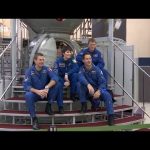
With ESA astronaut Alexander Gerst due to return on 10 November after six months onboard the ISS, Samantha Cristoforetti is set to fly to the station for a long-duration mission on 24 November. She will launch from Baikonur in Kazakhstan, and is currently joined at Star City by three other ESA astronauts – whose first missions are scheduled for 2015 and 2016.
Tag: astronauts
-
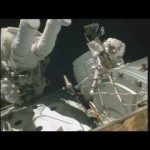
NASA Astronauts Conduct Space Walk To Make Important Repairs On International Space Station
Outside the International Space Station, Expedition 41 Flight Engineers Reid Wiseman and Barry Wilmore of NASA replaced a voltage regulation device and relocated camera and television equipment during a spacewalk Oct. 15, the second excursion outside the Quest airlock by station astronauts in U.S. spacesuits in as many weeks. The voltage regulator, called a Sequential Shunt Unit, failed in May, taking down one of eight power channels for station systems. Its replacement brought the station’s electrical output back to full capacity. The repositioning of the camera and television equipment was the first step in a major reconfiguration of station systems and modules to accommodate next year’s delivery of new docking adapters that will be used by commercial crew vehicles later this decade. The spacewalk was the 183rd in support of station assembly and maintenance, the second by Wiseman and the first for Wilmore.
-

NASA Astronauts Conduct Spacewalk on ISS
Clad in U.S. spacesuits, Expedition 41 Flight Engineers Reid Wiseman of NASA and Alexander Gerst of the European Space Agency conducted a spacewalk outside the International Space Station Oct. 7 to relocate a failed cooling pump and to install a power cable device designed to provide backup electrical capability to the station’s rail car system. The spacewalk was the 182nd in support of station assembly and maintenance and the first for both Wiseman and Gerst.
-
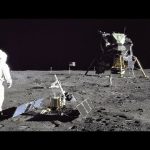
Restored Apollo 11 Moonwalk – Original NASA EVA Mission Video – Walking on the Moon
Original Mission Video as aired in July 1969 depicting the Apollo 11 astronauts conducting several tasks during extravehicular activity (EVA) operations on the surface of the moon. The EVA lasted approximately 2.5 hours with all scientific activities being completed satisfactorily. The Apollo 11 (EVA) began at 10:39:33 p.m. EDT on July 20, 1969 when Astronaut Neil Armstrong emerged from the spacecraft first. While descending, he released the Modularized Equipment Stowage Assembly on the Lunar Module’s descent stage. A camera on this module provided live television coverage of man’s first step on the Moon. On this, their one and only EVA, the astronauts had a great deal to do in a short time. During this first visit to the Moon, the astronauts remained within about 100 meters of the lunar module, collected about 47 pounds of samples, and deployed four experiments. After spending approximately 2 hours and 31 minutes on the surface, the astronauts ended the EVA at 1:11:13 a.m. EDT on July 21.
-
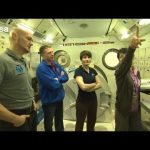
ESA astronauts training in Japan
ESA astronauts have to train with all International Space Station partners: we often see images of them training at Star City in Russia or in Houston, in the US, but they also have to go to Japan during the preparations for their mission.
ESA astronauts Alexander Gerst and Samantha Cristoforetti were recently in Tsukuba, at the Japanese Aerospace Exploration Centre.
-
Caves 2013: Discovery
Members of the CAVES 2013 crew talk about exploring inside the Sa Grutta cave – comparing their experience to arriving on the surface of a planet like Mars, where you don’t quite know what to expect.
CAVES, ESA’s unique training programme for astronauts, takes place over a couple of weeks in Sardinia’s Supramonte. Six astronauts spend two weeks deep in caves, in the dark and cold. They are separated from the outside world, doing scientific research and daily tasks together, as a group, just like in space. Moving in the cave system is also comparable to spacewalking with the use of harnesses and safety devices.
Read more about CAVES on our dedicated website (esa.int/caves) and read more about the CAVES 2013 campaign in the blog (blogs.esa.int/CAVES2013)
ESA–V. Crobu & S. Sechi
(Italian subtitles also available)
-
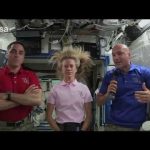
Luca Parmitano and Chris Cassidy explain what happened during EVA 23
Italian astronaut Luca Parmitano and NASA astronaut Chris Cassidy were hard at work outside the International Space Station (ISS) for the second time, when water started to leak into Luca Parmitano’s space suit helmet, immediately resulting in the duo heading back to the Quest Airlock to terminate the EVA. Luca and Chris explain the events that happened during EVA # 23.
-

NASA Long-Distance Google+ Hangout to Connect with Space Station
In a first for the agency, NASA hosted a Google+ Hangout live with the International Space Station on Feb. 22, 2013 from 10:30 a.m EST to 11:30 a.m. EST. Google+ Hangouts allow people to chat face-to-face while thousands more can tune in to watch the conversation live on Google+ or YouTube. This unique opportunity connected you, our fans, with astronauts living and working on the orbiting laboratory 240 miles above the Earth.
During the event, several video questions were selected and answered by astronauts on the space station and on the ground. Additionally, NASA asked real-time questions submitted by our followers on Google+, Twitter, and Facebook. During the hangout, astronauts Kevin Ford, Chris Hadfield and Tom Marshburn will answer questions and provide insights about life aboard the station. Station crews conduct a variety of science experiments and perform station maintenance during their six-month stay on the outpost. Their life aboard the station in near-weightlessness requires unique approaches to everyday activities such as eating, sleeping and exercising.
-
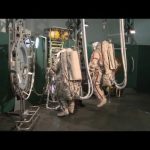
ESA astronauts training for ISS
ESA astronauts training for International Space Station
ESA’s human spaceflight programme is gaining experience with long-duration missions on the International Space Station.
A new generation of European astronauts will conduct scientific experiments and enjoy orbiting Earth in 2013 and 2014.
ESA astronaut Luca Parmitano will fly from Baikonur, Russia, next May for six months, followed by ESA astronauts Alexander Gerst and Samantha Cristoforetti in 2014.
This video shows them training at the Johnson Space Centre in Houston, USA
and Star City in Moscow, Russia.More information can be found on: http://www.esa.int/Our_Activities/Human_Spaceflight
-
Meet ESA, the space agency for Europe
You, together with your 500 million fellow citizens from ESA’s 20* European member nations, are the collective owners of one of the world’s leading space agencies.
The European Space Agency is an intergovernmental organisation, a cooperative coming together of its Member States in their national interest and common good.
This new video offers a quick introduction: Europe, meet ESA.
(*As of February 2015, 22 Member States)
-
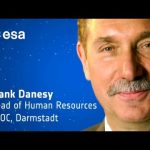
How to become an astronaut
‘How do I become an astronaut?’ is a question that Frank Danesy has been asked many, many times. In this video Frank talks about the qualities needed to become an astronaut, the selection campaigns and the rigorous training involved for the lucky few who are eventually chosen.
-
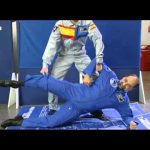
Mission 1: Newton in Space (Español)
While on board the ISS, Pedro Duque was filmed conducting demonstrations explaining Newton’s Three Laws of Motion – the subject of ISS DVD Lesson 1.
-
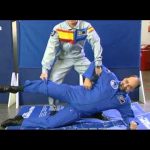
Mission 1: Newton in Space (Português)
While on board the ISS, Pedro Duque was filmed conducting demonstrations explaining Newton’s Three Laws of Motion – the subject of ISS DVD Lesson 1.
-
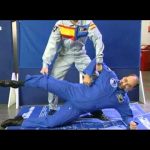
Mission 1: Newton in Space (Italiano)
While on board the ISS, Pedro Duque was filmed conducting demonstrations explaining Newton’s Three Laws of Motion – the subject of ISS DVD Lesson 1.
-
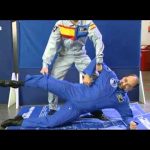
Mission 1: Newton in Space
While on board the ISS, Pedro Duque was filmed conducting demonstrations explaining Newton’s Three Laws of Motion – the subject of ISS DVD Lesson 1.
-
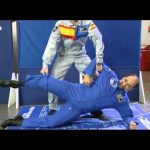
Mission 1: Newton in Space (Deutsch)
While on board the ISS, Pedro Duque was filmed conducting demonstrations explaining Newton’s Three Laws of Motion – the subject of ISS DVD Lesson 1.
-

Mission 2: Body Space (Italiano)
During the DELTA Mission, André Kuipers performed a number of physiology demonstrations showing the effects of weightlessness on the human body – the theme of DVD Lesson 2.
-
Tribute to the Space Shuttle from the European astronauts
Space Shuttle is perhaps the most complex technological system ever built. In 30 years, it has flown 135 times and helped humankind to dispatch and partially even return many satellites and deep-space probes, to build the International Space Station and to conduct out-of-this-world science. The Shuttle has transported also 24 European astronauts to Earth orbit on 25 missions.
This video highlights these flights with European flavour – from STS-9 in 1983 to STS-134 in last May. -
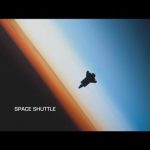
The Space Shuttle (Narrated by William Shatner)
An idea born in unsettled times becomes a feat of engineering excellence. The most complex machine ever built to bring humans to and from space and eventually construct the next stop on the road to space exploration.
-

New Shuttle Launch Date on This Week @NASA
NASA has re-targeted the liftoff of space shuttle Endeavour for Friday, April 29, at 3:47 p.m. EDT. The move comes to resolve a scheduling conflict with a Russian Progress supply vehicle scheduled to launch April 27 and arrive at the station two days later. Also, Goddard Memorial Symposium; “Wheels” rolls with big Shorty; cost-saving software summit; two honors for Ames; and, marking Odyssey’s beginning.
-

NASA Celebrates Black History Month
Administrator Charles Bolden talks of the contributions to the space program made by African Americans, including Guy Bluford, the first black man in space; the first African American woman in space; and Fred Gregory, the first black to pilot and command a space shuttle mission.
-
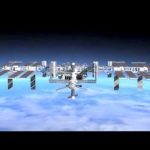
ATV-2 – A key ESA contribution to the ISS
In recent weeks several space freighters, the Russian Progress and Japanese HTV, have arrived at the International Space Station. But the most important logistics spacecraft for the ISS is Europe’s Automated Transfer Vehicle. The ATV-2 called Johannes Kepler is to be launched from Kourou in just over a week and will be docking at the orbital complex on February 23rd with over 7 tonnes of cargo.
-

New Shuttle Launch Date Tops This Week @NASA
A new target launch date has been selected for STS-133, allowing ample time for repairs to space shuttle Discovery. Also, NASA’s chief technologist and planetary science director were among more than 20 speakers featured at the second TEDxNASA conference in Newport News, Virginia. Hosted by the Langley Research Center, TEDx focused on education, innovation, family, technology, art and space travel. Plus, X-15 astronaut Joe Wagner joins Aerospace Hall of Fame; HQ Honor Awards; and Herrington helps celebrate American Indian & Alaska Native Heritage Month.
-
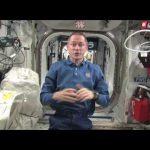
How do you feel after the first few months in orbit?
Frank De Winne is answering a few questions on the ISS submitted by the pupils of Class 7M from the Christian Morgenstern School in Hersching (Germany):
Question:
– Jerome (13): How do you feel in orbit after 2 months?
– Karina (13): How much time do you spend working outside the ISS?
– Tamara: Do you have any real free time in the ISS, and how can you spend this time? How often do you contact your family?
– Antoine (13): Have you ever felt scared in orbit? Has there ever been a moment that you wished to be back on Earth?
– Regina (14): Has anything strange happened on the ISS that none of your colleagues have been able to explain?
– Flavu: Which kind of education and qualification do you need for this kind of work? -
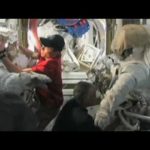
ESA astronauts working on the ISS
ESA astronauts Frank De Winne and Christer Fuglesang met up on the International Space Station in September 2009. Fuglesang was visiting the ISS during his 14-day Alissé mission. De Winne, on his six-month OasISS mission, was already on the ISS as part of the resident ISS Expedition 20 crew.
-

Space for Europe
Space touches us all on Earth – it is used for protecting our environment, for improving our everyday lives, for safety and security, and for stimulating our need for knowledge. Space is a key asset for Europe to face global challenges, for boosting our economic growth, for building our future.
-
Space: for protecting our environment
Space touches us all on Earth – it is used for protecting our environment, for improving our everyday lives, for safety and security, and for stimulating our need for knowledge. Space is a key asset for Europe to face global challenges, for boosting our economic growth, for building our future.
-
European missions to the International Space Station
Capturing the excitement of three highlights of European manned spaceflight in 2007 and 2008, these clips feature Paolo Nespoli’s STS-120 flight, the Columbus laboratory, and finally the ATV Jules Verne, Europe’s first space ferry.
-

NASA 50th Anniversary Lecture – Dr. Stephen Hawking – Part 4
NASA 50th Anniversary Lecture Series
Dr. Stephen Hawking Lecture
“Why We Should Go Into Space”
George Washington University
April 21, 2008In 4 parts
-

NASA 50th Anniversary Lecture – Stephen Hawking – Part 3
NASA 50th Anniversary Lecture Series
Dr. Stephen Hawking Lecture
“Why We Should Go Into Space”
George Washington University
April 21, 2008In 4 parts
-

NASA 50th Anniversary Lecture – Dr. Stephen Hawking – Part 1
NASA 50th Anniversary Lecture Series
Dr. Stephen Hawking Lecture
“Why We Should Go Into Space”
George Washington University
April 21, 2008In 4 parts