Ginevra Favole is an ESAC research fellow working on the large-scale structures of the universe. Her main scientific field is emission-line galaxies, galaxy clustering and weak gravitational lensing. She also works with mock catalogues and N-body cosmological simulations.
Maggie Lieu is an ESAC research fellow working on Euclid, a visible and near-infrared space telescope due to launch in 2021. By measuring the shapes of distant galaxies we can determine the mass of the largest systems in the Universe, galaxy clusters. Euclid will achieve unprecedented shape measurements of galaxies covering almost half of the extragalactic sky.Maggie is developing statistical methods to deal with this upcoming big, noisy dataset, so that we can better understand the physics of galaxy clusters and theirrolein the Dark Universe.
On 7 February 2018, 10 years to the day that Europe’s Columbus space laboratory was launched to the International Space Station, 20 lucky clubbers got a taste of weightlessness – not to conduct gravity-free science but to party with superstar DJs Steve Aoki, W&W and Le Shuuk.
Taking off from Frankfurt airport and organised by BigCityBeats, the WORLD CLUB DOME project served as a teaser party for a bigger event on Earth in June. The aircraft flew up and down angled at 45º – at the top of the curve the passengers and experiments experience around 20 seconds of microgravity. Before and after the weightless period, increased gravity of up to 2 g is part of the ride.
ESA astronauts Pedro Duque and Jean-Francois Clervoy joined the weightless flight and provided background and safety tips to the DJs and party-goers.
The aircraft was on loan from its usual airport in Bordeaux, France, where it is used for scientific research and testing equipment for spaceflight. These flights are the only way to test microgravity with humans without going through lengthy astronaut-training and flights to the International Space Station. For this reason, parabolic flights are often used to validate space instruments and train astronauts before spaceflight.
ESA’s parabolic flight campaigns for science and technology investigations are generally performed twice a year, in spring and autumn.
ESA, Fraport Frankfurt and the City of Frankfurt and BigCityBeats combined a fascination of science with the joy and fun of dancing in this world’s-first flight.
This event was the official pre-party to the BigCityBeats WORLD CLUB DOME “The Hollywood Edition” taking place 1/2/3 June 2018 in Frankfurt. More info via http://www.worldclubdome.com
Looking at a decade of European science on the International Space Station with the Columbus laboratory.
Columbus houses as many disciplines as possible in a small volume, from astrobiology to solar science through metallurgy and psychology – more than 227 experiments have been carried out during this remarkable decade. Countless papers have been published drawing conclusions from experiments performed in Columbus.
From circadian rhythms and new temperature sensors to edible algae as astronaut food through running experiments to grow crystals and investigate processes in a pure environment without gravity interfering with the process – Columbus helping scientists push the boundaries of what is possible and increase our knowledge for life on Earth.
The Moon is a destination, a laboratory for science, a place to learn the skills of planetary exploration, and a source of materials and energy for use on the Moon and in space to create new spacefaring capability.
Advocate of a human return on the Moon, Paul D. Spudis, Senior Staff Scientist at the Lunar and Planetary Institute in Houston (Texas, USA), takes us on a journey to rediscover the value of lunar exploration, a topic on which he has spent more than 40 years of study, thought and publications.
Space Bites hosts the best talks on space exploration from the most inspiring and knowledgeable speakers from the field. Held at the technical heart of the European Space Agency in the Netherlands, the lectures are now also available on YouTube. If you want to know about the present and future challenges of ESA, stay tuned for more.
We are Europe’s gateway to space. Our mission is to shape the development of Europe’s space capability and ensure that investment in space continues to deliver benefits to the citizens of Europe and the world. Check out https://www.esa.int/ to get up to speed on everything space related.
After a fruitful 2017 with many exciting launches and the end of some historic missions, ESA is ready for the year to come. 2018 will see the 10th anniversary of the International Space Station’s Columbus module and an ESA astronaut taking the helm of the ISS as commander. There will be more launches of new Earth observation and exploration satellites and ESA will venture to the innermost planet in our Solar System. 2018 will also mark the completion of the first part of the Copernicus constellation observing the Earth and of the full Galileo constellation, Europe’s own satellite navigation system.
Aleksandra, 24, from Latvia, shares her experience as an ESA YGT. In this video, the Aerospace Engineer speaks about her work in the thermal analysis and verification section, working with measurements at cryogenic temperatures. Aleks also shows her experiment set up in the Mechanical Systems Laboratory (MSL).
At the 68th International Astronautical Congress, in Adelaide, Australia, IAC TV gets the chance to sit down with Johann-Dietrich Woerner, the Director General of the European Space Agency to talk about the focus of the ESA for the future of space exploration and why he thinks meetings like the IAC are crucial for the industry.
ESA astronaut Paolo Nespoli is currently living and working on the International Space Station as part of his VITA mission. This video shows highlights from his first month.
The mission is part of ESA’s vision to use Earth-orbiting spacecraft as a place to live and work for the benefit of European society while using the experience to prepare for future voyages of exploration further into the Solar System.
Acting Administrator Robert Lightfoot was in Kazakhstan on July 28 to observe the launch to the International Space Station of our astronaut Randy Bresnik with his crewmates – Sergey Ryazanskiy of Roscosmos, and Paolo Nespoli of the European Space Agency. The trio is scheduled to spend more than four months on the station working on hundreds of science and technology experiments. Also, New 4K Footage of Spacewalk, NASA Technologies Showcased at AirVenture Event, Preparing to Chase the Total Solar Eclipse from the Sky, and Another Successful RS-25 Engine Test!
It’s an age when many of us would be considering winding down, and cutting back on physical exertion. Not so for Paolo Nespoli, who is about to embark on his third space mission at the age of 60, which makes him Europe’s oldest astronaut. At the end of July he will voyage to the International Space Station (ISS), where he will remain for some months.
Visions and clips from ESA’s future for human spaceflight and robotic exploration. Exploring is about visiting new places and coming back with new experiences and knowledge to help us on Earth.
Our strategy includes three destinations where humans will work with robots to gather new knowledge: low-Earth orbit on the International Space Station, the Moon – our closest neighbour, and our third destination Mars.
The exploration programme includes Europe’s service module for NASA’s Orion spacecraft around the Moon, a landing on the Moon with Roscomos’ Luna lander and ESA’s Exomars rover on Mars.
A deep-space gateway farther afield than the International Space Station is considered as a springboard for exploration beyond the Moon.
ESA’s vision for human spaceflight and robotic exploration is part of humanity’s road to the stars. Exploring is about visiting new places and coming back with new experiences and knowledge to help us on Earth.
Our strategy includes three destinations where humans will work with robots to gather new knowledge: low-Earth orbit on the International Space Station, the Moon – our closest neighbour, and our third destination Mars.
The exploration programme includes Europe’s service module for NASA’s Orion spacecraft around the Moon, a landing on the Moon with Roscomos’ Luna lander and ESA’s Exomars rover on Mars.
A deep-space gateway farther afield than the International Space Station is considered as a springboard for exploration beyond the Moon.
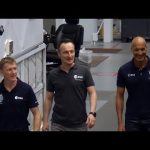
Four ESA astronauts have recently been training at NASA’s Johnson Space Centre (JSC) in Houston, Texas. For ESA’s newest astronaut Matthias Maurer, it was a chance to inspect a mock-up of NASA’s future space vehicle Orion alongside Tim Peake and Luca Parmitano, both experienced astronauts. Tim and Matthias have undergone spacewalk training in the neutral buoyancy pool. Alexander Gerst is also at JSC, training for his 2018 long-duration mission to the ISS.
Expedition 50 Commander Shane Kimbrough of NASA and Flight Engineer Thomas Pesquet of the European Space Agency conducted a spacewalk outside the International Space Station March 24 to disconnect cables and electrical connections on Pressurized Mating Adapter-3 (PMA-3), lubricate the latching end effector on the Canadarm2 robotic arm and replace a computer relay box on the station’s truss. PMA-3 will be robotically relocated March 30 by ground controllers from the port side of the Tranquility module to the space-facing side of the Harmony module for the future installation of a second International Docking Adapter that will accommodate the arrivals of commercial crew vehicles. The spacewalk is the first of three planned in a two-week period for station crewmembers that will see PMA-3 reconnected to its new location on Harmony and an avionics box replaced that routes electricity and data to station experiments.
‘The Moon – ESA’s interactive guide’ is a web documentary with over 40 videos narrated by scientists involved in lunar research. The platform allows you to explore your own path and discover the science, technology and the missions around our moon. An engaging space to satisfy your curiosity, learn and be inspired.
NASA astronaut Randy Bresnik, Paolo Nespoli of ESA (European Space Agency), and Sergey Ryazanskiy of the Russian space agency Roscosmos, who are scheduled to launch to the International Space Station in late spring, participated in a news conference Jan. 25, at the agency’s Johnson Space Center in Houston.
This will be Bresnik’s second trip to the space station, the second expedition for Ryazanskiy, and Nespoli’s third trip to the space station. They will be part of Expeditions 52 and 53.
On Jan. 4, NASA held a press briefing at the agency’s Johnson Space Center in Houston to preview a pair of planned spacewalks to perform a complex upgrade to the International Space Station’s power system. NASA’s Shane Kimbrough and Peggy Whitson will conduct the spacewalk on Jan. 6. The second spacewalk, on Jan. 13, will be performed by Kimbrough and Thomas Pesquet of ESA (European Space Agency). Working on the right side truss of the space station, the crew members will install adapter plates and hook up electrical connections for six new lithium-ion batteries that were delivered to the station in December.
In the edition of Space, Euronews correspondent Jeremy Wilks reports from the Observatory of the Côte d’Azur in the south of France on a unique mission to deflect an asteroid.
Asteroids have the potential to cause a catastrophe – a small asteroid could wipe out an entire city, while a large one could mean the end for us all.
It’s a threat we’re aware of, and which scientists and engineers are working to overcome.
The Expedition 50/51 crew, including NASA astronaut Peggy Whitson, launched aboard a Soyuz spacecraft from the Baikonur Cosmodrome in Kazakhstan Nov. 17 eastern time, to begin a two-day flight to the International Space Station. Whitson, Oleg Novitskiy of the Russian space agency Roscosmos and Thomas Pesquet of ESA (European Space Agency) are scheduled to join Expedition 50 commander Shane Kimbrough of NASA and Roscosmos cosmonauts Sergey Ryzhikov and Andrey Borisenko, who all have been aboard the orbiting laboratory since October. Whitson will assume command of the station in February – making her the first woman to command the space station twice. Whitson and her Expedition 50 crewmates are scheduled to return to Earth next spring. Also, Supermoon Shines Bright, Newman Participates in Operation IceBridge, and Advanced Weather Satellite Mission Previewed!
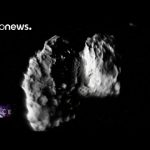
In just a few days’ time ESA’s Rosetta mission is going to come to a close in a most extraordinary fashion, because the spacecraft is going to slowly, and deliberately crash-land into the comet that it has been orbiting for the past two years.
Euronews is with the team as they prepare for this dramatic finale.
En pocos días, la misión Rosetta de la Agencia Espacial Europea (ESA) tocará a su fin. Y lo hará de la forma más extraordinaria, porque la nave espacial irá a chocar, lenta y deliberadamente, contra el cometa alrededor del cual ha estado orbitando durante los últimos dos años. Nos reunimos con el equipo mientras preparan este dramático final.
Le 30 septembre prochain, la sonde Rosetta s’écrasera lentement et délibérément sur la comète autour de laquelle elle orbite depuis deux ans. Or elle n’a pas été conçue pour cela. L’issue sera fatale. Mais avant cette dernière manoeuvre, les scientifiques ont prévu d’effectuer des relevés inédits à l’approche de “Tchouri”.
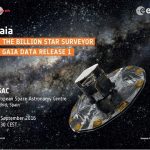
Launched in December 2013, Gaia is destined to create the most accurate map yet of the Milky Way. By making accurate measurements of the positions and motions of stars in the Milky Way, it will answer questions about the origin and evolution of our home galaxy.
The first intermediate data release, containing among other things three-dimensional positions and two-dimensional motions of a subset of two million stars, demonstrates that Gaia’s measurements are as precise as planned, paving the way to create the full map of one billion stars to be released towards the end of 2017.
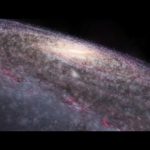
A virtual journey, from our Solar System through the Milky Way, based on data from the first release of ESA’s Gaia satellite.
The journey starts by looking back at the Sun, surrounded by its eight planets. We then move away from the Sun and travel towards and around the Hyades star cluster, the closest open cluster to the Solar System, some 150 light-years away.
The 3D positions of the stars shown in the animation are drawn from the Tycho-Gaia Astrometric Solution (TGAS), which combines information from Gaia’s first year of observations with the earlier Hipparcos and Tycho-2 Catalogues, both based on data from ESA’s Hipparcos mission.
This new dataset contains positions on the sky, distances and proper motions of over two million stars. It is twice as precise and contains almost 20 times as many stars as the previous reference for astrometry, the Hipparcos Catalogue.
The journey continues showing the full extent size of the stars contained in the Tycho-Gaia Astrometric Solution, all relatively near to the Sun, in the overall context of our Milky Way galaxy.
The final Gaia catalogue will contain the most detailed 3D map ever made of the Galaxy, charting a billion stars – about 1% of the Milky Way’s stellar content – to unprecedented accuracy.
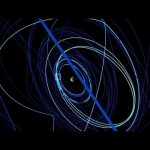
Animation visualising Rosetta’s two-year journey around Comet 67P/Churyumov–Gerasimenko.
The animation begins on 31 July 2014, during Rosetta’s final approach to the comet after its ten-year journey through space. The spacecraft arrived at a distance of 100 km on 6 August whereupon it gradually approached the comet and entered initial mapping orbits that were needed to select a landing site for Philae. These observations also enabled the first comet science of the mission. The manoeuvres in the lead up to, during and after Philae’s deployment on 12 November are seen, before Rosetta settled into longer-term science orbits.
In February and March 2015 the spacecraft made several flybys. One of the closest flybys triggered a ‘safe mode’ event that forced it to retreat temporarily until it was safe to gradually draw closer again. The comet’s increased activity in the lead up to and after perihelion in August 2015 meant that Rosetta remained well beyond 100 km distances for several months.
In June 2015, contact was restored with Philae again – albeit temporary, with no permanent link able to be maintained, despite a series of dedicated trajectories flown by Rosetta for several weeks.
Following perihelion, Rosetta performed a dayside far excursion some 1500 km from the comet, before re-approaching to closer orbits again, enabled by the reduction in the comet’s activity. In March–April 2016 Rosetta went on another far excursion, this time on the night side, followed by a close flyby and orbits dedicated to a range of science observations.
The animation finishes at 9 August 2016, before the details of the end of mission orbits were known. A visualisation of the trajectories leading to the final descent to the surface of the comet on 30 September will be provided once available.
The trajectory shown in this animation is created from real data, but the comet rotation is not. An arrow indicates the direction to the Sun as the camera viewpoint changes during the animation.
Følg Paxi til randen av solsystemet, oppdag kometenes verden og lær om det fantastiske Rosetta har på kometen 67P/Churyumov-Gerasimenko.
I videoen, som retter seg mot barn mellom 6–12 år, tar Paxi barna med seg for å oppdage kometer og Rosetta – det fantastiske ESA-romfartøyet som flyr langs kometen 67P/Churyumov-Gerasimenko. 12.11.2014 skal det prøve å slippe en lander på denne.
Videoen er den tredje i en serie av animasjoner hvor Paxi, ESAs utdannelsesmaskot, kommer i kontakt med forskjellige sider ved solsystemet, universet, jordens hemmeligheter og mye mer.
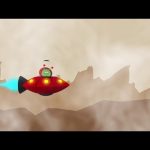
Bli med Paxi på en reise i solsystemet vårt, fra de steinete indre planetene i nærheten av solen, forbi de store planetene, til den iskalde utkanten og hjemstedet til kometene.
I denne videoen, som retter seg mot barn mellom 6–12 år, tar Paxi oss med på en tur i solsystemet. I løpet av turen besøker dere alle de åtte planetene og andre mindre ting som asteroider, kometer og dvergplaneten Pluto.
Videoen er den andre i en serie av animasjoner hvor Paxi, ESAs utdannelsesmaskot, kommer i kontakt med forskjellige sider ved solsystemet, universet, jordens hemmeligheter og mye mer.
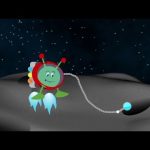
Møt Paxi, ESAs utdannelsesmaskot: hvor han kommer fra, hva han liker med romfart, hvem vennene hans er …
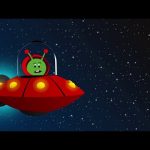
I videoen, som retter seg mot barn mellom 6–12 år, presenteres seeren for Paxi, et lite romvesen som kommer fra planeten Ally-O. Paxi har kommet til jorden for å møte nye venner og ta med seg barn på eventyrlige reiser i verdensrommet. Videoen er den første i en serie av animasjoner hvor Paxi, ESAs utdannelsesmaskot, kommer i kontakt med forskjellige sider ved solsystemet, universet, jordens hemmeligheter og mye mer.
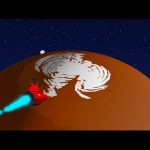
Följ med Paxi på hans resa till den röda planeten för att undersöka om det finns marsmänniskor och lär dig samtidigt om europeiska rymdsamarbetets ExoMars-projekt.
Acompaña a Paxi en su viaje al Planeta Rojo para investigar si existen los marcianos y descubrir más cosas sobre las misiones ExoMars de la Agencia Espacial Europea.
Însoţeşte-l pe Paxi în călătoria sa spre Planeta Roşie, pentru a investiga dacă există marţieni şi pentru a afla mai multe despre misiunile ExoMars ale Agenţiei Spaţiale Europene.
Leć razem z Paxim na Czerwoną Planetę, aby sprawdzić, czy Marsjanie istnieją i dowiedzieć się więcej o misjach ExoMars Europejskiej Agencji Kosmicznej.