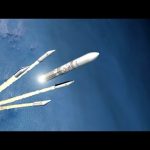
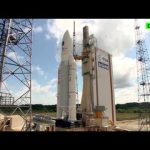
The ride to the International Space Station sees astronauts launched on top of a rocket fuelled by 300 tonnes of propellant. Where on Earth do astronauts take off? When do they experience weightlessness for the first time? And how long does the trip take?
Watch in just over a minute the events from launch to docking. This video is based on a training lesson for ESA astronauts, and it features footage taken from inside the Soyuz spacecraft.
We are Europe’s gateway to space. Our mission is to shape the development of Europe’s space capability and ensure that investment in space continues to deliver benefits to the citizens of Europe and the world. Check out http://www.esa.int/ESA to get up to speed on everything space related.
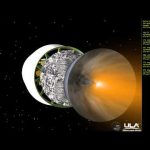
Watch a fully functional launch abort system (LAS) and test Orion spacecraft launch to an altitude of 31,000 feet at Mach 1.15 (more than 1,000 mph)! On July 2, 2019, NASA successfully demonstrated the Orion spacecraft’s launch abort system can outrun a speeding rocket and pull astronauts to safety during an emergency during launch. News release: https://go.nasa.gov/2Xg7mkJ Orion was launched atop a Northrop Grumman provided booster from Launch Pad 46 at Cape Canaveral Air Force Station in Florida. The test is another milestone in the agency’s preparation for Artemis missions to the Moon that will lead to astronaut missions to Mars.
Rocket engines for Ariane 6 are being tested and qualified at the German Aerospace Center in Lampoldshausen, Germany.
Several of the facilities on site have been modified for Ariane 6 and a new facility will soon test the launcher’s complete upper stage, simulating as far as possible the conditions it will experience in flight. With testing and development at full pace, Ariane 6 is taking shape for its maiden voyage.
ESA is Europe’s gateway to space. Our mission is to shape the development of Europe’s space capability and ensure that investment in space continues to deliver benefits to the citizens of Europe and the world. Check out http://www.esa.int/ESA to get up to speed on everything space related.
Following the launch of Aeolus on 22 August 2018, scientists have been busy fine-tuning and calibrating this latest Earth Explorer satellite. Aeolus carries a revolutionary instrument, which comprises a powerful laser, a large telescope and a very sensitive receiver. It works by emitting short, powerful pulses – 50 pulses per second – of ultraviolet light from a laser down into the atmosphere. The instrument then measures the backscattered signals from air molecules, dust particles and water droplets to provide vertical profiles that show the speed of the world’s winds in the lowermost 30 km of the atmosphere. These measurements are needed to improve weather forecasts. As part of the working being done to calibrate this novel mission, scientists have been taking similar measurements from an aircraft carrying an airborne version of Aeolus’ instrument. The pilot flies the plane under the satellite as it orbits above so that measurements of wind can be compared.
ESA is Europe’s gateway to space. Our mission is to shape the development of Europe’s space capability and ensure that investment in space continues to deliver benefits to the citizens of Europe and the world. Check out http://www.esa.int/ESA to get up to speed on everything space related.
This year saw ESA’s science exploration mission BepiColombo begin its seven year cruise to the innermost planet of our Solar System: Mercury. This timelapse recalls some of the preparations that went into readying the mission at Europe’s Spaceport in Kourou, French Guiana.
The mission, a joint endeavour between ESA and JAXA, comprises three spacecraft modules: ESA’s Mercury Planetary Orbiter and JAXA’s Mercury Magnetospheric Orbiter that will study all aspects of Mercury from their complementary orbits around the planet, and ESA’s Mercury Transfer Module that will bring them to the planet using a combination of solar electric propulsion and nine planetary flybys.
The video includes testing of the individual spacecraft units, stacking of the three modules and a protective sunshield into their launch configuration, integration of the spacecraft inside the launcher fairing, roll out to the launch pad, and finally launch itself. The mission lifted off at 01:45:28 GMT on 20 October 2018.
ESA is Europe’s gateway to space. Our mission is to shape the development of Europe’s space capability and ensure that investment in space continues to deliver benefits to the citizens of Europe and the world. Check out http://www.esa.int/ESA to get up to speed on everything space related.
It’s 5 a.m. on a normal September day and #NASAExplorers have gathered in a California field to watch a rocket launch light up the pre-dawn sky. On board the rocket is a satellite more than 10 years in the making, with one single instrument that will revolutionize the study of ice on Earth. Join the team in the excitement and stress of watching ICESat-2 launch into space and begin its work measuring our home planet.
This is what three astronauts being launched into space looks like – seen from space. ESA astronaut Alexander Gerst took this time-lapse sequence from the International Space Station’s Cupola observatory on 3 December 2018.
Inside the Soyuz MS-11 spacecraft were NASA astronaut Anne McClain, Canadian Space Agency astronaut David Saint-Jacques and Roscosmos astronaut and Soyuz commander Oleg Konenenko. The trio blasted into orbit at 11:31 GMT from the Baikonur cosmodrome in Kazakhstan and docked with the International Space Station just six hours later.
Spacecraft are launched after the Space Station flies overhead. This allowed Alexander to set up a camera to take regular pictures at intervals that are played back to create this video.
The rocket leaves behind a trail of exhaust as it gains altitude and passes through the layers of Earth’s atmosphere.
ESA is Europe’s gateway to space. Our mission is to shape the development of Europe’s space capability and ensure that investment in space continues to deliver benefits to the citizens of Europe and the world. Check out http://www.esa.int/ESA to get up to speed on everything space related.
Timelapse of the Russian Progress MS-10 cargo spacecraft launched on 16 November 2018 at 18:14 GMT from Baikonur cosmodrome, Kazakhstan, taken by ESA astronaut Alexander Gerst from the International Space Station.
The spacecraft was launched atop a Soyuz rocket with 2564 kg of cargo and supplies. Flying at 28 800 km/h, 400 km high, the International Space Station requires regular supplies from Earth such as this Progress launch. Spacecraft are launched after the Space Station flies overhead so they catch up with the orbital outpost to dock, in this case two days later on 18 November 2018.
The images were taken from the European-built Cupola module with a camera set to take pictures at regular intervals. The pictures are then played quickly after each other at 8 to 16 times normal speed. The video shows around 15 minutes of the launch at normal speed.
The Progress spacecraft delivered food, fuel and supplies, including about 750 kg of propellant, 75 kg of oxygen and air and 440 l of water.
Some notable moments in this video are:
00:07 Soyuz-FG rocket booster separation.
00:19 Core stage separation.
00:34:05 Core stage starts burning in the atmosphere as it returns to Earth after having spent all its fuel.
00:34:19 Progress spacecraft separates from rocket and enters orbit to catch up with the International Space Station.
ESA is Europe’s gateway to space. Our mission is to shape the development of Europe’s space capability and ensure that investment in space continues to deliver benefits to the citizens of Europe and the world. Check out http://www.esa.int/ESA to get up to speed on everything space related.
Highlights from the days up to and including the exciting launch of the ESA-JAXA BepiColombo mission to Mercury.
BepiColombo launched at 01:45 GMT from Europe’s Spaceport in Kourou, French Guiana. It will make a seven year cruise to Mercury, flying by Earth once, Venus twice and Mercury six times before entering orbit.
It is the first European mission to Mercury, the smallest and least explored planet in the inner Solar System, and the first to send two spacecraft to make complementary measurements of the planet and its dynamic environment at the same time. The mission comprises two science orbiters: ESA’s Mercury Planetary Orbiter (MPO) and JAXA’s Mercury Magnetospheric Orbiter (MMO). The ESA-built Mercury Transfer Module (MTM) will carry the orbiters to Mercury using a combination of solar electric propulsion and gravity assist flybys.
ESA is Europe’s gateway to space. Our mission is to shape the development of Europe’s space capability and ensure that investment in space continues to deliver benefits to the citizens of Europe and the world. Check out http://www.esa.int/ESA to get up to speed on everything space related.
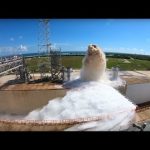
This system is used to reduce extreme heat and energy generated by a rocket launch.🚀 On Oct. 15, 2018, the Ignition Overpressure Protection and Sound Suppression water deluge system at Kennedy Space Center’s Launch Pad 39B was tested, sending water about 100 feet in the air. The test is part of preparation for launching our Space Launch System rocket on Exploration Mission-1 and subsequent missions.
Modifications were made to the pad after a previous wet flow test, increasing the performance of the system. During launch, this water deluge system will release approximately 450,000 gallons of water across the mobile launcher and Flame Deflector.
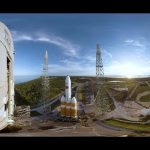
Watch in 360 degrees as an United Launch Alliance Delta IV Heavy rocket lifts off from Space Launch Complex-37 at Cape Canaveral Air Force Station in Florida carrying NASA’s Parker Solar Probe spacecraft. Roughly the size of a small car, the spacecraft lifted off at 3:31 a.m. EDT on Aug. 12, 2018, starting its historic mission to “touch” the Sun.
ESA’s Earth Explorer Aeolus satellite lifted off on a Vega rocket from Europe’s Spaceport in Kourou, French Guiana, at 21:20 GMT (23:20 CEST, 18:20 local time) on 22 August 2018. Aeolus carries one of the most sophisticated instruments ever to be put into orbit. The first of its kind, the Aladin instrument includes revolutionary laser technology to generate pulses of ultraviolet light that are beamed down into the atmosphere to profile the world’s winds – a completely new approach to measuring the wind from space. By profiling the lowermost 30 km of the atmosphere, Aeolus will give scientists global information on the speed of the wind in near-real time. This will improve our understanding of how wind, pressure, temperature and humidity are interlinked. This new mission will also provide insight into how the wind influences the exchange of heat and moisture between Earth’s surface and the atmosphere. These aspects are important for understanding climate change. As well as advancing science and improving weather forecasts, data from Aeolus will be used in air-quality models to improve forecasts of dust and other airborne particles that affect public health.
NASA’s Parker Solar Probe mission launched Aug. 11 from Cape Canaveral Air Force Station in Florida. The mission will be the first to fly directly through the Sun’s corona – the hazardous region of intense heat and solar radiation in the Sun’s atmosphere that is visible during an eclipse. It will gather data that could help answer questions about solar physics that have puzzled scientists for decades. Gathering information about fundamental processes near the Sun can help improve our understanding of how our solar system’s star changes the space environment, where space weather can affect astronauts, interfere with satellite orbits, or damage spacecraft electronics.
Enjoy this animation visualising BepiColombo’s launch and cruise to Mercury. Some aspects have been simplified for the purpose of this animation.
The joint ESA-JAXA mission comprises the European Mercury Planetary Orbiter and Japan’s Mercury Magnetospheric Orbiter, which will be transported to the innermost planet by the Mercury Transfer Module. The animation highlights several key milestones, including the solar array and antenna deployments once in space, through to the arrival at Mercury seven years later. When approaching Mercury, the transfer module will separate and the two science orbiters, still together, will be captured into orbit around the planet. Their altitude will be adjusted until the Magnetospheric Orbiter’s desired orbit is reached. Then the Planetary Orbiter will separate and descend to its lower orbit, and the two craft will begin their scientific exploration of Mercury and its environment.
This unique video shows a full launch of the Soyuz MS-09: from liftoff to orbit.
Watch the launch from inside the crew capsule with first-ever shots from outside the spacecraft recorded by cameras fixed to the exterior of the Soyuz.
The intense launch lasts less than ten minutes whereby the Soyuz spacecraft is propelled 1640 km and gains 210 km altitude. Every second for nine minutes, the spacecraft accelerates 50 km/h on average as the rocket’s boosters burn their fuel and are discarded.
See the astronaut’s reactions and what the spacecraft looks like as the main steps are carried out to get into orbit:
-00:12 Launch command issued
-00:10 Engine turbopumps at flight speed
-00:05 Engines at maximum thrust
00:00 Launch
+1:54 Separation of emergency rescue system
+1:57 First stage separation
+2:38 Fairing separation
+4:48 Second stage separation
+4:58 Tail adapter separation
+8:45 Third stage engine cut off having arrived in orbit
+8:49 Soyuz separation, deploy solar arrays and antennae
The astronauts, from left to right, are NASA astronaut Serena Auñón-Chancellor, Roscosmos commander Sergei Prokopyev and ESA astronaut and flight engineer Alexander Gerst launched in the Soyuz MS-09 spacecraft from the Baikonur cosmodrome in Kazakhstan to the International Space Station on 6 June 2018. ESA astronaut Matthias Maurer and ESA television host Richard Hollingham provide commentary taken from the live event.
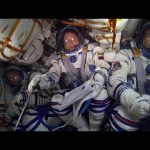
Hunched in their Sokol flight suits that offer protection in case of fire or depressurisation, the trio stay in the crew capsule of the Soyuz – the only module that is also designed to survive a return to Earth. The bags above their heads contain supplies for the International Space Station as every bit of space is used.
During a Soyuz launch astronauts typically experience forces of up to 4g – having to work while being pressed into their seats with a force that is four times more than the gravity felt on Earth. The Soyuz commander uses a stick to press buttons as they are too far away from the control panel.
The fluffy toys above the astronauts’ heads are mascots and good luck charms but also serve as a simple but effective test to see when the spacecraft is in orbit: when they start to float the spacecraft is weightless and orbiting Earth. Above Sergei is the mascot for the 2018 FIFA soccer World Cup held in Russia. Alexander took German children television icon “Die Maus” with him.
The launch went as planned as the 50-m tall Soyuz rocket propelled the astronauts to their cruising speed of around 28 800 km/h.
For this launch the astronauts took 34 orbits of Earth over two days to arrive at their destination spending their time in the cramped orbital module of the Soyuz that is no larger than a car. With limited communications and living space the astronauts had time to adapt to weightlessness and reflect on their mission ahead. They aligned their spacecraft with the International Space Station and approached the orbital outpost for docking on 8 June 2018. The files for this video were downloaded by the astronauts after arriving at the Space Station.
Alexander is a returning visitor to the International Space Station, the first of ESA’s 2009 class of astronauts to be sent into space for a second time. During the second part of his mission Alexander will take over as commander of the International Space Station, only the second time an ESA astronaut will take on this role so far.
The Copernicus Sentinel-3B satellite spent six weeks at the Plesetsk cosmodrome in Russia being carefully prepared for liftoff. After being shipped from France to the launch site, the satellite was tested, joined to the rocket launch adapter, sealed from view in the fairing and taken by train to the launch pad. Sentinel-3B lifted off on 25 April 2018 at 17:57 GMT (19:57 CEST).
It joins its twin, Sentinel-3A, in orbit. The pairing of identical satellites provides the best coverage and data delivery for Europe’s Copernicus programme – the largest environmental monitoring programme in the world. The satellites carry the same suite of cutting-edge instruments to measure oceans, land, ice and atmosphere. While these data are fed primarily into the Copernicus Marine Environment Monitoring Service, all the Copernicus services benefit to produce knowledge and information products in near-real time for a wide range of applications. The Sentinel-3 mission is essential for applications for ocean and coastal monitoring, numerical weather and ocean prediction, sea-level change and sea-surface topography monitoring, ocean primary production estimation and land-cover change mapping.
New data reveal that the interstellar asteroid that recently zipped through our solar system is rocky, cigar-shaped, and has a somewhat reddish hue. It’s the first confirmed object from another star observed in our solar system, and was discovered Oct. 19 by the University of Hawaii’s Pan-STARRS1 telescope team, funded by NASA’s Near-Earth Object Observations Program. The telescope team named it ‘Oumuamua (oh MOO-uh MOO-uh) – Hawaiian for “a messenger from afar arriving first.” The unusually-shaped asteroid, which is up to a quarter mile long and perhaps 10 times as long as it is wide, may provide new clues into how other solar systems formed. Also, Advanced Weather Satellite Launched, James Webb Space Telescope Completes Final Cryogenic Testing, Recurring Martian Streaks: Flowing Sand, Not Water? and Happy Thanksgiving, from Space!
This video is available for download from NASA’s Image and Video Library: https://images.nasa.gov/details-NHQ_2017_1124_New%20Details%20about%20Interstellar%20Visitor%20on%20This%20Week%20@NASA%20%E2%80%93%20November%2024,%202017.html
On Friday, August 18, NASA launched the third in a series of three advanced, Tracking and Data Relay Satellites, known as TDRS-M, from Cape Canaveral Air Force Station, in Florida. This latest addition to the fleet will augment a space communications network that provides the critical path for high data-rate communication to a host of spacecraft including the International Space Station and its resupply vehicles, the Hubble Space Telescope and many of NASA’s Earth-observing fleet spacecraft.
Acting Administrator Robert Lightfoot was in Kazakhstan on July 28 to observe the launch to the International Space Station of our astronaut Randy Bresnik with his crewmates – Sergey Ryazanskiy of Roscosmos, and Paolo Nespoli of the European Space Agency. The trio is scheduled to spend more than four months on the station working on hundreds of science and technology experiments. Also, New 4K Footage of Spacewalk, NASA Technologies Showcased at AirVenture Event, Preparing to Chase the Total Solar Eclipse from the Sky, and Another Successful RS-25 Engine Test!
On 28 May 2014, ESA astronaut Alexander Gerst and NASA astronaut Reid Wiseman under the command of Russian cosmonaut Maxim Suraev rocketed into space in a Soyuz spacecraft. This was their voyage.
For Alexander and Reid it was the first time they saw Earth from space.
Strapped atop 274 tonnes of rocket propellants delivering 26 million horsepower, it took only six hours to reach their destination, International Space Station.
Alexander worked as a geophysicist and volcanologist before he was selected as an ESA astronaut in 2009. His Blue Dot mission included an extensive scientific programme of experiments in physical science, biology, and human physiology as well as radiation research and technology demonstrations. All experiments make use of the out-of-this-world laboratory to improve life on Earth or prepare for further human exploration of our Solar System.
Decided in Luxemburg by the European Space Agency council meeting at Ministerial level, Ariane 6 is a modular three-stage launcher (solid–cryogenic–cryogenic) with two configurations using: four boosters (A64) or two boosters (A62).
ESA astronaut Thomas Pesquet, NASA astronaut Peggy Whitson and Roscosmos commander Oleg Novitsky were launched to the International Space Station on 17 November from Baikonur cosmodrome in Kazakhstan on their Soyuz MS-03 spacecraft.
Thomas, Peggy and Oleg will spend six months in space working and living on the International Space Station.
The Proxima mission is the ninth long-duration mission for an ESA astronaut. It is named after the closest star to the Sun, continuing a tradition of naming missions with French astronauts after stars and constellations.
During Proxima, Thomas will perform around 50 scientific experiments for ESA and France’s space agency CNES as well as take part in many research activities for the other Station partners. The mission is part of ESA’s vision to use Earth-orbiting spacecraft as a place to live and work for the benefit of European society while using the experience to prepare for future voyages of exploration further into the Solar System.
On June 28, the booster for NASA’s Space Launch System (SLS) rocket was fired up for a major two-minute full-duration qualification ground test at Orbital ATK Propulsion Systems’ test facilities in Promontory, Utah. Engineers will evaluate test data on the motor’s performance using cold propellant, the steering operation of its redesigned nozzle, and other operational data to help qualify the booster for flight. This is the last time the booster will be fired in a test environment before it’s used for the first uncrewed test flight of SLS with NASA’s Orion spacecraft, known as Exploration Mission-1, in late 2018. Also, SLS Test Hardware Arrives at Marshall, Juno Arrives at Jupiter July 4th, Test Lab Launched to Streamline Air Travel, Russian Docking System Tested on ISS, and NASA 2016 Agency Honor Award Distinguished Honorees.
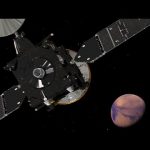
After a successful launch from Kazakhstan’s Baikonur Cosmodrome in March, the ExoMars spacecraft is making good progress on its 500 million km trip to Mars.
The joint European and Russian mission will perform science, test lander and descent technology, and may help solve the mystery of why there is methane on Mars. The gas could indicate a geological origin or past or present life – most likely from microbes. The mission carries four scientific packages with Russia developing one of the three spectrometers on board the orbiter’s Atmospheric Chemistry Suite.
This film provides an update of ExoMars’ journey. It includes the first test image from the Trace Gas Orbiter’s high-resolution camera and looks ahead to a major course correction manoeuvre in July. The spacecraft will then be lined up for arrival at Mars on 19 October 2016.
Includes interviews with Thomas Passvogel, Head of Science Projects, ESA (English); Oleg Korablev, ACS Experiment Principal Investigator (Russian); Nicolas Thomas, CaSSIS Experiment Principal Investigator, University of Bern (English).
Timelapse movie following the preparations of the ExoMars 2016 spacecraft in the lead up to launch on 14 March 2016. The movie includes the integration of the entry, descent and landing demonstrator module, Schiaparelli, with the Trace Gas Orbiter, and the journey of the spacecraft inside the Proton rocket as it is moved to the launch pad and raised to a vertical position.
ExoMars launched from Baikonur, Kazakhstan at 09:31 GMT on 14 March. It will arrive at the Red Planet on 19 October. Its mission is to address unsolved mysteries of the planet’s atmosphere that could indicate present-day geological – or even biological – activity, and to demonstrate the landing technologies needed for future missions to Mars.
¿Existe la vida en Marte? La misión ExoMars intenta responder a esta pregunta. Aquí, en el Cosmódromo de Baikonur, en Kazajistán, nos reunimos con los científicos que trabajan en este proyecto. El cohete de la misión ExoMars se dirige hacia el planeta rojo para buscar buscar potenciales pruebas de actividad biológica.
Al cosmodromo di Bajkonur, in Kazakhstan, euronews ha seguito l’avvio di ExoMars,missione sviluppata dall’ESA, l’Agenzia Spaziale Europea ESA e da Roscosmos, Agenzia Spaziale Russa.
L’obiettivo di ExoMars è lo studio dell’ambiente biologico della superficie del pianeta ma anche la ricerca di eventuali tracce di vita, passata o presente.
Bajkonur, a Csillagváros a kazah sztyeppéken, az űrkutatás történelmi helyszíne, ahonnan az első ember felszállt az űrbe – itt kezdődik az Exomars-kaland.
A megfigyelőplatform három kilométerre van a kilövőállástól. Európai és orosz mérnökök figyelik, hogyan indulnak el az általuk éveken át tervezett és épített műszerek a Marsra.
This timelapse video shows Sentinel-3A, from final preparations to liftoff on a Rockot launcher from the Plesetsk Cosmodrome in northern Russia, at 17:57 GMT (18:57 CET) on 16 February 2016.
Sentinel-3A is the third satellite to be launched for Europe’s Copernicus environment monitoring programme.
Designed as a two-satellite constellation – Sentinel-3A and -3B – the Sentinel-3 mission carries a series of cutting-edge instruments for systematic measurements of Earth’s oceans, land, ice and atmosphere. Over oceans, Sentinel-3 measures the temperature, colour and height of the sea surface as well as the thickness of sea ice. These measurements will be used, for example, to monitor changes in sea level, marine pollution and biological productivity. Over land, this innovative mission will monitor wildfires, map the way land is used, provide indices of vegetation state and measure the height of rivers and lakes.
Animation visualising milestones during the launch of the ExoMars 2016 mission and its cruise to Mars. The mission comprises the Trace Gas Orbiter and an entry, descent and landing demonstrator module, Schiaparelli, which are scheduled to be launched on a four-stage Proton-M/Breeze-M rocket from Baikonur during the 14–25 March 2016 window.
About ten-and-a-half hours after launch, the spacecraft will separate from the rocket and deploy its solar wings. Two weeks later, its high-gain antenna will be deployed. After a seven-month cruise to Mars, Schiaparelli will separate from TGO on 16 October. Three days later it will enter the martian atmosphere, while TGO begins its entry into Mars orbit.
This timelapse video shows the preparations for LISA Pathfinder’s launch at Europe’s Spaceport in Kourou, French Guiana. The video spans three weeks, starting on 12 November 2015 with the completed and fuelled spacecraft and ending on the 3 December launch day.
Over this period, the spacecraft was attached to the payload adaptor of the Vega launcher, encapsulated within the half-shells of the rocket fairing, transferred to the launcher assembly area, and installed on top of Vega inside the mobile gantry, which was rolled back shortly before liftoff.
LISA Pathfinder will test key technologies for space-based observation of gravitational waves – ripples in the fabric of spacetime that are predicted by Albert Einstein’s general theory of relativity.
Credit/Copyrights: Directed by Stephane Corvaja, ESA; Edited by Manuel Pedoussaut, Zetapress; Music: Hubrid-Gravity
ESA astronaut Tim Peake, NASA astronaut Tim Kopra and commander Yuri Malenchenko were launched into space 15 Decemeber 11:03 GMT from Baikonur cosmodrome, Kazakhstan.
The launch marks the start of Tim Peake’s six-month Principia mission on the International Space Station running over 30 scientific experiments for ESA.
ESA astronaut Tim Peake, NASA astronaut Tim Kopra and commander Yuri Malenchenko were launched into space 15 Decemeber 11:03 GMT from Baikonur cosmodrome, Kazakhstan.The launch marks the start of Tim Peake’s six-month Principia mission on the International Space Station running over 30 scientific experiments for ESA.Follow Tim Peake viatimpeake.esa.int and follow the whole mission on ESA’sPrincipia blog.
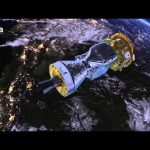
Artist’s impression of the launch of LISA Pathfinder, ESA’s technology demonstration mission that will pave the way for future gravitational-wave observatories in space.
Scheduled to lift off on a Vega rocket from Europe’s Spaceport in French Guiana in late 2015, LISA Pathfinder will operate at the Lagrange point L1, 1.5 million km from Earth towards the Sun. After launch, the spacecraft will take about eight weeks to reach its operational orbit around L1.
The Vega rocket is designed to take small payloads into low-Earth orbit. The animation shows the rocket shortly after launch, rising above our planet and releasing the fairing.
Vega will place the spacecraft onto an elliptical orbit with perigee at 200 km, apogee at 1540 km and angled at about 6.5° to the equator. Then, LISA Pathfinder will continue on its own, using its separable propulsion module to perform a series of six manoeuvres and gradually raise the apogee of the initial orbit.
Eventually, LISA Pathfinder will cruise towards its final orbiting location, discarding the propulsion system along the way, one month after the last burn. Once in orbit around L1, the spacecraft will begin its six months of operations devised to demonstrate key technologies for space-based observation of gravitational waves.
On 20 August 2015, Ariane 5 flight VA225 lifted off from Europe’s Spaceport in French Guiana and delivered two telecom satellites, Eutelsat-8 West B and Intelsat-34, into their planned orbits.
NASA’s Soil Moisture Active Passive (SMAP) spacecraft launched Jan. 31 from California’s Vandenberg Air Force Base. SMAP is the first U.S. Earth-observing satellite designed to collect global observations of surface soil moisture. The mission’s high resolution space-based measurements of soil moisture will give scientists a new capability to better predict natural hazards of extreme weather and improve our understanding of Earth’s water, energy and carbon cycles.
The successful first flight test of NASA’s Orion spacecraft on Dec. 5 not only was a historic moment for the agency – but also was a critical step on NASA’s Journey to Mars. Orion rode to space from Cape Canaveral Air Force Station on a Delta IV heavy rocket with no crew, but loaded with about 1,200 sensors. The flight test basically was a compilation of the riskiest events that will happen when astronauts fly on Orion on deep space missions. Also, Journey to Mars briefing, 1st SLS flight barrel and Commercial crew milestone.
This timelapse video shows the Soyuz TMA-15M spacecraft during transfer from the MIK 40 integration facility to Baikonur Cosmodrome launch pad 31, as well as the launch on 23 November 2014 with ESA astronaut Samantha Cristoforetti and her crewmates to the International Space Station where they will live and work for five months.
With Samantha are Russian Soyuz commander Anton Shkaplerov and NASA astronaut Terry Virts. All three are part of the Station’s Expedition 42/43 crew.
On this mission, Samantha is flying as an ESA astronaut for Italy’s ASI space agency under a special agreement between ASI and NASA.
Directed by Stephane Corvaja, ESA Edited by Manuel Pedoussaut, Zetapress Music: MZB