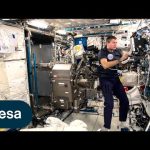
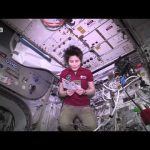
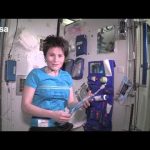
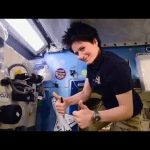
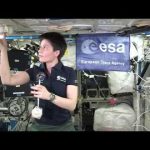
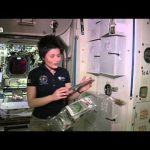
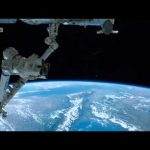
Join ESA astronaut Samantha Cristoforetti for a guided tour of the International Space Station’s crew quarters – the bedroom.
After a day’s work running experiments and maintaining the weightless research centre astronauts can retreat to their private quarters that is no larger than a changing room. In this small space they can store personal items, use a laptop for internet and float to sleep in their sleeping bag.
NASA Television’s newest offering, NASA TV UHD, brings ultra-high definition video to a new level with the kind of imagery only the world’s leader in space exploration could provide.
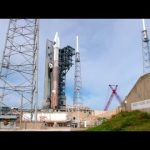
Using an array of six 4K+ cameras, Harmonic documented the Dec. 6 launch of Orbital ATK’s commercial resupply mission to the International Space Station from Cape Canaveral Air Force Station in Florida. Capturing footage at Ultra High Definition with high frame rate and in high dynamic range (HDR) options.
The company then post-produced the footage into a program showcasing the entire launch process for airing on NASA TV UHD.
Named after Isaac Newton’s text Naturalis Principia Mathematica, ESA’s Principia mission will be the eighth long-duration mission to the International Space Station. British astronaut Tim Peake will be launched from Baikonur in Kazakhstan onboard a Russian Soyuz vehicle, spending five months in orbit. He’ll carry out an intensive schedule of European and international experiments, in addition to numerous educational activities from space.
This timelapse shows ESA astronaut Andreas Mogensen working with Roscosmos cosmonaut Sergei Volkov during the iriss mission to unpack, setup, test and then store the MARES muscle-measurement machine in Europe’s space laboratory Columbus on the International Space Station over three days.
The Muscle Atrophy Research and Exercise System, or MARES for short, is a three-in-one muscle-measurement machine on the International Space Station that monitors astronauts’ muscles as they work out.
Muscle strength decreases during spaceflight and researchers need to know why this happens in order to prepare for long-duration missions and safe space tourism. MARES is an exercise bench that offers detailed information about how muscles behave during spaceflight.
MARES was a large part of Andreas’s ten-day iriss mission to the International Space Station that started 2 September 2015.
We are Europe’s gateway to space. Our mission is to shape the development of Europe’s space capability and ensure that investment in space continues to deliver benefits to the citizens of Europe and the world. Check out https://www.esa.int/ to get up to speed on everything space related.
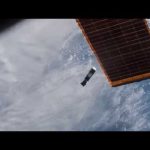
On 5 October at 15:55 CEST two ESA CubeSats, the student-built AAUSAT5 and the professional technology demonstrator GomX-3, were deployed from the International Space Station (ISS). The two satellites have just started their mission in space.
The pioneering and highly influential British synthpop band Orchestral Manoeuvres in the Dark (OMD) have dedicated their classic song ‘Electricity’ to ESA astronaut Tim Peake.
The band have always been fascinated by science, technology and transport, with songs inspired in particular by aircraft and space, so they have been following Tim’s preparations for his upcoming Principia mission with great interest. OMD are Andy McCluskey and Paul Humphreys, backed by Malcolm Holmes and Martin Cooper.
Connect with Tim Peake at timpeake.esa.int, follow Tim on Twitter at @astro_timpeake.
ESA astronaut Samantha Cristoforetti photographs stunning Earth images of Lufthansa worldwide destinations during her Futura mission onboard the ISS. An ESA for Lufthansa inflight film.
ESA astronaut Andreas Mogensen, the first astronaut from Denmark, explains the deployment of the student-built AAUSAT5 CubeSat – the first ESA student CubeSat mission launched from space and the pilot project of ESA’s ‘Fly Your Satellite from the ISS!’ education programme.
AAUSAT5, a CubeSat entirely built by a university team with ESA’s support, was launched to the International Space Station aboard the Japanese HTV-5 cargo vehicle 19 August 2015. Andreas gives a brief tour of the Japanese cargo vehicle’s storage space, where AAUSAT5 was housed during its flight to the Station. AAUSAT5 was taken to the Japanese Kibo Laboratory, put in a Nanoracks deployer, and placed into the airlock to be launched into space.
AAUSAT5 will be deployed into orbit 5 October 2015. Aalborg University will host a special event in Aalborg, Denmark entitled “ESA CubeSats from the Space Station: a new path for education and technology” to celebrate the deployment.
Aboard the International Space Station, the Expedition 45 crew – including new Commander Scott Kelly and Kjell Lindgren of NASA, said goodbye to Gennady Padalka of the Russian Federal Space Agency, Andreas Mogensen of ESA (European Space Agency) and Aidyn Aimbetov of the Kazakh Space Agency (Kazcosmos) as the trio climbed aboard their Soyuz spacecraft for the return trip to Earth. The Soyuz landed safely in Kazakhstan on Sept. 11 Eastern time, Sept. 12 in Kazakhstan — closing out a 168-day mission for Padalka and an 8-day stay on the station for Mogensen and Aimbetov. Also, First Orion crew module segments welded, SLS Launch Vehicle Stage Adapter, New Ceres imagery, New Horizons update, 9/11 tribute and National Preparedness Month!
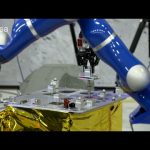
Putting a round peg in a round hole is not hard to do by someone standing next to it. But on 7 September 2015 ESA astronaut Andreas Mogensen did this while orbiting 400 km up aboard the International Space Station, remotely operating a rover and its robotic arm on the ground.
Andreas used a force-feedback control system developed at ESA, letting him feel for himself whenever the rover’s flexible arm met resistance.
These tactile sensations were essential for the success of the experiment, which involved placing a metal peg into a round hole in a ‘task board’ that offered less than a sixth of a millimetre of clearance. The peg needed to be inserted 4 cm to make an electrical connection.
Andreas managed two complete drive, approach, park and peg-in-hole insertions, demonstrating precision force-feedback from orbit for the very first time in the history of spaceflight.
The Interact Centaur rover used in the experiment was based at ESA’s technical centre ESTEC in Noordwijk, the Netherlands. It was designed and built by ESA’s Telerobotics & Haptics Laboratory in collaboration with graduate students from Delft University of Technology.
The Interact experiment is a first step towards developing robots that provide their operators with much wider sensory input than currently available. In this way, ESA is literally ‘extending human reach’ down to Earth from space.
It was a busy week for the crew aboard the International Space Station. The Japanese Aerospace Exploration Agency’s fifth H-II Transfer Vehicle, or HTV-5 arrived on Aug. 24 with more than 8,000 pounds of equipment, supplies and experiments in its pressurized cargo compartment. The delivery included an investigation that will search for signatures of dark matter, as well as enough additional food and supplies to last through 2015. Also, Soyuz relocated to Zvezda, Orion parachute drop test, Rising Seas, Hurricane Katrina remembrance, Tail first crash test, Webb telescope’s backplane arrives and Hubble’s double black hole!
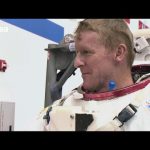
ESA astronaut Tim Peake during spacewalk training in Houston, USA.
Training underwater on life-size mockups of the Space Station is one way astronauts prepare for their missions as working in water resembles working in space.
Tim is training for his mission to the International Space Station set to be launched on a Soyuz spacecraft from Baikonur Cosmodrome in Kazakhstan in December 2015.
Join ESA astronaut Samantha Cristoforetti for a guided tour of the International Space Station’s crew quarters – the bedroom.
After a day’s work running experiments and maintaining the weightless research centre astronauts can retreat to their private quarters that is no larger than a changing room. In this small space they can store personal items, use a laptop for internet and float to sleep in their sleeping bag.
ESA astronaut Samantha Cristoforetti is currently living on board the International Space Station for her long duration mission Futura. Food is an important item in space, also on the psychological side; that’s why astronauts are allowed a certain quantity of the so-called “bonus food” of their choice that reminds them of their home cooking tastes. We asked Samantha to show us how she manages to cook one of her bonus food recipes in microgravity: whole red rice with peas and chicken turmeric.
Don’t panic! This is the story of a book, a book called The Hitchiker’s Guide to the Galaxy, a wholly remarkable book.
ESA astronaut Samantha Cristoforetti reads from Douglas Adam’s “The Hitchhiker’s Guide to the Galaxy” for towel day from the European laboratory Columbus on the International Space Station.
The Guide has a few things to say on the subject of towels. A towel, it says, is about the most massively useful thing an interstellar hitchhiker can have.
To all you froods on the mostly harmless planet Earth, happy towel day!
Towel Day is an annual celebration on 25 May, as a tribute to the late author Douglas Adams when fans around the universe proudly carry a towel in his honour.
Fra i libri che l’astronauta Samantha Cristoforetti ha portato a bordo della Stazione Spaziale Internazionale c’è anche “I Viaggi di Giovannino Perdigiorno” di Gianni Rodari.
Sono tante le filastrocche di questa raccolta e Samantha ha deciso di leggerne alcune iniziando questa serie di letture spaziali da “Il pianeta di cioccolato”. Buon ascolto… dallo spazio!
Still images taken by ESA astronaut Samantha Cristoforetti on the International Space Station were joined together to create this timelapse.
The astronauts on the Space Station spend as much time as possible on science. During her 40-hour working week Samantha runs many experiments from Italy’s ASI space agency and ESA, and takes part in even more from scientists all over the world.
Samantha is living and working on board the International Space Station as part of the six-strong Expedition 42 and 43 crew. Follow her Futura mission at http://samanthacristoforetti.esa.int.
ESA astronaut Samantha Cristoforetti shows how to use the most unglamorous but often asked-about part of living on the International Space Station: the toilet.
A fan creates suction to avoid smells and floating waste. Solid waste is stored and put in cargo ferries to burn up when the spacecraft leaves the Space Station. The astronaut urine is recycled – into drinking water.
Join ESA astronaut Samantha Cristoforetti as she shows how astronauts on the International Space Station keep clean.
From soap to water and cutting your nails, everything is different in space. Samantha demonstrates her ways to ‘shower’ depending on how much time she has.
The astronauts on the Space Station spend as much time as possible on science. During her 40-hour working week Samantha runs many experiments from Italy’s ASI space agency and ESA, and takes part in even more from scientists all over the world.
Samantha is living and working on board the International Space Station as part of the six-strong Expedition 42 and 43 crew. Follow her Futura mission at http://samanthacristoforetti.esa.int.
ESA astronaut Samantha Cristoforetti, from Italy, will shortly be ending her long-duration stay onboard the International Space Station. Launched in November 2014, the Futura mission is the result of a special agreement between NASA and the Italian Space Agency ASI.
During her time in orbit Samantha Cristoforetti has undergone an intensive programme of scientific research, educational and maintenance activities, as well as overseeing the undocking of ESA’s fifth – and last – Automated Transfer Vehicle.
This video, part of a new series of ESA teaching resources called ‘Teach with space’, shows an experiment performed by ESA astronaut Samantha Cristoforetti on the International Space Station demonstrating the concept of a barycentre, or centre of mass, freefall and how objects in orbit around each other move.
ESA astronaut Samantha Cristoforetti running experiments in weightlessness during her Futura mission for scientists from all over the world. The International Space Station offers three state-of-the-art laboratories where research can be done without gravity. The European Columbus laboratory, the Japanese Kibo and the American Destiny module offer facilities for physics, biology, geophysics and medicine.
Samantha’s 40-hour work week is devoted to science and maintaining the weightless research centre. This video gives a fast-track impression of some of the experiments she worked on. In quick succession we see Samantha working on: exercise machine ARED, measuring her body mass, the robotic droids SPHERES, ESA’s microgravity glovebox, muscle-measurement machine MARES, centrifuge-incubator Kubik, Biolab, Materials Science Laboratory and ejecting miniature satellites called Cubesats into space.
The astronauts on board the International Space Station get hungry from time to time during their long day of work in microgravity. We asked Samantha Cristoforetti, ESA astronaut on board the ISS for the Futura mission, to tell us about the kind of healthy snack she likes to eat during her breaks.
Anche a bordo della Stazione Spaziale Internazionale gli astronauti hanno ogni tanto bisogno di una pausa tra esperimenti, esercizio fisico e lavori di manutenzione. Samantha Cristoforetti, astronauta dell’Agenzia Spaziale Europea in missione per l’Agenzia Spaziale Italiana, ci mostra qualche esempio di uno snack sano in microgravitá.
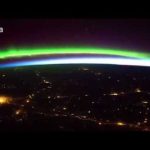
Similar to ESA astronaut Samantha Cristoforetti’s night timelapse over Italy and Egypt (https://www.youtube.com/watch?v=Lgw36RCQPvM) but taken during the day, this video takes you on a 30-second journey over Italy, passing Greece while flying over the Mediterranean Sea to follow the Nile and finish at the Indian Ocean.
Looking out from the International Space Station’s Cupola observatory while circling Earth at speeds of 28 800 km/h, the 5500 km flight took Samantha around 12 minutes. Images from a Space Station camera were joined together to create this video and make the flight seem even faster.
The astronauts on the Space Station spend as much time as possible on science. During her 40-hour working week Samantha runs many experiments from Italy’s ASI space agency and ESA, and takes part in even more from scientists all over the world.
Samantha is living and working on board the International Space Station as part of the six-strong Expedition 42 and 43 crew. Follow her Futura mission at http://samanthacristoforetti.esa.int.
We could call them the good, the bad and the ugly! No, we are not talking of spaghetti westerns… Instead, we are talking about a type of fat called lipids. Often we speak badly about them, but some are essential to our health as they reduce chronic inflammation, help lower ‘bad’ cholesterol – LDL – and are a valuable aid in the prevention of cardiovascular disease.
We asked Samantha Cristoforetti, ESA astronaut on board of the International Space Station for the Futura mission, to tell us about which king of healthy fats she and the other astronauts can enjoy while on orbit.
Potremmo chiamarli il buono, il brutto e il cattivo! No, non stiamo parlando di spaghetti-western ma di lipidi. Spesso se ne parla male ma alcuni tipi di grassi sono essenziali per la nostra salute, sulla Terra come anche a bordo della Stazione Spaziale Internazionale. Abbiamo chiesto a Samantha Cristoforetti, astronauta ESA in missione per l’Agenzia Spaziale Italiana, di mostrarci come questi “lipidi buoni” siano presenti nel cibo spaziale che lei e gli altri astroanuti hanno a disposizione mentre sono in orbita.
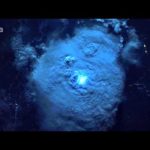
Lightning illuminates the area they strike on Earth but their flash can be seen from space too. This timelapse was made from 49 images taken 400 km above Earth in 2012 by an astronaut on the International Space Station travelling at 28 800 km/h. At these distances a camera flash is pointless, but our planet moves by so quickly images can end up being blurred.
ESA’s Nightpod camera aid compensates for the motion of the Station. The target stays firmly centred in frame so the final image is in focus. Astronauts can set up the device to take ultra-sharp images automatically using off-the-shelf cameras.
The steady progression of frames seen in this video with the target staying in centre frame would be nearly impossible without Nightpod.
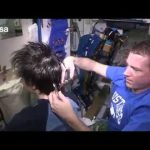
On the International Space Station, ESA astronaut Samantha Cristoforetti gets a haircut from colleague NASA astronaut Terry Virts while cosmonaut Anton Shkaplerov assists with the vacuum cleaner, making sure that no hair cuttings float off.
Samantha posted updates about the haircut on Twitter. She started off saying: “New Year, time for a haircut. Setting up shop at ‘Chez Terry’”. Commenting on this image she said: “While master @AstroTerry cuts, apprentice @AntonAstrey is at the vacuum cleaner”.
Samantha Cristoforetti is currently living and working on board the International Space Station as part of the six-strong Expedition 42 crew. Follow her Futura mission at samanthacristoforetti.esa.int.
New Year greeting from ESA astronaut Samantha Cristoforetti and her crewmates, NASA astronauts Barry Wilmore and Terry Virts, who are currently living and working on board the International Space Station as part of the Expedition 42 crew.
Watch Earth roll by through the perspective of ESA astronaut Alexander Gerst in this six-minute timelapse video from space. Combining 12 500 images taken by Alexander during his six-month Blue Dot mission on the International Space Station this Ultra High Definition video shows the best our beautiful planet has to offer.
Marvel at the auroras, sunrises, clouds, stars, oceans, the Milky Way, the International Space Station, lightning, cities at night, spacecraft and the thin band of atmosphere that protects us from space.
Often while conducting scientific experiments or docking spacecraft Alexander would set cameras to automatically take pictures at regular intervals. Combining these images gives the timelapse effect seen in this video.
Watch the video in 4K resolution for the best effect and find out more about Alexander Gerst’s Blue Dot mission here: http://www.esa.int/BlueDot
Audio via the Audio Network library:
1. Into The Matrix (1899/6) Jason Pedder / Ben Ziapour
2. We Are Delirious (2073/6) Annie Drury / Bob Bradley / Matt Sanchez / Matt Parker
The Soyuz TMA-15M spacecraft approaches the International Space Station. The spacecraft lifted off at 20:59 GMT on 23 November (21:59 CET; 02:59 local time 24 November) and reached orbit nine minutes later.
Their spacecraft docked as planned at 02:49 GMT (03:49 CET), and the hatch to their new home in space was opened at 05:00 GMT (06:00 CET).
Follow the Futura mission with live updates from Samantha and the mission directors themselves on the mission blog ‘Outpost 42’ via http://outpost42.esa.int
This second video in the ‘Journey to the International Space Station’ series follows the Soyuz capsule from Earth orbit to docking with the Space Station. Featuring interviews with ESA astronauts Luca Parmitano, Frank De Winne and Paolo Nespoli, and an introduction by Alexander Gerst, it includes unique footage taken from inside the Soyuz spacecraft.
Produced by the ESA Human Spaceflight and Operations Astronaut Training Division in Cologne, Germany, in collaboration with the Human Spaceflight and Operations Strategic Planning and Outreach Office in Noordwijk, The Netherlands.
Narration: Bernard Oattes
Technical experts: Stephane Ghiste, Dmitriy Churkin
Content design: Stephane Ghiste, Dmitriy Churkin, Matthew Day, Celena Dopart
Animation: Nelson Steinmetz, Yannis Nourrisson
Video editing: Celena Dopart, Andrea Conigli
Project coordination: Matthew Day
Special thanks to:
NASA
Roscosmos
Frank De Winne
Paolo Nespoli
Luca Parmitano
Alexander Gerst
Smithsonian National Air and Space Museum
Captions available in English, Spanish, German, French, Russian and Italian. We’re working on more languages and they will be added as they become available. Click on the CC button to switch between languages.
ESA astronaut Alexander Gerst spent 166 days in space with NASA astronaut Reid Wiseman and Roscosmos commander Max Suraev in 2014.
This ten-minute video shows highlights of his Blue Dot mission, from docking spacecraft to science and spacewalks Alexander worked to improve the International Space Station and life on Earth.
From launch to landing, look at the experiments and beautiful images Alexander shared with us.
Russian ISS commander, cosmonaut Maxim Suraev, NASA astronaut Reid Wiseman and ESA astronaut Alexander Gerst send a peace message from space. They remind us that the International Space Station serves as a shining example of how people can live and work together for the benefit of all humankind. It’s the hallmark of international cooperation – a milestone in human history.
ESA astronaut Alexander Gerst performs a demonstration of how ESA’s Rosetta mission will attempt to put a lander, called ‘Philae’ on the surface of comet 67P/Churyumov–Gerasimenko.
Alexander narrates the story of the Rosetta mission and performs a demonstration that visualises the difficulties of landing on an object that has little gravitational pull. Using the weightless environment of the Space Station, Alexander attempts to land ‘Philae’ (an ear plug) onto the surface of the ‘comet’ (an inactive SPHERES robot) with increasing levels of difficulty: a rotating comet that is not moving to one that is both rotating and moving.
This video is one of the six experiments and demonstrations in the Flying Classroom, Alexander will use small items to demonstrate several principles of physics in microgravity to students aged 10–17 years.
The Rosetta mission’s lander, Philae, will be deployed on 12 November at 08:35 GMT/09:35 CET from a distance of 22.5 km from the centre of the comet. It will land about seven hours later, with confirmation expected to arrive at Earth at around 16:00 GMT/17:00 CET.
ESA astronaut Alexander Gerst sends his greetings to the Euro-Space-Day in Saarbrücken, Germany. The tri-national (FR-LU-DE) event will bring together students, scientific institutions and space industry.
This timelapse video shows two passes over Europe taken by ESA astronaut Alexander Gerst as he flew overhead on the International Space Station at around 400 km altitude.
The International Space Station travels at 28 800 km/h meaning that it only takes 90 minutes to circle Earth completely. Each orbit the Station moves around 2200 km to the West in relation to 90 minutes before.
Astronauts often use normal consumer digital cameras to take pictures of Earth through Europe’s observatory module Cupola in their spare time. Setting the camera to take an image every few seconds and then playing the images back quickly create this timelapse effect.
Alexander worked as a geophysicist and volcanologist before he was chosen as an ESA astronaut in 2009. His Blue Dot mission includes an extensive scientific programme of experiments in physical science, biology, and human physiology as well as radiation research and technology demonstrations. All experiments chosen make use of the out-of-this-world laboratory to improve life on Earth or prepare for further human exploration of our Solar System.